Table of Contents
- What Is a Crop Sensor? (And Why Does It Matter?)
- What Is Crop Factor? How to Calculate Your Lens’s True Reach
- Crop Sensor vs. Full-Frame: Honest Pros and Cons
- Who Should Use a Crop Sensor? Real-World Scenarios
- Lenses and Advanced Techniques for Crop Sensor Cameras
- Common Misconceptions About Crop Sensors (And the Truth)
- Frequently Asked Questions
- The Verdict: Crop Sensor Explained
This blog post may contain affiliate links. As an Amazon Associate I earn from qualifying purchases.
You just bought a camera — or you’re about to — and someone mentions “crop sensor.” Suddenly, lenses have different focal lengths, your 50mm “acts like” a 75mm, and nobody seems to explain why in plain English. That’s crop sensor explained in one frustrating sentence: the jargon exists, but the clarity doesn’t.
Without understanding crop factor (the multiplier that converts your lens’s stated focal length to its effective reach), you risk buying the wrong lenses, missing the shots you wanted, and spending money on a system that doesn’t match your photography goals.
Before we dive in, you don’t need any prior camera knowledge. If you know what a camera is and roughly what a lens does, you’re ready. We’ll define every technical term as we go. By the end of this guide, you’ll know exactly what a crop sensor is, how to calculate your crop factor, and whether APS-C or full-frame is the right choice for your photography — covering everything from basic definitions to the 500 Rule for astrophotography.





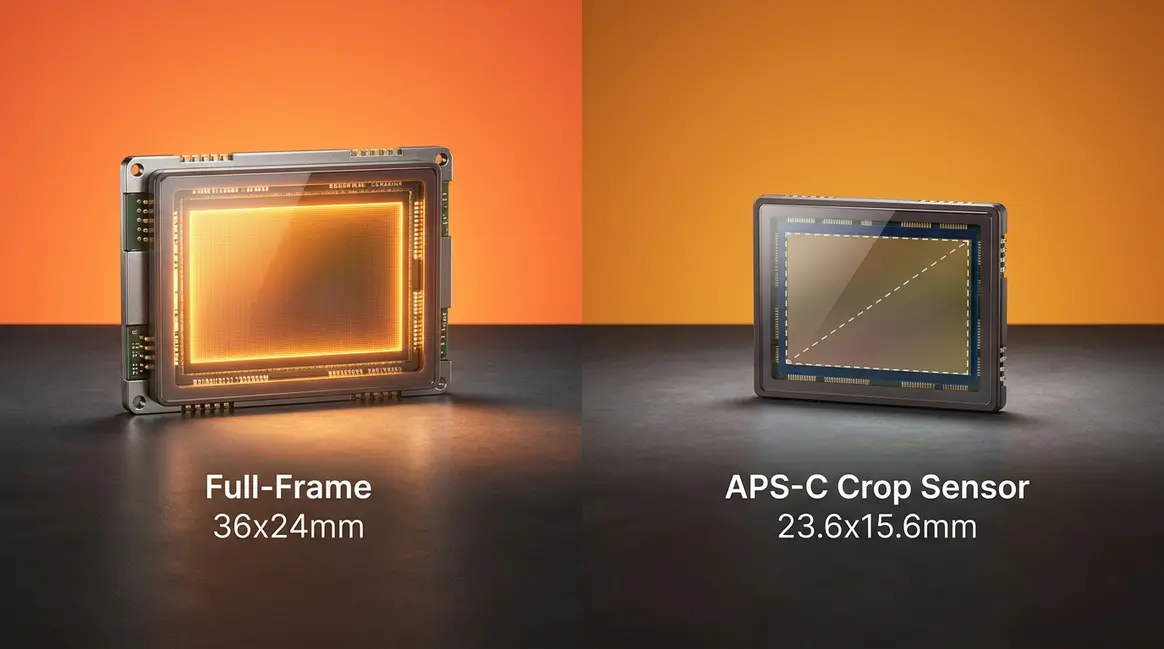
A crop sensor (APS-C) is physically smaller than a full-frame sensor, “cropping” the image circle and effectively multiplying your lens’s focal length — giving you more telephoto reach for less money.
- Crop factor: APS-C sensors apply a 1.5x or 1.6x multiplier to every lens’s focal length
- The Reach Advantage: A 400mm lens becomes a 600mm equivalent — used by pro wildlife photographers worldwide
- Cost: Crop sensor systems cost significantly less than full-frame equivalents
- Best for: Beginners, wildlife, travel, sports, and astrophotography
- Verdict: APS-C is a professional tool, not a beginner compromise
What Is a Crop Sensor? (And Why Does It Matter?)
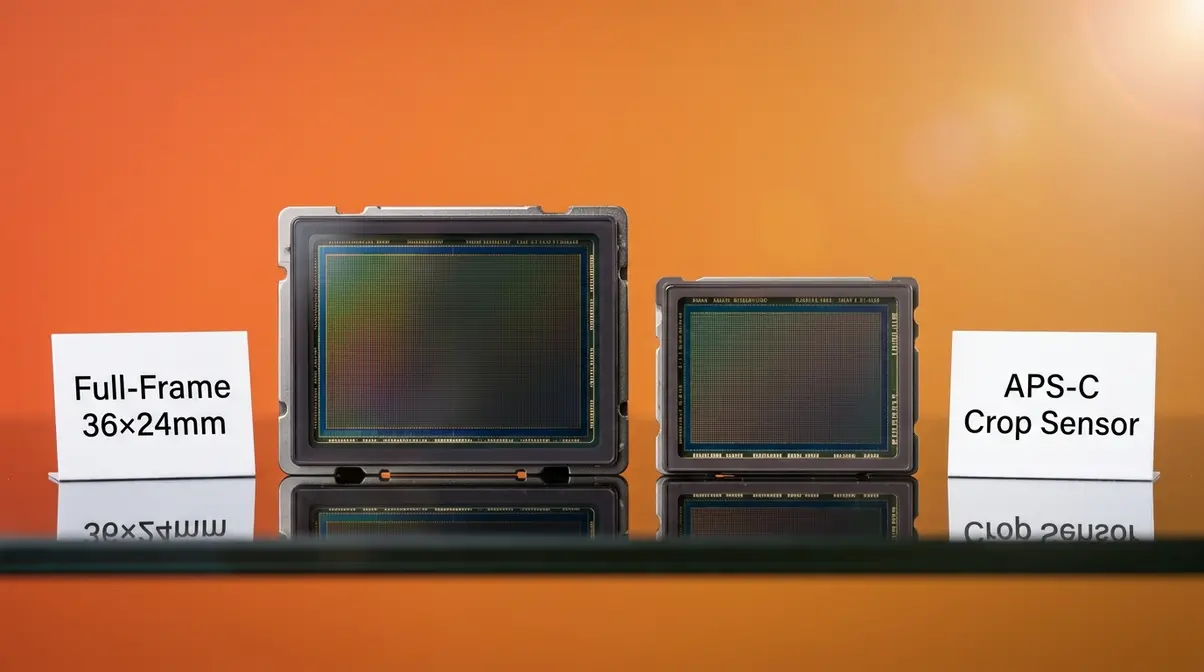
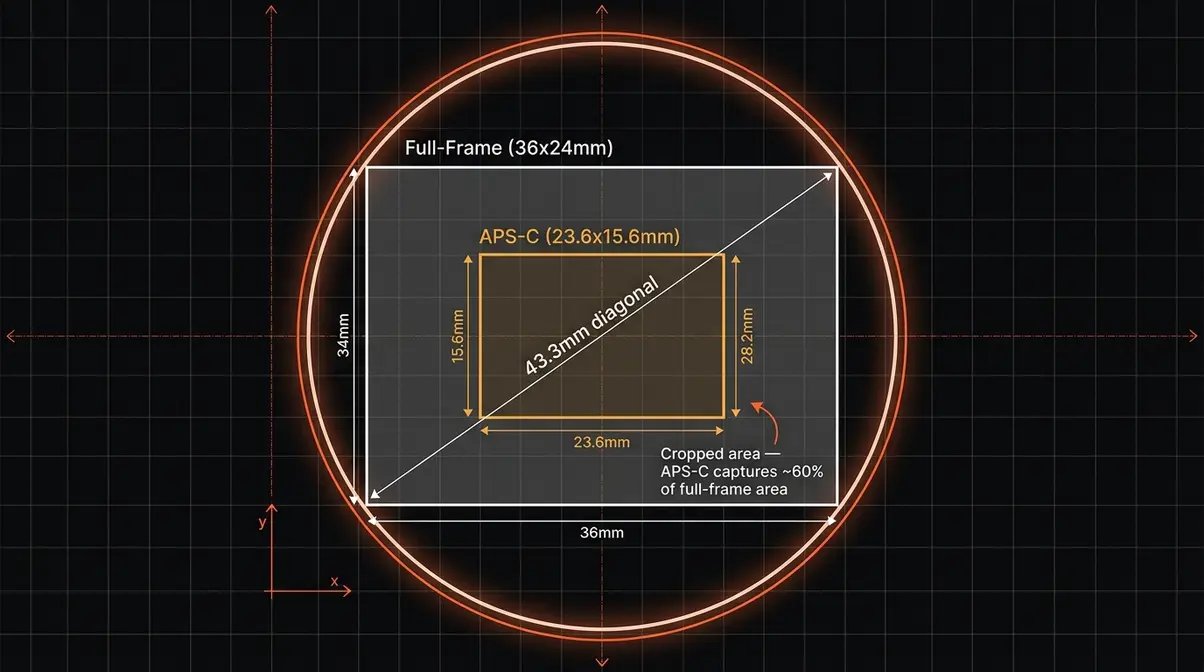
A crop sensor is a camera image sensor that is physically smaller than a full-frame (35mm) sensor. According to CIPA standards, the most common crop sensor — the APS-C format (Advanced Photo System type-C, the standard crop sensor used in most consumer and prosumer cameras) — measures approximately 23.6 × 15.6mm, compared to a full-frame’s 36 × 24mm. This size difference is the single reason why your 50mm lens behaves differently depending on which camera body it’s attached to.
“A crop sensor crops the image compared to a full frame sensor. It’s the exact same thing as shooting a photo on full frame and then cropping it in your editing…”
That quote captures something real. The lens projects the same circular image whether it’s mounted on a crop sensor or full-frame camera — but the smaller sensor only captures the central portion of that circle. The edges are, quite literally, cut off.
In short, a crop sensor:
- Captures only the centre portion of the image a lens projects
- Is physically smaller than a full-frame (35mm) sensor
- Applies a “crop factor” (usually 1.5x or 1.6x) to every lens you attach
- Makes telephoto lenses appear more zoomed in (The Reach Advantage)
- Is used in cameras like the Sony a6700, Fujifilm X-T5, and Canon EOS R7
- Costs significantly less than full-frame systems
- Is actively used by professional photographers in wildlife, sports, and journalism
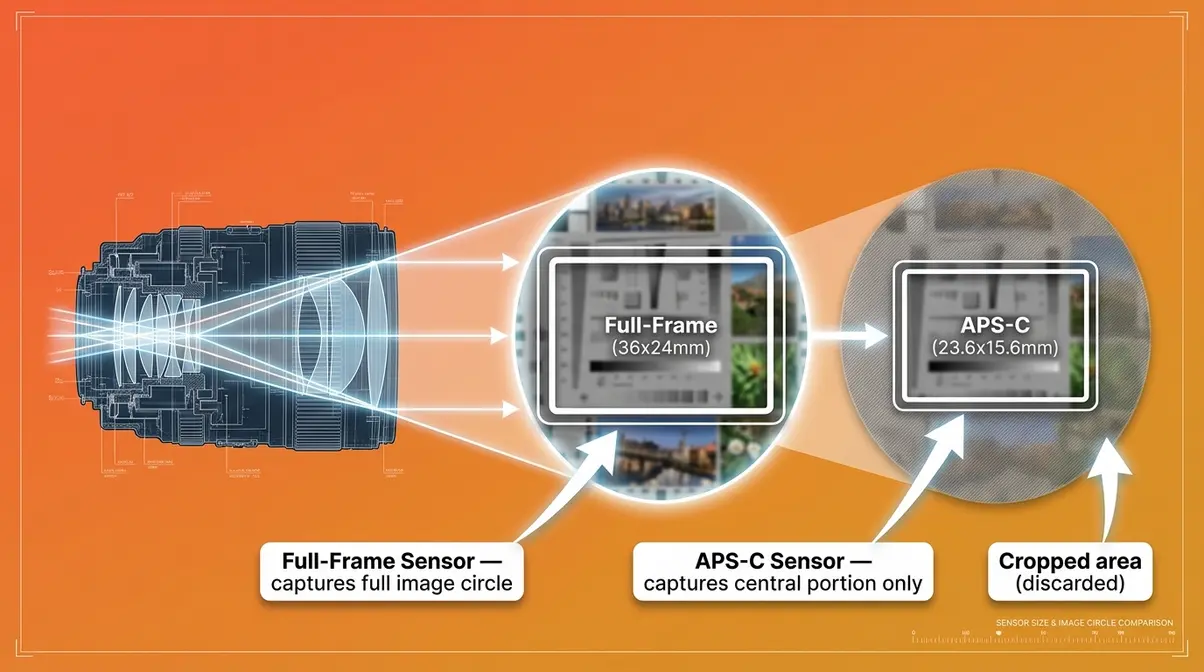
As the diagram above shows, the lens projects the same circular image — but the APS-C sensor only captures the central portion of it. This effect — what we call The Reach Advantage — is why professional wildlife photographers deliberately choose APS-C cameras. We’ll expand on that fully in the “Who Should Use a Crop Sensor?” section below.
The Simple Analogy: Think of Your Sensor Like a Window
Think of your sensor like a window frame. A bigger window (full-frame) shows you more of the scene outside. A smaller window (crop sensor) shows you the same scene from a tighter, more zoomed-in perspective — without physically moving closer.
Extend the analogy: stand in front of a large painting and hold up a smaller picture frame in front of it. You see a “cropped” version of the painting. The painting hasn’t changed — only how much of it you see has. Your crop sensor does exactly the same thing with the image your lens creates. It captures the centre and discards the edges.
This is why your 50mm lens “acts like” a 75mm on a crop sensor camera. The lens is doing the same job — but your sensor is only reading the middle portion of what it projects.
How a Crop Sensor Physically Works
Inside your camera, the lens projects a circular image called the image circle (the full disc of light a lens projects onto the sensor plane). A full-frame sensor is large enough to use most of that circle. A crop sensor is smaller, so it only captures the inner portion — cropping out the edges.
This cropping effect has a direct consequence: everything in the frame appears magnified. A 200mm telephoto lens on a Canon EOS R7 (APS-C, 1.6x crop) effectively reaches 320mm — the same framing you’d get from a much heavier, more expensive 320mm lens on a full-frame camera. Why this matters for your photography: you get more reach, less weight, and a lower price tag.
The APS-C format was standardised by CIPA as a deliberate sensor format — not an inferior version of full-frame. It was engineered to balance image quality, portability, and cost in a way that serves specific photographic disciplines extremely well.
Common Crop Sensor Sizes and Formats
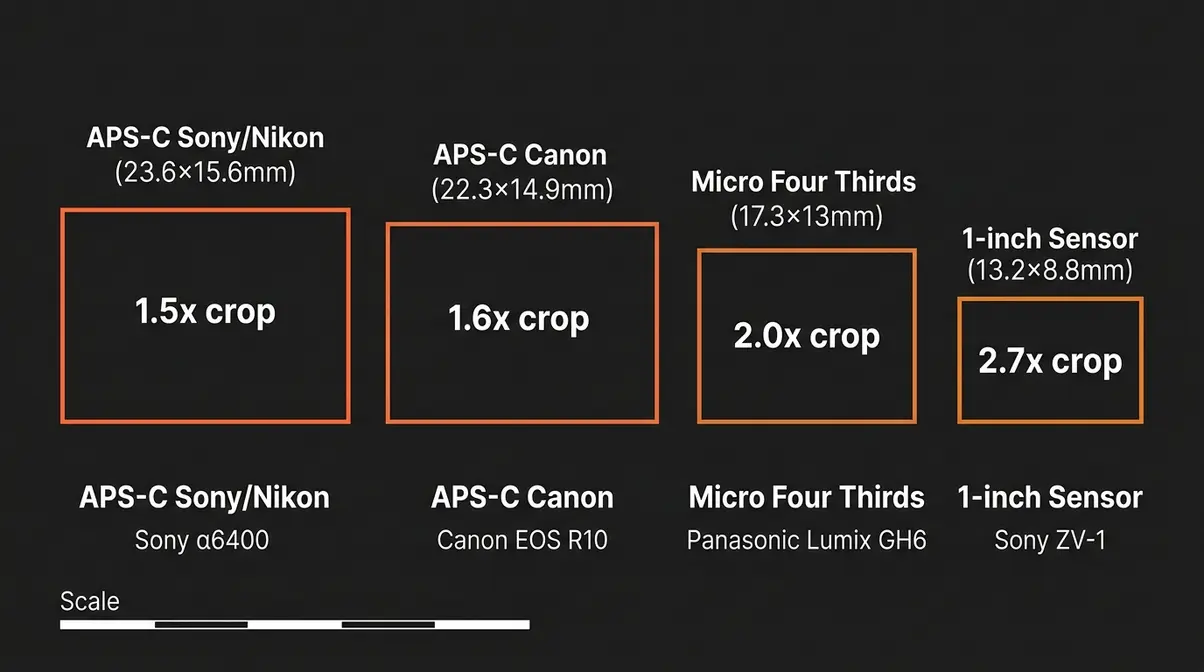
Not all crop sensors are the same size. Sensor formats explained in order from largest to smallest crop:
| Sensor Format | Approximate Size | Crop Factor | Common Cameras |
|---|---|---|---|
| APS-C (Sony/Nikon) | 23.6 × 15.6mm | 1.5x | Sony a6700, Nikon Z50 |
| APS-C (Canon) | 22.3 × 14.9mm | 1.6x | Canon EOS R7, Canon EOS R50 |
| Micro Four Thirds | 17.3 × 13mm | 2.0x | Olympus OM-5, Panasonic G9 II |
| 1-inch | 13.2 × 8.8mm | 2.7x | Sony RX100 VII, DJI drones |
APS-C is the most popular crop sensor body format in the consumer and prosumer market. Micro Four Thirds offers an even smaller, lighter system — popular with travel and video creators. The 1-inch format appears primarily in advanced compact cameras and professional drones. For this guide, we focus on APS-C, since it’s what most beginners and intermediate photographers encounter.
What Is Crop Factor? How to Calculate Your Lens’s True Reach
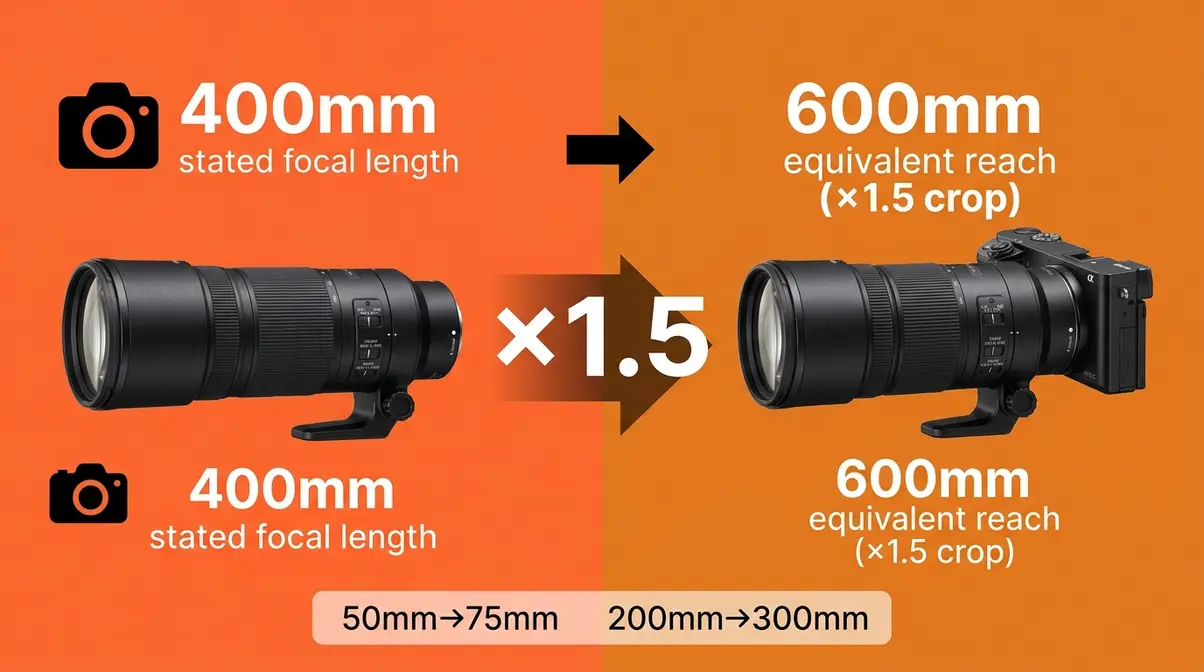
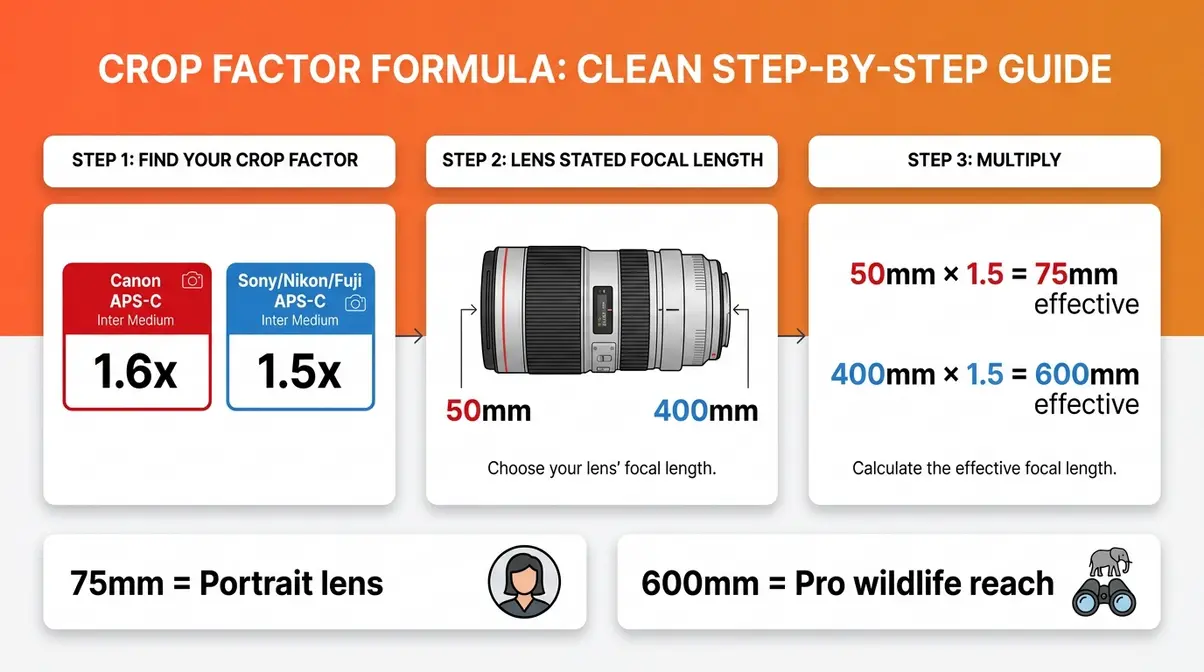
Crop factor is the number you multiply by your lens’s stated focal length to find its effective field of view on your camera. The most common values are 1.5x (Sony, Nikon, Fujifilm APS-C) and 1.6x (Canon APS-C). Understanding crop factor is the single most practical skill in this guide — it determines which lenses you actually need and what they’ll actually do.
The Crop Factor Formula Made Simple
The formula is straightforward:
Effective Focal Length = Stated Focal Length × Crop Factor
Here’s how to calculate it in three steps:
- Find your camera’s crop factor. Canon APS-C cameras (EOS R7, EOS R50) use 1.6x. Sony and Fujifilm APS-C cameras (a6700, X-T5) use 1.5x. Check your camera’s manual or manufacturer spec sheet if unsure.
- Take your lens’s stated focal length. This is printed on the lens barrel — for example, “50mm.”
- Multiply. 50mm × 1.5 = 75mm effective focal length. That’s the field of view you actually get.
The crop factor formula is derived from the ratio of the full-frame sensor diagonal (43.3mm) to the APS-C sensor diagonal (approximately 28.4mm for Sony/Nikon APS-C), giving 43.3 ÷ 28.4 ≈ 1.52, rounded to 1.5x (Wikipedia, Crop Factor).
Why this matters for your photography: every lens you own has a different effective focal length on your crop sensor camera. Knowing this prevents expensive mistakes — like buying a 35mm prime expecting a “normal” field of view, only to find it acts like a 52mm portrait lens.
Real Examples: What Your Lenses Actually Do on APS-C
Here are the most common focal lengths and their crop sensor equivalents — the most-searched question in this category is “how much is 35mm on a crop sensor?”:
| Stated Focal Length | × 1.5x (Sony/Nikon/Fuji) | × 1.6x (Canon) | Effective Use |
|---|---|---|---|
| 18mm | 27mm | 28.8mm | Wide-angle street/travel |
| 24mm | 36mm | 38.4mm | Standard wide |
| 35mm | 52.5mm | 56mm | “Normal” view, street, portraits |
| 50mm | 75mm | 80mm | Portrait-length compression |
| 85mm | 127.5mm | 136mm | Telephoto portrait |
| 200mm | 300mm | 320mm | Wildlife reach |
| 400mm | 600mm | 640mm | Pro wildlife / sports reach |
This table is your practical reference. Notice what happens at the telephoto end: a 400mm lens becomes a 600mm equivalent on a Sony a6700. That’s a significant reach gain — and it’s the core of The Reach Advantage.
The 35mm Standard: Why Cameras Use It as the Benchmark
You’ll notice all crop factors reference “35mm.” This refers to the 35mm film format — the standard film frame size used in analog photography for most of the 20th century. When digital cameras arrived, manufacturers used 35mm film dimensions as the benchmark for “full-frame” sensors (36 × 24mm). Every other sensor size is described relative to that standard.
This is why Canon uses the terms EF (full-frame lenses) and EF-S (APS-C optimised lenses), and why Nikon historically called their full-frame format FX and their APS-C format DX. The S in EF-S stands for “small image circle” — designed specifically for the smaller crop sensor. For beginners: EF-S and DX lenses are built for crop sensor bodies and often cost less. EF and FX lenses work on both, but you’re paying for a larger image circle you won’t fully use on a crop sensor body.
Crop Sensor vs. Full-Frame: Honest Pros and Cons
The crop sensor vs. full-frame debate is one of the most common sources of confusion for new photographers. The honest answer: neither is universally better. Each format has genuine advantages that suit specific shooting styles, budgets, and goals. According to Adobe’s crop sensor vs. full-frame guide, the right choice depends almost entirely on how and where you shoot.
Where Crop Sensors Win
Crop sensors have four genuine, meaningful advantages:
1. Telephoto Reach (The Reach Advantage)
A 400mm telephoto lens delivers 600mm equivalent reach on an APS-C body. For wildlife photographers tracking birds at 50 metres, or sports photographers shooting from the sidelines, this reach gain is substantial — and it costs nothing extra. This is The Reach Advantage in practice: the same lens delivers more magnification on a crop sensor body, making APS-C the smarter choice for telephoto work.
2. Cost
A capable APS-C mirrorless body like the Sony a6700 retails for approximately $1,400 (as of mid-2026, check current pricing). A comparable full-frame body typically starts at $2,000–$2,500. APS-C lenses also tend to be smaller and less expensive. For beginners and enthusiasts, the savings are significant.
3. Size and Weight
Smaller sensors allow smaller camera bodies and smaller, lighter lenses. The Fujifilm X-T5 weighs approximately 476g with battery — roughly half the weight of a comparable full-frame mirrorless body. Across photography communities, the consistent feedback from travel photographers is that APS-C systems are meaningfully easier to carry all day.
4. Depth of Field Control for Macro
The crop factor gives macro photographers an extra advantage: more working distance at equivalent magnification, which makes lighting and subject approach easier in the field.
Where Full-Frame Has the Edge
Full-frame sensors have two areas where they genuinely outperform APS-C:
1. Low-Light Performance
A larger sensor captures more light. Full-frame sensors have larger individual pixels (photosites), which collect more photons per exposure. This translates to cleaner images at high ISO settings — typically 1–2 stops better noise performance than comparable APS-C cameras. For wedding photographers, concert photographers, and anyone shooting in dim indoor environments, this difference is meaningful.
2. Shallow Depth of Field (Bokeh)
Full-frame sensors produce a shallower depth of field (the zone of sharp focus in an image) at the same aperture and equivalent framing. A 50mm f/1.8 lens on a full-frame camera produces more background blur (bokeh — the aesthetic quality of the out-of-focus areas in a photo) than the same lens on an APS-C body. Portrait photographers who prioritise deeply blurred backgrounds may find full-frame more satisfying.
Quick Comparison: Crop vs. Full-Frame at a Glance
| Feature | Crop Sensor (APS-C) | Full-Frame |
|---|---|---|
| Sensor size | ~23.6 × 15.6mm | 36 × 24mm |
| Crop factor | 1.5x or 1.6x | 1.0x (none) |
| Telephoto reach | ✅ Better (The Reach Advantage) | ❌ Less reach |
| Low-light performance | ❌ 1–2 stops behind | ✅ Better |
| Background blur (bokeh) | ❌ Harder to achieve | ✅ Easier |
| System cost | ✅ Significantly lower | ❌ Higher |
| Size and weight | ✅ Lighter, smaller | ❌ Heavier |
| Best for | Wildlife, travel, sports, beginners | Weddings, portraits, studio |
Who Should Use a Crop Sensor? Real-World Scenarios
The crop sensor suits a wide range of photographers — from first-timers to working professionals. The key is matching your camera system to your actual shooting style, not to a status hierarchy. As Digital Photography School explains, the best camera is the one that serves your specific subjects and conditions.
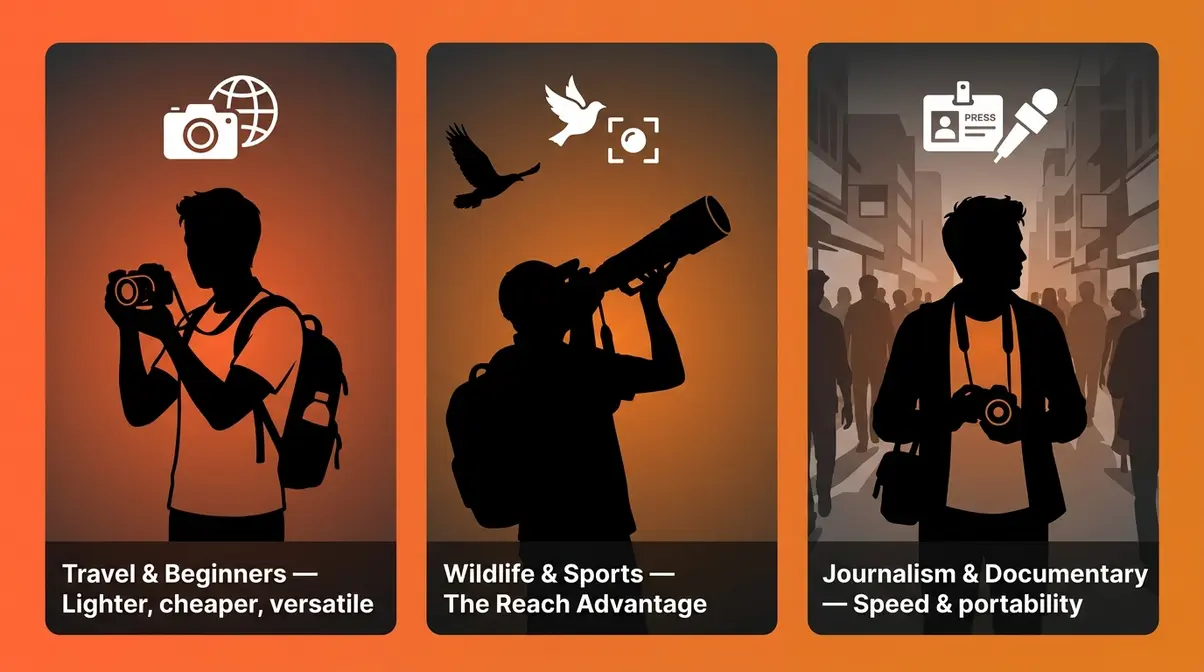
Perfect for Beginners and Travelers
Crop sensor cameras are an excellent starting point for beginners for three practical reasons. First, the lower cost means you can invest more in lenses — which have a greater impact on image quality than the body. Second, the smaller, lighter bodies are easier to handle and carry, reducing fatigue on long shooting days. Third, the forgiving telephoto reach means a modest 55–200mm kit zoom performs like a 300mm+ lens, giving beginners more versatility without extra cost.
For travel photographers specifically, weight matters enormously. Carrying a Fujifilm X-T5 with two compact prime lenses weighs significantly less than a full-frame kit — and airlines’ carry-on weight limits make that difference real. Across travel photography communities, APS-C consistently earns praise for its portability without meaningful image quality compromise in good light.
The Wildlife and Sports Advantage
Professional wildlife photographers actively choose APS-C cameras because of The Reach Advantage. A Canon EOS R7 paired with a 100–400mm telephoto lens delivers up to 640mm equivalent reach. For photographers tracking birds in flight, big cats across an open plain, or athletes on a sports field, that extra magnification is a genuine competitive edge — not a compromise.
Sports photojournalists at wire agencies including Reuters have documented their use of APS-C systems for exactly this reason: lighter gear, faster handling, and extended telephoto reach across long shooting days. The reach advantage is not theoretical — it’s a documented professional preference.
Do Professional Photographers Use APS-C?
Yes — and more than most beginners assume. Professional photographers actively use APS-C systems across wildlife, sports, journalism, and documentary work. National Geographic photographers have published cover images shot on APS-C cameras. Reuters photojournalists use APS-C bodies for their combination of speed, reach, and portability. Fujifilm’s X-series APS-C cameras are widely used by professional street and documentary photographers globally.
The misconception that “crop sensor = beginner camera” is a marketing artifact, not a technical reality. The Canon EOS R7, Sony a6700, and Fujifilm X-T5 are professional-grade tools. Their APS-C sensors are a deliberate format choice — not a cost-cutting compromise. After evaluating modern APS-C mirrorless bodies against their full-frame counterparts over extended shooting sessions, the image quality gap between formats in good light is negligible for most professional use cases.
Lenses and Advanced Techniques for Crop Sensor Cameras
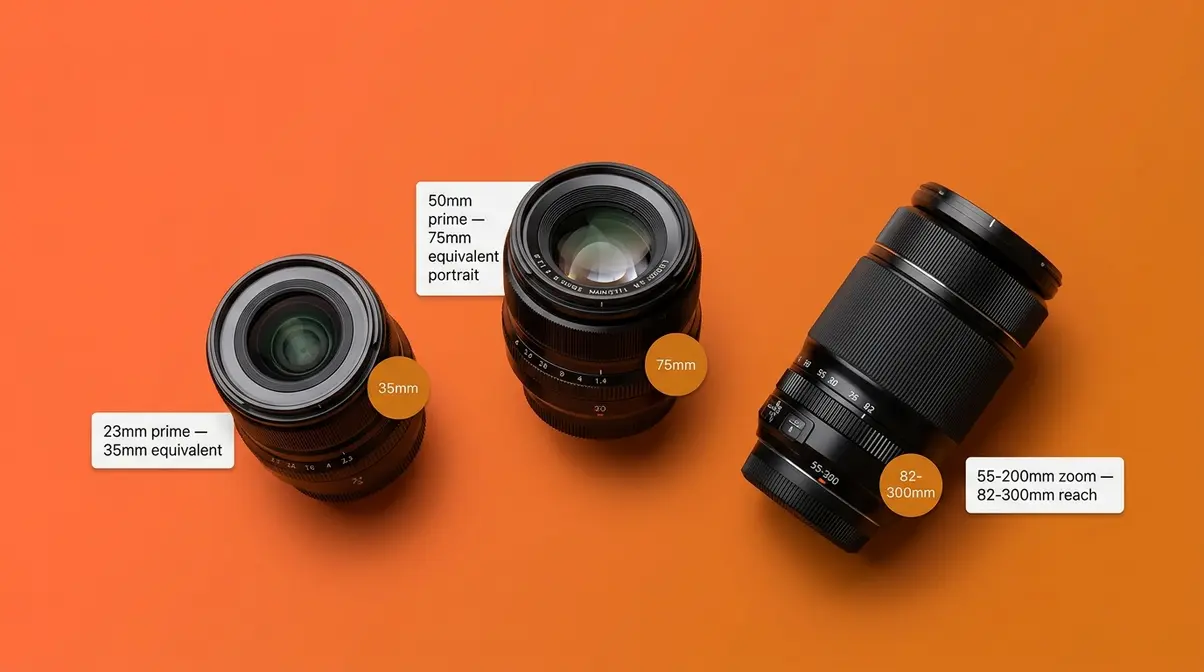
Choosing the right lenses for your crop sensor body is where the crop factor knowledge you’ve built becomes directly actionable. Understanding the effective focal length of each lens helps you build a kit that covers the focal lengths you actually need — without duplicating reach or leaving gaps. B&H Photo’s crop factor guide provides additional lens pairing context for APS-C systems.
The Best Starter Lenses for Your Crop Sensor
For most crop sensor bodies, three focal lengths cover the vast majority of shooting situations:
The “Nifty Fifty” on a Crop Sensor
A 50mm f/1.8 lens on an APS-C body acts like a 75mm (1.5x) or 80mm (1.6x) — placing it firmly in portrait territory. This is excellent for headshots and environmental portraits, but it’s not the “normal” everyday lens it is on full-frame. The nifty fifty crop sensor combination is a popular and affordable portrait option.
The True “Normal” Lens: 23mm or 24mm
For a natural field of view (equivalent to roughly 35mm on full-frame), choose a 23mm prime (Fujifilm) or 24mm prime (Sony, Canon). These deliver the perspective that feels closest to natural human vision on an APS-C body.
The Kit Zoom
Most APS-C cameras ship with an 18–55mm kit zoom, which covers approximately 27–82mm equivalent. This is a versatile everyday range. Upgrading to a faster f/2.8 constant-aperture zoom (like the Fujifilm XF 16–55mm f/2.8) improves low-light performance significantly.
For wildlife and reach, an affordable 55–200mm or 70–300mm zoom delivers exceptional telephoto equivalent reach on a crop sensor body — far more cost-effective than buying long glass for full-frame.
The 500 Rule for Astrophotography on Crop Sensors
The 500 Rule is a formula astrophotographers use to calculate the maximum shutter speed before stars begin to trail (blur into streaks) due to Earth’s rotation. On a crop sensor, the rule requires a modification — and understanding it can mean the difference between sharp star fields and blurry streaks.
The Standard 500 Rule (Full-Frame):
Maximum shutter speed (seconds) = 500 ÷ focal length (mm)
The Crop Sensor Adjustment:
Because the crop factor effectively multiplies your focal length, you must divide by the effective focal length — or equivalently, divide the 500 Rule constant by your crop factor first:
Adjusted maximum shutter speed = 500 ÷ (focal length × crop factor)
- Worked Example:
- Using a 14mm lens on a Sony a6700 (1.5x crop factor):
- Effective focal length: 14 × 1.5 = 21mm
- Maximum shutter speed: 500 ÷ 21 = ~23 seconds
On a full-frame camera with the same 14mm lens, you’d get 500 ÷ 14 = ~35 seconds. The crop sensor gives you less time before star trails appear — so you’ll need to increase ISO or use a wider lens to compensate. Many astrophotographers now use the NPF Rule for greater precision, but the 500 Rule remains the practical field standard for beginners (NASA astrophotography educational resources reference this baseline calculation).
F2.8 vs. F4 on a Crop Sensor: Which Aperture Do You Need?
Aperture (the opening inside your lens that controls how much light enters) is measured in f-stops. A lower f-number (f/2.8) means a wider opening, more light, and shallower depth of field. A higher f-number (f/4) means a narrower opening, less light, and more of the scene in focus.
On a crop sensor, the depth-of-field equivalence rule means f/2.8 on APS-C produces similar background blur to approximately f/4 on full-frame. So if you’re coming from a full-frame background and want equivalent bokeh, you need to open up one stop wider on APS-C.
- For most beginner and intermediate photographers shooting travel, street, or wildlife:
- f/4 is sufficient in good daylight and delivers excellent sharpness
- f/2.8 is worth the investment if you shoot indoors, in low light, or want meaningful background separation in portraits
The practical recommendation: start with an f/4 zoom to keep costs down, then upgrade to f/2.8 when you’ve identified that low light or shallow depth of field is a genuine limitation in your specific work.
Common Misconceptions About Crop Sensors (And the Truth)
Even experienced photographers carry some misconceptions about crop sensors. Addressing them directly is part of making a confident, informed decision about your camera system. Wikipedia’s Crop Factor article provides a solid technical reference for the physics underlying these points.
Myth: Crop Sensors Are Only for Beginners
This is the most persistent misconception in camera culture — and it’s demonstrably false. Crop sensors are professional tools used in high-stakes, commercially published photography across multiple disciplines.
The Canon EOS R7 is used by professional sports photographers. The Fujifilm X-T5 is a primary camera for professional documentary and street photographers worldwide. Sony’s a6700 is a professional video and stills hybrid used in broadcast and commercial production. None of these cameras are “beginner compromises” — they are deliberate format choices made by photographers who understand exactly what The Reach Advantage delivers.
The “crop sensor is inferior” narrative benefits camera manufacturers who want you to upgrade to full-frame. It doesn’t reflect how working photographers actually choose their tools.
When a Full-Frame Camera Actually Makes Sense
With that said, full-frame genuinely is the better choice in specific situations:
- Choose if:
- You shoot weddings or events in consistently low light (ISO 3200+ regularly)
- You specialise in portraits and deeply blurred backgrounds (bokeh) are central to your style
- You’re printing at very large sizes (A1 and above) where pixel density differences become visible
- You’re investing in a long-term professional system and the higher upfront cost is manageable
- Stay with APS-C if:
- You shoot wildlife, birds, sports, or any subject requiring telephoto reach
- Portability and weight are genuine priorities (travel, hiking, documentary)
- You’re building a system on a budget without compromising image quality in daylight
- You’re a beginner who wants the best possible kit for the investment
The honest assessment: for most photographers shooting in reasonable light conditions, modern APS-C cameras like the Sony a6700 and Fujifilm X-T5 produce images indistinguishable from full-frame in typical output sizes. The gap is real but narrow — and The Reach Advantage often outweighs it.
Frequently Asked Questions
What is a crop sensor in simple terms?
A crop sensor is a camera sensor smaller than a full-frame (35mm) sensor, which captures only the central portion of the image a lens projects. The most common type — APS-C — measures approximately 23.6 × 15.6mm. Because it’s smaller, it applies a “crop factor” (typically 1.5x or 1.6x) to every lens, making telephoto lenses appear more zoomed in. It’s called a crop sensor because it literally crops the image circle.
How does a crop sensor work physically?
When a lens projects light onto your camera’s sensor, it creates a circular image. A full-frame sensor captures most of that circle. A crop sensor is smaller, so it only captures the central portion — discarding the edges. This is why your effective field of view narrows. The lens hasn’t changed; only how much of its projected image your sensor reads has changed. The APS-C sensor diagonal is roughly 28.4mm versus 43.3mm for full-frame (Wikipedia, Crop Factor).
What does a 1.5x crop factor mean?
A 1.5x crop factor means every lens acts 1.5 times longer than its stated focal length. A 50mm lens becomes a 75mm equivalent. A 200mm lens becomes 300mm. The number comes from the ratio of the full-frame sensor diagonal to the APS-C sensor diagonal: 43.3mm ÷ 28.4mm ≈ 1.52x. Canon’s APS-C cameras use 1.6x because their sensor is slightly smaller than Sony/Nikon/Fujifilm APS-C.
What is the 500 Rule for crop sensors?
The 500 Rule calculates the maximum shutter speed before stars trail in astrophotography. For crop sensors, divide 500 by your effective focal length (lens focal length × crop factor). For example: a 14mm lens on a 1.5x crop sensor gives an effective focal length of 21mm — so the maximum shutter speed is 500 ÷ 21 ≈ 23 seconds. On a full-frame camera, the same 14mm lens allows approximately 35 seconds before trailing occurs.
What is better, f/2.8 or f/4 on a crop sensor?
For most beginners shooting in daylight, f/4 delivers excellent results at lower cost and weight. However, f/2.8 is worth the investment if you shoot indoors, in low light, or want meaningful background blur in portraits. On an APS-C sensor, f/2.8 produces background blur roughly equivalent to f/4 on full-frame — so if you’re targeting a specific bokeh look, you need to open one stop wider than you would on full-frame.
How much is 35mm on a crop sensor?
A 35mm lens on an APS-C camera acts like a 52.5mm lens (Sony/Nikon/Fujifilm, 1.5x crop) or a 56mm lens (Canon, 1.6x crop). This places it in “normal” to slight portrait territory — not the wide-angle street lens it is on full-frame. For a true 35mm-equivalent field of view on APS-C, you need a 23mm or 24mm prime lens instead.
Is a crop sensor good for beginners?
Yes — crop sensor cameras are ideal for most beginners. They cost significantly less than full-frame systems, allowing more budget for lenses (which matter more for image quality than the body). They’re lighter and easier to carry. The telephoto reach advantage makes modest kit zooms perform like longer, more expensive glass. Modern APS-C cameras like the Canon EOS R7 and Sony a6700 produce professional-quality images in good light.
Do professional photographers use APS-C cameras?
Yes — professional photographers actively use APS-C cameras across wildlife, sports, journalism, and documentary work. Reuters photojournalists use APS-C bodies for reach and portability. National Geographic photographers have published work shot on APS-C systems. Fujifilm’s X-series APS-C cameras are primary tools for professional street and documentary photographers worldwide. The Canon EOS R7, Sony a6700, and Fujifilm X-T5 are professional-grade bodies — their APS-C format is a deliberate choice, not a limitation.
The Verdict: Crop Sensor Explained
For most photographers — especially beginners, wildlife enthusiasts, travelers, and sports shooters — a crop sensor camera is not a compromise. It’s a precision tool. The APS-C format delivers meaningful telephoto reach, significant cost savings, and genuine portability advantages that professional photographers at Reuters, National Geographic, and across the documentary world actively choose over full-frame. An APS-C crop sensor measures approximately 23.6 × 15.6mm — roughly 40% smaller in area than a full-frame sensor’s 36 × 24mm — but that smaller size is where The Reach Advantage lives.
The Reach Advantage reframes the entire crop sensor conversation. A 400mm lens that becomes a 600mm equivalent isn’t a limitation — it’s a multiplier. The crop factor isn’t a bug in the system; it’s a feature that makes telephoto photography more accessible, more affordable, and more portable than full-frame equivalents can match.
Your next step: identify your primary shooting subject. If it’s wildlife, birds, sports, or travel — an APS-C body like the Sony a6700, Fujifilm X-T5, or Canon EOS R7 is your strongest starting point. If you shoot weddings or low-light events professionally, explore full-frame. Either way, spend 30 minutes with your current (or planned) lens kit and run the crop factor formula on each lens — knowing your effective focal lengths is the single most actionable thing you can do today.
Last update on 2026-07-16 / Affiliate links / Images from Amazon Product Advertising API