DSLR vs iPhone Camera: Which Is Actually Better?

A growing segment of professional photographers has quietly switched their everyday carry to the iPhone—while hobbyists who spent $600 on a DSLR three years ago watch it collect dust on a shelf. That tension is exactly what this guide resolves. When you’re weighing a DSLR vs. an iPhone camera, most comparison articles compare an old iPhone to a seven-year-old Canon and declare a winner. You’re here because you need a real answer for current hardware—and a decision framework that actually matches your life.
What’s in this guide
By the end of this guide, you’ll know exactly which camera—iPhone, DSLR, or modern mirrorless—is the right tool for your specific type of photography, so you can stop second-guessing and start shooting. We’ll cover the hardware realities, model-by-model comparisons, where mirrorless fits in, and a use-case scorecard for four photographer types.
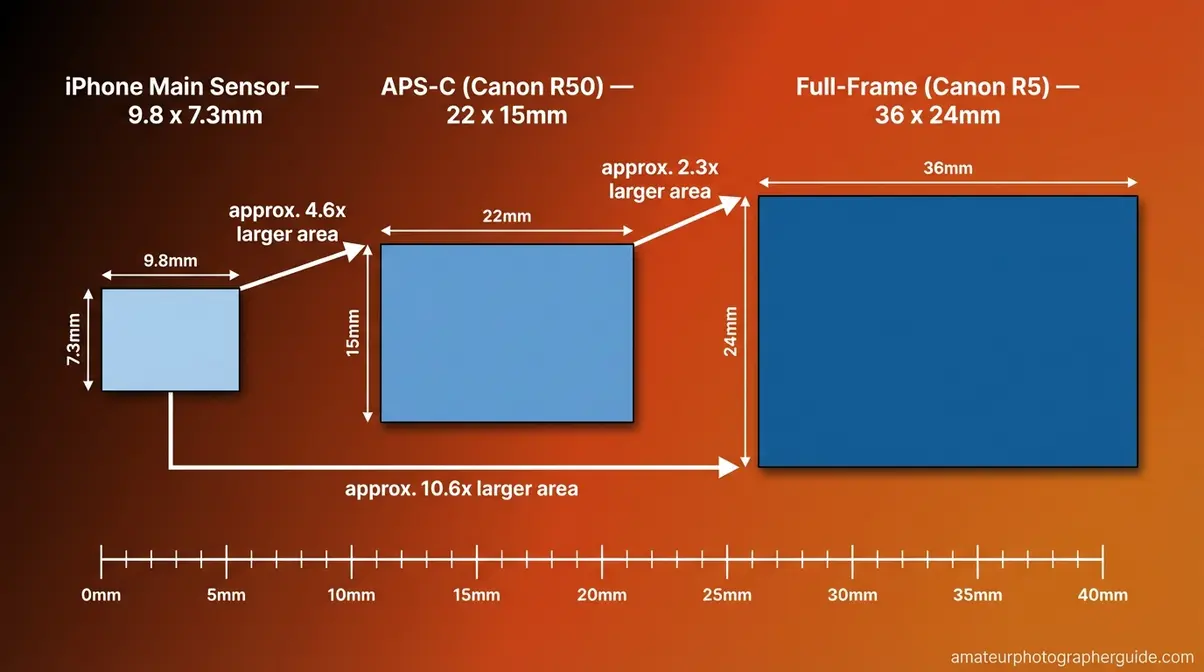
Caption: Sensor size to scale—APS-C (Canon R50), full-frame (Canon R5), and iPhone main sensor. The physical area difference explains the low-light performance gap.
Hardware Reality: Why Sensor Size Matters
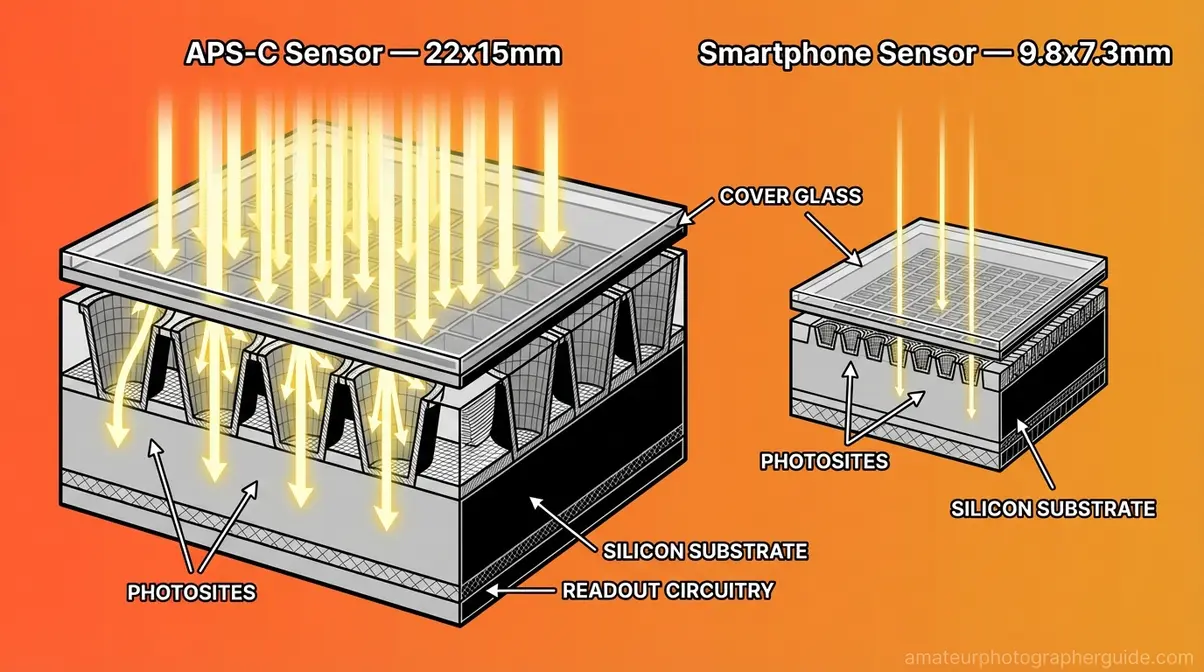
The fundamental difference in any DSLR vs. iPhone comparison comes down to sensor surface area, not megapixel count. Smartphone sensors collect approximately 1/20th the light of a DSLR sensor during a given exposure time (DXOMARK). This is why a 12MP DSLR image in a dim restaurant will consistently beat a 48MP iPhone photo for shadow detail and noise control. Megapixels measure resolution; sensor size determines image quality.
“The DSLR is 10 years old since its release, but I still think it outperforms iPhone.”
That sentiment is shared across photography communities—and the physics backs it up. Before comparing models, it’s worth understanding why the hardware gap exists and where Apple’s engineering has started to close it.
Why a Bigger Sensor Collects More Light
A camera sensor is a grid of light-collecting “photosites.” Each photosite converts incoming light into an electrical charge; the larger the photosite, the more light it captures. How a camera sensor works is well documented: bigger photosites produce stronger signals, which translates to less digital noise and wider dynamic range (Canon Europe).
The numbers are striking. An APS-C sensor—the type found in most entry-level DSLRs and mirrorless cameras like the Canon R50—measures approximately 22×15mm. The main sensor in an iPhone is about 9.8×7.3mm, roughly one-fifth the surface area. More area means cleaner shadows, more detail in highlights, and less grain in difficult light. This is why even a 10-year-old DSLR can outperform a current iPhone in a dimly lit room.
Sensor size—not megapixels—is the decisive factor in image quality. This matters because marketing consistently leads buyers toward pixel counts that have little real-world impact.
Computational vs. Optical Photography
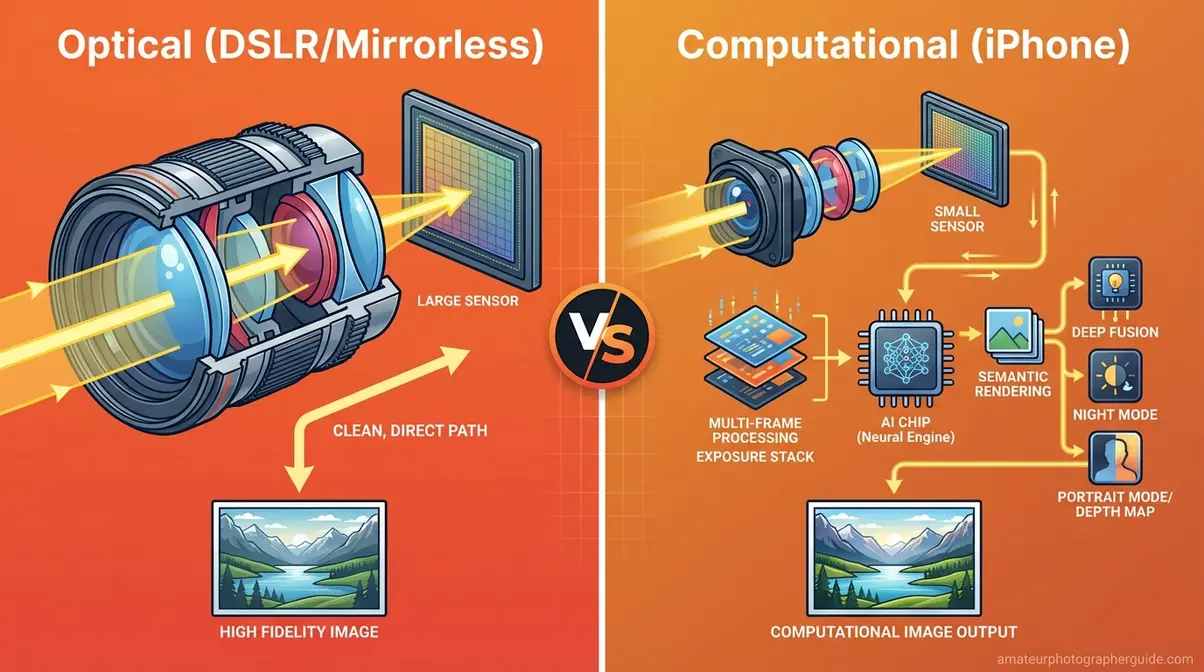
Computational photography—software algorithms that stack exposures, apply AI noise reduction, and synthesize detail—is the iPhone’s primary answer to its sensor size disadvantage. The Association for Computing Machinery explains that these systems move beyond traditional optical processes, enabling handheld results that once required a tripod (Communications of the ACM).
The iPhone’s Night Mode, Smart HDR, and Photonic Engine genuinely produce excellent results, often better than an entry-level DSLR on full auto. However, computation is inference, not capture. The iPhone can simulate background blur (bokeh), but it can’t replicate the smooth depth separation from a large sensor and a fast lens like a 50mm f/1.8. Less chromatic aberration (color fringing) is achieved optically—no algorithm fully replicates this.
What the Latest iPhone Gets Right
The iPhone 16 Pro is Apple’s most capable camera, with a 48MP main sensor, f/1.78 aperture, and sensor-shift OIS (optical image stabilization). In good daylight with high dynamic range, Apple’s computational engine can match or exceed what older DSLRs produce automatically.
9to5Mac’s real-world comparison of the iPhone 15 Pro Max against a Canon EOS 80D found the iPhone competitive in HDR environments—the DSLR retained an advantage in telephoto and low-light detail (9to5Mac, 2023). This pattern holds true for the latest iPhone generation. Where the iPhone still falls behind: telephoto reach, RAW editing latitude (ProRAW is less malleable than a native DSLR RAW file), and continuous action shooting where DSLR autofocus maintains a speed advantage.
iPhone Generations: How Models Stack Up
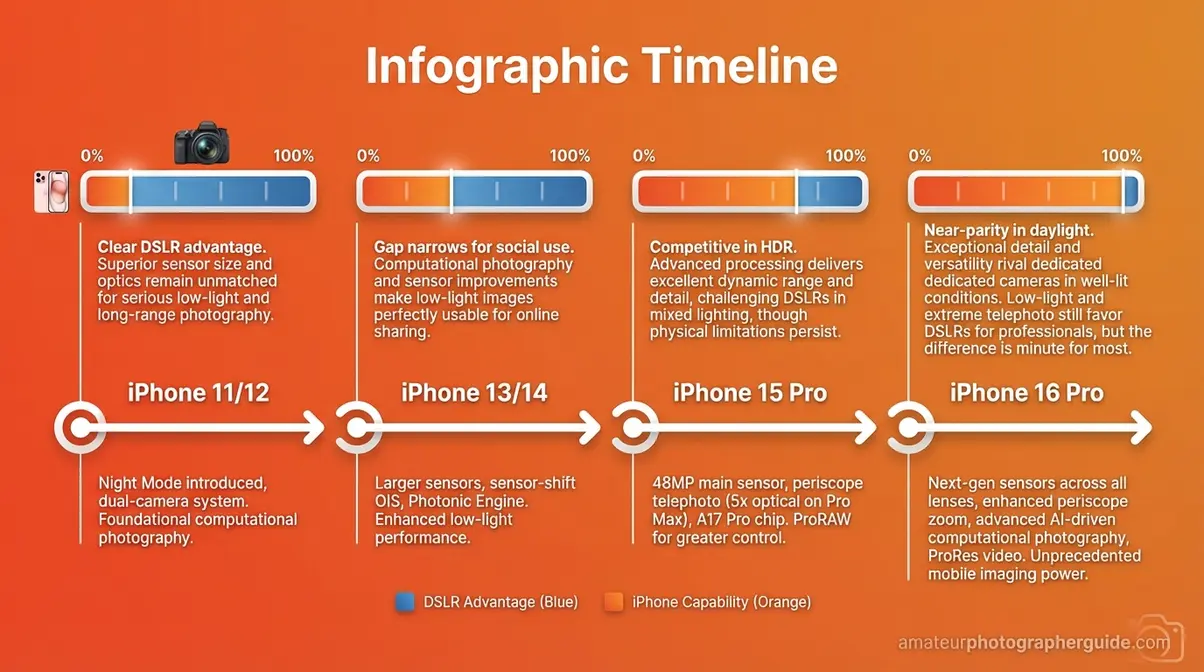
The iPhone model you own matters. An iPhone 12 faces a different competitive gap against a DSLR than an iPhone 16 Pro does. Rather than a blanket verdict for “the iPhone,” here’s how each generation stacks up, keeping in mind that The Right Tool Doctrine applies: the scenario often matters more than the generation.
The iPhone 15 Pro Max matched a Canon EOS 80D DSLR in HDR scenarios but fell behind in telephoto and low-light portrait detail (9to5Mac, 2023)—a pattern that persists in the latest iPhone generation.
iPhone 15/16 Pro: Closing the Daylight Gap
The iPhone 15 Pro Max and iPhone 16 Pro represent a genuine step change. Sensor-shift OIS and computational processing mean these phones produce daylight results competitive with APS-C cameras shooting JPEG. While not a complete replacement for a mirrorless camera, the results are close enough that many casual viewers won’t spot the difference.
9to5Mac’s real-world comparison found the iPhone 15 Pro Max matched or exceeded the Canon EOS 80D in HDR environments and wide-angle shots. The iPhone 16 Pro extends this with improved ultra-wide sharpness and 4K 120fps video. The gap still appears in telephoto shots, fast-action tracking, and RAW post-processing latitude.
[ORIGINAL PHOTO: Wide-angle landscape — iPhone 16 Pro vs. Canon R50. Label each clearly. Note: R50 shows marginally more dynamic range in sky-to-shadow transitions.]
Are Older iPhones (11-14) Still Viable?
For iPhone 11 and 12 owners, the comparison is straightforward: an entry-level DSLR or mirrorless camera will produce noticeably sharper images in most demanding conditions. iMore’s hands-on comparison of the iPhone 15 Pro Max against the Canon EOS 1300D found the DSLR retained an advantage in portrait sharpness and chromatic aberration control—a result that applies even more to older iPhones.
For iPhone 13 and 14 owners, the gap is smaller, particularly for social-media-sized output. If your primary use is Instagram, the iPhone 13/14 camera is sufficient for most casual scenarios. The difference becomes visible in low-light portraits, telephoto shots, and any situation requiring significant cropping.
5 Scenarios That Reveal the Difference
The scenario matters more than the device. Here’s where each system wins:
| Scenario | Winner | Why |
|---|---|---|
| Low-light portrait | DSLR/Mirrorless | Larger sensor collects more light; less noise; natural depth separation at f/1.8 |
| Macro/close-up | Draw* | iPhone macro mode (iPhone 13+) is excellent; mirrorless with macro lens wins on fine detail |
| Wide-angle landscape | iPhone 16 Pro | Computational HDR and ultra-wide lens produce excellent results in good daylight |
| Action/motion | DSLR/Mirrorless | Faster autofocus tracking; higher burst rate; no shutter lag |
| 4K video stills | iPhone | Superior stabilization (Cinematic Mode); 4K 120fps; external mic support |
*Macro draw caveat: The result depends on having a dedicated macro lens for your mirrorless. iPhone 13+ macro mode is excellent for food and product shots—a macro lens adds $150–$400 to the mirrorless kit.
[ORIGINAL PHOTO: Side-by-side for all 5 scenarios — iPhone 16 Pro vs. Canon R50. Label each scenario clearly.]
The Modern Camera Landscape
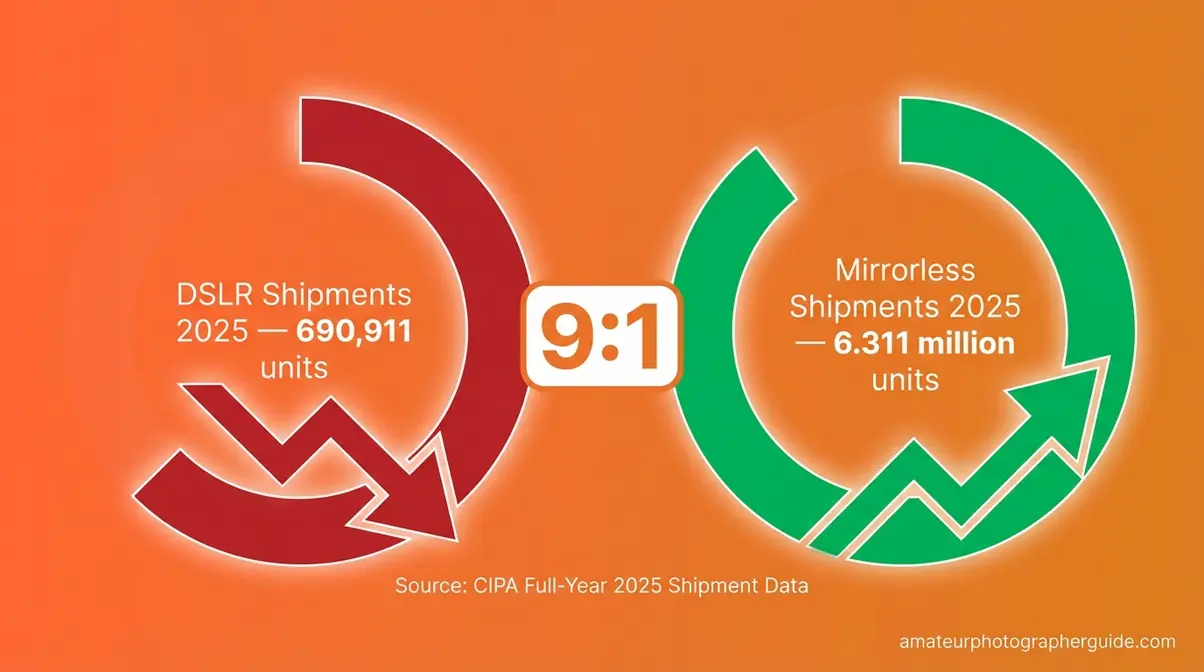
Here’s the context most DSLR vs. iPhone articles omit: the camera market has fundamentally shifted. Mirrorless cameras—which remove the physical mirror mechanism found in DSLRs for a more compact body and faster autofocus—have overtaken DSLRs by a ratio of roughly 9 to 1 in production volume, according to CIPA’s full-year 2025 shipment data. This reveals that the DSLR is no longer the relevant benchmark.
According to official CIPA shipment data, mirrorless cameras shipped 6.311 million units in 2025—compared to just 690,911 DSLRs—marking a structural shift away from DSLR investment by all major manufacturers (CIPA, 2025).
Why the DSLR vs. iPhone Debate Is Dated
The iPhone vs. DSLR vs. mirrorless comparison reveals something the traditional debate misses: the DSLR is the wrong target. DPReview’s market analysis confirms that major brands are concentrating innovation on mirrorless systems, with DSLR development largely stagnant (DPReview).
Entry-level mirrorless cameras—like the Canon R50 or Sony ZV-E10—now occupy the $500–$700 price point of mid-range DSLRs from a few years ago. If you’re planning a new purchase, the mirrorless ecosystem is where your money belongs.
How Mirrorless Cameras Changed Everything
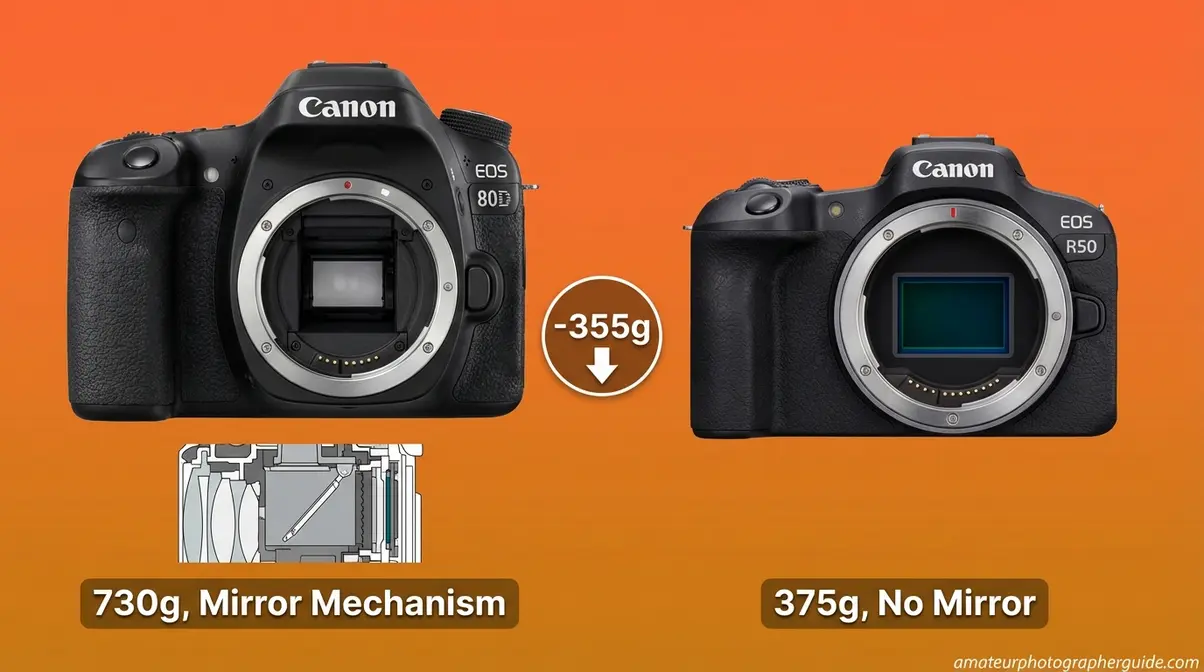
Mirrorless cameras use the same large sensors as DSLRs—retaining the image quality advantage over an iPhone—but in a much smaller body. For example, the Canon R50 weighs 375g, while the older Canon EOS 80D DSLR is 730g. For travelers, that weight difference is significant.
Modern mirrorless systems also feature superior autofocus with subject and eye tracking, which narrows one of the iPhone’s key usability advantages. Furthermore, the lens ecosystem has shifted. New RF, Z, and E-mount lenses are optimized for mirrorless, while DSLR lens mounts are being phased out. Official camera shipment data from CIPA confirms this trend, showing where investment and demand are converging.
Preference: DSLR vs. Mirrorless Cameras
Professional and serious hobbyist photographers increasingly prefer mirrorless cameras over DSLRs. CIPA’s full-year 2025 data shows mirrorless units shipped up 12% year-over-year while DSLRs declined 31%—a 9-to-1 ratio favoring mirrorless. All major manufacturers have shifted development investment to mirrorless platforms. While enthusiasts with large DSLR lens collections often retain their systems, new camera purchases skew heavily toward mirrorless across the board.
Is DSLR Being Phased Out?
DSLRs are not disappearing overnight, but they are in structural decline—no major manufacturer has announced a new flagship DSLR since 2020. CIPA’s 2025 full-year data shows DSLRs shipped down 31% in units and 36% in value year-over-year (CIPA, 2025). The market is now sustained by existing owners and used-camera buyers, not new products.
A new DSLR purchase today means buying into a technology with no significant future development. A used DSLR, however, remains excellent value for hobbyists who want APS-C image quality on a budget. A used Canon Rebel T6 or Nikon D3200 at $150–$200 still outperforms any smartphone in demanding conditions.
Decision Guide: Which Camera Is Right for You?
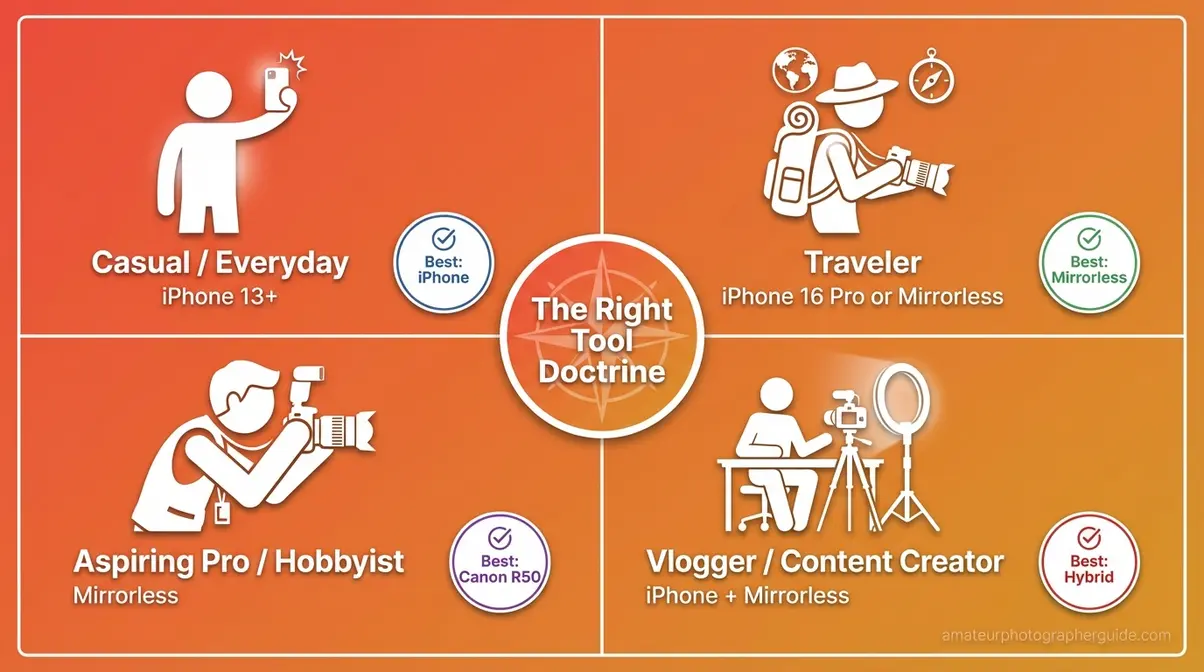
The honest answer to “which is better” depends entirely on you as a photographer. The Right Tool Doctrine holds that the best camera is the one you’ll actually carry and use consistently. Here’s how that plays out across four distinct photographer types.
The Four Photographer Personas
No single verdict serves every shooter. The following scorecard delivers unambiguous recommendations by matching the camera system to the person holding it.
| Photographer Type | Best Choice | Why | Approx. Cost |
|---|---|---|---|
| Casual / Everyday | iPhone (any model 13+) | Always available; good-light performance is sufficient; zero learning curve | $0 (already own it) |
| Traveler | iPhone 16 Pro or Mirrorless | Mirrorless (R50 + kit lens) for image quality; iPhone for pure portability | $0–$680 |
| Aspiring Pro / Hobbyist | Mirrorless (Canon R50, Sony ZV-E10) | APS-C sensor, expandable lens ecosystem, RAW flexibility, superior low-light | $500–$1,200 kit |
| Vlogger / Content Creator | iPhone 15/16 Pro (primary) + Mirrorless (secondary) | iPhone wins on stabilization and portability; mirrorless wins on audio and low-light video | $0–$800 |
For the Aspiring Pro, a mirrorless system is the only sensible recommendation. Buying a new DSLR now means investing in a declining ecosystem. For the Casual shooter, the inverse is true: if your iPhone already captures the moments that matter, adding equipment adds friction, not quality.
Total Cost of Ownership: The Hidden Math
The upfront price is rarely the total price. Here’s the full cost picture:
iPhone 16 Pro (~$999 new): On a three-year upgrade cycle, the camera costs roughly $333 per year. No additional lenses or accessories are required. The key advantage: you already own it.
Entry DSLR kit (Used Canon Rebel T7):
| Item | Used Cost |
|---|---|
| Body & Kit Lens | ~$300 |
| Spare battery | ~$30 |
| SD card (64GB) | ~$20 |
| Camera bag | ~$40 |
| Total starter kit | ~$390 |
Entry mirrorless kit (Canon R50):
| Item | Cost |
|---|---|
| Body + kit lens | ~$680 (as of March 2026) |
| Spare battery | ~$30 |
| SD card (64GB) | ~$20 |
| Total starter kit | ~$730 |
The hidden cost of a DSLR: if it’s too cumbersome to carry, it “gathers dust,” meaning you paid for a device you barely use. The Consumer Reports camera guide highlights that bulkiness is a top barrier for beginners (Consumer Reports).
The iPhone’s true cost advantage is consistent use. A camera in your pocket beats a better camera at home.
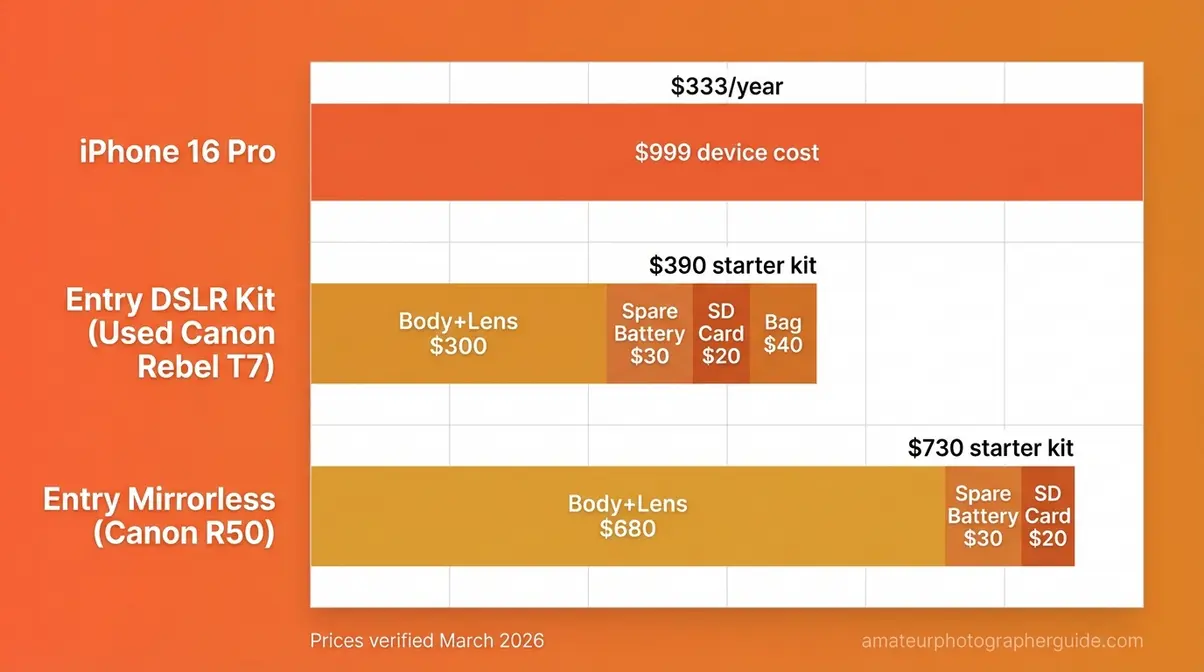
Caption: Three-year total cost of ownership across iPhone, entry DSLR kit, and entry mirrorless kit—including accessories most buyers forget to price in.
Video & Audio: The Vlogger’s Decision
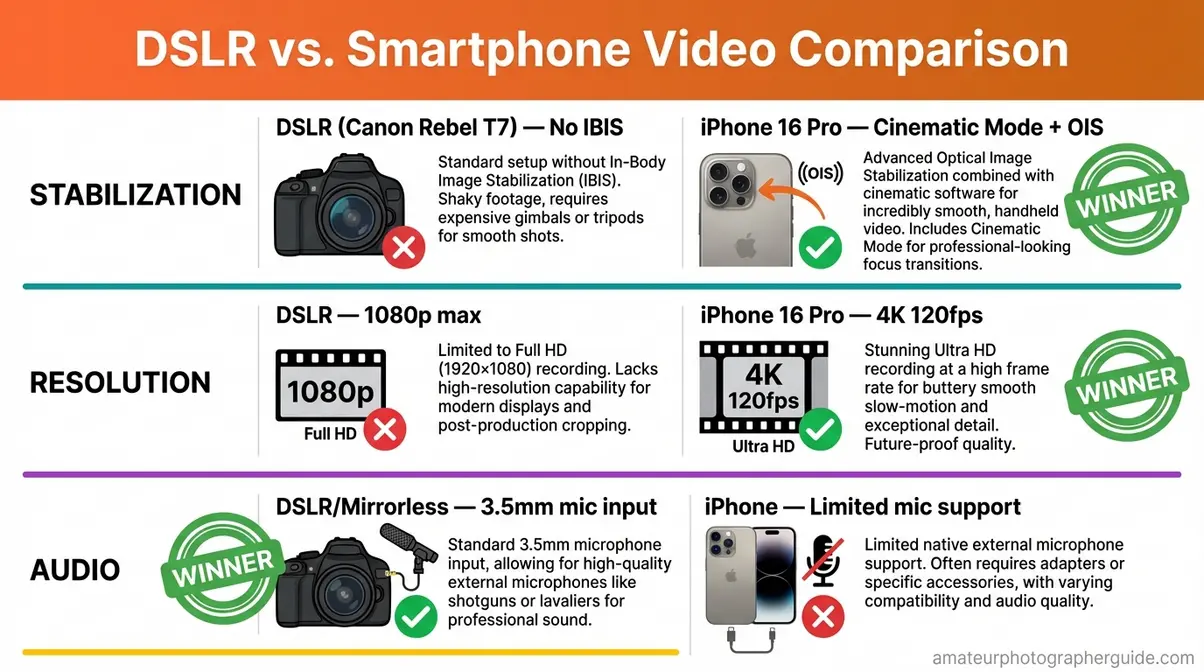
Video is where the comparison shifts, and the iPhone often wins over entry-level dedicated cameras.
Stabilization: Sensor-shift OIS combined with Cinematic Mode on newer iPhones delivers gimbal-quality handheld stabilization. Entry-level DSLRs like the Canon Rebel T7 have no in-body stabilization, a decisive gap for solo vloggers.
Resolution: The iPhone 16 Pro shoots 4K at up to 120fps with Log profiles. The Canon Rebel T7 is limited to 1080p. Entry mirrorless cameras like the Canon R50 shoot 4K at 30fps, which is capable but doesn’t match the iPhone’s frame rate ceiling.
Audio: Here, the calculus reverses. DSLRs and mirrorless cameras include a 3.5mm microphone input for professional audio. While iPhones support external mics, they offer less flexibility.
Future-Proofing Your Choice
DSLRs: No major new DSLR body has been announced by Canon or Nikon since 2020. CIPA data shows a 31% year-over-year decline in DSLR shipments for 2025 (CIPA, 2025). Used DSLRs are an excellent value, but buying new is difficult to justify.
Mirrorless: Canon RF, Sony E-mount, and Nikon Z-mount ecosystems are actively expanding. An entry-level mirrorless purchase today locks you into a growing lens catalog with better resale value.
iPhone: Guaranteed annual hardware and software updates. The iPhone is future-proofed by default but is also the most expensive option over a decade if you upgrade frequently.
Common Mistakes When Choosing a Camera
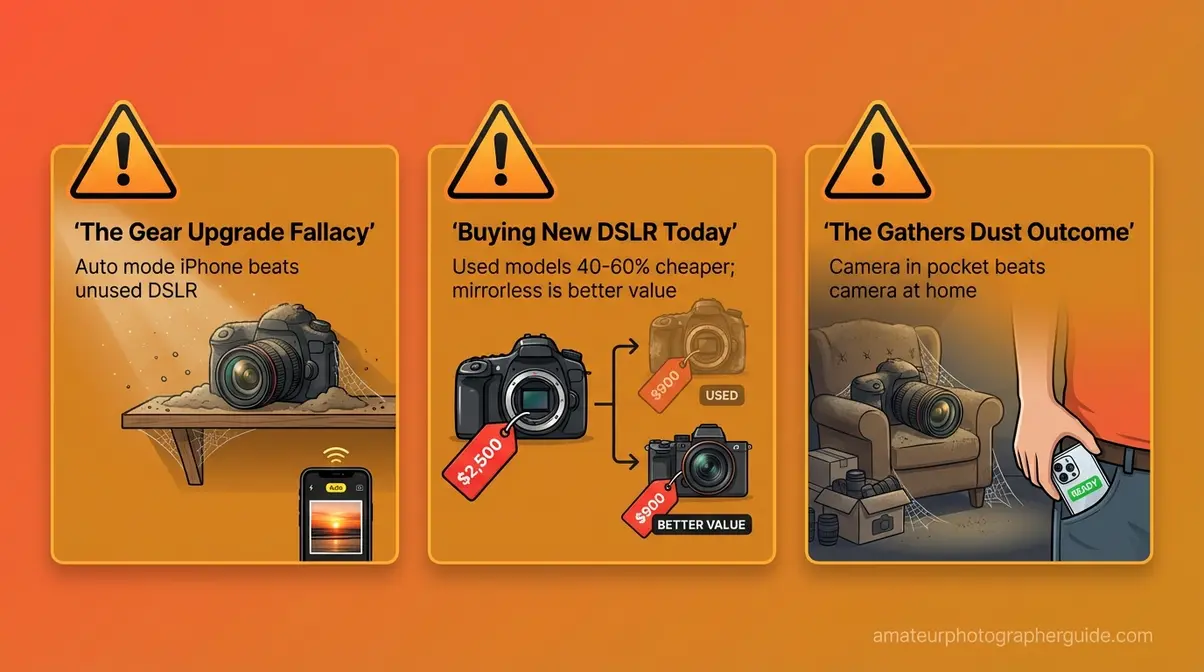
Understanding the tech is only half the battle. These are the errors that cost photographers money.
3 Pitfalls That Cost Photographers Money
1. The Gear Upgrade Fallacy. Buying a DSLR assuming it will automatically produce better photos. A camera with manual controls requires a learning investment. Without that knowledge, the iPhone’s auto mode will consistently outperform a DSLR on program mode.
2. Buying a New DSLR Today. Paying full retail for a new DSLR body when used models are available at 40–60% below retail—and a mirrorless at the same price is a better long-term investment. The Consumer Reports camera guide notes that DSLR complexity and size are top barriers for new buyers.
3. The “It Gathers Dust” Outcome. Buying a DSLR on enthusiasm, then finding it too heavy for everyday carry. The DSLR sits unused while you continue using your iPhone. Before buying, honestly ask yourself how often you’ll carry a dedicated camera bag.
Key Disadvantages of a DSLR
The main disadvantages of a DSLR are its size, weight, complexity, and declining ecosystem. DSLRs are significantly bulkier than smartphones or mirrorless cameras, often requiring a dedicated bag. They have a genuine learning curve to master manual settings. Furthermore, with manufacturers shifting R&D to mirrorless systems, the DSLR lens ecosystem is contracting, making it a poor long-term investment for new buyers.
When Neither Option Is Right for You
Some use cases expose the limits of both entry-level DSLRs and modern iPhones.
Wildlife and Sports Photography: Neither system handles fast subjects at telephoto distances reliably. A mirrorless with continuous tracking AF and a dedicated super-telephoto lens is required.
Professional Studio Work: Entry-level DSLRs and iPhones lack the resolution, tethering support, and flash sync precision for professional studio work. Full-frame mirrorless or medium-format digital is the correct tool.
The Budget-First Buyer: For the best camera under $200, the answer is a used DSLR. A Canon Rebel T6 or Nikon D3200 at $150–$200 offers APS-C image quality that no phone in that price tier can match.
Frequently Asked Questions
Do DSLRs Take Better Pictures Than Phones?
DSLRs generally take technically superior photos compared to phones, particularly in low light and high-detail scenarios. Their much larger sensors collect dramatically more light, producing cleaner images with greater shadow detail. This difference is most visible when printing large or shooting in challenging conditions. Smartphones compensate with computational photography, which produces excellent results in good daylight for casual use.
Is it still worth getting a DSLR?
Getting a used DSLR is still worth it for specific scenarios, like shooting sports or wildlife on a tight budget, or if you inherit a lens collection. Used DSLRs offer excellent image quality for 40–60% below original retail prices. However, for most new buyers, an entry-level mirrorless camera like the Canon R50 offers equivalent quality in a more compact, future-proof package.
Do professionals use DSLR?
Many professional photographers still actively use DSLR cameras, particularly those with large investments in Canon EF or Nikon F-mount lenses. DSLRs remain common in wedding, sports, and photojournalism contexts due to their robust build and long battery life. However, the professional community is actively transitioning, with mirrorless cameras dominating new purchases due to superior autofocus and video features.
Are iPhones as good as DSLRs?
iPhones are not technically equivalent to DSLRs in raw image quality, but the gap has narrowed significantly. In good daylight, the latest iPhone Pro models produce results competitive with entry-level DSLRs and often outperform them in video stabilization and convenience. In low light, fast action, or telephoto scenarios, a DSLR or mirrorless camera with its larger sensor retains a clear hardware advantage.
Do billionaires use iPhone or Android?
The iPhone dominates the US premium smartphone market, capturing 69% of the market in Q4 2025 (Counterpoint Research, 2026). This reflects ecosystem loyalty and brand preference among high-income demographics, not necessarily camera superiority. For photography specifically, serious enthusiasts of any income level use dedicated camera systems for intentional work and smartphones for daily convenience.
What camera does Taylor Swift use?
Taylor Swift is a documented user of Olympus mirrorless cameras for her personal photography, specifically the OM-D series (Digital Camera World). She favors their compact form factor and analog aesthetic. Professional photography of her is handled by credentialed photographers using full-frame systems. Her choice illustrates the Right Tool Doctrine: a capable mirrorless for personal use and pro-grade gear for professional contexts.
Prices and features verified as of March 2026. Camera pricing is subject to change.
For photographers weighing a DSLR vs. an iPhone camera, the binary itself is outdated. Smartphone sensors collect approximately 1/20th the light of a dedicated camera sensor (DXOMARK)—a hardware gap that genuinely matters in low light, telephoto, and professional print scenarios. For the casual photographer, the latest iPhone is excellent and the correct tool. For the serious hobbyist, an entry-level mirrorless like the Canon R50 (~$580–$680 as of March 2026) is the modern, future-proof choice.
The Right Tool Doctrine comes down to one question: which camera will you actually carry? A DSLR that gathers dust because it’s too heavy produces worse results than an iPhone that’s always in your pocket. Match the camera to your real shooting behavior—the way you actually shoot, not the way you imagine you’ll shoot after buying new gear.
If you’re still deciding, audit the last 30 photos you took. If they’re all from your iPhone and you’re satisfied, your current tool is working. If you’re consistently frustrated by low-light blur, missed action shots, or flat portrait backgrounds, that’s the signal to evaluate a mirrorless system—and the Canon R50 with kit lens is the recommended starting point.

Dave King
Hi, I'm Dave, the founder of Amateur Photographer Guide. I created this site to help beginner and hobbyist photographers build their skills and grow their passion. Here, you’ll find easy-to-follow tutorials, gear recommendations, and honest advice to make photography more accessible, enjoyable, and rewarding.