Best Camera Lens for Beginners: Your Complete 2026 Guide
Choosing the best camera lens for beginners doesn't need to be overwhelming. This comprehensive guide breaks down prime vs zoom lenses, explains focal lengths and apertures in plain English, and recommends specific starter lenses for every budget and camera system. Learn why your lens matters more than your camera body and which affordable options deliver professional results immediately.

You’ve just bought your first proper camera, and you’re already hitting a frustrating wall. Your photos aren’t as sharp as you’d hoped. That background blur everyone talks about? Nowhere to be seen. Your kit lens works fine in bright daylight, but indoors or at golden hour, everything’s a blurry mess. And when you start researching lenses, you’re bombarded with confusing numbers, cryptic abbreviations, and hundreds of options ranging from £50 to £5,000.
What’s in this guide
- Quick Comparison: Best Camera Lens for Beginners in 2026
- Understanding Camera Lenses: The Basics You Actually Need
- The "Nifty Fifty": Why Every Beginner Needs a 50mm Lens
- Best Versatile Zoom Lenses for Beginners
- Best Prime Lenses for Specific Photography Styles
- Budget-Friendly Starter Camera Lens Options Under £200
- Matching Lenses to Your Camera System
- Common Mistakes When Buying Your First Lens
- Frequently Asked Questions About Beginner Camera Lenses
- Your Next Steps: Choosing and Using Your First Lens
Here’s the truth most photography websites won’t tell you upfront: your lens matters significantly more than your camera body. You can attach a brilliant lens to a ten-year-old camera and get stunning results. But pair the latest camera body with a mediocre lens, and your images will still disappoint. The glass in front of your sensor determines sharpness, background blur, low-light performance, and creative possibilities far more than megapixels or the latest processor ever will.
This guide cuts through the marketing nonsense to help you choose the best camera lens for beginners based on what you actually photograph, your budget, and your camera system. Whether you’re shooting portraits of your children, landscapes on holiday, or experimenting with street photography, there’s a perfect starter lens that won’t require remortgaging your house.
Quick Comparison: Best Camera Lens for Beginners in 2026
| Lens Name | Type | Best For | Price Range |
|---|---|---|---|
| 50mm f/1.8 (Canon/Nikon/Sony) | Prime | Portraits, low light, learning composition | £100-£200 |
| 35mm f/1.8 (Various brands) | Prime | Street photography, environmental portraits, everyday shooting | £150-£300 |
| 18-55mm f/3.5-5.6 (Kit Lens Upgrade) | Zoom | General purpose, travel, learning basics | £150-£400 |
| 24-70mm f/4 | Zoom | Events, versatile everyday use, professional-looking results | £400-£900 |
| 85mm f/1.8 | Prime | Portrait photography, subject isolation, headshots | £300-£500 |


Canon RF100-400mm F5.6-8 is USM Telephoto Lens, Black, Compatible with EOS R Series Mirrorless Cameras

Canon EF 75-300mm f/4-5.6 III Telephoto Zoom Lens for Canon SLR Cameras, 6473A003 (Renewed)


Canon RF24-70mm F2.8 L is USM Lens, Mirrorless Lens, Standard Zoom, Compatible with EOS R Series Mirrorless Cameras, High Image Quality, Portraits, Landscapes, Travel, Photography, Black
Understanding Camera Lenses: The Basics You Actually Need
Before we dive into specific recommendations, let’s decode the numbers and terms you’ll encounter when shopping for your first camera lens to buy.
Focal Length: Your Creative Window
That first number on a lens—35mm, 50mm, 85mm—represents the focal length in photography, measured in millimetres. Think of it as your angle of view. Lower numbers (like 24mm) capture wide scenes, perfect for landscapes or cramped interiors. Higher numbers (like 85mm or 200mm) magnify distant subjects, ideal for portraits or wildlife.
Here’s the catch: if you’re using a camera with a crop sensor (most beginner DSLRs and mirrorless cameras), these numbers work differently. A 50mm lens on a crop sensor explained actually behaves more like a 75mm or 80mm lens would on a full-frame camera. This affects which lenses work best for different photography styles.
Aperture: Your Light-Gathering Power
The f-number (f/1.8, f/2.8, f/4) tells you how wide the lens can open. Smaller f-numbers mean larger openings, which allow more light in and create that gorgeous blurred background effect. An f/1.8 lens performs brilliantly in dim lighting and creates beautiful depth of field photography with sharp subjects and creamy backgrounds. An f/5.6 lens struggles indoors and keeps more of the scene in focus.
Prime vs Zoom: The Fundamental Choice
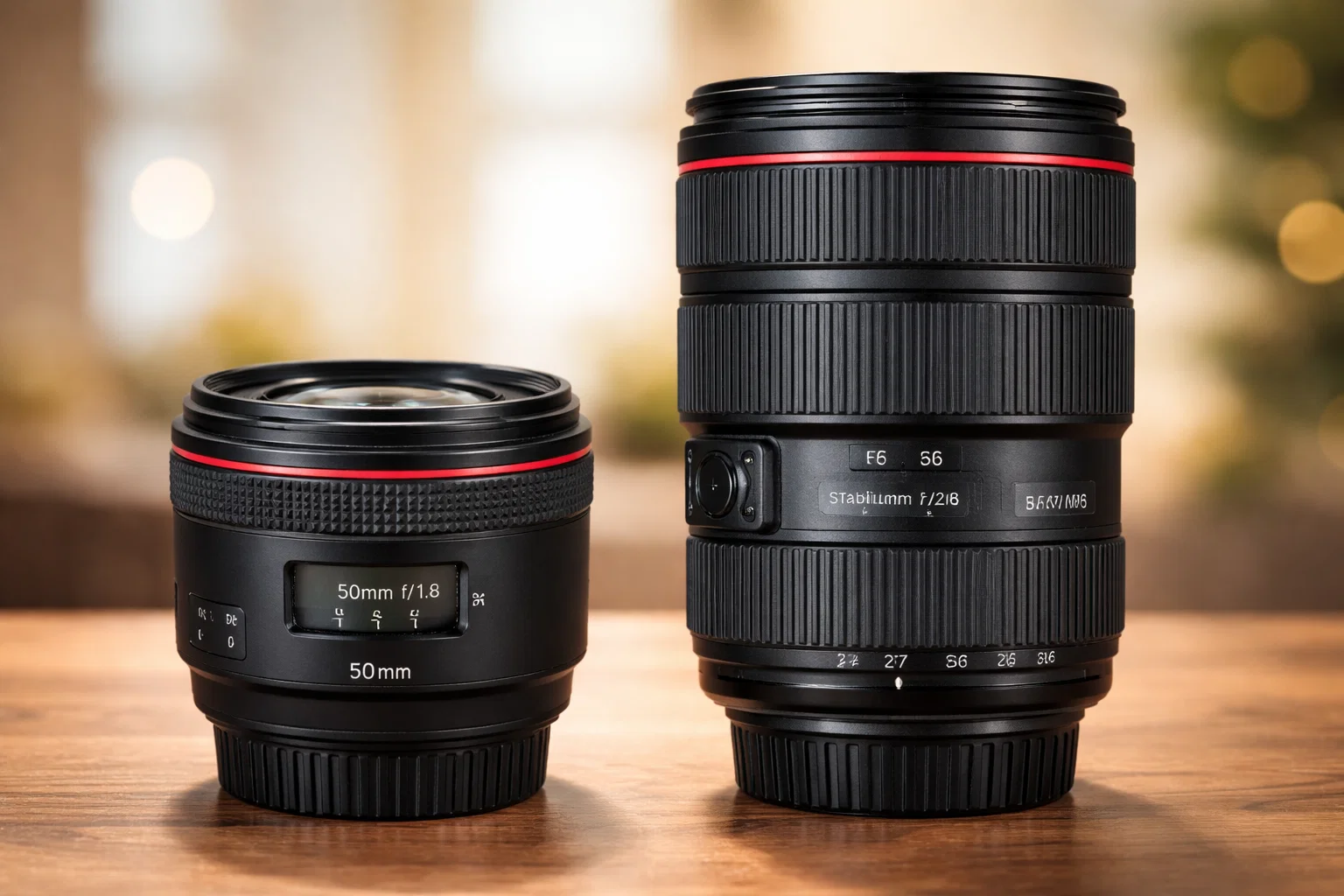
Prime lenses have a fixed focal length—you zoom with your feet, not a ring on the lens. They’re typically sharper, faster (wider apertures), lighter, and more affordable than zoom lenses. The trade-off? Less convenience. Zoom lenses offer versatility, letting you reframe without moving, but they’re usually heavier, more expensive for equivalent quality, and have narrower maximum apertures.
For beginners, prime lenses teach composition and force you to think about positioning. Zoom lenses offer flexibility for events or situations where you can’t easily change position. Both have legitimate places in a beginner’s kit.
The “Nifty Fifty”: Why Every Beginner Needs a 50mm Lens
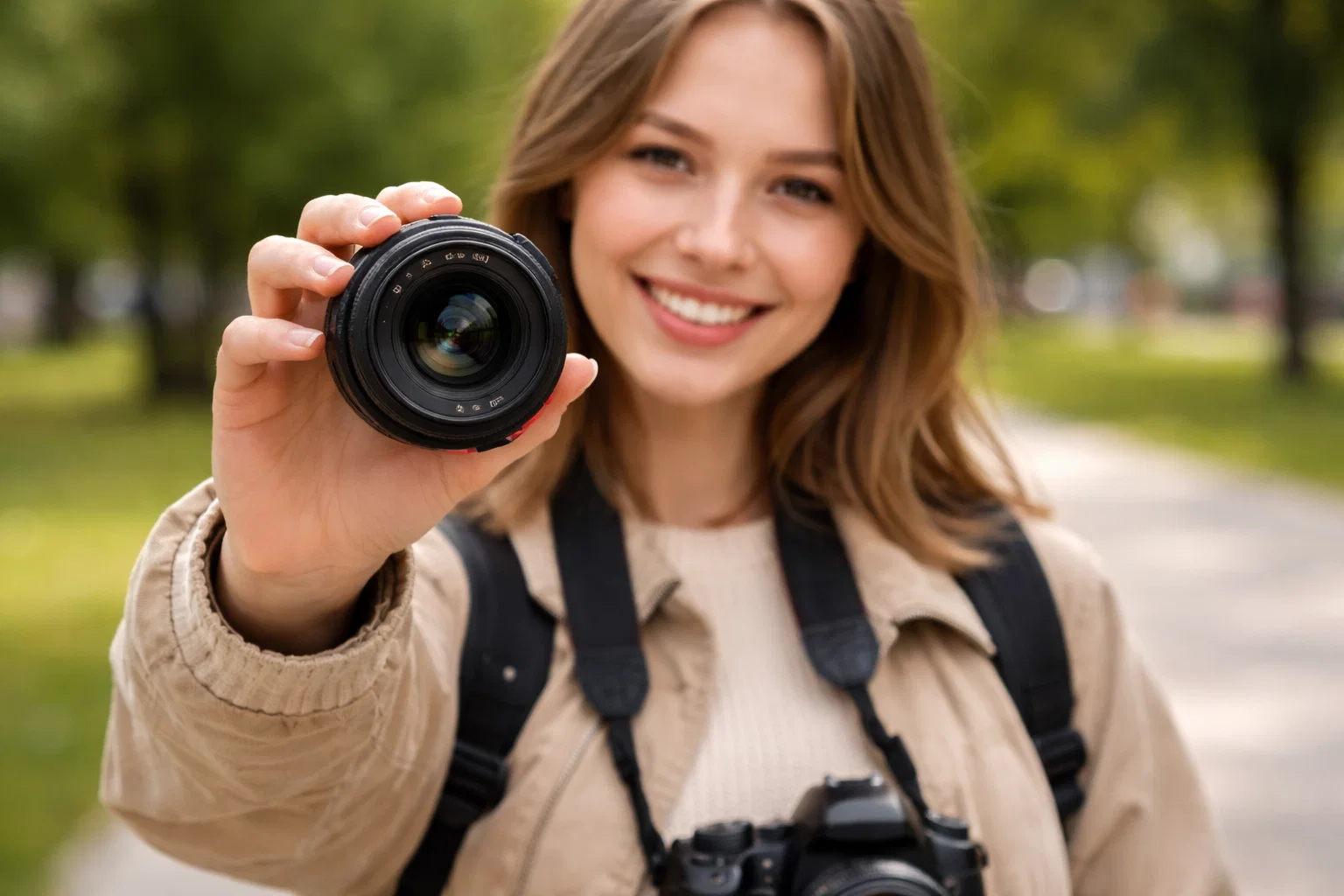
Photography forums universally recommend the 50mm f/1.8 as the best lens for new photographers, and they’re absolutely right. This lens—nicknamed the “nifty fifty”—offers the best return on investment for beginners across all camera systems.
Why does this affordable camera lens punch so far above its price point? First, the wide f/1.8 aperture lets you shoot in challenging lighting without cranking your ISO to unusable levels. You can photograph indoors, during golden hour, or at dimly lit events and still get sharp, properly exposed images. Second, that wide aperture creates beautiful background blur that makes your subjects pop, giving you professional-looking portraits even as a complete novice.
The 50mm focal length on a full-frame camera approximates how we naturally see the world. On a crop sensor camera, it becomes a short telephoto (around 75-80mm equivalent), which actually makes it even better for portrait photography. You can shoot headshots, couple photos, or street scenes with flattering perspective and compression.
Canon’s 50mm f/1.8 STM costs around £110, Nikon’s AF-S 50mm f/1.8G runs about £180, and Sony’s FE 50mm f/1.8 sits around £200. For that investment, you’re getting a lens that’ll remain useful even as your skills and gear collection grow. Many professional photographers still carry a fifty in their bag because it’s so versatile and compact.
Mini-FAQ: Is 50mm Good for Beginners?
Yes, absolutely. The 50mm focal length forces you to think about composition and positioning rather than relying on zoom. The wide aperture teaches you about depth of field control. The affordable price means you can invest in learning rather than gear. And the sharp images it produces will genuinely surprise you compared to your kit lens. The only caveat: on crop sensor cameras, it’s not ideal for group photos or interiors because it’s too tight. For those situations, consider a 35mm instead.
Best Versatile Zoom Lenses for Beginners
If the idea of changing lenses mid-shoot makes you anxious, or you photograph events where you need flexibility, a quality zoom lens serves as your photographic Swiss Army knife.
The Standard Zoom: 18-55mm and Its Better Cousins
Your camera probably came with an 18-55mm kit lens. It’s serviceable for learning basics, but upgrading to a better version transforms your photography. Look for lenses with constant apertures (like f/2.8 throughout the zoom range) or those marketed as “professional” versions of the kit lens.
Canon’s EF-S 18-55mm f/2.8 IS STM and Nikon’s AF-P DX 18-55mm f/3.5-5.6G VR represent significant improvements over basic kit lenses, with better how autofocus works performance, sharper optics, and more solid construction. Budget £300-£450 for these upgraded standard zooms.
The Professional Standard: 24-70mm f/2.8 or f/4
If you’re serious about photography and can stretch your budget, a 24-70mm lens represents the workhorse of professional photographers. The f/2.8 versions cost £1,200-£2,000, but f/4 versions (£400-£900) offer 90% of the capability at a fraction of the cost.
This focal range handles portraits, events, street photography, travel, and documentary work brilliantly. On a crop sensor, you lose a bit of the wide end, but the versatility remains exceptional. Tamron and Sigma offer third-party versions with excellent optical quality at more accessible prices than Canon, Nikon, or Sony alternatives.
Best Prime Lenses for Specific Photography Styles
Once you’ve identified your favourite type of photography, investing in a prime lens optimised for that style accelerates your progress dramatically.
35mm: The Street Photographer’s Friend
A 35mm lens on a crop sensor (or 23mm on APS-C) approximates natural human vision, making it perfect for documentary work, street photography, and environmental portraits where you want to show context around your subject. Understanding wide angle lens uses helps you maximise this focal length’s potential.
The wider field of view compared to a 50mm means you can shoot in tighter spaces and capture more of the scene. Yet it’s not so wide that it distorts faces when shooting portraits. Canon’s EF 35mm f/2 IS USM (£450), Nikon’s AF-S 35mm f/1.8G (£400), and Sony’s FE 35mm f/1.8 (£550) all deliver exceptional results.
For tighter budgets, the older Nikon AF-S DX 35mm f/1.8G for crop sensors costs around £150 and remains one of the best value lenses you can buy.
85mm: The Portrait Specialist
If portrait photography becomes your passion, an 85mm lens delivers flattering facial proportions, subject isolation, and professional-quality results that make people ask what camera you’re using (when it’s actually the lens doing the heavy lifting).
The longer focal length creates compression that’s flattering for faces, and the wide apertures available (f/1.8 or f/1.4) throw backgrounds beautifully out of focus. Canon’s EF 85mm f/1.8 USM (£330), Nikon’s AF-S 85mm f/1.8G (£420), and Sony’s FE 85mm f/1.8 (£500) represent the affordable end of portrait lenses, with more expensive f/1.4 versions offering incrementally better performance.
On a crop sensor, an 85mm becomes quite long (around 127-135mm equivalent), which means you’ll need space to work. For tight indoor spaces, the 50mm remains more practical for portraits on crop sensors.
Budget-Friendly Starter Camera Lens Options Under £200
Quality photography needn’t empty your bank account. Several excellent lenses deliver outstanding results whilst respecting a modest budget.
Canon EF 50mm f/1.8 STM (£110): The cheapest way into fast prime lenses, with surprisingly good image quality and useful autofocus for the price. The plastic construction feels cheap, but the optical performance definitely isn’t.
Nikon AF-S DX 35mm f/1.8G (£150): Purpose-built for crop sensor Nikons, this lens offers the perfect normal focal length with fast aperture performance. It’s compact, sharp, and should be in every beginner Nikon shooter’s bag.
Yongnuo YN 50mm f/1.8 (£50-£70): The budget option for Canon shooters produces decent results for about half the price of Canon’s version. Build quality and autofocus speed lag behind, but for learning and experimentation, it’s remarkable value.
Canon EF-S 24mm f/2.8 STM (£120): A pancake lens that’s ridiculously compact whilst offering good image quality and a useful wide angle on crop sensors. Perfect for street photography and travel when you want to pack light.
Used Professional Lenses: Don’t overlook the used market. Older professional lenses from reputable sellers often outperform new budget lenses. A used Nikon 50mm f/1.4D or Canon 50mm f/1.4 USM can be found for £150-£200 and offers better build quality and slightly wider apertures than the f/1.8 versions.
Matching Lenses to Your Camera System
Not all lenses work with all cameras. Understanding your camera’s mount system prevents expensive mistakes.
Canon Shooters
Canon DSLRs use either EF (full-frame) or EF-S (crop sensor) mounts. EF lenses work on all Canon DSLRs, but EF-S lenses only fit crop sensor bodies. If you might upgrade to full-frame later, stick with EF lenses. The newer Canon mirrorless cameras (R-series) use RF mount and require an adapter for EF lenses, which works flawlessly but adds bulk.
Nikon Users
Nikon’s F-mount has decades of compatibility, but newer lenses with AF-P or AF-S designations offer better autofocus than older AF or AF-D lenses. DX lenses are designed for crop sensors, whilst FX lenses work on all bodies. Nikon’s Z-mount mirrorless cameras need the FTZ adapter for F-mount lenses.
Sony Photographers
Sony’s E-mount serves both full-frame (FE lenses) and crop sensor (E lenses) cameras. FE lenses work on all E-mount cameras, but E lenses vignette on full-frame bodies. Sony’s excellent third-party lens support from Sigma, Tamron, and Samyang offers superb alternatives to Sony’s sometimes pricey options.
Fujifilm Enthusiasts
Fujifilm’s X-mount crop sensor cameras have a brilliant lens lineup. Start with the XF 35mm f/2 (£150) for a normal field of view, or the XF 23mm f/2 (£350) for wider coverage. Fujifilm’s primes are generally sharper and better built than comparable Canon or Nikon crop sensor lenses.
Common Mistakes When Buying Your First Lens
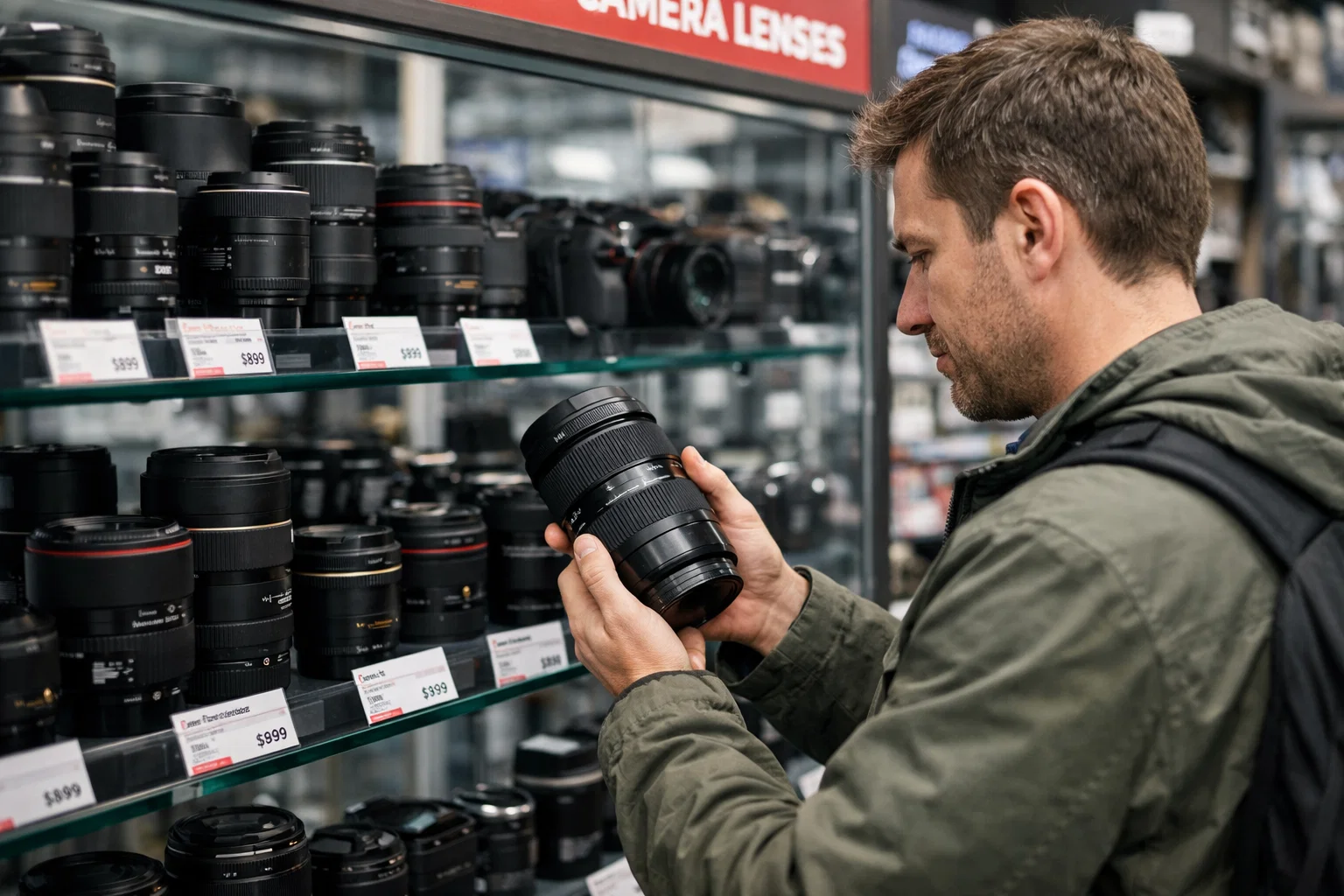
Avoid these pitfalls that waste money and slow your photographic development:
Buying zoom range instead of optical quality: That 18-300mm superzoom looks convenient, but it compromises image quality, maximum aperture, and autofocus speed. You’re better off with two or three quality lenses that cover less range but perform brilliantly.
Ignoring the used market: Lenses hold value well and last decades. A used professional lens from five years ago typically outperforms a new budget lens whilst costing the same. Check MPB, Wex Photo Video’s used department, or local camera shops for certified pre-owned options with warranties.
Prioritising image stabilisation over aperture: Image stabilisation (IS, VR, VC, or OSS depending on brand) helps with camera shake but doesn’t freeze subject movement. A wide aperture lets you use faster shutter speeds, which eliminates both camera shake and subject motion blur. For beginners, aperture matters more than stabilisation.
Buying for hypothetical situations: Don’t buy a 200mm telephoto because you might photograph birds someday. Buy lenses for what you actually photograph now. Your needs will become clear through shooting, and your second or third lens purchase will be much more informed.
Neglecting third-party options: Sigma, Tamron, and Tokina produce excellent lenses, often matching or exceeding first-party quality whilst costing significantly less. The “you must buy the camera manufacturer’s lenses” advice is outdated.
Frequently Asked Questions About Beginner Camera Lenses
What lens should I buy first as a beginner?
For most beginners, a 50mm f/1.8 prime lens represents the best first purchase after your kit lens. It’s affordable (£100-£200), teaches fundamental photography concepts, works brilliantly in low light, and produces professional-looking images immediately. The fixed focal length forces you to move and think about composition rather than relying on zoom. If you shoot in tight spaces frequently or want something wider, consider a 35mm f/1.8 instead.
Is the kit lens enough for beginners?
Your kit lens is enough for learning basic camera controls, exposure, and composition. However, it’s not enough if you want to progress beyond snapshots. Kit lenses typically have narrow maximum apertures (f/3.5-5.6), which struggle in low light and don’t create appealing background blur. They’re also rarely sharp at their edges. Think of your kit lens as training wheels—useful initially, but you’ll quickly want something better.
How much should I spend on my first lens?
Budget £150-£300 for your first lens purchase beyond the kit lens. This range gets you excellent 50mm or 35mm prime lenses that’ll dramatically improve your images. Spending less risks disappointment; spending more yields diminishing returns until you’ve developed your skills. Put the money you save towards workshops, books, or simply more shooting time.
What is the best all-round lens for beginners?
If you can only own one lens beyond your kit lens, a 35mm f/1.8 or f/2 offers the best all-round capability. It’s wide enough for group shots and interiors, yet tight enough for portraits. The fast aperture handles low light and creates background separation. On crop sensors, it provides a natural field of view that works for most situations. It’s not the best at anything specific, but it’s good at nearly everything.
Should I buy a prime or zoom lens as a beginner?
Prime lenses teach better photographic fundamentals because the fixed focal length forces you to move and consider composition. They’re also sharper, faster, and more affordable than equivalent-quality zooms. However, zoom lenses offer convenience for events, travel, or situations where you can’t easily change position. The ideal approach: start with an affordable prime (50mm f/1.8) to learn fundamentals, then add a quality zoom (24-70mm) as your second or third lens when you understand your needs better.
Do I need to buy the camera brand’s lenses?
No. Third-party manufacturers like Sigma, Tamron, and Tokina produce superb lenses, often matching first-party optical quality whilst costing 30-50% less. Modern third-party lenses support all autofocus features, image stabilisation, and electronic communication with your camera body. The only caveat: ensure the lens is designed for your specific camera mount (Canon EF, Nikon F, Sony E, etc.).
What’s the difference between full-frame and crop sensor lenses?
Full-frame lenses (Canon EF, Nikon FX, Sony FE) project a larger image circle and work on all camera bodies. Crop sensor lenses (Canon EF-S, Nikon DX, Sony E) project a smaller image circle optimised for crop sensors, making them smaller and lighter. You can use full-frame lenses on crop sensor cameras without issues, but crop sensor lenses on full-frame bodies either won’t work or will vignette heavily. If you might upgrade to full-frame eventually, buy full-frame lenses from the start.
Is a 50mm lens good for landscape photography?
A 50mm lens can work for landscapes, particularly for compressed, telephoto landscape scenes that emphasise layers and patterns. However, it’s not ideal as your primary landscape lens. Most landscape photography benefits from wider angles (16-35mm) that capture expansive scenes and foreground interest. Save your 50mm for portraits, street photography, and low-light shooting, and consider a wide-angle lens specifically for landscapes.
How do I know if a lens will fit my camera?
Check your camera’s lens mount type in the manual or on the manufacturer’s website. Common mounts include Canon EF/EF-S/RF, Nikon F/Z, Sony E/FE, Fujifilm X, and Micro Four Thirds. When buying a lens, ensure it explicitly states compatibility with your mount. Online retailers list compatible camera models, and physical stores can verify fitment before purchase. When in doubt, photograph your camera’s lens mount and show it to a knowledgeable sales assistant.
Can I use vintage lenses on modern cameras?
Yes, with adapters. Vintage manual focus lenses from brands like Pentax, Minolta, Olympus, and Nikon often cost £20-£100 and produce characterful images. You’ll lose autofocus and electronic aperture control, but for portraits, street photography, and artistic work, manual focus actually slows you down in beneficial ways. Ensure you buy the correct adapter for your camera mount, and expect a learning curve mastering manual focus.
What does STM, USM, or VR mean on a lens?
These abbreviations indicate autofocus motor types and features. Canon’s STM (Stepping Motor) and USM (Ultrasonic Motor) describe autofocus systems—USM is faster and quieter. Nikon’s VR (Vibration Reduction), Canon’s IS (Image Stabilization), Sony’s OSS (Optical SteadyShot), and Tamron’s VC (Vibration Compensation) all refer to optical stabilisation that counteracts camera shake. These features improve performance but aren’t essential—a fast aperture often matters more for beginners than stabilisation.
Your Next Steps: Choosing and Using Your First Lens
By now, you understand that the best camera lens for beginners depends on what you photograph, your camera system, and your budget. The 50mm f/1.8 remains the universal recommendation because it delivers transformative results for minimal investment, but a 35mm f/1.8 might suit your shooting style better if you work in tight spaces or prefer environmental portraits.
Don’t overthink your first lens purchase. Choose something affordable in the £100-£300 range, shoot with it extensively for three months, and you’ll develop clear opinions about what you need next. Photography skills develop through shooting, not gear accumulation. A modest lens that you actually use beats an expensive lens that intimidates you into leaving it home.
Start with one quality prime lens. Master it completely. Understand its strengths and limitations through thousands of shots. Then, and only then, consider adding a second lens to address specific gaps in your capabilities.
Remember: professional photographers create stunning work with modest gear by understanding their tools completely. The camera lens buying guide journey matters less than the photographs you’ll create once you’re comfortable with your choice. Pick a lens, learn it thoroughly, and focus on the photography itself.
Ready to transform your photography with the right lens? The lenses discussed in this guide are available through reputable retailers with buyer protection and return policies. Investing in quality glass now means you’ll still be using these lenses years from now, even after upgrading camera bodies multiple times.
Last update on 2026-07-21 / Affiliate links / Images from Amazon Product Advertising API

Dave King
Hi, I'm Dave, the founder of Amateur Photographer Guide. I created this site to help beginner and hobbyist photographers build their skills and grow their passion. Here, you’ll find easy-to-follow tutorials, gear recommendations, and honest advice to make photography more accessible, enjoyable, and rewarding.