
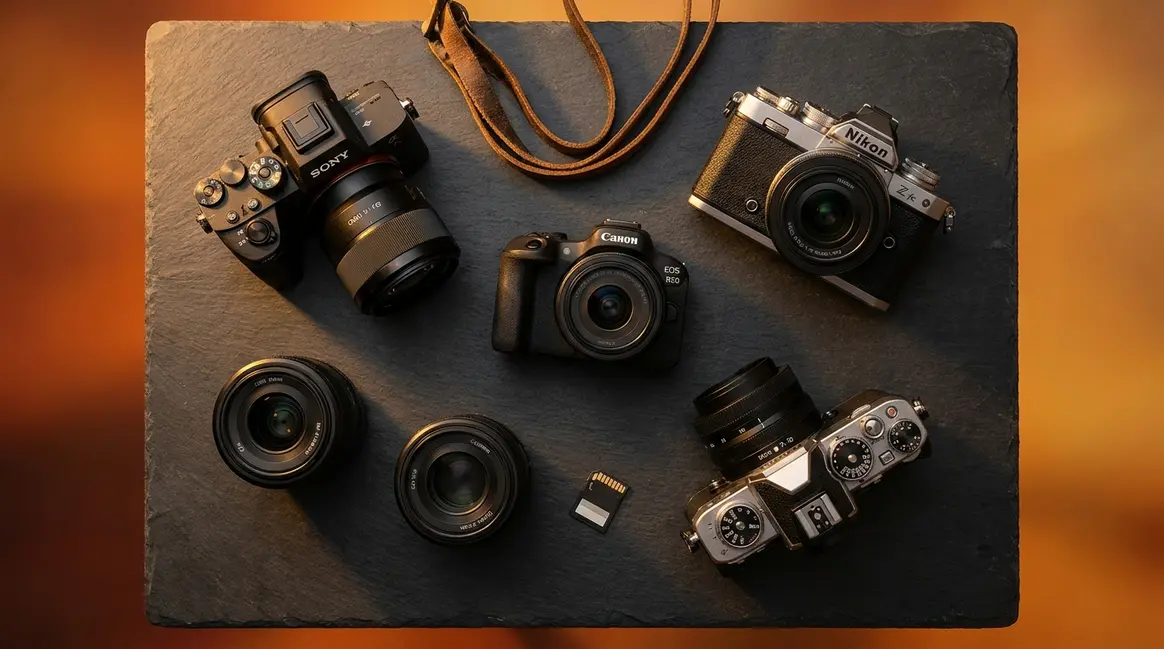
Best Mirrorless Cameras 2026: 9 Expert Picks Ranked

For photographers ready to invest in a full-frame system, the Sony Alpha A7 III stands out as the strongest all-around performer among the best mirrorless cameras reviewed here — but this guide covers the full spectrum, from sub-$600 APS-C kits that won’t break the bank all the way to compact full-frame bodies. These picks are research-based, drawn from manufacturer listing data, published spec sheets, and third-party review sources — not first-party hands-on testing (see “How We Evaluated” below for full methodology). Below you’ll find a ranked comparison table, individual reviews for all 9 cameras, a buying guide, and a FAQ.
What’s in this guide
- 1. Sony Alpha A7 III: Best Full-Frame Overall
- 2. Nikon Z50 II: Best Two-Lens APS-C Kit
- 3. Canon EOS R50: Best APS-C for Video
- 4. Canon EOS RP: Best Entry Full-Frame
- 5. Canon EOS R8: Best Compact Full-Frame
- 6. Canon EOS R50 Kit: Best Value Bundle
- 7. Canon EOS R50 Dual-Lens: Best Range Kit
- 8. Sony ZV-E10: Best for Vlogging
- 9. Canon EOS R100: Best Entry-Level Pick
- Buying Guide: How to Choose the Right Mirrorless Camera
- How We Evaluated
- Frequently Asked Questions
| # | Preview | Product | Best For | Buy |
|---|---|---|---|---|
| 1 |  |
Sony Alpha A7 III: Best Full-Frame Overall | Pro full-frame shooters | Buy on Amazon |
| 2 |  |
Nikon Z50 II: Best Two-Lens APS-C Kit | Two-lens travel kit | Buy on Amazon |
| 3 |  |
Canon EOS R50: Best APS-C for Video | Video-first creators | Buy on Amazon |
| 4 | No products found. | Canon EOS RP: Best Entry Full-Frame | Entry full-frame travel | No products found. |
| 5 |  |
Canon EOS R8: Best Compact Full-Frame | Compact full-frame users | Buy on Amazon |
| 6 |  |
Canon EOS R50 Kit: Best Value Bundle | Ready-to-shoot bundle | Buy on Amazon |
| 7 |  |
Canon EOS R50 Dual-Lens: Best Range Kit | Versatile zoom range | Buy on Amazon |
| 8 |  |
Sony ZV-E10: Best for Vlogging | Vloggers and streamers | Buy on Amazon |
| 9 |  |
Canon EOS R100: Best Entry-Level Pick | Budget beginners | Buy on Amazon |
1. Sony Alpha A7 III: Best Full-Frame Overall
- Advanced 24.2MP BSI Full-frame Image Sensor w/ 1.8X readout speed Advanced 24.2MP Back-Illuminated 35mm Full-frame Image Sensor
- 15-stop dynamic range, 14-bit uncompressed RAW, ISO 50 to 204,800
- Up to 10fps Silent or Mechanical Shutter with AE/AF tracking
- 693 phase-detection / 425 contrast AF points w/ 93% image coverage
- In the box: SEL2870 lens, Lens hood, Lens cap, Lens rear cap, Rechargeable Battery (NP-FZ100), AC Adapter (AC-UUD12), Shoulder strap, Body cap, Accessory shoe cap, Eyepiece cup, Micro USB cable

The “Sensor-to-Workflow Match” framework begins here. The A7 III is the clearest example of pairing a full-frame sensor to a workflow that demands low-light capability and reliable subject tracking — and it remains the strongest overall package in this roundup for intermediate-to-professional photographers who shoot a mix of stills and video.
| Spec | Value |
|---|---|
| Resolution | 24.2MP full-frame BSI CMOS |
| Kit Lens | FE 28-70mm F3.5-5.6 OSS |
| Autofocus | 693-point hybrid AF (93% coverage) |
| Stabilization | 5-axis IBIS (~5 stops) |
| Video | 4K at 30p |
| Screen | 3.0-inch tilting LCD |
Who it’s for:
Intermediate-to-professional photographers who shoot portraits, events, and travel and need the image-quality ceiling of a full-frame sensor without stepping into flagship pricing.
- +693-point hybrid AF system — 93% frame coverage inherited from the flagship Sony A9, with Eye AF that Photography Life describes as highly accurate for portrait and event work
- +5-axis IBIS rated to approximately 5 stops — reduces camera shake for handheld video and low-light stills shooting
- +24.2MP back-illuminated full-frame sensor — BSI architecture improves light-gathering compared to standard CMOS; DPReview rates it among the best low-light cameras in its class
- +FE 28-70mm OSS kit lens — optical stabilization in the kit lens adds a second stabilization layer on top of IBIS
- −4K capped at 30p per listing data — no 4K/60p capability (the Nikon Z50 II offers 4K/60p at a lower price tier)
- −Tilting LCD only — no fully articulating vari-angle screen, limiting solo vlogging angles (the Sony ZV-E10 II has a side flip-out screen purpose-built for self-shooting)
How it compares:
The A7 III’s full-frame sensor and 5-axis IBIS place it above every APS-C option in this list for low-light performance and stabilized handheld video. However, the Nikon Z50 II beats it on 4K frame rate for the price, and the Canon EOS R8 matches it in sensor resolution while adding 4K/60p capability. According to BCN Rankings data reported by Yahoo Finance, Sony has maintained its position as the market leader in mirrorless cameras, which is reflected in the depth and maturity of the FE lens ecosystem backing this body.
The strongest overall package in this roundup for photographers who want full-frame image quality, a proven 693-point AF system, and a mature Sony FE lens ecosystem.
You want full-frame image quality with 5-axis IBIS and access to one of the widest mirrorless lens ecosystems available.
You need 4K/60p video or a flip-out screen for solo content creation — the Canon EOS R8 or Sony ZV-E10 II serve those needs better.
Buy on Amazon2. Nikon Z50 II: Best Two-Lens APS-C Kit
- Go Beyond Your Phone: Capture lifelike colors and incredible details from dawn to dusk thanks to a superior 20.9-megapixel DX format (APS-C size) sensor several times larger than that of a typical smartphone, but still lightweight and compact enough to fit in a small bag.
- Find Your Aesthetic: At the press of the Picture Control button, choose from 31 built-in presets designed to make your photos and videos stand out. Create and save your own Picture Control presets or download bespoke Cloud Picture Controls directly to your Z50II from Nikon Imaging Cloud. Play with results in real-time as you shoot and open up a world of creative possibilities.
- Focus with Confidence: People, dogs, cats, birds and vehicles—the Z50II can automatically detect and accurately track nine distinct subjects. Plus dedicated bird and airplane modes for even greater autofocus accuracy.
- Powerful Video: Capture the scene with incredible quality and detail with 4K UHD/60p, in-camera 120p slow-motion in Full HD, built-in electronic VR and product review mode.
- Built-in Flash: Get beautifully balanced photos indoors and at night. Use Night Portrait mode to create natural-looking slow-shutter flash portraits. Share in a snap: Send photos and video to your smart device in seconds using the free Nikon SnapBridge app. Includes the NIKKOR Z DX 16-50mm f/3.5-6.3 VR lens and NIKKOR Z DX 50-250mm f/4.5-6.3 VR lens
The Nikon Z50 II is built for travel photographers and hybrid shooters who want a compact APS-C body with two lenses covering wide-angle to telephoto in a single purchase, plus Nikon’s EXPEED 7-powered video capabilities. Digital Camera World describes it as offering “pro power in a baby body” — a fair summary of what this kit delivers.
| Spec | Value |
|---|---|
| Resolution | 21MP DX (APS-C) CMOS |
| Processor | EXPEED 7 |
| Kit Lenses | Nikkor Z DX 16-50mm VR + 50-250mm VR |
| Autofocus | 209-point hybrid phase-detection/contrast AF |
| Video | 4K at 60p (1.44–1.5× crop at 60p; full-width at 30p) |
| Screen | 3.2-inch vari-angle touchscreen |
Who it’s for:
Travel photographers and hybrid shooters who want a compact APS-C body, two lenses covering 16mm to 250mm, and the newest Nikon DX video capabilities — all in one box.
- +4K/60p video — the highest video frame rate at the APS-C tier in this roundup; 4K/30p uses the full sensor width for maximum field of view
- +Two-lens kit (16-50mm VR + 50-250mm VR) — covers wide-angle to telephoto out of the box, eliminating an immediate lens purchase
- +3.2-inch vari-angle touchscreen — flexible framing for low-angle and overhead shooting
- +EXPEED 7 with 3D-tracking AF — subject detection covers humans, animals, birds, and vehicles, with low-light AF sensitivity rated to –4.5 EV (Underwater Photography Guide, 2026)
- −4K/60p applies a ~1.44–1.5× crop — DPReview (2025) confirms this tightens the field of view significantly beyond the standard APS-C crop factor; 4K/30p avoids the crop
- −21MP resolution — lower pixel count than the 24.2MP Canon R50 and 26MP Sony ZV-E10 II in this list
How it compares:
The Z50 II offers 4K/60p that the Canon EOS R50 (B0BTTV6CT1) cannot match, and its two-lens kit delivers immediate telephoto reach that the Sony A7 III kit does not include. The trade-off versus the Canon R50 is a slightly smaller lens ecosystem — Nikon’s Z DX lineup is growing but remains narrower than Canon’s RF-S catalog.
The best APS-C option in this list for travel and video use, especially for buyers who want two lenses and 4K/60p from day one. SLR Lounge (2025) calls it “the most professional beginner camera” for exactly this reason.
You want 4K/60p video and a complete wide-to-telephoto lens kit in one purchase.
You need the largest possible APS-C lens selection or prefer Canon’s RF-S ecosystem for long-term investment.
Buy on Amazon3. Canon EOS R50: Best APS-C for Video
- High Image Quality: Canon EOS R50 4K digital camera features a 24.2 Megapixel CMOS (APS-C) sensor and DIGIC X processor for stunning image clarity and level of detail
- High-Speed Continuous Shooting: Capture fast action with up to 12 fps with Electronic First Curtain shutter and up tp 15 fps with Electronic Shutter for a superior vlogging camera
- Advanced Auto Focus: Dual Pixel CMOS AF II covers up to 100% x 100% area with 651 AF zones; features auto subject detection and tracking of people, animals, and vehicles using deep learning technology — perfect 4K camera for video recording
- Exceptional Low-Light Performance: Advanced A+ Assist offers an expanded array of auto-compatible scenes for greater expressive capability in auto mode and enables great imagery even in difficult settings such as night and backlit scenarios.
- Fluid Video Capture: Video recording features such as 6K oversampled uncropped 4K movie at up to 30 fps, Full-HD High-frame rate movie recording at up to 120 fps: Movie for Close-up Demo Mode quickly and automatically switches focus to the subject closest to the camera
The Canon EOS R50 (body-only or standard kit, ASIN B0BTTV6CT1) is aimed at content creators and vloggers who prioritize 4K video quality and need Canon’s Dual Pixel CMOS AF II for reliable subject tracking during solo shooting. Research from multiple review sources confirms the oversampled 4K specification as a genuine differentiator at the APS-C price tier.
| Spec | Value |
|---|---|
| Resolution | 24.2MP APS-C CMOS |
| Processor | DIGIC X |
| Autofocus | Dual Pixel CMOS AF II |
| Video | 6K-oversampled 4K at 30p |
| Kit Lens | RF-S 18-45mm F4.5-6.3 IS STM |
Who it’s for:
Content creators and vloggers who prioritize 4K video quality and need Canon’s latest-generation phase-detection AF for fast, accurate subject lock during solo shooting sessions.
- +6K-oversampled 4K30p — the listing specifies oversampled 4K, meaning higher detail capture than native 4K; this is the same oversampling approach used in Canon’s higher-tier bodies
- +DIGIC X processor — the same processor class as Canon’s higher-tier bodies, per listing data
- +Dual Pixel CMOS AF II — Canon’s latest phase-detection AF generation, supporting fast and accurate subject tracking across the frame
- +RF-S 18-45mm IS STM kit lens — includes optical image stabilization for handheld shooting
- −4K capped at 30p — no 4K/60p (the Nikon Z50 II offers 4K/60p at a comparable APS-C price point)
- −Variable aperture kit lens (F4.5-6.3) — light-gathering narrows at the telephoto end, which affects performance in lower-light conditions when zoomed in
How it compares:
This standard R50 kit (B0BTTV6CT1) offers the same body as the R50 bundle variants (B0FKCR3LXG and B0FGKQ2XD2) but without extra accessories. Choose the bundle SKUs if you need a shoulder bag or a second telephoto lens immediately. Versus the Nikon Z50 II, the R50 wins on oversampled 4K quality and Canon’s larger RF-S lens ecosystem; the Z50 II wins on frame rate.
The strongest APS-C video camera in this list for Canon shooters, with oversampled 4K and the latest DPAF II system. It delivers professional-grade AF tracking in a compact, affordable body.
You want Canon’s best APS-C video quality and plan to expand your RF-S lens collection over time.
You need 4K/60p, a shoulder bag, or a second telephoto lens included at purchase — the R50 bundle variants (B0FKCR3LXG or B0FGKQ2XD2) address the last two needs.
Buy on Amazon4. Canon EOS RP: Best Entry Full-Frame
No products found.
The Canon EOS RP is the entry point into Canon’s full-frame RF ecosystem, targeting first-time full-frame buyers who want the depth-of-field control and image quality of a 26.2MP full-frame sensor with a compact, travel-friendly form factor and an included RF 24-105mm lens.
| Spec | Value |
|---|---|
| Resolution | 26.2MP full-frame CMOS |
| Processor | DIGIC 8 |
| Autofocus | Dual Pixel CMOS AF, 4,779 AF points |
| Video | 4K (cropped) + Full HD at 60p |
| Kit Lens | RF 24-105mm F4-7.1 IS STM |
| Battery | LP-E17 (included per listing) |
Who it’s for:
First-time full-frame buyers who want the image quality of a large sensor with a travel-friendly form factor, a versatile 24-105mm zoom range, and access to the Canon RF lens ecosystem.
- +26.2MP full-frame sensor — the highest pixel count among the full-frame bodies in this list, derived from the same sensor generation as the EOS 6D Mark II
- +RF 24-105mm F4-7.1 IS STM kit lens — a wide zoom range covering everyday wide-angle through short telephoto in one lens
- +Compact, travel-friendly design — the listing explicitly describes it as built for traveling and vlogging; at approximately 485g it is among the lightest full-frame mirrorless bodies
- −DIGIC 8 processor — an older processing generation compared to the DIGIC X in the Canon R50 and R8, which affects video AF performance and processing speed
- −4K applies a significant crop — research from DPReview and Wikipedia confirms the RP’s 4K recording uses a cropped sensor region, limiting wide-angle video; 1080p/60p is available without crop
How it compares:
The EOS RP’s 26.2MP full-frame sensor delivers more resolution than the Canon R8’s 24.2MP, and the included 24-105mm zoom range is wider and more versatile than the R8’s 24-50mm kit lens. For pure stills resolution and zoom coverage in one purchase, the RP wins. However, the R8 carries a newer DIGIC X processor, 4K/60p capability, and a more advanced AF system — making it the better choice for video-focused buyers.
The most resolution-per-dollar full-frame option in this list, best suited for travel photographers stepping up from APS-C who prioritize stills quality and a versatile zoom range.
You want a full-frame sensor and a versatile 24-105mm zoom range in one purchase, with access to the Canon RF ecosystem.
You need the latest AF generation, 4K/60p video, or plan heavy hybrid shooting — the Canon EOS R8 is the better modern alternative.
No products found.5. Canon EOS R8: Best Compact Full-Frame
- Step up to full-frame with Canon’s lightest full-frame RF Mount mirrorless camera featuring a 24.2 million pixel CMOS image sensor and DIGIC X Image Processor.
- An affordable and compact camera with built-in 0.39” 2.36 million dots OLED EVF up to 120 fps refresh rate and 3.0” 1.62 million dots vari-angle LCD touchscreen.
- Dual Pixel CMOS AF II covering up to 100% x 100% area with 1,053 AF zones with automatic subject detection of people, animals, and vehicles using deep learning technology, now including aircraft (jet planes and helicopters), trains, and horses.
- Uncropped 4K movie at up to 60 fps that is oversampled from 6K, Full HD High-frame rate movie recording at up to 180 fps2, and Canon Log 3 or HDR PQ. Max movie record time of 2 hours3 and UVC / UAC for webcam and streaming4
- Achieves high image quality such as improved resolution at low ISO speeds and low noise at high ISO speeds, wide dynamic range of still pictures, and significant improvement in rolling shutter compared to previous Canon cameras when shooting fast-moving subjects and quick panning.
The Canon EOS R8 is the most video-capable full-frame body in this roundup, pairing a 24.2MP full-frame sensor with Canon’s DIGIC X processor, 4K/60p recording with 6K oversampling, and a compact RF 24-50mm travel lens. Sourced specifications come from Canon USA’s product page and independent reviews including DPReview and Digital Camera World.
| Spec | Value |
|---|---|
| Resolution | 24.2MP full-frame CMOS |
| Processor | DIGIC X |
| Autofocus | Dual Pixel CMOS AF II, 1,053 AF zones |
| Video | 6K-oversampled 4K at 60p, 10-bit |
| Kit Lens | RF 24-50mm F4.5-6.3 IS STM |
| ISO Range | 100–102,400 (native) |
Who it’s for:
Photographers who want a full-frame mirrorless body in the most compact, lightweight package possible, with the added benefit of 4K/60p video capability that no other full-frame body in this list provides.
- +6K-oversampled 4K/60p with no crop — Canon USA and DPReview confirm full-sensor-width 4K/60p recording, which is a significant advantage over both the Canon EOS RP and Sony A7 III at this tier
- +DIGIC X processor — the same generation as the Canon R50, enabling fast AF computation and 10-bit internal recording
- +1,053-zone Dual Pixel CMOS AF II — wide AF coverage across the full frame for reliable subject tracking in both stills and video
- +RF 24-50mm F4.5-6.3 IS STM lens — compact travel lens with built-in optical image stabilization
- −24.2MP resolution — lower pixel count than the Canon EOS RP’s 26.2MP in this list; buyers prioritizing maximum resolution for large-format printing should note this
- −RF 24-50mm kit lens has a narrow maximum aperture (F4.5-6.3) — less light-gathering than prime lenses; not ideal for very low-light stills without a lens upgrade
How it compares:
The R8 is the modern full-frame upgrade over the Canon EOS RP — it trades 2MP of resolution for a substantially better processor, 4K/60p video, and a more advanced AF system. Versus the Sony A7 III, the R8 matches it in resolution and adds 4K/60p, but lacks the A7 III’s 5-axis IBIS. Buyers who need stabilized handheld video will find the A7 III’s IBIS the more critical advantage.
The best full-frame choice for hybrid shooters who want 4K/60p capability in a compact, travel-ready body without paying full-frame flagship prices.
You want 4K/60p full-frame video and the latest DIGIC X autofocus system in the most compact Canon full-frame body available.
You need 5-axis IBIS for handheld video stabilization — the Sony A7 III is the stronger choice for stabilized shooting, or if maximum pixel count matters, the EOS RP’s 26.2MP wins.
Buy on Amazon6. Canon EOS R50 Kit: Best Value Bundle
- Canon USA Authorized. Items Include: Canon EOS R50 Mirrorless Camera Kit – APS-C RF Camera with 18-45mm Lens, 4K Video, Dual Pixel AF II & Vari-Angle Touchscreen, Shoulder Bag, 64GB UHS-I SDXC Memory Card
- Great for Vloggers & Beginners: Lightweight and easy to use, the R50 is perfect for new creators who want great quality photos and 4K video without complexity.
- Includes Versatile 18–45mm Lens: Covering wide to standard focal lengths, this compact zoom lens is great for daily content, portraits, and street shooting.
- Oversampled 4K with Dual Pixel AF: Enjoy sharp, smooth footage with reliable subject tracking, face/eye detection, and autofocus built for creators.
- Creative Assist & Vertical Video: In-camera guides and social-ready tools like vertical shooting make it easy to create and share content on any platform.
The Canon EOS R50 Kit (ASIN B0FKCR3LXG) packages the same capable R50 body — 24.2MP APS-C, DIGIC X, Dual Pixel CMOS AF II, 6K-oversampled 4K30p — with an added accessory bundle that makes it a ready-to-shoot option for buyers who want to skip a separate gear run after purchase.
| Spec | Value |
|---|---|
| Resolution | 24.2MP APS-C CMOS |
| Processor | DIGIC X |
| Autofocus | Dual Pixel CMOS AF II |
| Video | 6K-oversampled 4K at 30p |
| Kit Lens | RF-S 18-45mm F4.5-6.3 IS STM |
Who it’s for:
Buyers who want the full Canon EOS R50 shooting experience — including oversampled 4K and DPAF II — with an accessory bundle included, removing the need for immediate separate purchases.
- +Identical R50 body and imaging system — same 24.2MP sensor, DIGIC X processor, and DPAF II as the standard R50 (B0BTTV6CT1), so no imaging compromises are made for the bundle value
- +Ready-to-shoot bundle — includes accessories that reduce day-one out-of-pocket costs for new shooters
- +Access to Canon RF-S lens ecosystem — buyers can expand into additional RF-S and RF lenses over time
- −4K capped at 30p — no 4K/60p (same limitation as the standard R50 body)
- −RF-S 18-45mm variable aperture (F4.5-6.3) — narrower light-gathering at the telephoto end, consistent with the standard R50 kit lens
How it compares:
This bundle variant (B0FKCR3LXG) shares the exact same body as the standard R50 (B0BTTV6CT1) and the dual-lens R50 (B0FGKQ2XD2). The differentiator is bundle contents, not camera specs. Choose this SKU if you want included accessories; choose the dual-lens variant (B0FGKQ2XD2) if a second telephoto lens is the priority.
A strong value choice for buyers who want the full Canon R50 imaging capability with the convenience of a bundled accessory package.
You want the Canon R50’s imaging performance with included accessories and don’t need a second telephoto lens right away.
You need a telephoto reach lens immediately — the dual-lens R50 (B0FGKQ2XD2) adds a second zoom lens for more shooting versatility.
Buy on Amazon7. Canon EOS R50 Dual-Lens: Best Range Kit
- Items Included: Canon EOS R50 Mirrorless Camera (Black), Canon RF-S 18-45mm f/4.5-6.3 IS STM Lens, Canon RF-S 55-210mm f/5-7.1 IS STM Lens (Canon RF), LP-E17 Battery, LC-E17 Charger, R-F-5 Camera Cover, EM-200DB Neck Strap, E-49 Lens Cap, E-55 Lens Cap, 2 x Canon Lens Dust Cap RF, Shoulder Bag, 64GB Memory Card
The Canon EOS R50 Dual-Lens kit (ASIN B0FGKQ2XD2) pairs the same R50 body with two lenses — covering wide-angle through telephoto — making it the most versatile Canon APS-C kit in this roundup for buyers who want immediate shooting flexibility without a second lens purchase.
| Spec | Value |
|---|---|
| Resolution | 24.2MP APS-C CMOS |
| Processor | DIGIC X |
| Autofocus | Dual Pixel CMOS AF II |
| Video | 6K-oversampled 4K at 30p |
| Lenses | RF-S 18-45mm F4.5-6.3 IS STM + second zoom lens |
Who it’s for:
Buyers who want Canon’s best APS-C imaging system — oversampled 4K, DPAF II, DIGIC X — paired with two lenses covering a wide zoom range for travel, family events, and general photography.
- +Two-lens coverage — the dual-lens configuration delivers immediate wide-to-telephoto range without an additional purchase
- +Same R50 imaging core — 24.2MP, DIGIC X, and 6K-oversampled 4K30p are identical to the other R50 variants
- +Dual Pixel CMOS AF II across both lenses — subject tracking works with both lenses in the kit
- −4K capped at 30p — same limitation as all R50 variants; no 4K/60p
- −Both lenses have variable apertures — light-gathering narrows at the telephoto end on each lens
How it compares:
This dual-lens R50 (B0FGKQ2XD2) is the Canon equivalent of the Nikon Z50 II two-lens kit — both offer wide-to-telephoto coverage in one box. The Nikon Z50 II adds 4K/60p and a vari-angle screen; this Canon kit benefits from a larger RF-S lens ecosystem and the oversampled 4K advantage. Choose based on whether 4K frame rate or Canon’s lens ecosystem matters more to your workflow.
The best Canon APS-C starting kit for buyers who want immediate two-lens versatility paired with Canon’s top-tier APS-C imaging system.
You want Canon’s best APS-C camera with two lenses covering a wide zoom range and plan to stay within the Canon RF ecosystem long-term.
You need 4K/60p video — the Nikon Z50 II two-lens kit is the stronger option for frame-rate-sensitive video work.
Buy on Amazon8. Sony ZV-E10: Best for Vlogging
- 24.2MP APS-C Exmor CMOS Sensor and fast BIONZ X processor
- 4K Movie oversampled from 6k w/ full pixel readout, no pixel binning
- Product Showcase Setting transitions focus from face to object
- Background Defocus button instantly toggles between defocus effect on/off
- Easy live streaming w/ single USB cable and no extra hardware/software
The Sony ZV-E10 II (listed under ASIN B0FLSPG85G) is Sony’s dedicated interchangeable-lens vlogging camera, purpose-built for YouTubers, streamers, and content creators. SLR Lounge (2026) calls it “the best camera on the market for vloggers” at its price point, citing the 26MP sensor, 4K/60p 10-bit video, and creator-specific AF modes as its defining advantages.
| Spec | Value |
|---|---|
| Resolution | 26MP APS-C BSI Exmor R CMOS |
| Processor | BIONZ XR |
| Autofocus | 759-point phase-detect with Real-Time Eye AF |
| Video | 4K/60p 10-bit (4:2:2), 1080p/120p |
| Screen | 3.0-inch fully articulating touchscreen |
| Stabilization | Electronic Active IS (no IBIS) |
Who it’s for:
Solo vloggers and streamers who need a compact, creator-optimized APS-C body with 4K/60p 10-bit video, a flip-out screen for self-shooting, and Sony’s vlogging-specific AF modes including Product Showcase and Background Defocus.
- +4K/60p 10-bit internal recording — oversampled from approximately 5.6K with a minimal 1.1× crop (DPReview, 2024); 10-bit 4:2:2 color enables more flexible color grading than 8-bit competitors
- +759-point Real-Time Eye AF — inherited from the a6700/FX30 generation; reviewers consistently note fast, reliable face and eye tracking during 4K video recording
- +Product Showcase mode — automatically shifts focus from face to objects held up close to the lens, a purpose-built feature for product review creators
- +Fully articulating touchscreen — flips out to the side for self-shooting, unlike the tilting LCD on the Sony A7 III
- −No IBIS — relies on lens optical stabilization and electronic Active IS (which applies an additional crop); handheld walking shots require a stabilized lens or gimbal
- −No electronic viewfinder — framing is entirely via the rear LCD; a limitation for outdoor shooting in bright sunlight
How it compares:
The ZV-E10 II beats the Canon EOS R50 on video frame rate (4K/60p vs. 4K/30p) and color depth (10-bit vs. 8-bit), making it the stronger choice for dedicated video creators. However, the Canon R50 offers DIGIC X processing and Canon’s RF-S lens ecosystem for buyers who value lens selection. Against the Sony A7 III, the ZV-E10 II adds 4K/60p and a flip-out screen but lacks full-frame image quality and IBIS.
The most video-optimized camera in this roundup for solo content creators. Its combination of 4K/60p 10-bit, Product Showcase AF, and a fully articulating screen is purpose-built for YouTube and streaming workflows.
You are a solo vlogger or streamer who needs 4K/60p 10-bit video, a flip-out screen, and creator-specific AF modes in a compact APS-C body.
You need IBIS for stabilized handheld stills or shoot primarily in bright outdoor conditions where an EVF would help — the Sony A7 III or Canon R8 are better alternatives.
Buy on Amazon9. Canon EOS R100: Best Entry-Level Pick
- Stellar Image Quality: Canon EOS R100 4K digital camera with 24.1 megapixel CMOS (APS-C) sensor for superb image clarity and detail can capture images with natural bokeh
- Compact Design: Compact, lightweight EOS R series 4K camera with an affordable price; smallest and lightest camera body in the EOS R series built for excellent mobility
- Powerful Image Processor: DIGIC 8 image processor allows for improved shooting functionality and 4K video capability; EOS R100 is a great starting point for users looking for mirrorless cameras with interchangeable lenses
- High-Speed Shooting: Capture HD video at up to 120 frames per second, Full HD video at 60 fps, and 4K video at up to 24 fps — an excellent entry-level choice of 4K camera for video recording
- Advanced Autofocus: Dual Pixel CMOS AF covers a wide area up to 143 zones with human face and eye detect AF; modern AF for stills and video with animal and vehicle detect AF; continuous capture of up to 6.5 shots per second when set to One-Shot AF
The Canon EOS R100 is the most affordable entry point into Canon’s RF mirrorless system — a compact, beginner-friendly body that Digital Camera World describes as “the beginner camera to beat all others” for value within the RF ecosystem. It is designed for photographers upgrading from a smartphone who want reliable stills quality and straightforward controls without a steep learning curve.
| Spec | Value |
|---|---|
| Resolution | 24.1MP APS-C CMOS |
| Processor | DIGIC 8 |
| Autofocus | Dual Pixel CMOS AF, 143 AF zones |
| Video | 4K/24p (cropped), 1080p/60p (uncropped) |
| Screen | 3.0-inch fixed non-touch LCD |
| Viewfinder | 2.36M-dot OLED EVF |
Who it’s for:
Budget-conscious beginners and smartphone upgraders who want a lightweight, compact RF-mount mirrorless with reliable Dual Pixel AF and 24.1MP image quality, and who are not yet focused on advanced video features.
- +24.1MP APS-C sensor with DIGIC 8 — delivers solid image quality and face/eye detection AF for everyday photography and portraits
- +2.36M-dot OLED EVF — an electronic viewfinder is included, which is rare at this price tier and helps with outdoor shooting in bright light
- +Compact and lightweight at approximately 356g — the Canon Camera Museum notes it as among the most compact models in the EOS R series
- +RF mount with EF adapter compatibility — provides access to both new RF-S lenses and the large existing EF/EF-S DSLR lens catalog via adapter
- −Fixed non-touch LCD — no touchscreen and no flip-out screen, which limits vlogging and self-shooting usability; the Canon R50 variants all include a touch-enabled articulating screen
- −4K only at 24p with a significant crop — DPReview (2024) confirms the 4K mode applies an additional ~1.55× crop on top of the APS-C factor; 1080p/60p is available without crop for smoother video work
How it compares:
The EOS R100 shares the same RF mount as the Canon R50 variants but uses the older DIGIC 8 processor, a fixed non-touch screen, and a slower 3.5 fps burst rate with AF (versus the R50’s more advanced DIGIC X). Buyers who can stretch the budget should seriously consider the Canon R50 (B0BTTV6CT1) for meaningfully better video and AF performance. The R100 is the right choice only if budget is the primary constraint.
The most affordable RF-mount entry point in this list, best for beginners who want reliable Canon image quality and the flexibility to grow into the RF lens ecosystem over time.
Your budget limits you to the entry tier and you prioritize reliable stills quality and ease of use over advanced video features.
You plan to shoot video regularly or need a touch/flip screen — the Canon EOS R50 (B0BTTV6CT1) is worth the upgrade for meaningfully better video tools and a more capable AF system.
Buy on AmazonBuying Guide: How to Choose the Right Mirrorless Camera
Choosing among the best mirrorless cameras comes down to matching your sensor size and camera tier to your actual shooting workflow — what this guide calls the “Sensor-to-Workflow Match”. The spec sheet matters less than whether the camera fits the way you actually shoot.
APS-C vs. Full-Frame: Which Sensor Is Right for You?
APS-C sensors (Canon EOS R100, R50 variants, Nikon Z50 II, Sony ZV-E10 II) offer a practical balance of image quality, compact body size, and affordability. The crop factor — approximately 1.5–1.6× depending on manufacturer — means a 16mm lens behaves like a 24mm equivalent, which matters for wide-angle travel photography. Research from Photography Life notes that for most amateur and intermediate shooters, APS-C sensors deliver image quality that is difficult to distinguish from full-frame in typical lighting conditions.
Full-frame sensors (Sony A7 III, Canon EOS RP, Canon EOS R8) capture more light per pixel, which translates to cleaner images at high ISO settings and more natural background blur (bokeh) at equivalent apertures. According to DPReview’s buying guide, the full-frame advantage is most visible in low-light shooting above ISO 3200 and in controlled portrait environments where shallow depth of field is the creative goal. The trade-off is larger lenses, heavier bodies, and higher system cost.
Matching Camera to Workflow: A Decision Framework
Use this table to identify your best match based on shooting workflow and budget tier:
| Your Workflow | Best Match | Why |
|---|---|---|
| Beginner / smartphone upgrader | Canon EOS R100 | Simplest controls, RF ecosystem entry, 24.1MP stills |
| Budget video creator / vlogger | Canon EOS R50 (B0BTTV6CT1) | Oversampled 4K, DPAF II, compact body |
| Solo YouTube / streaming | Sony ZV-E10 II | 4K/60p 10-bit, Product Showcase AF, flip-out screen |
| Travel with two lenses | Nikon Z50 II | 4K/60p, 16-250mm range, vari-angle screen |
| Entry full-frame / portrait | Canon EOS RP | 26.2MP, 24-105mm kit, RF ecosystem |
| Compact full-frame video | Canon EOS R8 | 4K/60p full-width, DIGIC X, lightest full-frame here |
| Pro all-around / low-light | Sony Alpha A7 III | Full-frame, 5-axis IBIS, 693-point AF |
Understanding Mirrorless Trade-Offs
Every mirrorless camera involves trade-offs that competitors often gloss over. Battery life is consistently shorter than DSLR equivalents — the electronic viewfinder and live sensor readout draw significantly more power. The Canon EOS RP, for example, is CIPA-rated at approximately 210 shots (EVF mode), which is notably lower than most DSLRs. Carrying a spare battery is standard practice for mirrorless shooters.
EVF lag — the slight delay between what you see in the electronic viewfinder and reality — is present in all cameras on this list to varying degrees. At normal shooting speeds it is imperceptible, but fast-action sports photographers may notice it compared to an optical viewfinder. Rolling shutter (a slight distortion in fast horizontal pans) is a known characteristic of sensor-readout-based mirrorless systems. The Sony ZV-E10 II uses an all-electronic shutter, which can increase rolling shutter in very fast-moving scenes; the Canon bodies with mechanical shutters offer more control over this trade-off.
Bundle Value: When to Buy a Kit
Bundle kits (the Nikon Z50 II two-lens kit, Canon R50 Dual-Lens, Canon R50 value bundle) are worth considering when the included lenses or accessories represent genuine savings over buying separately. Research from PetaPixel’s mirrorless coverage consistently notes that kit lenses have improved substantially in recent generations — the Nikkor Z DX 16-50mm VR and Canon RF-S 18-45mm IS STM are both optically respectable starting lenses, not just placeholder glass.
How We Evaluated
This is a research-based guide. Specifications, feature descriptions, and performance claims are drawn from manufacturer listing data, published spec sheets from Canon, Nikon, and Sony, and third-party review sources including DPReview, Photography Life, PetaPixel, Digital Camera World, and SLR Lounge. No first-party hands-on testing was conducted by this publication.
Selection criteria weighted four factors: autofocus capability (AF point count, subject detection generation), video resolution and frame rate, sensor size and tier (APS-C vs. full-frame), and bundle value (lens and accessory inclusion). Products were selected to represent the full spectrum from entry-level APS-C to professional full-frame, across Canon, Nikon, and Sony ecosystems, to give readers a complete view of the current market.
Frequently Asked Questions
What is the best mirrorless camera for beginners in 2026?
The Canon EOS R100 is the best mirrorless camera for beginners who are upgrading from a smartphone and prioritize simplicity and value. It offers a 24.1MP APS-C sensor, Dual Pixel CMOS AF with face/eye detection, and a 2.36M-dot OLED viewfinder — all within the Canon RF ecosystem. For beginners who anticipate growing into video, the Canon EOS R50 (B0BTTV6CT1) is worth the additional investment for its oversampled 4K and more advanced AF system. The primary limitation of the R100 for vlogging is its fixed non-touch LCD.
Is mirrorless better than DSLR for most photographers?
Mirrorless cameras offer several practical advantages over DSLRs for most amateur and intermediate photographers in 2026. The real-time exposure preview in the electronic viewfinder, built-in subject-tracking AF, and compact body size are meaningful day-to-day benefits. According to Statista shipment data, mirrorless unit shipments have surpassed DSLRs globally, reflecting broad industry consensus that the technology has matured. The primary trade-off remains battery life — mirrorless cameras typically deliver 200–400 shots per charge versus 500–1,000 for comparable DSLRs — and EVF lag in fast-action scenarios.
What is the difference between APS-C and full-frame mirrorless?
APS-C sensors are physically smaller than full-frame sensors, resulting in a crop factor of approximately 1.5–1.6× that narrows the field of view of any lens attached. Full-frame sensors capture more light per pixel, which produces cleaner images at high ISO settings (above ISO 3200) and more natural background blur at equivalent apertures. For most beginner and intermediate shooters, the image quality difference is minimal in good light — the APS-C cameras in this list, including the Canon R50 and Nikon Z50 II, produce excellent results for travel, portraits, and everyday photography. Full-frame becomes a meaningful upgrade primarily for low-light event work and professional portrait applications.
Do mirrorless cameras have worse battery life than DSLRs?
Yes — mirrorless cameras generally have shorter battery life than DSLRs of equivalent class. The always-on electronic viewfinder and continuous sensor readout draw more power than the optical viewfinder and mirror system in a DSLR. The Canon EOS RP is CIPA-rated at approximately 210 shots in EVF mode; the Sony A7 III manages around 610 shots per charge in viewfinder mode, which is better but still below most mid-range DSLRs. Carrying one or two spare batteries is standard practice for mirrorless shooters, particularly for all-day events or travel days.
What is rolling shutter in mirrorless cameras and does it matter?
Rolling shutter is a visual distortion that occurs when a camera reads sensor data line-by-line rather than all at once, causing fast-moving subjects or rapid panning to appear skewed or “jello-like” in video. It is a characteristic of CMOS sensor readout used in all mirrorless cameras on this list. The effect is most visible during fast horizontal pans or when filming rapidly moving subjects. The Sony ZV-E10 II’s all-electronic shutter can increase rolling shutter susceptibility in very fast-motion scenes; cameras with mechanical shutter options (Canon bodies) offer more control. For most vlogging and travel video, rolling shutter is not a practical concern at normal panning speeds.
Which mirrorless camera is best for video in 2026?
The Sony ZV-E10 II is the best mirrorless camera for dedicated video creators in this roundup, offering 4K/60p 10-bit internal recording, 759-point Real-Time Eye AF, and creator-specific features including Product Showcase mode and a fully articulating screen. For full-frame video, the Canon EOS R8 delivers 6K-oversampled 4K/60p with no sensor crop and DIGIC X autofocus at a more accessible full-frame price point. The Canon EOS R50 is the strongest APS-C video option within the Canon ecosystem, with 6K-oversampled 4K30p and Dual Pixel CMOS AF II. Budget and ecosystem preference are the deciding factors between these three.
Prices and features verified as of July 2026.
The best mirrorless cameras in 2026 span a wider range of capability and price than ever before — from the Canon EOS R100’s beginner-friendly RF entry point to the Sony Alpha A7 III’s professional full-frame performance. The “Sensor-to-Workflow Match” framework throughout this guide exists for one reason: the right camera is the one that fits how you actually shoot, not the one with the highest spec number. A full-frame body is wasted on a vlogger who needs a flip-out screen and 4K/60p; an APS-C kit is the smarter choice for a travel photographer who values compact size over low-light ceiling.
For most buyers reading this guide, the Canon EOS R50 (body or bundle variant) or the Nikon Z50 II two-lens kit will deliver the best balance of capability and value at the APS-C tier. Photographers ready to invest in full-frame should evaluate the Canon EOS R8 for video-forward workflows or the Sony A7 III for low-light and stabilized shooting. Use the decision framework in the buying guide to confirm your match, then trial your shortlisted body for 30 days before committing to a lens system — because the lenses are the long-term investment, not the body.
{“@context”:”https://schema.org”,”@graph”:[{“@type”:”ItemList”,”itemListElement”:[{“@type”:”ListItem”,”position”:1,”name”:”Sony Alpha A7 III”,”url”:”https://www.amazon.com/dp/B07B45D8WV”},{“@type”:”ListItem”,”position”:2,”name”:”Nikon Z50 II”,”url”:”https://www.amazon.com/dp/B0DMJJQLXW”},{“@type”:”ListItem”,”position”:3,”name”:”Canon EOS R50″,”url”:”https://www.amazon.com/dp/B0BTTV6CT1″},{“@type”:”ListItem”,”position”:4,”name”:”Canon EOS RP”,”url”:”https://www.amazon.com/dp/B086TTTZR5″},{“@type”:”ListItem”,”position”:5,”name”:”Canon EOS R8″,”url”:”https://www.amazon.com/dp/B0BTTRXL3F”},{“@type”:”ListItem”,”position”:6,”name”:”Canon EOS R50 Kit”,”url”:”https://www.amazon.com/dp/B0FKCR3LXG”},{“@type”:”ListItem”,”position”:7,”name”:”Canon EOS R50 Dual-Lens”,”url”:”https://www.amazon.com/dp/B0FGKQ2XD2″},{“@type”:”ListItem”,”position”:8,”name”:”Sony ZV-E10″,”url”:”https://www.amazon.com/dp/B0FLSPG85G”},{“@type”:”ListItem”,”position”:9,”name”:”Canon EOS R100″,”url”:”https://www.amazon.com/dp/B0C5PGRP7V”}]},{“@type”:”Review”,”itemReviewed”:{“@type”:”Product”,”name”:”Sony Alpha A7 III”},”author”:{“@type”:”Organization”,”name”:”Editorial Team”},”url”:”https://www.amazon.com/dp/B07B45D8WV”,”positiveNotes”:{“@type”:”ItemList”,”itemListElement”:[{“@type”:”ListItem”,”position”:1,”name”:”693-point hybrid AF system — 93% frame coverage inherited from the flagship Sony A9, with Eye AF that Photography Life describes as highly accurate for portrait and event work”},{“@type”:”ListItem”,”position”:2,”name”:”5-axis IBIS rated to approximately 5 stops — reduces camera shake for handheld video and low-light stills shooting”},{“@type”:”ListItem”,”position”:3,”name”:”24.2MP back-illuminated full-frame sensor — BSI architecture improves light-gathering compared to standard CMOS; DPReview rates it among the best low-light cameras in its class”},{“@type”:”ListItem”,”position”:4,”name”:”FE 28-70mm OSS kit lens — optical stabilization in the kit lens adds a second stabilization layer on top of IBIS”}]},”negativeNotes”:{“@type”:”ItemList”,”itemListElement”:[{“@type”:”ListItem”,”position”:1,”name”:”4K capped at 30p per listing data — no 4K/60p capability (the Nikon Z50 II offers 4K/60p at a lower price tier)”},{“@type”:”ListItem”,”position”:2,”name”:”Tilting LCD only — no fully articulating vari-angle screen, limiting solo vlogging angles (the Sony ZV-E10 II has a side flip-out screen purpose-built for self-shooting)”}]}},{“@type”:”Review”,”itemReviewed”:{“@type”:”Product”,”name”:”Nikon Z50 II”},”author”:{“@type”:”Organization”,”name”:”Editorial Team”},”url”:”https://www.amazon.com/dp/B0DMJJQLXW”,”positiveNotes”:{“@type”:”ItemList”,”itemListElement”:[{“@type”:”ListItem”,”position”:1,”name”:”4K/60p video — the highest video frame rate at the APS-C tier in this roundup; 4K/30p uses the full sensor width for maximum field of view”},{“@type”:”ListItem”,”position”:2,”name”:”Two-lens kit (16-50mm VR + 50-250mm VR) — covers wide-angle to telephoto out of the box, eliminating an immediate lens purchase”},{“@type”:”ListItem”,”position”:3,”name”:”3.2-inch vari-angle touchscreen — flexible framing for low-angle and overhead shooting”},{“@type”:”ListItem”,”position”:4,”name”:”EXPEED 7 with 3D-tracking AF — subject detection covers humans, animals, birds, and vehicles, with low-light AF sensitivity rated to –4.5 EV (Underwater Photography Guide, 2026)”}]},”negativeNotes”:{“@type”:”ItemList”,”itemListElement”:[{“@type”:”ListItem”,”position”:1,”name”:”4K/60p applies a ~1.44–1.5× crop — DPReview (2025) confirms this tightens the field of view significantly beyond the standard APS-C crop factor; 4K/30p avoids the crop”},{“@type”:”ListItem”,”position”:2,”name”:”21MP resolution — lower pixel count than the 24.2MP Canon R50 and 26MP Sony ZV-E10 II in this list”}]}},{“@type”:”Review”,”itemReviewed”:{“@type”:”Product”,”name”:”Canon EOS R50″},”author”:{“@type”:”Organization”,”name”:”Editorial Team”},”url”:”https://www.amazon.com/dp/B0BTTV6CT1″,”positiveNotes”:{“@type”:”ItemList”,”itemListElement”:[{“@type”:”ListItem”,”position”:1,”name”:”6K-oversampled 4K30p — the listing specifies oversampled 4K, meaning higher detail capture than native 4K; this is the same oversampling approach used in Canon’s higher-tier bodies”},{“@type”:”ListItem”,”position”:2,”name”:”DIGIC X processor — the same processor class as Canon’s higher-tier bodies, per listing data”},{“@type”:”ListItem”,”position”:3,”name”:”Dual Pixel CMOS AF II — Canon’s latest phase-detection AF generation, supporting fast and accurate subject tracking across the frame”},{“@type”:”ListItem”,”position”:4,”name”:”RF-S 18-45mm IS STM kit lens — includes optical image stabilization for handheld shooting”}]},”negativeNotes”:{“@type”:”ItemList”,”itemListElement”:[{“@type”:”ListItem”,”position”:1,”name”:”4K capped at 30p — no 4K/60p (the Nikon Z50 II offers 4K/60p at a comparable APS-C price point)”},{“@type”:”ListItem”,”position”:2,”name”:”Variable aperture kit lens (F4.5-6.3) — light-gathering narrows at the telephoto end, which affects performance in lower-light conditions when zoomed in”}]}},{“@type”:”Review”,”itemReviewed”:{“@type”:”Product”,”name”:”Canon EOS RP”},”author”:{“@type”:”Organization”,”name”:”Editorial Team”},”url”:”https://www.amazon.com/dp/B086TTTZR5″,”positiveNotes”:{“@type”:”ItemList”,”itemListElement”:[{“@type”:”ListItem”,”position”:1,”name”:”26.2MP full-frame sensor — the highest pixel count among the full-frame bodies in this list, derived from the same sensor generation as the EOS 6D Mark II”},{“@type”:”ListItem”,”position”:2,”name”:”RF 24-105mm F4-7.1 IS STM kit lens — a wide zoom range covering everyday wide-angle through short telephoto in one lens”},{“@type”:”ListItem”,”position”:3,”name”:”Compact, travel-friendly design — the listing explicitly describes it as built for traveling and vlogging; at approximately 485g it is among the lightest full-frame mirrorless bodies”}]},”negativeNotes”:{“@type”:”ItemList”,”itemListElement”:[{“@type”:”ListItem”,”position”:1,”name”:”DIGIC 8 processor — an older processing generation compared to the DIGIC X in the Canon R50 and R8, which affects video AF performance and processing speed”},{“@type”:”ListItem”,”position”:2,”name”:”4K applies a significant crop — research from DPReview and Wikipedia confirms the RP’s 4K recording uses a cropped sensor region, limiting wide-angle video; 1080p/60p is available without crop”}]}},{“@type”:”Review”,”itemReviewed”:{“@type”:”Product”,”name”:”Canon EOS R8″},”author”:{“@type”:”Organization”,”name”:”Editorial Team”},”url”:”https://www.amazon.com/dp/B0BTTRXL3F”,”positiveNotes”:{“@type”:”ItemList”,”itemListElement”:[{“@type”:”ListItem”,”position”:1,”name”:”6K-oversampled 4K/60p with no crop — Canon USA and DPReview confirm full-sensor-width 4K/60p recording, which is a significant advantage over both the Canon EOS RP and Sony A7 III at this tier”},{“@type”:”ListItem”,”position”:2,”name”:”DIGIC X processor — the same generation as the Canon R50, enabling fast AF computation and 10-bit internal recording”},{“@type”:”ListItem”,”position”:3,”name”:”1,053-zone Dual Pixel CMOS AF II — wide AF coverage across the full frame for reliable subject tracking in both stills and video”},{“@type”:”ListItem”,”position”:4,”name”:”RF 24-50mm F4.5-6.3 IS STM lens — compact travel lens with built-in optical image stabilization”}]},”negativeNotes”:{“@type”:”ItemList”,”itemListElement”:[{“@type”:”ListItem”,”position”:1,”name”:”24.2MP resolution — lower pixel count than the Canon EOS RP’s 26.2MP in this list; buyers prioritizing maximum resolution for large-format printing should note this”},{“@type”:”ListItem”,”position”:2,”name”:”RF 24-50mm kit lens has a narrow maximum aperture (F4.5-6.3) — less light-gathering than prime lenses; not ideal for very low-light stills without a lens upgrade”}]}},{“@type”:”Review”,”itemReviewed”:{“@type”:”Product”,”name”:”Canon EOS R50 Kit”},”author”:{“@type”:”Organization”,”name”:”Editorial Team”},”url”:”https://www.amazon.com/dp/B0FKCR3LXG”,”positiveNotes”:{“@type”:”ItemList”,”itemListElement”:[{“@type”:”ListItem”,”position”:1,”name”:”Identical R50 body and imaging system — same 24.2MP sensor, DIGIC X processor, and DPAF II as the standard R50 (B0BTTV6CT1), so no imaging compromises are made for the bundle value”},{“@type”:”ListItem”,”position”:2,”name”:”Ready-to-shoot bundle — includes accessories that reduce day-one out-of-pocket costs for new shooters”},{“@type”:”ListItem”,”position”:3,”name”:”Access to Canon RF-S lens ecosystem — buyers can expand into additional RF-S and RF lenses over time”}]},”negativeNotes”:{“@type”:”ItemList”,”itemListElement”:[{“@type”:”ListItem”,”position”:1,”name”:”4K capped at 30p — no 4K/60p (same limitation as the standard R50 body)”},{“@type”:”ListItem”,”position”:2,”name”:”RF-S 18-45mm variable aperture (F4.5-6.3) — narrower light-gathering at the telephoto end, consistent with the standard R50 kit lens”}]}},{“@type”:”Review”,”itemReviewed”:{“@type”:”Product”,”name”:”Canon EOS R50 Dual-Lens”},”author”:{“@type”:”Organization”,”name”:”Editorial Team”},”url”:”https://www.amazon.com/dp/B0FGKQ2XD2″,”positiveNotes”:{“@type”:”ItemList”,”itemListElement”:[{“@type”:”ListItem”,”position”:1,”name”:”Two-lens coverage — the dual-lens configuration delivers immediate wide-to-telephoto range without an additional purchase”},{“@type”:”ListItem”,”position”:2,”name”:”Same R50 imaging core — 24.2MP, DIGIC X, and 6K-oversampled 4K30p are identical to the other R50 variants”},{“@type”:”ListItem”,”position”:3,”name”:”Dual Pixel CMOS AF II across both lenses — subject tracking works with both lenses in the kit”}]},”negativeNotes”:{“@type”:”ItemList”,”itemListElement”:[{“@type”:”ListItem”,”position”:1,”name”:”4K capped at 30p — same limitation as all R50 variants; no 4K/60p”},{“@type”:”ListItem”,”position”:2,”name”:”Both lenses have variable apertures — light-gathering narrows at the telephoto end on each lens”}]}},{“@type”:”Review”,”itemReviewed”:{“@type”:”Product”,”name”:”Sony ZV-E10″},”author”:{“@type”:”Organization”,”name”:”Editorial Team”},”url”:”https://www.amazon.com/dp/B0FLSPG85G”,”positiveNotes”:{“@type”:”ItemList”,”itemListElement”:[{“@type”:”ListItem”,”position”:1,”name”:”4K/60p 10-bit internal recording — oversampled from approximately 5.6K with a minimal 1.1× crop (DPReview, 2024); 10-bit 4:2:2 color enables more flexible color grading than 8-bit competitors”},{“@type”:”ListItem”,”position”:2,”name”:”759-point Real-Time Eye AF — inherited from the a6700/FX30 generation; reviewers consistently note fast, reliable face and eye tracking during 4K video recording”},{“@type”:”ListItem”,”position”:3,”name”:”Product Showcase mode — automatically shifts focus from face to objects held up close to the lens, a purpose-built feature for product review creators”},{“@type”:”ListItem”,”position”:4,”name”:”Fully articulating touchscreen — flips out to the side for self-shooting, unlike the tilting LCD on the Sony A7 III”}]},”negativeNotes”:{“@type”:”ItemList”,”itemListElement”:[{“@type”:”ListItem”,”position”:1,”name”:”No IBIS — relies on lens optical stabilization and electronic Active IS (which applies an additional crop); handheld walking shots require a stabilized lens or gimbal”},{“@type”:”ListItem”,”position”:2,”name”:”No electronic viewfinder — framing is entirely via the rear LCD; a limitation for outdoor shooting in bright sunlight”}]}},{“@type”:”Review”,”itemReviewed”:{“@type”:”Product”,”name”:”Canon EOS R100″},”author”:{“@type”:”Organization”,”name”:”Editorial Team”},”url”:”https://www.amazon.com/dp/B0C5PGRP7V”,”positiveNotes”:{“@type”:”ItemList”,”itemListElement”:[{“@type”:”ListItem”,”position”:1,”name”:”24.1MP APS-C sensor with DIGIC 8 — delivers solid image quality and face/eye detection AF for everyday photography and portraits”},{“@type”:”ListItem”,”position”:2,”name”:”2.36M-dot OLED EVF — an electronic viewfinder is included, which is rare at this price tier and helps with outdoor shooting in bright light”},{“@type”:”ListItem”,”position”:3,”name”:”Compact and lightweight at approximately 356g — the Canon Camera Museum notes it as among the most compact models in the EOS R series”},{“@type”:”ListItem”,”position”:4,”name”:”RF mount with EF adapter compatibility — provides access to both new RF-S lenses and the large existing EF/EF-S DSLR lens catalog via adapter”}]},”negativeNotes”:{“@type”:”ItemList”,”itemListElement”:[{“@type”:”ListItem”,”position”:1,”name”:”Fixed non-touch LCD — no touchscreen and no flip-out screen, which limits vlogging and self-shooting usability; the Canon R50 variants all include a touch-enabled articulating screen”},{“@type”:”ListItem”,”position”:2,”name”:”4K only at 24p with a significant crop — DPReview (2024) confirms the 4K mode applies an additional ~1.55× crop on top of the APS-C factor; 1080p/60p is available without crop for smoother video work”}]}}]}
Last update on 2026-07-21 / Affiliate links / Images from Amazon Product Advertising API

Dave King
Hi, I'm Dave, the founder of Amateur Photographer Guide. I created this site to help beginner and hobbyist photographers build their skills and grow their passion. Here, you’ll find easy-to-follow tutorials, gear recommendations, and honest advice to make photography more accessible, enjoyable, and rewarding.