Table of Contents
- Key Takeaways
- Defining Leading Lines in Photography
- Types of Leading Lines and Their Effects
- How Leading Lines Guide Your Viewer’s Eye
- Techniques for Finding and Using Leading Lines
- Common Leading Lines Mistakes to Avoid
- Mastering Leading Lines to Transform Your Photography
- Frequently Asked Questions
- Recommended
This blog post may contain affiliate links. As an Amazon Associate I earn from qualifying purchases.
Struggling to make your photos stand out, even when your subject is perfect? Many amateur photographers find their images feel flat or lack focus because viewers’ eyes wander without direction. Mastering leading lines is a game changer for composition. These visual pathways pull attention exactly where you want, turning a simple scene into one with depth and intentional flow. Discover how to spot and use these creative tools to direct your viewer’s gaze and bring your photography to life.
Key Takeaways
| Point | Details |
|---|---|
| Understand Leading Lines | Leading lines guide the viewer’s eye, enhancing depth and directing attention to focal points in a photograph. |
| Types of Leading Lines Matter | Different types of leading lines—straight, curved, and diagonal—evoke varied emotional responses and influence the composition. |
| Experiment with Angles | Exploring multiple viewpoints and perspectives can dramatically alter the narrative and impact of a leading line. |
| Avoid Common Mistakes | Be intentional with leading lines to ensure they effectively guide focus without overshadowing the main subject. |
Defining Leading Lines in Photography
Leading lines are visual pathways that guide your viewer’s eyes through a photograph toward a specific focal point or area of interest. Think of them as invisible arrows embedded in your image, directing attention exactly where you want it to go. These lines can be straight, curved, zigzag, or circular, and they appear naturally in both manmade and natural environments. What makes them so powerful is their ability to transform a flat, two-dimensional image into something that feels three-dimensional and purposeful.
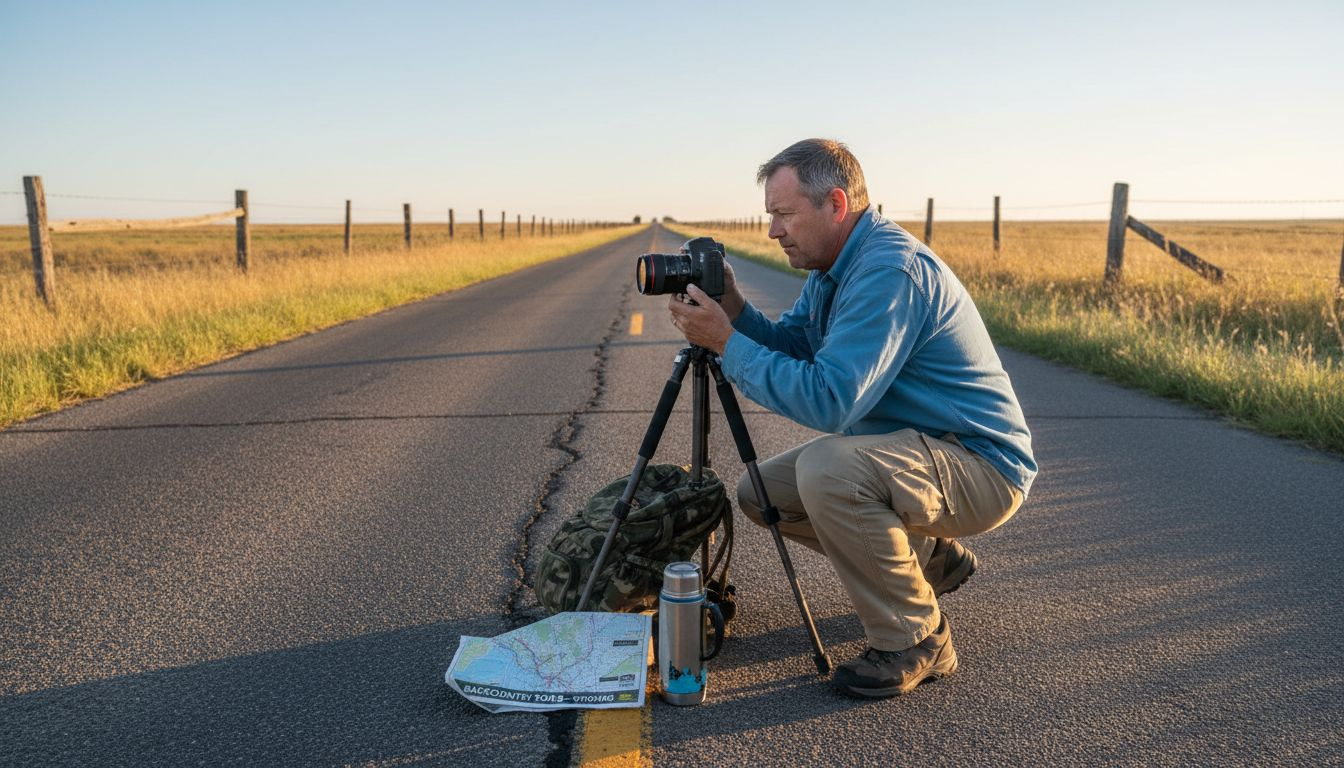
You’ve probably experienced this without realizing it. When you look at a photograph of a road stretching into the distance, your eye naturally follows that road into the frame. A river winding through a landscape pulls your gaze along its path. Train tracks, fence lines, bridges, or even a row of trees all function as leading lines. The key characteristic of these visual guides is that they enhance depth and create visual interest by establishing a clear route through your composition. This isn’t accidental. Leading lines work because they tap into how human eyes naturally scan images. Rather than letting viewers wander aimlessly across your photo, leading lines give them a journey to follow.
The reason leading lines matter so much for amateur photographers comes down to composition fundamentals. When you understand how elements like composition in photography work together, you recognize that leading lines are one of your most accessible tools for controlling viewer attention. They transform ordinary subjects into compelling images by adding dimension and directing visual flow. A leading line doesn’t just sit there. It actively moves the viewer through your photograph, creates a sense of motion even in still images, and establishes a visual hierarchy that separates what’s important from what’s background noise. This is why photographers across every skill level prioritize them when framing shots.
Leading lines also serve a practical function beyond aesthetics. They can connect your main subject to the surrounding environment, create context, and build a narrative within your frame. If you’re photographing a person standing on a beach, the shoreline becomes a leading line that connects them to the landscape. If you’re shooting architecture, the lines of the building itself guide viewers toward windows, doorways, or specific architectural details.
The strength of a leading line depends on several factors: how obvious the line is, how directly it points toward your subject, and how well it contrasts with the surrounding areas. A subtle leading line might be a shadow or a change in texture. A bold leading line might be a bright pathway cutting through darker surroundings.
Pro tip: Start noticing leading lines in everyday scenes before you photograph them. Spend a week looking at your surroundings and identifying natural lines—sidewalk edges, shadows, tree branches, fence posts—so you train your eye to spot them instantly when you’re out with your camera.
Types of Leading Lines and Their Effects
Not all leading lines work the same way. The type of line you use fundamentally changes how viewers experience your photograph and what emotional response they have to it. Understanding these different categories helps you choose intentionally rather than relying on whatever lines happen to be in front of your camera. Each line type carries its own visual weight and psychological impact, allowing you to orchestrate the mood and flow of your images with precision.
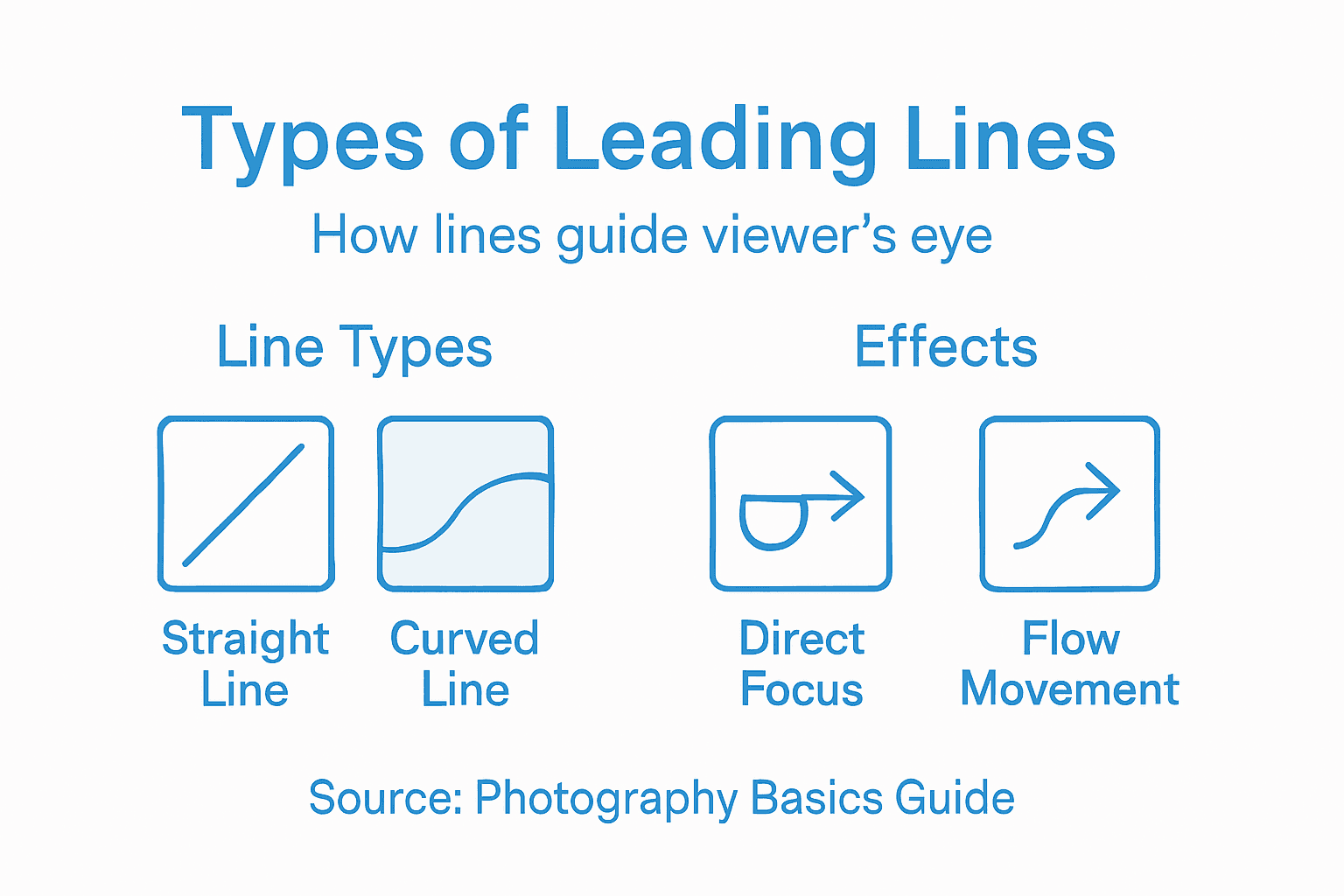
Straight leading lines are your most direct, no-nonsense option. Think of railroad tracks converging toward the horizon, a highway stretching into the distance, or the edge of a building cutting through your frame. These lines draw the viewer’s eye straight forward with purpose and clarity. They create a sense of direction and stability. Straight lines feel authoritative and structured. They’re excellent when you want viewers to move quickly through your composition toward a specific focal point. However, straight lines can sometimes feel static or predictable if you’re not careful. To add interest, position your straight line off-center rather than dead in the middle, or combine it with other compositional elements like the rule of thirds.
Curved leading lines operate on an entirely different wavelength. A winding river, a curved road, an S-shaped path through a landscape, or the arc of a bridge all add dynamic flow and a sense of mystery to your images. Curved lines are gentler on the eye. They invite viewers to follow along on a journey rather than march directly toward a destination. This creates more visual interest because the viewer doesn’t immediately know where the line leads.
Curved lines evoke feelings of elegance, movement, and organic beauty. They work beautifully in nature photography and landscape work. A curved leading line can transform an otherwise ordinary landscape into something that feels alive and engaging. The mystery inherent in a curve makes viewers linger longer on your image, exploring where the line ultimately leads.

Diagonal leading lines occupy a middle ground between straight and curved. These lines cut across your frame at an angle, creating energy and tension. A fence line angled across a field, a staircase descending from upper left to lower right, or a shadow cast across a surface all function as diagonal lines. Diagonals create a sense of motion and urgency that straight vertical or horizontal lines don’t achieve. They make static subjects feel dynamic. Diagonal lines also compress distance visually, making your photograph feel more compact and intentional. When combined with understanding perspective in photography, diagonal lines amplify the three-dimensional quality of your images.
Your viewpoint transforms everything. The angle and perspective from which you view a leading line determines its power and effect. Shoot a road from ground level and it creates an immersive, almost overwhelming sense of depth. Shoot the same road from above and it becomes a graphic design element, almost abstract. Get low and look up at a fence line and it feels imposing and monumental. Get high and look down and the same fence becomes a pattern.
This is why the research emphasizes that different angles and viewpoints using the same lines result in vastly different moods and visual impacts. A curved line photographed from directly in front of it creates one mood. The same line shot from an extreme angle creates something entirely different. This flexibility means you should always explore multiple angles before settling on your shot.
Leading lines also create curiosity or space depending on their shape and orientation. A leading line that disappears into darkness or fog creates mystery and curiosity. Viewers want to know what lies beyond. A leading line that creates a visual border or frame around negative space creates a sense of emptiness or isolation. These subtle psychological effects are powerful tools in your creative arsenal. You can use them to enhance the emotional tone of your images.
Pro tip: Photograph the same leading line from at least three different angles and heights before leaving a location. You’ll be amazed how drastically the mood and impact change, and you’ll discover which viewpoint best serves the story you want to tell.
Here’s a comparison of leading line types and the psychological effects each creates:
| Type of Leading Line | Typical Use Case | Visual Effect | Psychological Impact |
|---|---|---|---|
| Straight | Urban, architecture, roads | Strong direction, stability | Authority, clarity, order |
| Curved | Landscapes, nature, rivers | Gentle, flowing movement | Mystery, elegance, calm |
| Diagonal | Streets, stairs, shadows | Dynamic, energetic tension | Excitement, urgency, drama |
How Leading Lines Guide Your Viewer’s Eye
When someone looks at your photograph, their eyes don’t move randomly across the frame. They follow a path, usually without realizing it. Leading lines create that path intentionally. They act as visual cues that shape the way your audience explores and interprets your image. This isn’t magic. It’s the result of how human vision works combined with strategic composition choices. Your brain naturally follows lines because lines suggest direction and movement. A photographer who understands this can control exactly where viewers look, in what order they look there, and how long they spend examining each part of the image. This level of control is what separates snapshots from intentional photographs.
The power of leading lines lies in their ability to direct the viewer’s gaze to focal points or through a narrative sequence. Imagine photographing a portrait where a road leads directly to your subject’s face. Your viewer’s eye enters the frame, follows that road, and arrives at the face. The journey is guided. Without that leading line, the viewer might look anywhere in the frame equally. The leading line creates hierarchy and purpose.
This control is critical in storytelling because it ensures your intended message is communicated effectively. When you combine leading lines with other compositional tools like the rule of thirds explained, you create images where every element works together to guide attention precisely where you want it. The viewer isn’t aware they’re being guided. They simply experience a natural, compelling path through your image.
Leading lines establish visual hierarchy, which means they help viewers distinguish between what’s important and what’s background information. A leading line that points toward your main subject says “look here first.” Secondary lines or elements say “look here second.” Without this hierarchy, all parts of your image compete equally for attention, creating confusion rather than clarity. Think about a photograph of a person walking down a hallway.
The hallway walls form leading lines that converge toward your subject. The viewer’s eye naturally follows those lines and encounters the person. If you removed those lines and just shot the person against a cluttered background, the image loses impact because there’s no clear direction. The leading line does the organizational work for you. It tells viewers what matters and what doesn’t. This is especially valuable when your subject is small in the frame or when you’re trying to create a sense of scale or environment.
Different types of leading lines create different narrative experiences. A straight leading line creates a sense of directness and purpose. It says “this is the destination, move toward it.” A curved leading line creates mystery and exploration. It says “follow me, but I’m not telling you where we’re going.” A diagonal leading line creates tension and movement. It says “something is happening here.” By choosing your leading line strategically, you’re also choosing the emotional journey your viewer takes through your image.
A portrait where a straight road leads to the subject feels very different from the same portrait where a winding path leads there. The subject is identical. The leading line changed the entire mood. This demonstrates that leading lines aren’t just composition tools. They’re storytelling tools. They control pacing, emotion, and narrative.
Viewers rarely notice when they’re being guided skillfully. That’s the point. You want the leading line to be so natural, so integrated into your composition, that it feels inevitable rather than constructed. When a viewer looks at your photograph and naturally follows the path you created, they’re experiencing the photograph exactly as you intended. They’re not thinking about composition rules or leading lines. They’re simply experiencing the image as a complete story.
This is why leading lines are so powerful for amateur photographers. You don’t need expensive equipment or advanced technical skills to use them effectively. You need to see them, position yourself thoughtfully, and compose deliberately. A river, a fence, a shadow, a road—these are all free tools available to every photographer. The skill is recognizing them and using them intentionally.
Pro tip: Before you take a shot, trace the path your eye would follow through the frame with your finger or mentally. Does it lead where you want? If your leading line doesn’t clearly direct attention to your main subject, reposition yourself or adjust your framing until it does.
Techniques for Finding and Using Leading Lines
Finding leading lines requires you to train your eye differently. Instead of just looking at what’s in front of you, you need to see the lines and patterns that exist within the scene. This means developing awareness for both natural lines like rivers, tree branches, and streams, as well as man-made lines like roads, fences, railroad tracks, and building edges. The good news is that these lines are everywhere. Once you start noticing them, you’ll see them constantly.
A walk around your neighborhood reveals dozens of potential leading lines. A fence stretches across a yard. A sidewalk edge runs down a street. Shadows cast patterns across surfaces. Power lines cross the sky. Each one is a potential compositional tool waiting to be used. The key is intentionality. You’re not just passively observing. You’re actively hunting for lines that could enhance your photographs.
Once you’ve identified a leading line, the next step involves experimenting with angles and viewpoints to maximize its effectiveness. This is where many amateur photographers stop too early. They see a line, shoot from where they’re standing, and move on. Don’t do that. Instead, move around. Get low. Get high. Approach from different sides. Shift your position left and right. Each angle creates a different relationship between the leading line and your subject.
A fence line shot from ground level appears imposing and creates strong perspective. The same fence shot from above becomes a subtle compositional element. A road photographed straight on creates direct forward momentum. Photograph it from a sharp angle and it creates dynamic tension. The research emphasizes that best angles enhance the dynamic movement lines create, so experimentation isn’t optional. It’s essential to discovering which angle tells your story most effectively.
A powerful technique involves positioning leading lines in the corners or edges of your frame to pull the viewer’s eye deeper into the photograph. Rather than placing a leading line dead center, start it at a corner or along an edge. This creates a natural entry point for the viewer’s eye. They follow the line from the edge into the photograph, traveling deeper into your composition. This technique adds dimension and draws attention inward.
A road that begins in the lower left corner and extends toward the center creates more visual interest than a road centered in the frame. The corner placement creates a sense of journey and discovery. When you combine this technique with tips for taking stunning landscape photos, you’ll find that your images gain significantly more depth and visual impact than compositions with centered leading lines.
The practical workflow is straightforward but requires patience. First, scout your location and identify potential leading lines. Look for roads, fences, shadows, water features, or architectural elements. Second, position yourself so that a leading line connects your main subject to the foreground or background. Third, try at least three different angles before settling on your shot. Change your height. Change your horizontal position.
Change your distance from the subject. Fourth, evaluate which angle creates the strongest visual connection between the leading line and your subject. Does the line clearly point toward what matters? Does it create the mood you want? Fifth, refine your framing. Sometimes moving just a few inches left or right makes the difference between a good composition and an excellent one. This methodical approach transforms leading lines from happy accidents into intentional compositional choices.
Technically, leading lines work best when they have clear contrast with their surroundings. A bright fence against dark trees reads strongly as a leading line. A shadow on a light surface creates clear visual definition. A paved road contrasts with grass or dirt. This contrast makes the line obvious to viewers, so they follow it naturally. If your leading line blends too seamlessly into the background, viewers might miss it entirely.
You want your leading line to be visible without being obviously artificial or forced. The balance is subtle. Strong enough to guide attention, subtle enough to feel natural. When you’re evaluating potential leading lines, ask yourself whether they have sufficient contrast. If a line disappears into the background, reposition yourself until you find an angle where it stands out.
Pro tip: Before taking a photograph, close one eye and hold your finger at the edge of your frame pointing toward your subject. Does your leading line align with your finger, creating a clear path? If not, adjust your position until the line naturally guides the eye inward rather than pulling attention away from what matters.
Common Leading Lines Mistakes to Avoid
The most destructive mistake is failing to use leading lines deliberately at all. Many amateur photographers compose without intentionality. They point the camera at something interesting and shoot. If a leading line happens to be there, great. If not, that’s fine too. But this approach leaves composition to chance. When you don’t actively look for and incorporate leading lines, your photographs lack visual direction. They become scattered collections of elements rather than coherent visual stories.
The viewer’s eye wanders aimlessly. Nothing guides them to what matters. Your subject might be beautiful, but without a leading line directing attention toward it, the impact diminishes significantly. Deliberate composition changes everything. When you consciously identify a leading line and position it to serve your subject, you’re taking control of how viewers experience your image. This shift from passive observation to active composition is what separates amateur snapshots from intentional photography.
Another critical mistake involves using leading lines that are too subtle or completely disconnected from your subject. A faint line that barely stands out from the background won’t guide viewers anywhere. They might not even notice it exists. Similarly, a leading line that doesn’t actually point toward your main subject confuses viewers instead of guiding them. Imagine photographing a person where a fence line leads away from them rather than toward them.
The leading line works against your compositional intent. It pulls attention in the wrong direction. The viewer sees the fence line, follows it, and ends up looking at empty space instead of your subject. This is worse than having no leading line at all because it actively undermines your message. When you evaluate a leading line, ask yourself these questions: Is it visible enough that viewers will actually see it? Does it clearly point toward my subject? Does it strengthen or weaken the image? If the answer to any of these is no, reposition yourself or find a different line.
Poor framing and angle choices frequently cause leading lines to guide the viewer’s eye off the image or away from key subjects. You’ve positioned a leading line that points directly away from your frame. Or your angle makes the line so subtle that it disappears. Or you’ve cropped the line in a way that breaks its visual continuity. These framing errors destroy the leading line’s effectiveness. A road that enters your frame at the bottom and leads toward the center is compelling.
A road that enters at the bottom and leads toward the edge of the frame guides viewers right out of your photograph. The difference is subtle positioning, but the impact is dramatic. This is why experimentation with framing matters so much. Small adjustments in how you position the line within your frame determine whether it enhances or undermines your composition. Before you finalize your shot, trace the line with your eye. Where does it lead? Does it exit the frame? Does it point toward your subject?
Balance is another overlooked consideration. Leading lines must reinforce rather than distract from your photographic story. A line that dominates the entire composition can overwhelm your subject. The viewer gets so caught up following the line that they forget to appreciate what the line was supposed to lead them toward. Imagine photographing a person where a massive railroad track dominates the entire image. The track is so visually powerful that the person becomes secondary.
The line was supposed to guide attention toward the person, but instead it’s the line that captures attention. This is distraction, not direction. The ideal leading line enhances your subject without stealing the spotlight. It works quietly in the background, doing its job without calling attention to itself. Ask yourself whether the leading line is helping tell your story or becoming the story itself. If it’s the latter, you might need to reposition, change your angle, or find a subtler line that serves your subject better.
Here are the key mistakes to monitor in your own work:
- Ignoring leading lines entirely and composing without intention
- Using lines so subtle that viewers never notice them
- Incorporating disconnected lines that don’t point toward your subject
- Framing lines in ways that guide eyes out of the photograph
- Allowing lines to become more visually dominant than your main subject
- Failing to evaluate whether a line strengthens or weakens your composition
- Accepting the first angle without exploring alternatives
When you catch yourself making any of these mistakes, stop and adjust. Move. Reframe. Find a different line. The effort you invest in getting the composition right pays dividends in the final image. Leading lines are tools, not rules. They should serve your vision, not constrain it. Use them deliberately, evaluate their effectiveness honestly, and refine until they enhance rather than distract from what matters most in your photograph.
This summary outlines common leading line errors and how to correct them:
| Mistake Type | Visual Result | How to Fix |
|---|---|---|
| Too subtle | Line goes unnoticed | Increase contrast or reposition |
| Off-target | Guides eye away from subject | Shift angle to align with subject |
| Overpowering | Line overshadows subject | Use a weaker or less dominant line |
| Guides out | Eye exits frame too soon | Frame line to lead inward, not out |
Pro tip: After you think you’ve nailed a composition with a leading line, take one more shot from a slightly different angle or framing. Compare them side by side later. You’ll often discover that small positioning adjustments created significantly stronger compositions, training your eye for next time.
Mastering Leading Lines to Transform Your Photography
Struggling to harness the power of leading lines to guide your viewers and create impactful stories in your photos? This article breaks down the challenge of intentionally identifying and using leading lines to add depth, focus, and emotion to your shots. Whether you find it hard to spot natural or manmade lines or unsure how to position yourself for the best angles, these concepts and pro tips will elevate your compositional skills.

Dive deeper into practical advice and tutorials in our comprehensive photography basics to expand your understanding of composition principles like the rule of thirds explained and understanding perspective in photography. Start applying these techniques now to see how leading lines direct the eye and amplify the impact of your photos. Visit Amateur Photographer Guide to access step-by-step guides and expert insights that make challenging concepts simple and actionable.
Frequently Asked Questions
What are leading lines in photography?
Leading lines are visual pathways in a photograph that guide the viewer’s eyes toward a specific focal point or area of interest. They can be straight, curved, diagonal, or even circular, and help create depth and visual interest in the image.
How do I effectively incorporate leading lines into my photographs?
To effectively use leading lines, you should train your eye to identify them in your surroundings, experiment with different angles and viewpoints, and position lines in the corners or edges of your frame to draw viewers deeper into the image.
What types of leading lines exist and how do they impact the viewer’s experience?
There are three main types of leading lines: straight, curved, and diagonal. Straight lines convey stability and directness; curved lines create movement and mystery; and diagonal lines add energy and tension to the composition, changing how viewers emotionally respond to the image.
What common mistakes should I avoid when using leading lines?
Common mistakes include failing to use leading lines intentionally, using lines that are too subtle or disconnected from the subject, framing lines in a way that guides the viewer’s eye out of the image, and allowing lines to overshadow the main subject. Always evaluate whether the line enhances or distracts from your composition.