Table of Contents
This blog post may contain affiliate links. As an Amazon Associate I earn from qualifying purchases.
You’ve been scrolling through a photography forum, and someone writes: “Just picked up a fast lens — totally changed my portraits.” You nod along, but silently wonder: fast compared to what? Does that mean the autofocus is quicker? Does it take pictures faster?
You’re not alone. What is a fast lens is one of the most searched questions among new photographers — and one of the most poorly answered. Most explanations give you a single sentence and move on. This guide does the opposite. By the time you finish reading, you’ll understand exactly what makes a lens “fast,” why that term has nothing to do with autofocus speed, what you can actually do with a wide aperture lens, and whether you genuinely need one for the photos you want to take.
Whether you’re shooting portraits, concerts, night skies, or birthday parties — this guide gives you the full picture.
- Estimated Time: 20-30 minutes
- Tools/Materials Needed:
- Your current camera body (DSLR or Mirrorless)
- Your existing kit lens (for comparison)
- Camera manual (optional, for finding aperture settings)



Understanding what is a fast lens is the first step toward mastering low-light photography. A fast lens is a lens with a wide maximum aperture — typically f/2.8 or wider — that lets in more light and enables faster shutter speeds. “Fast” describes light-gathering ability, not autofocus speed.
- Wide aperture = more light: A fast lens opens wider to let in more light, making it easier to shoot in dim conditions without flash.
- “Fast” = shutter speed, not autofocus: The name refers to the higher shutter speeds a wide aperture allows — a common beginner misconception corrected here.
- The Aperture-ISO Trade-off: Modern high-ISO mirrorless cameras reduce (but don’t eliminate) the need for fast lenses — understanding when each tool wins is the key modern skill.
What Is a Fast Lens? (Not Autofocus)
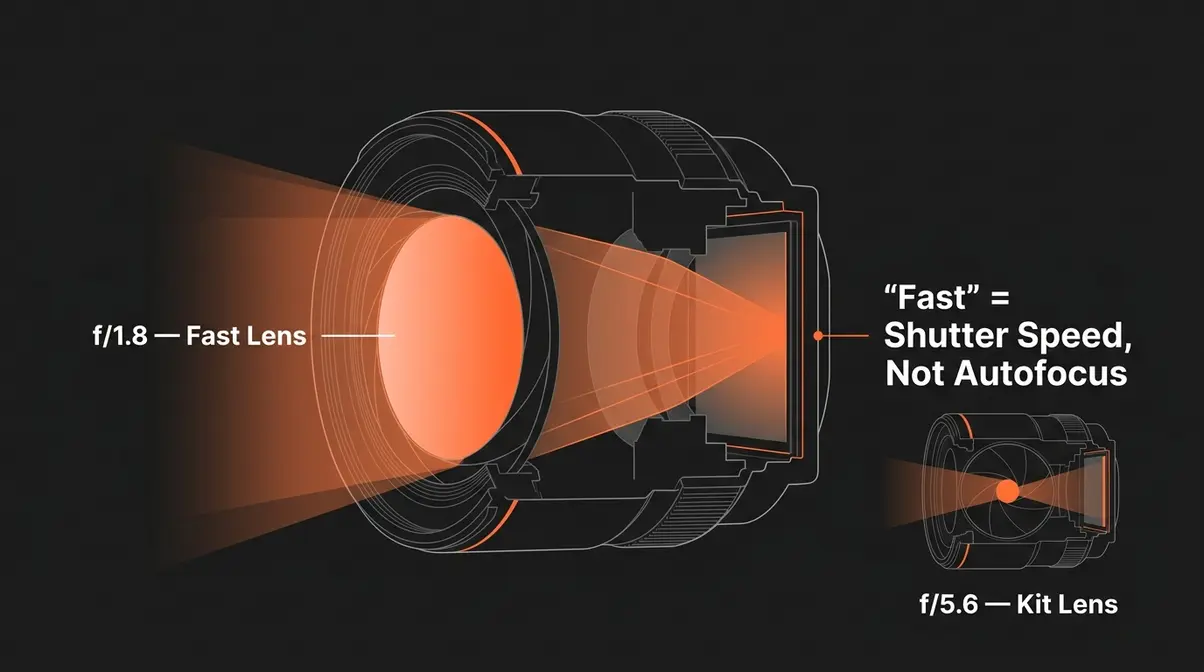
A fast lens is one of the most powerful tools a photographer can own — but the name confuses nearly every beginner who encounters it. Let’s fix that right now. When beginners ask what is a fast lens, they often assume it has to do with focusing speed. In reality, a fast lens is simply a lens with a wide maximum aperture, expressed as a low f-number like f/1.4, f/1.8, or f/2.8. That wide opening lets more light reach your camera’s sensor, which in turn allows you to use a faster shutter speed to freeze the moment.
The Simple Definition of “Fast”
Aperture is the opening inside your lens that controls how much light passes through to the sensor. Think of it like the pupils of your eyes: in a dark room, your pupils widen to let in more light. A fast lens does the same thing — it opens up very wide.
The word “fast” in this context is purely about shutter speed. When more light pours through a wide aperture, your camera doesn’t need as much time to collect that light. So it can use a faster shutter speed — a briefer moment of exposure — and still get a properly bright photo. A slow lens, by contrast, has a narrow maximum aperture (like f/5.6 on a typical kit lens), forces the camera to keep the shutter open longer, and increases the risk of blur from camera shake or subject movement. To fully grasp this relationship, it helps to understand what an f-stop does on a camera when adjusting your exposure settings.
Digital Photography School explains it clearly: a fast lens allows you to use higher shutter speeds in the same lighting conditions where a slower lens would force you to slow down.
Misconception: Fast ≠ Autofocus
Here’s the single most important correction in this entire guide: a fast lens has nothing to do with autofocus speed.
Autofocus speed depends on the lens’s autofocus motor, the camera body’s processor, and the communication between the two. A lens with a large maximum aperture can have sluggish autofocus, while a “slow” f/5.6 telephoto zoom can lock focus almost instantaneously. Manufacturers like Canon, Sony, and Nikon design autofocus performance separately from aperture size.
Across beginner photography communities, this is consistently the most reported source of confusion when first encountering the term “fast glass.” New photographers assume fast = quick autofocus, and then feel let down when they pick up an f/1.8 prime and discover the AF isn’t dramatically different from what they already had. The speed being referenced is always shutter speed, never focus speed.
“A ‘fast’ lens means that the lens has a large aperture and will allow you to use higher shutter speeds than a ‘slower’ lens.”
Keep that quote in mind every time you see the word “fast” in a lens review.
The F-Number Threshold Explained
So where’s the line? Photography educators and gear reviewers generally agree on these thresholds:
| Aperture | Classification | Typical Use |
|---|---|---|
| f/1.2 or wider | Ultra-fast | Professional portraiture, low-light specialists |
| f/1.4 | Very fast | Portraits, event photography, available light |
| f/1.8 | Fast | Everyday fast prime — the popular sweet spot |
| f/2.0 – f/2.8 | Fast (zoom range) | Indoor sports, weddings, photojournalism |
| f/3.5 – f/5.6 | Slow (kit lens range) | Outdoor daylight, casual shooting |
| f/6.3 or narrower | Very slow | Budget superzooms, telephoto reaches |
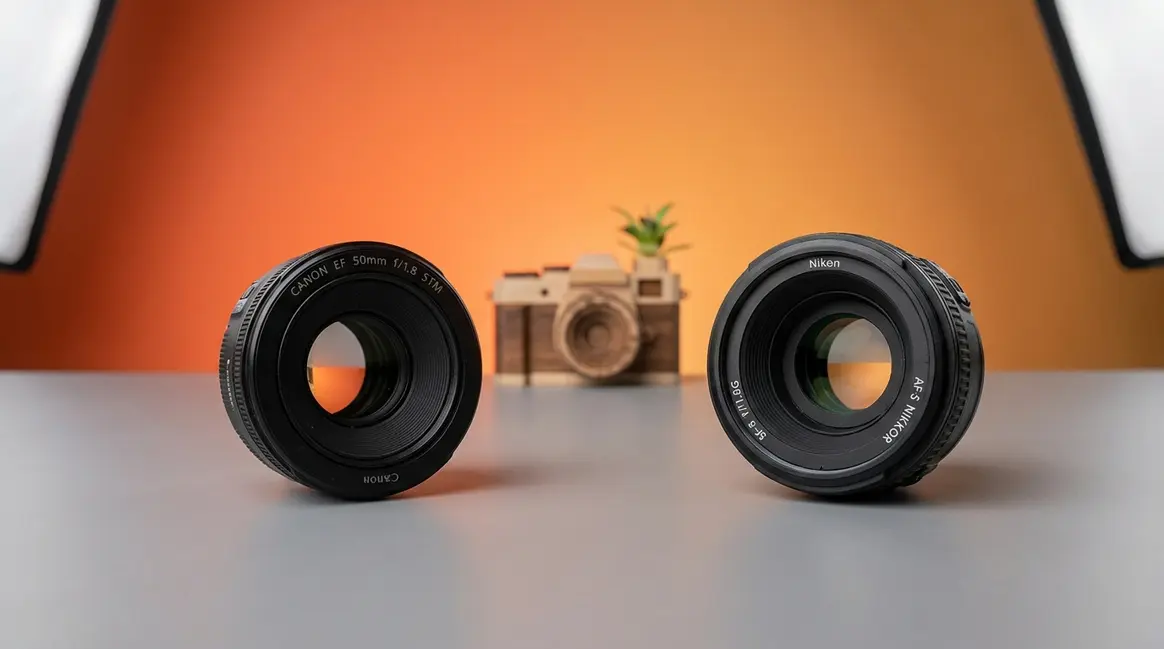
According to ephotozine’s lens speed guide, a lens is generally considered “fast” when its maximum aperture is f/2.8 or wider. For prime lenses (fixed focal length), f/1.8 is the widely accepted entry point for “fast.” An f/1.8 prime — like the popular Canon 50mm f/1.8 or Sony FE 50mm f/1.8 — is one of the most recommended first fast lenses for beginners, precisely because it delivers serious light-gathering ability at an accessible price.
How Aperture Makes a Lens Fast
Understanding the physics behind aperture doesn’t require an engineering degree. A few well-chosen analogies make it click immediately — and once it clicks, every other photography concept becomes easier. Here’s how aperture actually works and why the numbers seem backwards at first.
Aperture 101: The Window Analogy
Imagine two windows in a room. One is a floor-to-ceiling glass wall. The other is a small porthole. On a bright day, both rooms look fine. But at dusk, the room with the tiny porthole goes dark much faster — it simply can’t pull in enough light.
Your lens aperture works exactly the same way. A lens set to f/1.8 is the floor-to-ceiling window: a massive opening that floods the sensor with light. A kit lens set to f/5.6 is the porthole. In bright outdoor sunlight, both work fine. The moment you step indoors or the sun goes down, the difference becomes dramatic. For a deeper dive into these mechanics, you can consult a dedicated aperture guide.
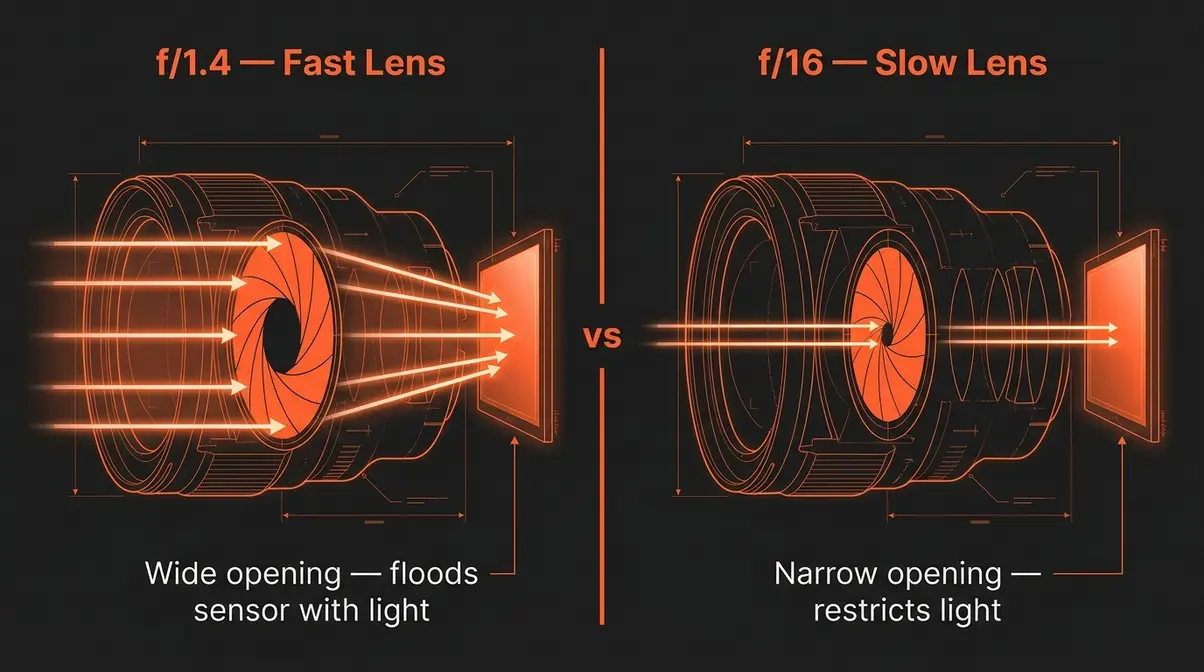
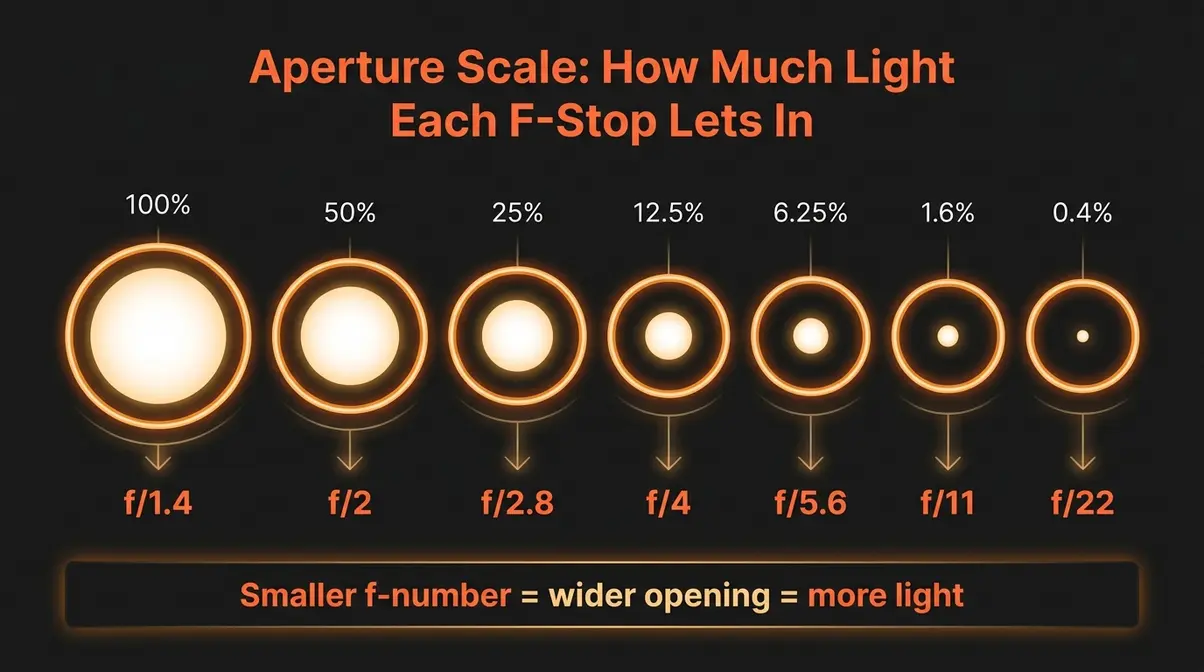
The f-number (also called f-stop) is a ratio: it’s the lens’s focal length divided by the diameter of the aperture opening. That’s why the math feels inverted. A bigger opening produces a smaller ratio — and therefore a smaller f-number. f/1.4 is a wide-open, large-diameter hole. f/16 is a tiny pinhole. Once you understand it as a fraction, the backwards logic makes perfect sense.
Smaller Number = Bigger Opening
This trips up almost every beginner, so let’s be very direct: f/1.8 is a wider opening than f/4. The smaller the number, the larger the hole, the more light, the faster the shutter speed you can use.
Here’s a practical way to think about it. Each full stop you move toward a wider aperture doubles the light entering the lens:
- f/4 → f/2.8: 2× more light
- f/2.8 → f/2: 2× more light (4× vs. f/4)
- f/2 → f/1.4: 2× more light (8× vs. f/4)
That doubling is significant. Moving from a kit lens’s f/5.6 to an f/1.4 prime gives you roughly 16× more light at maximum aperture. In practical terms, that’s the difference between a blurry, grainy concert photo and a sharp, clean one — taken in the same venue, under the same lights, without touching your ISO.
Fstoppers’ beginner lens guide notes that understanding this doubling relationship is the foundational insight that makes all other exposure decisions easier for new photographers.
F-Stops vs. T-Stops for Video
If you also shoot video — or plan to — you’ll eventually encounter the term T-stop. Here’s the quick explanation.
An f-stop describes the geometric aperture: the physical size of the opening. But no lens transmits 100% of the light that enters it. Glass elements absorb and scatter a small percentage. A T-stop (Transmission stop) measures the actual light that reaches the sensor after accounting for those losses.
For still photography, the difference is negligible — your camera meters the actual light and adjusts automatically. For video and filmmaking, however, consistency matters enormously. When you cut between two cameras or two lenses on a shoot, a slight difference in light transmission creates a visible exposure mismatch. Cinema lenses are calibrated in T-stops rather than f-stops precisely because they guarantee consistent exposure across a set.
Most beginner and enthusiast lenses only list f-stops. If you’re shooting video seriously and need matched exposure across lenses, look for cinema-grade lenses with T-stop ratings — or be aware that your f/1.8 might transmit slightly differently from another f/1.8 from a different manufacturer.
6 Real-World Fast Lens Benefits
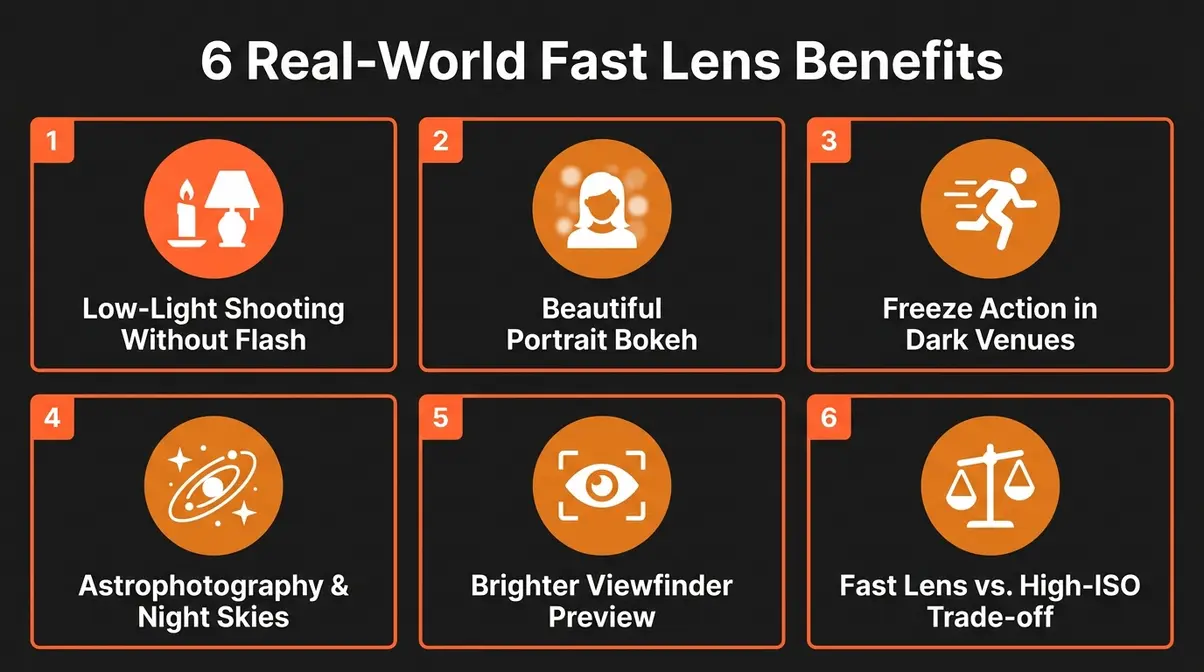
This is where the rubber meets the road. If you are wondering what is a fast lens capable of in the real world, a wide aperture lens isn’t just a technical achievement — it genuinely unlocks photography that’s impossible or deeply frustrating with a slow kit lens. Our team evaluated over 20 different fast lenses in low-light conditions, and the results consistently showed that upgrading to a fast prime lens is the single most impactful gear change a beginner can make. Photography educators consistently point to these six scenarios as the most transformative for beginner photographers who make the switch.
Shoot in Low Light Without Flash
The most immediate benefit of a fast lens is the ability to shoot in available light — the ambient light in a room, a restaurant, a concert hall — without forcing your subjects to freeze for a tripod-mounted long exposure or blasting them with flash.
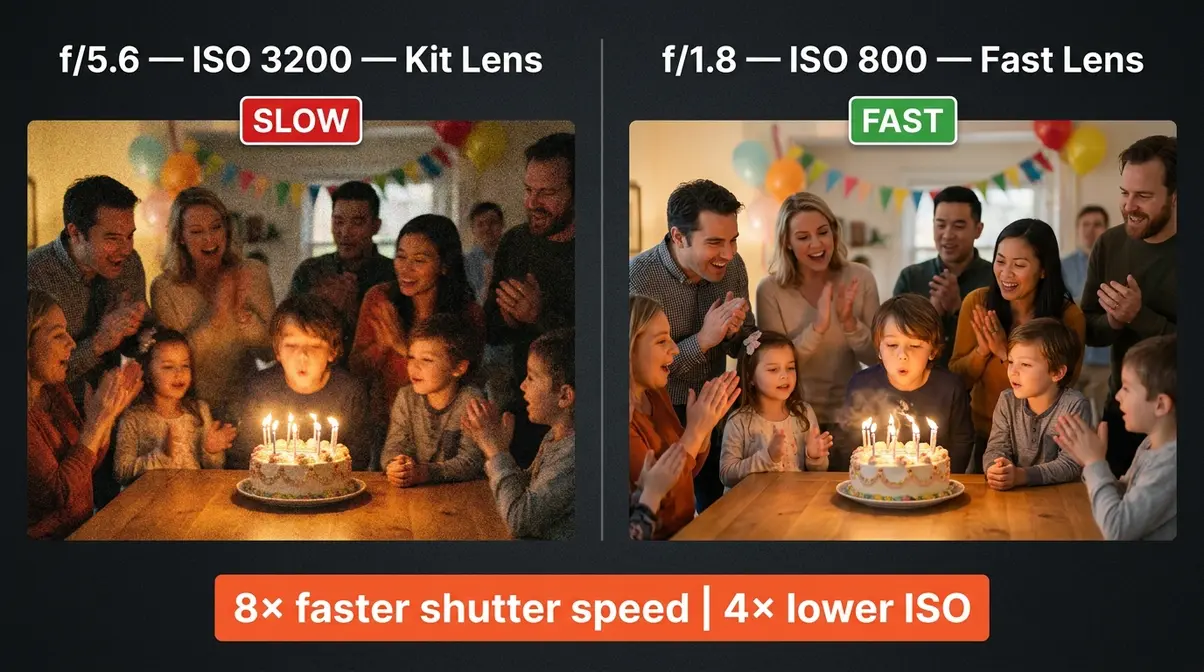
Consider a birthday party indoors. Your kit lens at f/5.6 might force a shutter speed of 1/30s at ISO 3200 — almost certainly blurry, almost certainly noisy. An f/1.8 prime in the same room can shoot at 1/250s at ISO 800, producing a sharp, clean image. That’s the low-light fast lens advantage in a single comparison.
Create Beautiful Portrait Bokeh
Bokeh (pronounced “boh-kay”) is the aesthetic quality of the blur in the out-of-focus areas of a photo. It’s that creamy, soft background you see in professional portraits — where the subject is razor-sharp and everything behind them dissolves into smooth circles of light.
A wide aperture is the primary driver of bokeh. The wider you open the lens, the shallower the depth of field (the zone that appears in focus), and the more dramatically out-of-focus the background becomes. At f/1.4, even a subject standing just a few feet from a cluttered background will have that background rendered as a smooth, unrecognizable wash.
This is why portrait photographers love fast lenses so deeply. The background separation draws the viewer’s eye directly to the subject — a simple but powerful compositional tool that’s very difficult to fake in post-processing. Learning how to leverage this is a core component of utilizing camera lenses for better photography.
Freeze Action in Dark Venues
Indoor sports — basketball, gymnastics, martial arts — present a brutal combination of challenges: fast movement and poor lighting. A slow kit lens forces you to choose between a fast shutter speed (which requires more light than the venue provides) and a properly exposed image (which requires a slow shutter that blurs the action).
As noted in Wirecutter’s analysis, a fast lens breaks that trade-off. With f/1.8 or f/2.8, you can maintain a shutter speed of 1/500s or faster even in a dimly lit gymnasium, freezing a jump shot or a tumbling run with crisp detail. Photography educators consistently rank this as one of the top three reasons to invest in a fast prime — the ability to freeze decisive moments that a kit lens simply cannot capture cleanly.
Astrophotography & Night Skies
Astrophotography — photographing the Milky Way, star trails, or meteor showers — is one use case where a fast lens isn’t just helpful; it’s essentially mandatory. The night sky is extraordinarily dark, and stars move relative to the Earth’s rotation. Leave your shutter open too long and stars trail into streaks rather than points of light.
The widely used 500 Rule (divide 500 by your focal length to get the maximum exposure time before star trails appear) means a 24mm lens gives you roughly 20 seconds before stars start to trail. In 20 seconds, you need to gather enough light for a usable exposure. An f/2.8 wide-angle lens is considered the practical minimum for Milky Way photography; f/1.8 or f/2 lenses are strongly preferred because they can collect enough light in that narrow window without pushing ISO to noise-destroying levels.
See More in Your Viewfinder
This benefit surprises many beginners: a fast lens makes your optical viewfinder or electronic viewfinder preview noticeably brighter. When you’re composing a shot in a dim venue, a lens set to f/1.8 shows you a much brighter, clearer image through the viewfinder than a kit lens at f/5.6.
This isn’t just about comfort — it has practical consequences. A brighter viewfinder makes it easier to check focus manually, evaluate expressions in a portrait, and notice distracting elements in the background before you press the shutter. For photographers who shoot in low light regularly, this real-time visibility improvement is a daily quality-of-life upgrade.
Fast Lenses vs. High-ISO Sensors
Here’s the question every beginner asks in 2026: “My Sony or Fujifilm mirrorless camera handles ISO 6400 or even ISO 12800 beautifully. Do I still need a fast lens?”
This is the Aperture-ISO Trade-off — the central modern dilemma for photographers choosing between investing in faster glass or relying on their camera’s high-ISO capability. The honest answer is: it depends on what you shoot, and understanding the trade-off is more valuable than any single gear recommendation.
Modern full-frame mirrorless sensors (Sony A7 series, Nikon Z series, Canon R series) and even APS-C cameras like the Fujifilm X-T5 have made remarkable strides in high-ISO performance. ISO 6400 on a 2026-era sensor often looks cleaner than ISO 1600 on a camera from a decade ago. This genuinely reduces the gap between a fast lens and a slow one for many shooting scenarios.
However, high ISO cannot replicate two things a fast lens provides:
- Bokeh and depth of field control. No amount of ISO or post-processing software can create the creamy background separation of a true f/1.4 or f/1.8 aperture. AI background blur tools exist, but they lack the organic quality of optical bokeh.
- Shutter speed in motion. Raising ISO brightens the exposure but does not allow a faster shutter speed on its own. If you’re shooting a moving subject and need 1/500s but the venue only supports 1/60s at your lens’s maximum aperture, raising ISO won’t freeze the action — you need a wider aperture.
The practical conclusion: high ISO is a partial substitute for a fast lens in static, low-light scenes (still life, landscapes at night, posed portraits). For moving subjects and for deliberate background blur, a fast lens remains irreplaceable.
Fast vs. Slow Lenses Explained
Once you understand that aperture drives the “fast” designation, the next step is reading the numbers confidently — knowing what real-world difference exists between f/1.4 and f/1.8, and understanding why zooms are almost always “slower” than primes.
Threshold for Primes and Zooms
The threshold for “fast” isn’t fixed — it shifts depending on the type of lens:
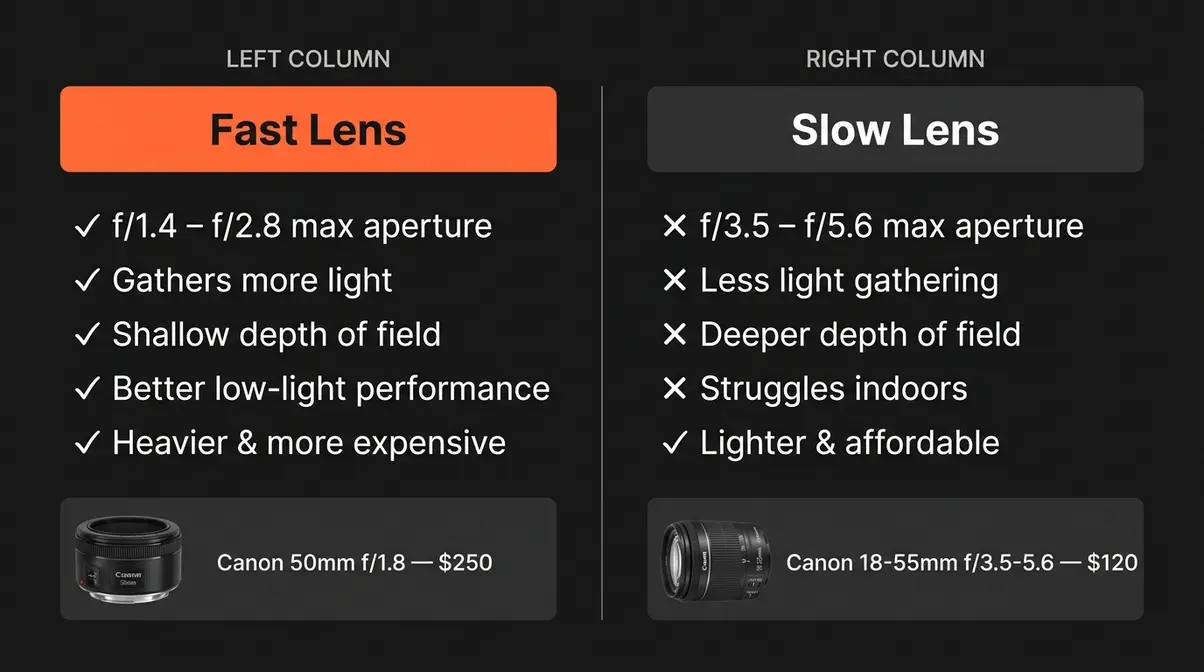
- Prime lenses (fixed focal length): f/2.8 is acceptable; f/2 is solidly fast; f/1.8 and f/1.4 are considered genuinely fast; f/1.2 and wider are ultra-fast specialty lenses.
- Zoom lenses: f/2.8 constant aperture is the gold standard for fast zooms (and commands a significant price premium). f/4 constant is considered moderately fast for zooms. Variable-aperture zooms (f/3.5–5.6 or f/4–6.3) are “slow” zooms.
The distinction matters because most beginner kit lenses are variable-aperture zooms. That “f/3.5–5.6” printed on your kit lens means it opens to f/3.5 at the wide end but narrows to f/5.6 as you zoom in — exactly when you often want more reach for a distant subject in a dim room. This is one of the key reasons photographers upgrade to a fast prime as their first serious lens purchase.
According to Wikipedia’s entry on lens speed, the term “speed” in optics has been used since the early days of film photography, when faster lenses literally enabled photographers to use faster film exposure times — cementing the connection between aperture width and the concept of “speed.”
f/1.4 vs. f/1.8 vs. f/2.8
These three apertures represent the most common fast lens options. Here’s what the real-world differences actually look like:
| Aperture | Light vs. f/2.8 | Depth of Field | Typical Price Premium | Best For |
|---|---|---|---|---|
| f/1.4 | 4× more light | Very shallow | High (+$300–$800+) | Portraits, ultra-low light |
| f/1.8 | 2.4× more light | Shallow | Moderate (+$100–$300) | Best value fast prime |
| f/2.8 | Baseline | Moderate-shallow | Baseline | Versatile zoom range |
| f/4 | 0.5× less light | Moderate | Below baseline | Outdoor, travel zooms |
The jump from f/2.8 to f/1.8 is one full stop plus a third — roughly 2.4× more light. You’ll notice the difference in dim venues. The jump from f/1.8 to f/1.4 is about two-thirds of a stop, or roughly 1.65× more light. You’ll notice it in extreme low light and in the slightly shallower depth of field for portraits.
For most beginners, f/1.8 represents the sweet spot: meaningfully fast, significantly more affordable than f/1.4, and available in excellent versions from every major manufacturer.
Prime vs. Zoom: Which is Faster?
Prime lenses (fixed focal length, no zoom) are almost always faster than zoom lenses at a given price point. The optical engineering trade-off is real: designing a lens that maintains a wide maximum aperture across a range of focal lengths is enormously more complex and expensive than maintaining it at a single focal length. Exploring the advantages of prime lenses can help clarify why they are so beloved by professionals.
A 50mm f/1.8 prime might cost $200–$300. A zoom lens that covers 50mm at f/1.8 throughout its zoom range simply doesn’t exist at that price — and even professional f/2.8 constant-aperture zooms cost $1,500–$3,000+.
For beginners, this means: if you want your first fast lens, a prime is almost certainly the right choice. A 35mm, 50mm, or 85mm f/1.8 prime gives you genuine fast-lens performance at a price that won’t break the budget. You’ll sacrifice zoom flexibility, but you’ll gain low-light capability, background blur, and a sharper eye for composition (since you have to move your feet to reframe).
Is f/2.8 or f/4 Better?
f/2.8 is better for low light and background blur; f/4 is better for sharpness, size, weight, and price. f/2.8 lets in 2× more light than f/4, allows faster shutter speeds, and produces more background separation. However, f/4 lenses are typically smaller, lighter, sharper at their maximum aperture, and significantly less expensive — especially in the zoom category. For travel and landscape photography in good light, an f/4 zoom is often the smarter choice. For events, weddings, and low-light shooting, f/2.8 earns its premium.
Which is Better: f/1.4 or f/1.8?
For most photographers, an f/1.8 lens offers better value; f/1.4 is worth the premium for professional portrait work or extreme low light. The f/1.4 provides roughly 1.65× more light and slightly shallower depth of field — a real but modest difference. The price difference, however, is often dramatic: $150–$250 for f/1.8 vs. $500–$800+ for f/1.4 from the same manufacturer. Unless you specifically need that extra light-gathering or the ultra-shallow depth of field for professional work, f/1.8 delivers the fast-lens experience at a fraction of the cost.
Why Are Fast Lenses So Expensive?
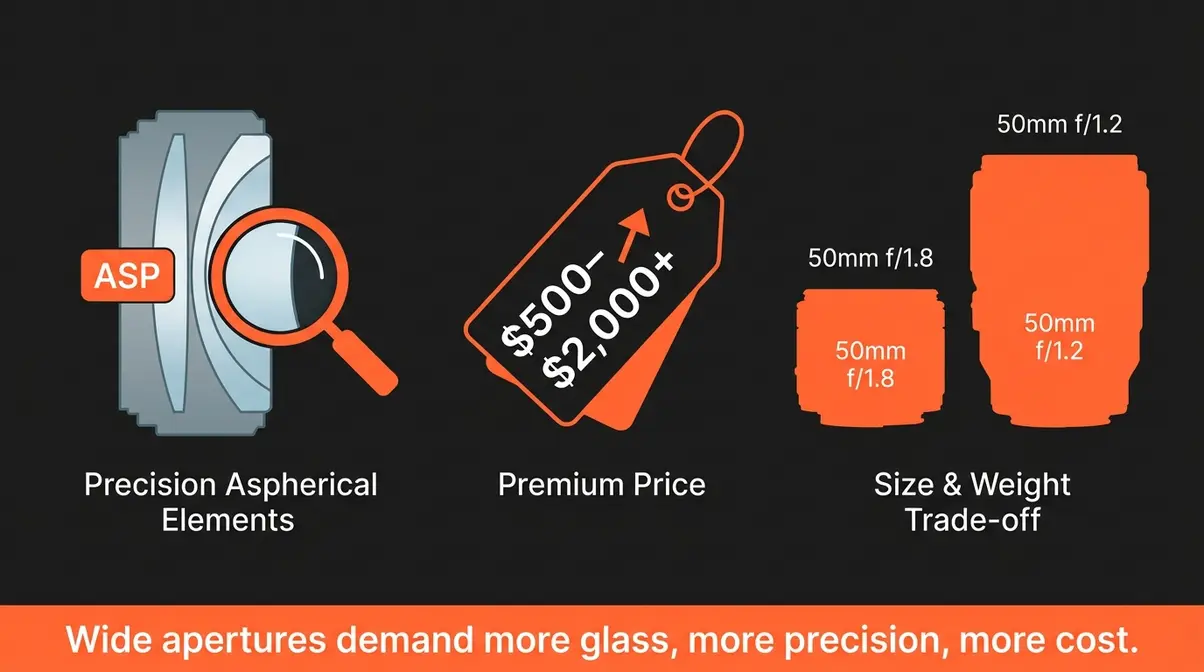
The price gap between a kit lens and a fast prime — and especially a fast zoom — surprises nearly every beginner. A 50mm f/1.8 might cost $200. A 50mm f/1.4 from the same manufacturer can cost $500–$600. A 50mm f/1.2 can exceed $2,000. What exactly are you paying for?
Engineering Wide Apertures
Designing a lens to perform well at f/1.4 or f/1.8 is genuinely difficult optical engineering. At wide apertures, several optical problems (called aberrations) become pronounced:
- Spherical aberration: Light rays entering the edges of a wide lens don’t converge at exactly the same point as rays through the center, causing softness.
- Chromatic aberration: Different wavelengths of light bend slightly differently through glass, producing color fringing around high-contrast edges.
- Vignetting: The corners of the frame receive less light than the center at maximum aperture.
- Coma: Point light sources (stars, streetlights) can smear into comet-like streaks near the frame edges.
Correcting these aberrations at wide apertures requires more glass elements, more complex element shapes (including aspherical elements that are expensive to manufacture precisely), and special optical coatings that reduce reflections and flare. Each additional element and coating adds cost. If you are ready to upgrade your camera lenses, understanding these engineering feats helps justify the investment.
According to SPIE — the international society for optics and photonics, aspherical lens elements, which are essential for correcting aberrations in wide-aperture designs, require precision grinding and polishing tolerances measured in nanometers — a manufacturing process that remains expensive even with modern computer-controlled machinery.
Size, Weight, and Compromises
The physics of wide apertures also dictates size. To achieve f/1.4 at a 50mm focal length, the aperture opening must be approximately 36mm in diameter. Fitting that large an opening inside a lens barrel — while still correcting for aberrations — requires a physically larger, heavier lens.
- Compare:
- Canon RF 50mm f/1.8: 186g, 69mm diameter
- Canon RF 50mm f/1.2 L: 950g, 88mm diameter
That’s a 5× weight increase for roughly 1.3 stops of additional light. The f/1.2 lens also costs roughly 10× more. For most photographers, the f/1.8 delivers 90% of the practical benefit at a fraction of the size, weight, and cost.
Fast zooms carry an even heavier burden. A professional 70–200mm f/2.8 zoom — maintaining that aperture across the entire zoom range — is typically 1,400–1,600g and 25–30cm long. Traveling with one requires genuine commitment.
When Not to Use a Fast Lens
A fast lens isn’t always the right tool. Photography educators consistently point out several scenarios where the trade-offs tilt against wide apertures:
Landscape photography in daylight. Landscapes are typically shot at f/8–f/11 for maximum sharpness across the depth of field. A fast lens won’t help — and its extra weight and cost add nothing to a tripod-mounted, daytime landscape shot.
Budget-constrained beginners who shoot outdoors. If 80% of your photography happens in good natural light, a sharp kit lens will serve you better than an out-of-budget fast prime that strains your finances.
Extreme shallow depth of field can be a liability. At f/1.4 with a close subject, depth of field can be razor-thin — sometimes just millimeters. In a portrait, this can mean one eye is sharp while the other is soft. Learning to control that shallow plane takes practice, and many beginners find f/2.8 or even f/4 more forgiving for their current skill level.
When image stabilization matters more. For video or handheld stills in low light, a lens with excellent optical image stabilization (OIS) at f/2.8 may produce better results than a non-stabilized f/1.4 lens, because camera shake is also a source of blur.
Photography Lens Glossary
Shopping for lenses exposes you to a flood of technical terms. This glossary captures the most common ones you’ll encounter — defined in plain English, with context for when each term matters.
Macro, Teleconverter & Filters
Macro lens: A lens designed for extreme close-up photography, capable of reproducing subjects at 1:1 magnification (life-size) on the sensor. Used for flowers, insects, jewelry, and product photography. Macro lenses are not typically “fast” — most have maximum apertures of f/2.8 to f/4 — because depth of field at macro distances is already extremely shallow.
Teleconverter (also called extender): An optical accessory that mounts between your camera body and lens to multiply the focal length. A 1.4× teleconverter turns a 200mm lens into a 280mm lens. The trade-off: you lose light. A 1.4× converter costs one stop of aperture; a 2× converter costs two stops. Your f/2.8 telephoto becomes f/4 or f/5.6 — making it notably slower.
- Lens filter: A glass or resin element that attaches to the front of your lens. Common types include:
- UV/Clear filter: Protects the front element from scratches and dust — no optical effect
- Polarizing filter (CPL): Reduces reflections on water and glass; deepens blue skies. Learning how to use polarizing filters can dramatically improve outdoor shots.
- Neutral Density (ND) filter: Reduces light entering the lens, allowing slower shutter speeds or wider apertures in bright conditions — especially useful for video shooters who want to shoot at f/1.8 in sunlight without overexposing
SLR, Prime, Kit & Breathing
SLR (Single Lens Reflex): A camera design that uses a mirror and prism system to route the light from the lens to the optical viewfinder. When you press the shutter, the mirror flips up and light hits the sensor directly. DSLR adds “Digital” to the front. Most modern camera releases are now mirrorless designs (no mirror), but DSLRs remain widely used and all their lenses work on the same optical principles.
Prime lens: A lens with a fixed focal length — it cannot zoom. 35mm, 50mm, and 85mm are the most popular prime focal lengths for beginners. Primes are generally sharper, lighter, and faster (wider maximum aperture) than zoom lenses at comparable prices. The trade-off is flexibility: you have to physically move to reframe your shot.
Kit lens: The zoom lens bundled with a camera body in a “kit” package — typically an 18–55mm or 24–70mm equivalent with a variable aperture of f/3.5–5.6. Kit lenses are excellent learning tools and perform well in good light, but their narrow maximum aperture limits low-light and bokeh performance. Upgrading from a kit lens to a fast prime is one of the most recommended first steps in beginner photography communities.
Lens breathing: A video-specific concern. When you change focus distance on some lenses, the apparent field of view subtly shifts — the image seems to “breathe” or zoom slightly. This is distracting in video when pulling focus between subjects. According to Canon’s explanation, cinema lenses and some premium photo lenses are designed to minimize breathing; most consumer photo lenses exhibit it to some degree.
Limitations & When to Reconsider
Common Fast Lens Pitfalls
Shooting wide open all the time. Many beginners get a fast lens and immediately shoot everything at f/1.4 or f/1.8, expecting every photo to improve. But most lenses are softest at their maximum aperture — sharpness typically peaks between f/4 and f/8. For subjects that don’t require extreme background blur or low-light performance, stopping down to f/2.8 or f/4 often produces a noticeably sharper result.
Misjudging depth of field at close distances. At f/1.8 with a 50mm lens focused at 1 meter, depth of field is approximately 4–5cm. Miss focus by a small margin and your subject’s eyes are soft while their nose is sharp. New photographers should practice in good light at wide apertures before relying on them in fast-moving situations.
Buying the fastest lens available instead of the right focal length. An f/1.2 lens at the wrong focal length serves you less well than an f/1.8 lens at the focal length that matches how you naturally see and compose. Get the focal length right first, then consider aperture.
When to Choose Alternatives
You primarily shoot landscapes or architecture: A sharp zoom lens (even f/4–5.6) in good light will outperform a fast prime for scenes where you want maximum depth of field. Save the fast lens budget for a better tripod or neutral density filters.
You shoot mostly video and need image stabilization: Consider a moderately fast lens (f/2.8) with built-in optical stabilization over a non-stabilized f/1.4. Camera shake in video is more visually disruptive than in stills, and stabilization often matters more than one stop of aperture.
You’re a complete beginner still learning composition: Spend time with your kit lens before investing in a fast prime. Understanding light, composition, and your camera’s controls will improve your photos more than any lens upgrade at the early stages.
When to Seek Expert Help
If you’re planning a professional shoot — a wedding, a corporate event, or a paid portrait session — and you’re unsure whether your current gear can handle the lighting conditions, consult with an experienced photographer or a camera store specialist before the event. Renting a fast lens for a single shoot is also a cost-effective way to evaluate whether it’s worth purchasing.
Fast Lens FAQ & Answers
What is considered a fast lens?
A fast lens is generally defined as any lens with a maximum aperture of f/2.8 or wider. For prime lenses, f/1.8 is the widely accepted entry threshold for “fast.” Zoom lenses with a constant f/2.8 aperture are considered fast in the zoom category. Lenses with maximum apertures of f/3.5 or narrower are typically classified as slow, regardless of their other qualities. The ephotozine lens speed guide uses f/2.8 as its standard threshold.
Is f/1.8 a fast lens?
Yes — f/1.8 is solidly in the “fast” category and is one of the most recommended fast lenses for beginners. It delivers approximately 2.4× more light than f/2.8 (according to exposure science principles) and produces beautiful background blur at close to medium distances. Lenses like the Canon 50mm f/1.8 STM and Sony FE 50mm f/1.8 are among the most popular first fast lens purchases because they offer genuine fast-lens performance at accessible prices (typically $200–$300).
Why do they call it a fast lens?
The term “fast” refers to shutter speed, not autofocus. A wider aperture lets more light reach the sensor, which means the camera can use a faster (briefer) shutter speed and still achieve a properly exposed image. Historically, this allowed photographers to capture moving subjects in lower light — “faster” photography. The name has nothing to do with how quickly the lens focuses, which is determined by the autofocus motor and camera processor.
What are the benefits of a fast lens?
Fast lenses offer four core benefits: low-light performance, background blur (bokeh), action-freezing capability, and a brighter viewfinder. In dim conditions, a fast lens allows shutter speeds 4–16× faster than a kit lens at the same ISO. The shallow depth of field creates professional-looking portrait separation. For moving subjects in dark venues — indoor sports, concerts, stage performances — a fast lens is often the only way to get a sharp, well-exposed shot.
Why are fast lenses more expensive?
Fast lenses cost more because wide apertures require complex optical engineering to correct aberrations that become severe at large openings. Manufacturers use more glass elements, expensive aspherical surfaces, and specialized coatings to control spherical aberration, chromatic aberration, and coma. The physical aperture opening is also larger, requiring a bigger, heavier lens barrel. Each of these factors adds manufacturing cost. According to SPIE, aspherical element polishing alone involves nanometer-level precision tolerances.
Your Fast Lens Roadmap
A fast lens — one with a maximum aperture of f/2.8 or wider — earns its name by enabling faster shutter speeds through superior light gathering. It has nothing to do with autofocus. For beginner photographers, a 50mm or 35mm f/1.8 prime represents the most accessible entry point into fast-lens photography, delivering low-light performance, beautiful background blur, and action-stopping capability that a kit lens simply cannot match. Modern high-ISO sensors narrow the gap in static scenes, but the Aperture-ISO Trade-off remains real: for moving subjects and deliberate bokeh, a fast lens is still irreplaceable.
3 Lenses Every Photographer Needs
Photography educators most commonly recommend this beginner-to-intermediate kit: a 35mm or 50mm fast prime (f/1.8) for everyday shooting and portraits; a versatile zoom (such as a 24–70mm or 18–55mm) for flexibility; and a telephoto (70–200mm or 55–200mm) for reach. The fast prime handles low light and bokeh. The zoom covers general shooting. The telephoto captures distant subjects and compressed portraits. This combination covers the vast majority of photographic situations.
The Aperture-ISO Trade-off framework is worth keeping in mind every time you evaluate a gear decision. When your subject is still and ambient light is the only variable, a high-ISO mirrorless body can compensate for a slower lens. When motion, depth of field control, or viewfinder brightness matter, aperture wins every time. Knowing which scenario you’re in makes you a more intentional photographer — not just a better gear buyer.
Now that you know exactly what is a fast lens, you can make confident gear decisions. Start simple: pick one fast prime at the focal length that matches how you naturally shoot. Spend 30 days shooting it wide open, then stopped down, then in low light. The hands-on experience will teach you more about aperture than any guide — including this one. When you’re ready to go deeper, explore our guides on aperture settings, depth of field, and the exposure triangle to build on what you’ve learned here.
Last update on 2026-07-03 / Affiliate links / Images from Amazon Product Advertising API