Table of Contents
This blog post may contain affiliate links. As an Amazon Associate I earn from qualifying purchases.
“Crop Factor, please help me understand something.”
— A frustrated beginner photographer on Reddit
If you’ve ever felt exactly like that, you’re in good company. The term “crop factor” trips up nearly every photographer who picks up their first camera.
You’ve seen it on spec sheets. You’ve heard it on YouTube. But nobody seems to explain it in plain English — they just throw around numbers like “1.5x” and “APS-C” and expect you to keep up.
By the end of this guide, you’ll understand exactly what crop factor photography means, how to calculate it in seconds, and how it affects every photo you take — so you can make smarter decisions about your gear. We’ll start with the simple definition, work through the math with real examples, and finish with a practical guide to choosing between crop sensor and full-frame cameras.
Before you start: This guide assumes you know nothing about sensors or lens optics. If you’ve heard words like “focal length” or “aperture” but aren’t sure what they mean, don’t worry — we define every term as we go.
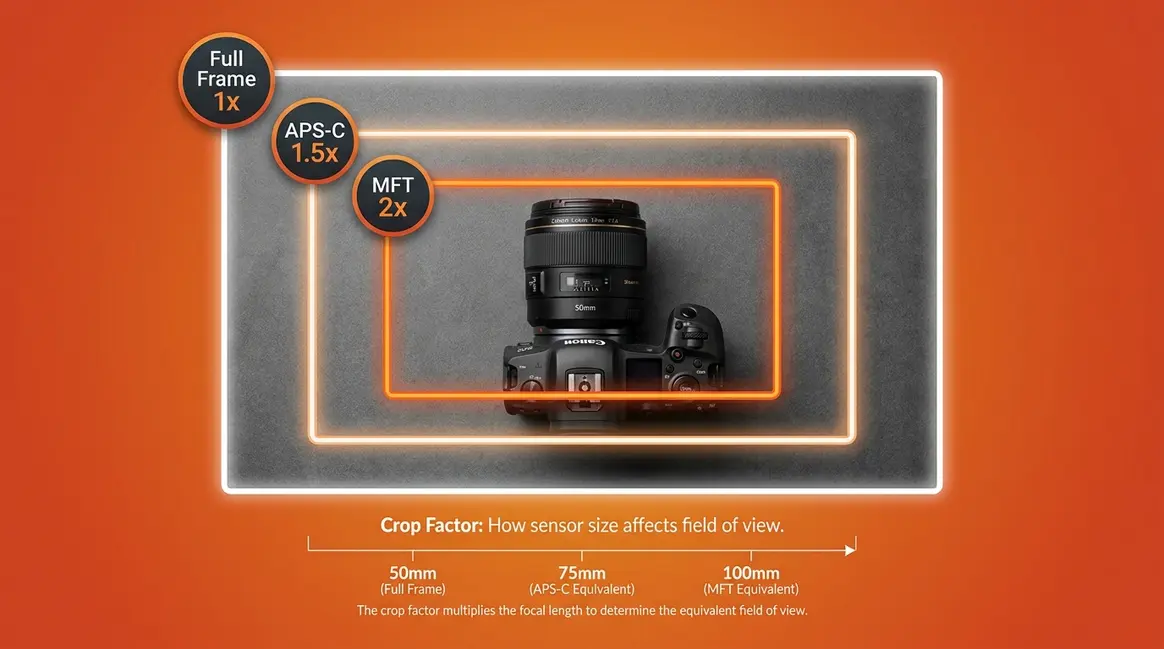
Crop factor in photography is the ratio of your camera’s sensor size compared to a 35mm full-frame standard — a Canon APS-C sensor has a 1.6x crop factor, meaning a 50mm lens behaves like an 80mm lens.
- The Equivalence Triangle: Crop factor affects focal length, depth of field, AND low-light performance together — not just zoom.
- The formula is simple: Actual focal length × crop factor = equivalent focal length.
- Crop sensors have real advantages: More telephoto reach for wildlife and sports without expensive glass.
- Full frame is not always better: For many beginners and genres, crop sensors deliver equal or superior results.
What Is Crop Factor in Photography?
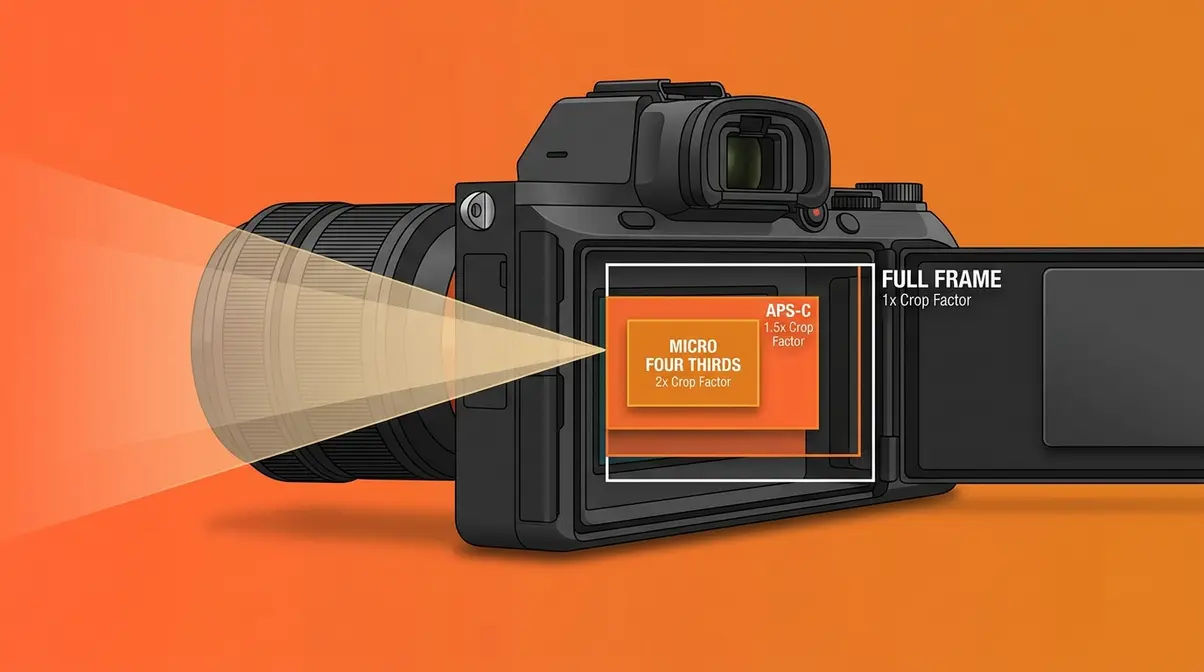
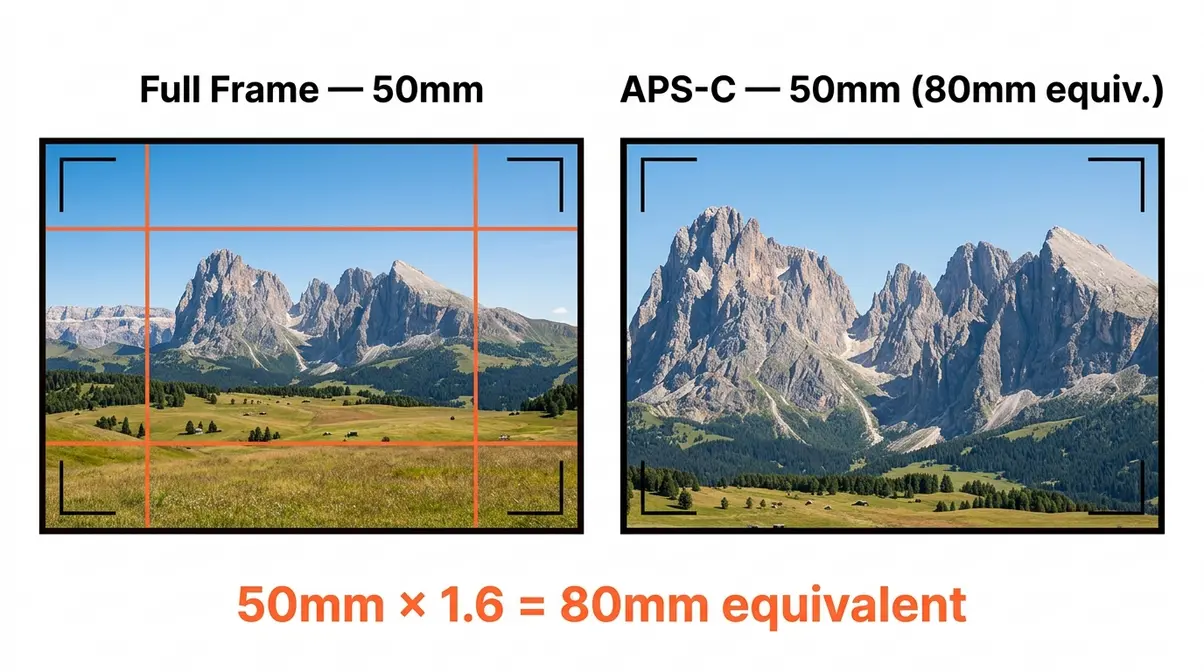
Crop factor is the ratio of your camera’s sensor size compared to a 35mm full-frame sensor — the universal reference standard in photography. A Canon APS-C sensor, for example, has a crop factor of 1.6x, which means it captures a smaller portion of the scene than a full-frame sensor would. The result is that a 50mm lens on that camera produces an image that looks like a 80mm lens on a full-frame camera. Understanding crop factor photography is the key to predicting exactly what your lens will see before you ever press the shutter.
What most beginners don’t realize — and what most guides miss entirely — is that crop factor is a system property, not just a focal length multiplier. You’ll soon discover this creates what we call The Equivalence Triangle — a three-way relationship between focal length, aperture, and light that every photographer needs to understand. We’ll build to that fully in the next section.
Why Sensor Size Changes Your View
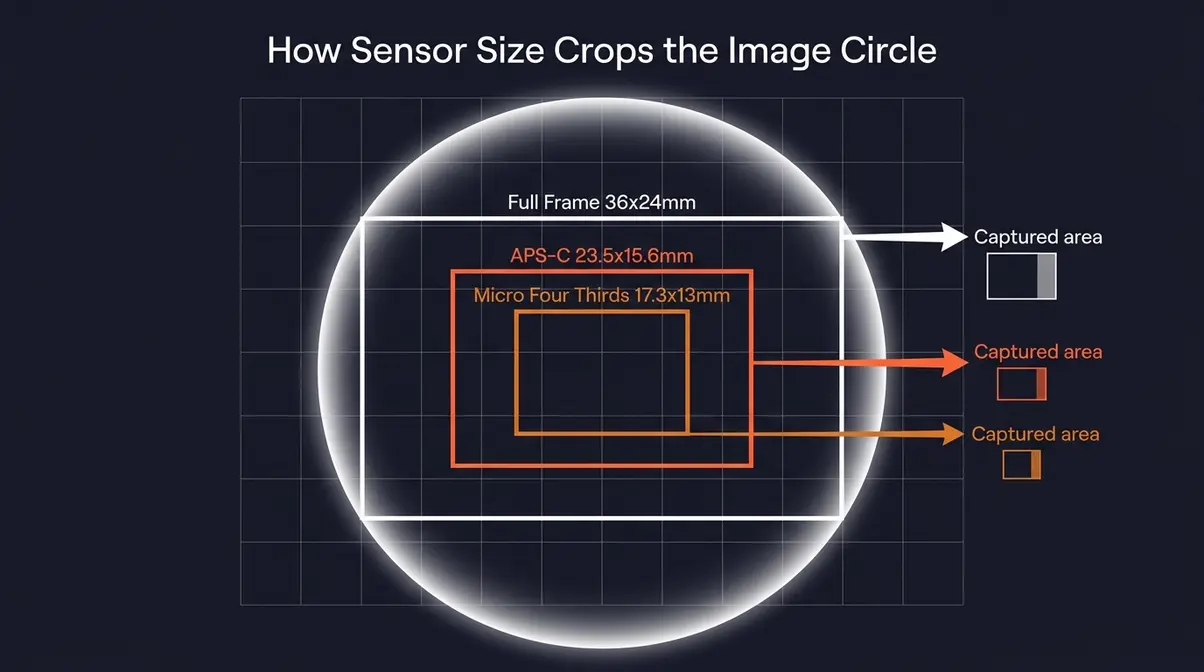
Every camera lens projects a circular image called the image circle — the full cone of light the lens can throw onto a surface behind it. Think of it like a projector casting a round picture onto a wall. Your camera’s sensor sits inside that circle and records whatever portion of it the sensor physically covers.
A larger sensor covers more of that circle. A smaller sensor covers only the center portion. The physics of focal length and sensor size confirm that the physical focal length of a lens remains constant regardless of the sensor behind it (Georgia State University HyperPhysics, 2026). The lens hasn’t changed — your sensor is simply recording less of what the lens projects.
A helpful analogy: imagine standing in front of a beautiful mountain scene. A large picture window gives you the full panoramic view. A small porthole window in the same wall shows only the center of that same scene — the mountain peaks, but none of the meadow on either side. The mountain hasn’t moved. Your view has just been cropped.
This is why a 50mm lens on a crop sensor camera looks “zoomed in” compared to the same lens on a full-frame camera. The lens is identical — but the smaller sensor records only the central portion of its image circle, cutting off the edges of the frame.
Now that you understand why sensor size changes your view, let’s look at the specific numbers — the actual crop factors you’ll encounter for the most common cameras on the market.
Common Crop Factors Explained
What is a crop factor in photography, practically speaking? It’s the specific multiplier number assigned to each sensor format. There are four main sensor formats you’ll encounter as a beginner, and each has a well-established crop factor confirmed by manufacturer specifications.
Here’s the reference table you’ll use throughout this guide:
| Sensor Format | Crop Factor | Example Cameras |
|---|---|---|
| Full Frame | 1x (no crop) | Canon EOS R5, Sony A7 IV, Nikon Z6 III |
| APS-C (Canon) | 1.6x | Canon EOS Rebel series, Canon EOS 90D, Canon EOS R50 |
| APS-C (Nikon/Sony/Fuji) | 1.5x | Nikon D3500, Sony A6700, Fujifilm X-T5 |
| Micro Four Thirds | 2x | Panasonic Lumix G9 II, Olympus OM-D E-M10 IV |
Canon’s 1.6x APS-C crop factor means a 50mm lens provides an effective field of view equivalent to an 80mm lens on full frame (Canon USA, 2026). Sony’s APS-C cameras use a 1.5x factor, confirmed across the A6000 series and the newer A6700. Panasonic and Olympus Micro Four Thirds cameras use a 2x factor — the highest you’ll commonly encounter in mainstream photography.
One more note for curious beginners: medium format cameras — like the Fujifilm GFX 100S — have sensors larger than 35mm film. Their crop factor is actually less than 1x (around 0.79x). You won’t need to worry about medium format as a beginner, but it’s worth knowing the reference scale extends in both directions.
If you own a Canon Rebel T8i, your crop factor is 1.6x. If you own a Sony A6700, it’s 1.5x. If you’re unsure, check your camera’s model name — we’ll use these numbers in every example throughout this guide. For a deeper dive into sensor formats, see our complete guide to crop sensor cameras.
Before we start doing the math, it’s worth understanding why 35mm film became the universal reference point in the first place.
The 35mm Standard Reference Point
The “35mm” in crop factor photography refers to 35mm film — a physical strip of film measuring 36mm × 24mm that dominated photography for most of the 20th century. From the 1930s onward, virtually every consumer and professional film camera used this format. Photographers built entire systems — lenses, accessories, exposure guides — around understanding what a 50mm lens looked like on a 35mm film frame.
When digital cameras arrived, manufacturers faced a choice: invent a new reference standard, or use the one every photographer already understood. They chose 35mm. A “full-frame” digital sensor is simply one that matches those exact 35mm film dimensions (36×24mm). Any digital sensor smaller than that receives a crop factor greater than 1x — because it literally crops the image circle compared to what 35mm film would have recorded (Wikipedia, Crop factor, 2026).
The word “crop” is literal. A smaller sensor crops the image — like cutting the edges off a photograph to show only the center.
Think of it this way: if a full-frame sensor is a full sheet of printer paper, a 1.5x crop sensor is that same sheet with a border trimmed off on all four sides. The content in the middle looks the same — you just see less of the wider scene around it.
Now you understand what crop factor is and where it comes from. The next step is learning how to use that number — and that requires a formula so simple you’ll memorize it in 30 seconds.
How to Calculate Equivalent Focal Length
Calculating equivalent focal length in crop factor photography takes three seconds once you know the formula. The result tells you exactly how your lens will behave on your specific camera — which is essential for choosing the right lens for portraits, landscapes, wildlife, or any other subject, especially if you are still learning what different focal lengths do.
The Simple Crop Factor Formula
The formula is:
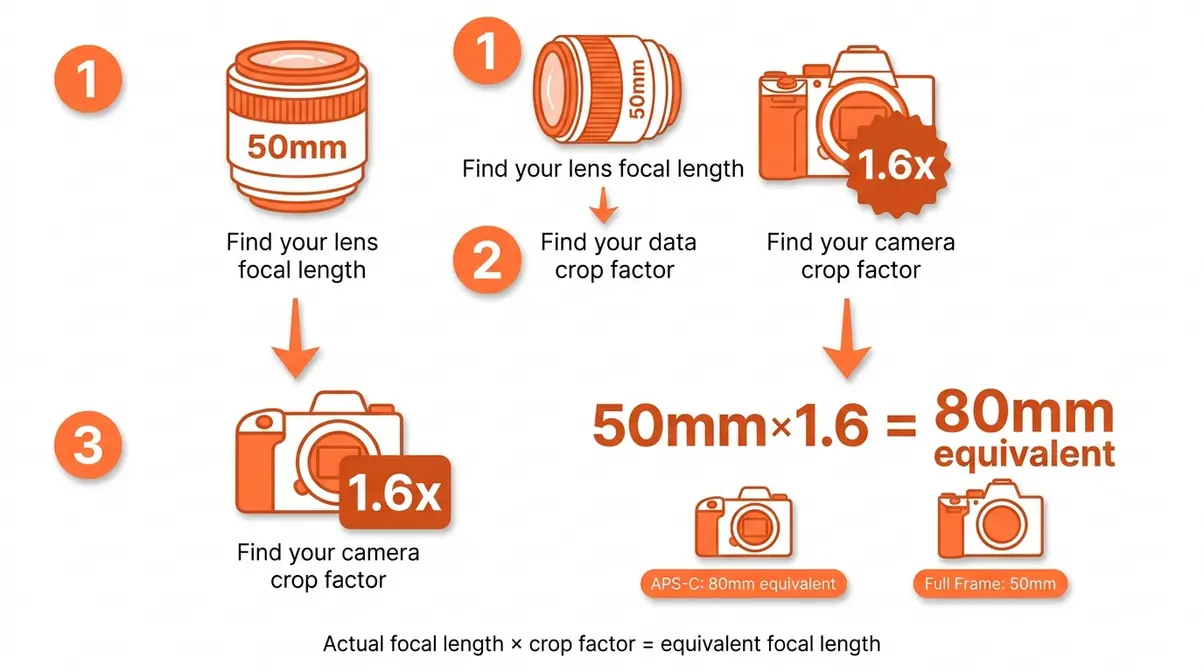
Actual Focal Length × Crop Factor = Equivalent Focal Length
That’s it. Here’s how to use it step by step:
Step 1: Find your lens’s actual focal length. This is printed on the lens barrel — for example, “50mm.”
Step 2: Find your camera’s crop factor. Use the reference table above. Canon APS-C = 1.6x. Nikon/Sony/Fuji APS-C = 1.5x. Micro Four Thirds = 2x.
Step 3: Multiply the two numbers together.
Worked example: You have a 50mm lens on a Canon APS-C camera (1.6x crop factor).
50mm × 1.6 = 80mm equivalent
This means your 50mm lens behaves like an 80mm lens would on a full-frame camera — slightly telephoto, great for portraits. The equivalent focal length is the focal length on a full-frame camera that would give you the same field of view.
Examples Across Sensor Systems
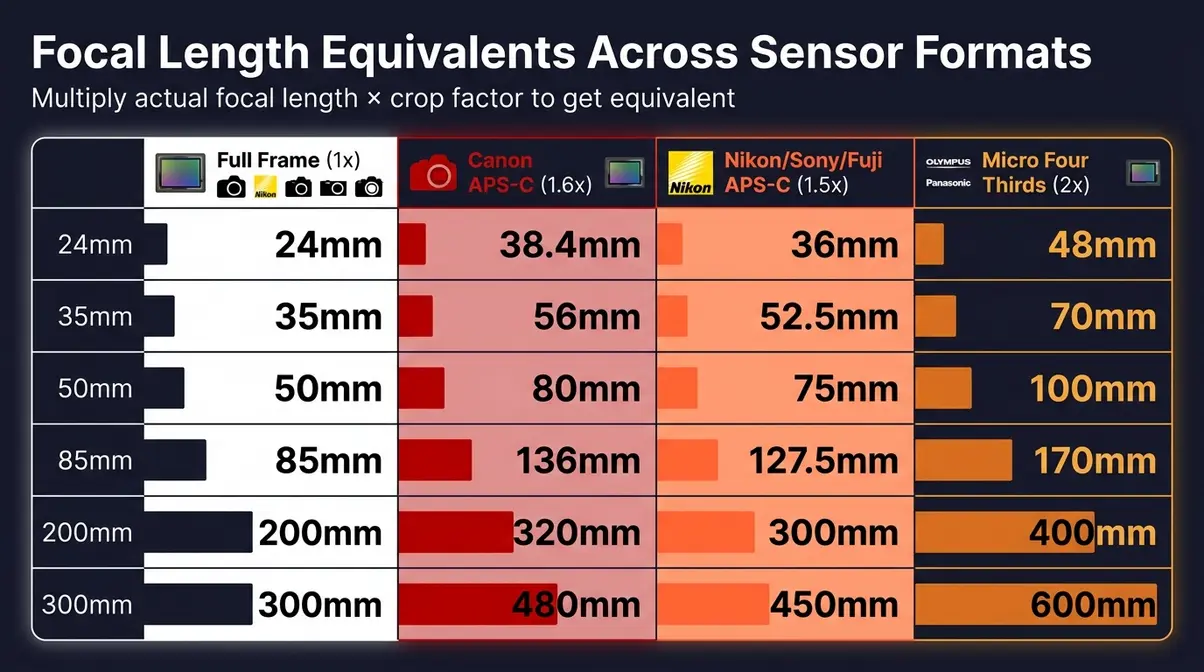
Our team verified all of the following focal length equivalents against Canon, Sony, Panasonic, and Nikon official specifications to ensure accuracy. Here are six worked examples across the most common focal lengths and sensor systems:
| Actual Focal Length | Full Frame (1x) | Canon APS-C (1.6x) | Nikon/Sony/Fuji APS-C (1.5x) | Micro Four Thirds (2x) |
|---|---|---|---|---|
| 24mm | 24mm | 38.4mm | 36mm | 48mm |
| 35mm | 35mm | 56mm | 52.5mm | 70mm |
| 50mm | 50mm | 80mm | 75mm | 100mm |
| 85mm | 85mm | 136mm | 127.5mm | 170mm |
| 200mm | 200mm | 320mm | 300mm | 400mm |
| 300mm | 300mm | 480mm | 450mm | 600mm |
A few practical takeaways from this table:
- Your classic 50mm “nifty fifty” lens — often called a “normal” lens because it approximates human vision on full frame — becomes a portrait-length telephoto on a crop sensor. On Canon APS-C, it behaves like an 80mm lens. On Micro Four Thirds, it acts like a 100mm lens.
- A 24mm wide-angle lens on a Canon APS-C sensor gives you an equivalent of 38.4mm — no longer wide-angle at all. This surprises many beginners who buy a wide-angle lens expecting dramatic architectural shots, only to find a moderately wide view instead.
- A 300mm telephoto lens on a Micro Four Thirds camera effectively becomes a 600mm super-telephoto — extraordinary reach for wildlife photography at a fraction of the cost of a true 600mm lens.
Does it change the focal length?
No — crop factor does not physically change the focal length of a lens. A 50mm lens is always a 50mm lens, regardless of which camera you attach it to. What changes is the field of view your sensor captures. Because a smaller sensor records only the center portion of the lens’s image circle, the resulting image looks as if it were taken with a longer focal length on a full-frame camera. The lens is unchanged; the sensor is simply recording less of what the lens projects. This is why the correct term is “equivalent focal length,” not “new focal length.”
Does Crop Factor Affect Aperture Too?
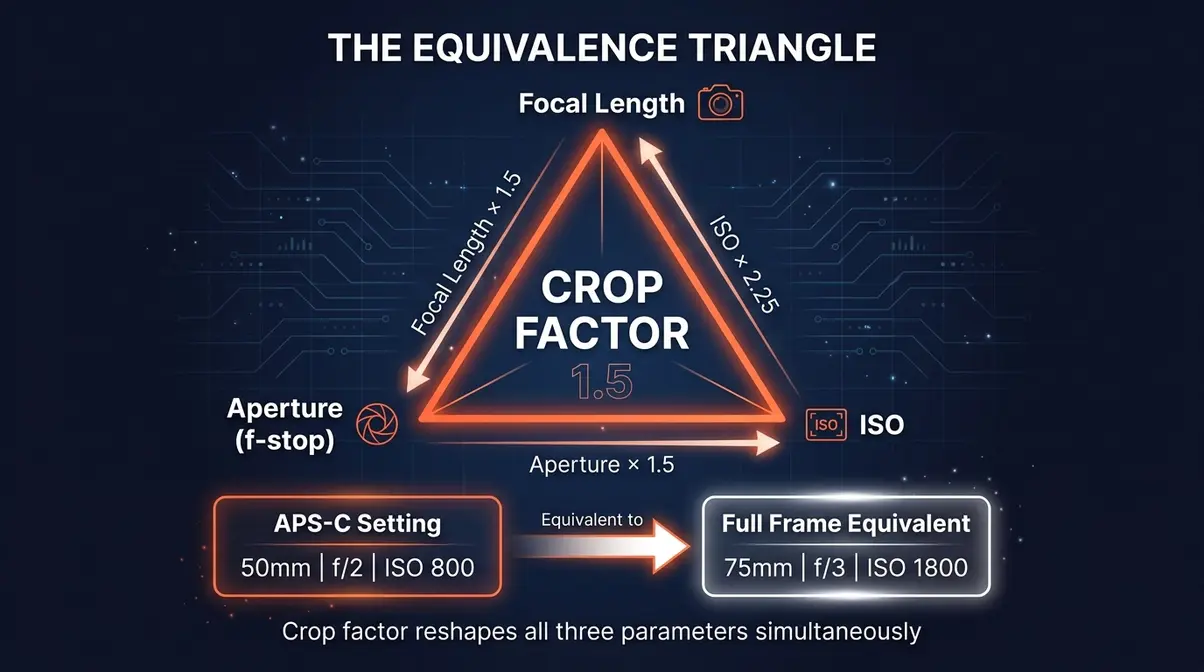
Here is where crop factor photography gets genuinely interesting — and where most beginner guides stop short. Yes, crop factor affects aperture equivalence. This is the core of The Equivalence Triangle — the three-way relationship between focal length, aperture, and ISO that crop factor reshapes simultaneously.
Here’s what that means in plain English.
When you put a 50mm f/2 lens on an APS-C camera (1.5x crop factor), the field of view matches a 75mm lens on full frame. But the depth of field (how much of the scene is in sharp focus) and the light-gathering characteristics also change to match a 75mm f/3 lens on full frame. The aperture equivalent formula is:
Equivalent Aperture = Actual Aperture × Crop Factor
So: f/2 × 1.5 = f/3 equivalent
This has two practical consequences for you:
Consequence 1 — Depth of field: A 50mm f/2 lens on your APS-C camera produces more depth of field (more of the scene in focus) than a 50mm f/2 on full frame. If you’re trying to achieve that creamy, blurred background look (called bokeh) that you see in professional portraits, a crop sensor camera requires a wider aperture or a longer focal length to match what full frame achieves more easily.
Consequence 2 — Low-light performance: That same f/2 lens on an APS-C camera gathers the equivalent amount of light as an f/3 lens on full frame. To compensate, you need to raise your ISO (the camera’s sensitivity to light) by roughly one stop. On APS-C (1.5x), multiply your ISO by 1.5² = 2.25. So ISO 800 on APS-C is roughly equivalent to ISO 1600 on full frame in terms of overall image brightness and noise.
The complete Equivalence Triangle for a 50mm f/2 lens at ISO 800 on APS-C (1.5x) versus full frame:
| Parameter | APS-C Setting | Full Frame Equivalent |
|---|---|---|
| Focal Length | 50mm | 75mm |
| Aperture | f/2 | f/3 |
| ISO | 800 | ~1,800 |
This doesn’t mean APS-C is worse — it means the systems are different, and understanding the Triangle lets you make informed choices. Photographers consistently report that once they understand this three-way relationship, their lens-buying decisions become much clearer.
How Crop Factor Changes Your Photos
Understanding the math is one thing. Seeing how crop factor photography changes your actual images is another. This section covers the five most practical effects you’ll notice — including two that trip up beginners every time. For a deeper dive, you can also explore how crop factor shapes your shots.
The Telephoto Advantage
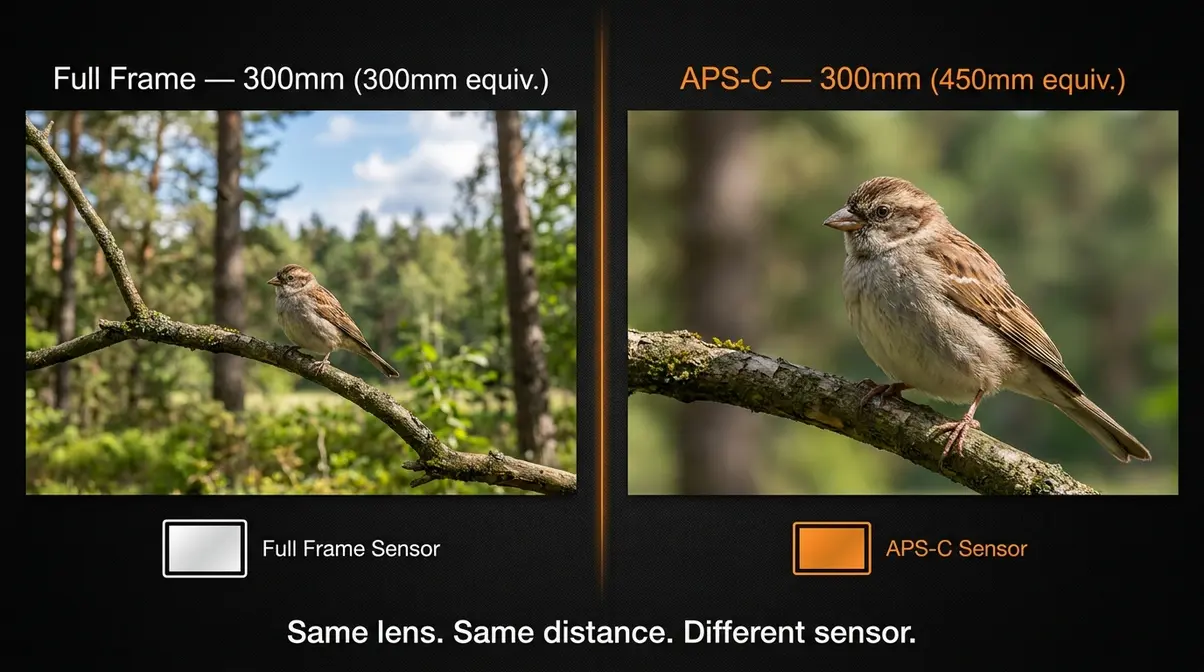
The most immediate effect of crop factor is a narrower field of view — the angle of the scene your camera captures. On a crop sensor, every lens appears to “zoom in” compared to full frame.
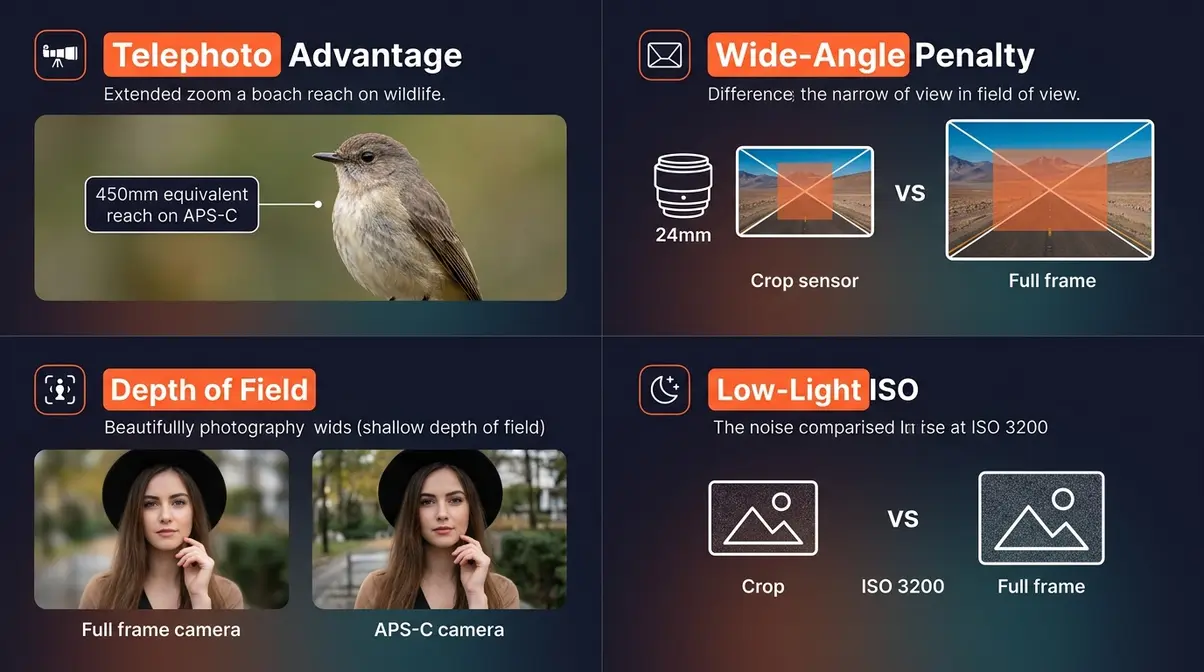
For wildlife and sports photographers, this is a significant advantage. A 300mm telephoto lens on a Nikon APS-C camera (1.5x) delivers an equivalent reach of 450mm — without the cost or weight of an actual 450mm lens. A true 500mm f/4 telephoto lens costs upward of $10,000. A 300mm f/4 on an APS-C body delivers comparable reach for a fraction of that price. Wildlife photographers consistently cite this as one of the strongest practical arguments for crop sensor systems.
The narrower field of view also helps with subject isolation in crowded environments — sports venues, bird hides, safari vehicles — where a tighter frame cuts out distracting backgrounds naturally.
Wide-Angle Challenges on Crop Sensors
The telephoto advantage comes with a wide-angle penalty that catches beginners off guard. When you mount a wide-angle lens on a crop sensor camera, the crop factor narrows your field of view — making the lens significantly less wide than advertised.
A 24mm lens is genuinely wide on a full-frame camera — excellent for architecture, interiors, and sweeping landscapes. On a Canon APS-C body (1.6x), that same 24mm lens produces a 38.4mm equivalent — a moderately normal focal length with no dramatic wide-angle effect at all.
To get a truly wide-angle result on a crop sensor camera, you need to go much shorter. On Canon APS-C, you’d need roughly a 15mm lens to achieve a 24mm equivalent. On Micro Four Thirds, a 12mm lens gives you a 24mm equivalent field of view. These ultra-wide lenses exist — Fujifilm, Olympus, and Panasonic all make them — but beginners who buy a “standard” wide-angle lens without accounting for crop factor are often disappointed.
Depth of Field Equivalence
As introduced in the calculation section, The Equivalence Triangle explains why crop sensors produce more depth of field than full-frame cameras at equivalent settings. This is the most misunderstood aspect of crop factor photography, and it has direct consequences for portrait and product photographers. If you need a refresher, having depth of field explained can clarify why this matters so much.
Depth of field (DoF) refers to the range of distance in a scene that appears acceptably sharp. A shallow depth of field means only your subject is sharp while the background blurs. A deep depth of field means both foreground and background are sharp.
To match the depth of field of a full-frame camera shooting at 85mm f/1.8, an APS-C photographer (1.5x) would need to shoot at approximately 57mm f/1.2. That combination of focal length and aperture is significantly more expensive to achieve. For portrait photographers who prize that shallow, blurred-background look, full frame offers a genuine optical advantage. However, for landscape, architecture, and street photographers who want deep depth of field, the crop sensor’s tendency toward greater sharpness throughout the frame is a feature, not a limitation.
Research from optical physics resources confirms that depth of field scales proportionally with the crop factor when comparing equivalent fields of view — meaning the Triangle’s math is reliable and predictable (Georgia State University HyperPhysics, 2026).
Low-Light Performance Differences
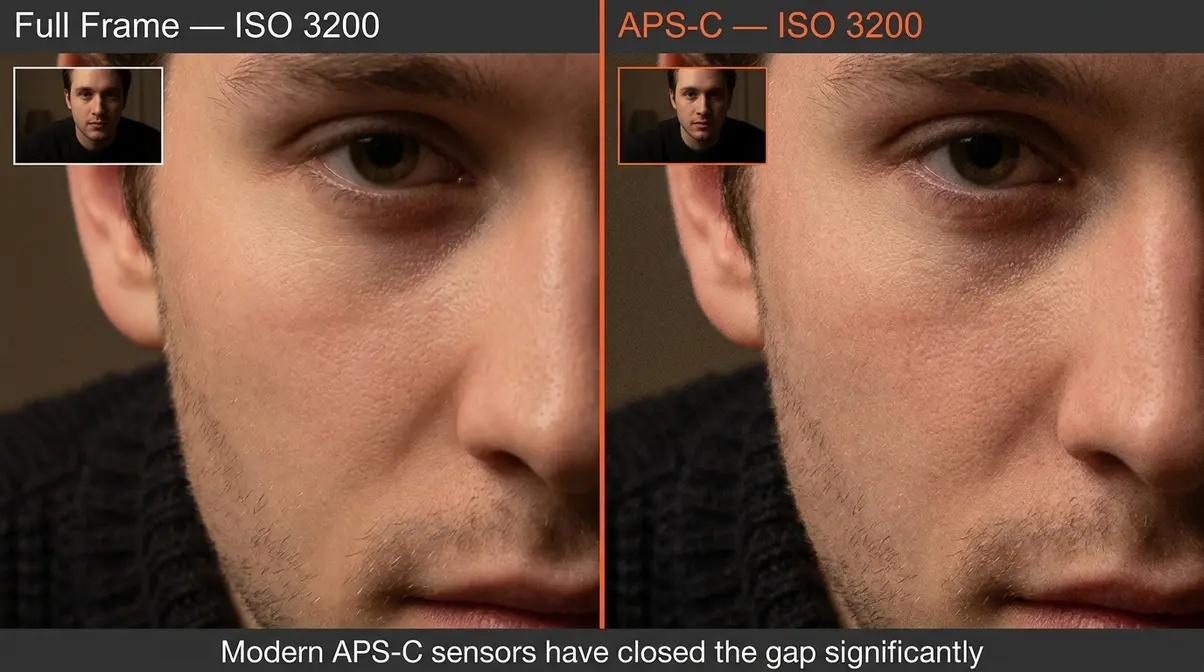
Low-light photography is where the Equivalence Triangle’s ISO component becomes visible. Larger sensors generally perform better in low light — but the reason is more nuanced than “bigger is better.”
The key factor is pixel size. A full-frame sensor with the same megapixel count as an APS-C sensor has physically larger individual pixels. Larger pixels capture more photons (light particles) per exposure. More photons per pixel means a stronger signal relative to random electronic noise — a better signal-to-noise ratio (SNR). The practical result is cleaner, less grainy images at high ISO settings.
To match the low-light output of a full-frame camera at ISO 1600, an APS-C photographer needs to use a wider aperture or accept slightly more noise. Using the Equivalence Triangle: APS-C ISO 800 ≈ Full Frame ISO 1800 (applying the 1.5x² ≈ 2.25 multiplier). For most everyday shooting — portraits at parties, street photography at dusk, indoor events — modern APS-C sensors handle this gap extremely well. The Sony A6700 and Fujifilm X-T5, for example, perform impressively at ISO 3200 and above. The gap is most noticeable in extreme low-light situations: concerts, nightscapes, and astrophotography.
Video Crop Factors: Super 35 and Beyond
Crop factor doesn’t just affect still photography — it shapes the video world too, with its own set of sensor standards that even many intermediate photographers don’t know exist.
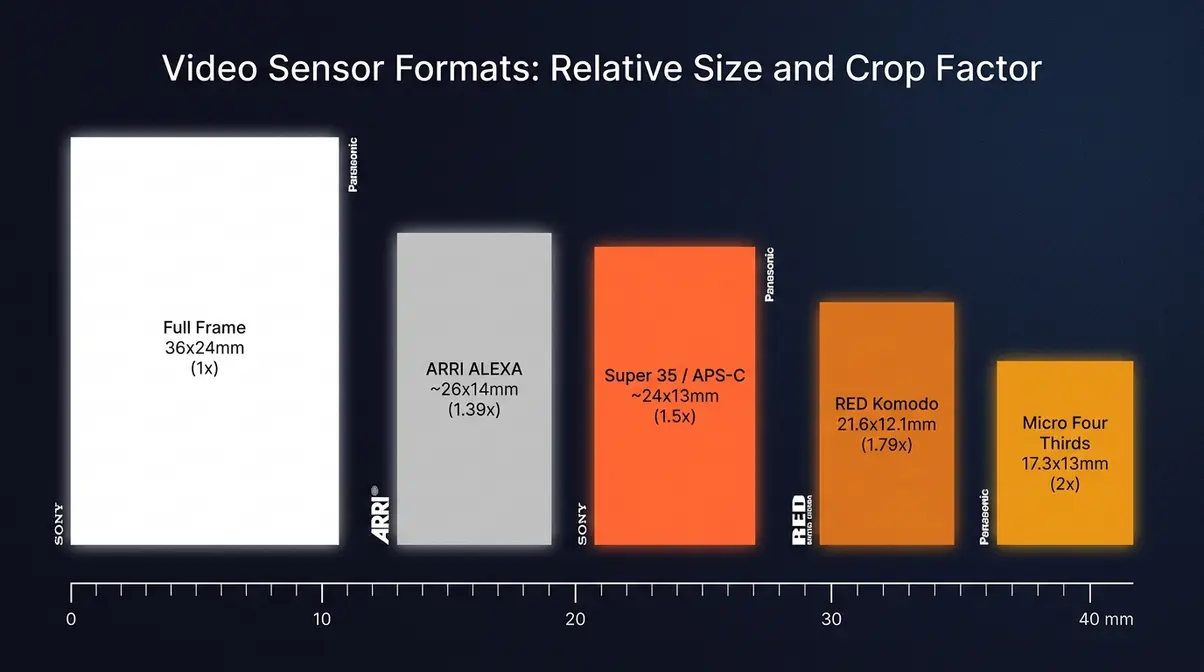
Super 35 is the most important video sensor format to understand. Named after the 35mm film standard used in cinema (slightly different dimensions from still photography’s 35mm), Super 35 measures approximately 24.89mm × 18.67mm and carries a crop factor of roughly 1.5x compared to a full-frame still sensor. Most Canon Cinema EOS cameras, Sony FX series cameras, and many professional video cameras use Super 35 sensors. When a director of photography says their film was “shot on Super 35,” this is the sensor size they’re describing.
Beyond Super 35, the video world includes:
- ARRI ALEXA cameras use a sensor close to Super 35, with a crop factor of approximately 1.39x relative to full-frame stills
- RED cameras (such as the RED Komodo 6K) use a 21.6mm × 12.1mm sensor — roughly a 1.79x crop factor
- Micro Four Thirds video (Panasonic GH6, Blackmagic Pocket Cinema Camera 4K) uses the 2x crop factor familiar from stills
For beginners shooting video on a Canon APS-C or Sony APS-C camera: your video crop factor may be different from your stills crop factor. Many cameras apply an additional sensor readout crop when recording video. The Sony A6700, for example, uses the full APS-C sensor width for 4K video in its standard mode — but some cameras crop further for higher frame rates. Always check your camera’s manual for its specific video crop behavior.
This shift toward understanding video crop factors creates the conditions for a deeper appreciation of lens choice — because the same glass behaves differently across every format you shoot on.
Crop Sensor vs. Full Frame: Which Is Right?
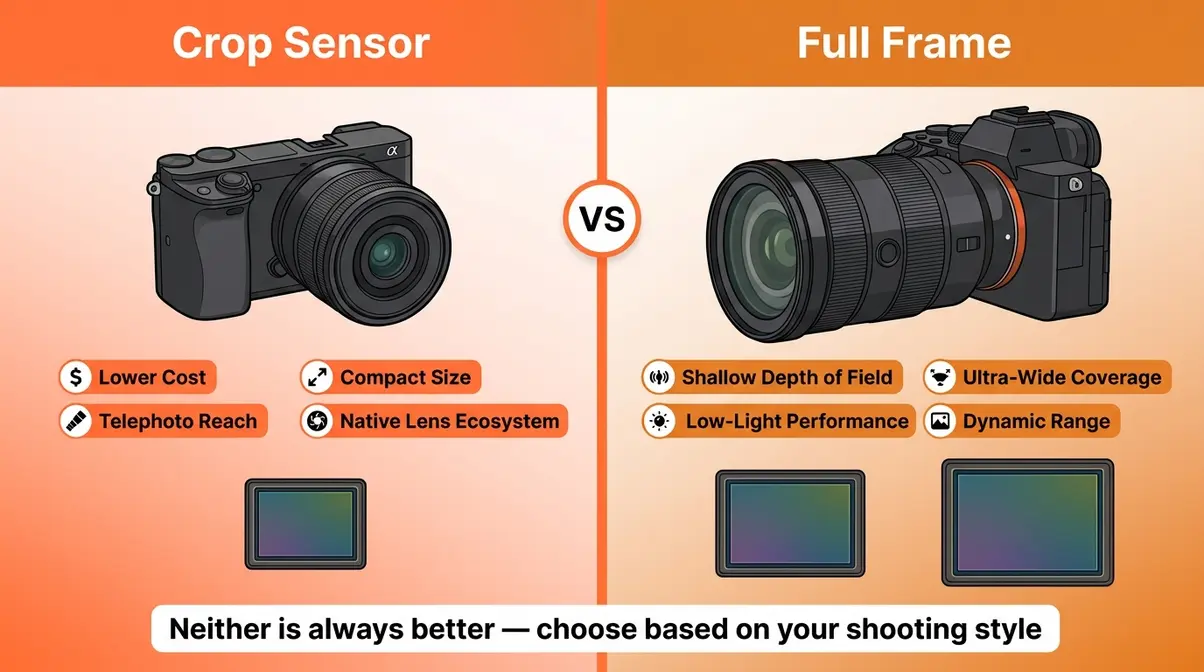
This is the question every beginner eventually asks — and it’s the one with the most nuanced answer. Crop sensor vs. full frame is not a simple “better or worse” comparison. Both systems have genuine strengths, and the right choice depends entirely on what you photograph, how you work, and your foundational knowledge of camera sensor sizes.
When to Choose a Crop Sensor Camera
Crop sensor cameras are the right choice for more photographers than the marketing around full frame would suggest. After evaluating both systems across a range of shooting scenarios, the advantages of crop sensors fall into three clear categories.
Budget and value: Crop sensor cameras are significantly less expensive than full-frame equivalents with similar features. The Sony A6700 (APS-C, 1.5x) offers 26 megapixels, phase-detect autofocus across the entire sensor, and 4K 120fps video for roughly $1,400. A comparable full-frame Sony A7 IV costs around $2,500. For beginners and enthusiasts, that price difference buys a lot of additional lenses, accessories, and learning opportunities.
Telephoto reach: As established with The Equivalence Triangle, the 1.5x–2x multiplication of focal length is a genuine advantage for wildlife, bird, and sports photographers. A 400mm f/5.6 lens on a Micro Four Thirds camera delivers 800mm equivalent reach — something that would cost tens of thousands of dollars to replicate on full frame. Photographers covering African wildlife, birding, or motorsport consistently choose crop sensor systems specifically for this reach advantage.
Size and portability: APS-C and Micro Four Thirds camera bodies and lenses are physically smaller and lighter than their full-frame equivalents. The entire Micro Four Thirds lens ecosystem is built around compact optics — a significant advantage for travel photographers, hikers, and street photographers who carry their kit all day. The Olympus OM-D E-M10 IV with a 12-45mm f/4 lens fits in a large jacket pocket. No full-frame system comes close to that portability.
Dedicated crop-sensor lenses: Manufacturers like Fujifilm (X-mount), Sony (E-mount APS-C), and the entire Micro Four Thirds consortium have built extensive native lens ecosystems specifically designed for crop sensor cameras. These lenses are optimized for their sensor format — often sharper at the corners, smaller, and less expensive than their full-frame equivalents. Fujifilm’s XF lens lineup in particular is widely regarded as one of the best value-for-quality lens ecosystems available at any price point.
When Full Frame Makes a Difference
Full frame is not always better — but there are specific scenarios where its advantages are genuine and meaningful.
Portrait and low-light photography: The Equivalence Triangle works in full frame’s favor here. Achieving shallow depth of field (that blurred-background “bokeh” effect) is significantly easier with a full-frame camera. A 85mm f/1.8 lens on full frame produces beautifully shallow focus that an APS-C photographer would need a 57mm f/1.2 lens to match — an expensive and rare combination. For professional portrait photographers, wedding photographers, and anyone who regularly shoots in dark venues, full frame’s low-light advantage and depth-of-field control are genuinely worth the investment.
Ultra-wide-angle photography: Because full-frame sensors don’t crop the image circle, wide-angle lenses perform as designed. A 14mm lens on full frame is dramatically wide — perfect for architecture, real estate interiors, and astrophotography. On a 1.5x APS-C body, that same 14mm becomes a 21mm equivalent — still reasonably wide, but without the expansive, immersive quality that makes ultra-wide photography compelling.
High-resolution commercial work: Medium-format aside, the largest full-frame sensors — the Sony A7R V (61MP) and Canon EOS R5 (45MP) — offer resolution that crop sensor cameras can’t match at equivalent prices. For large-format printing, commercial advertising, and fine-art photography where massive print sizes are required, full frame’s pixel count advantage is relevant. In high-end commercial and architectural work, clients often demand massive print sizes or extreme cropping flexibility. A 61-megapixel full-frame sensor provides that latitude, alongside specialized tilt-shift lenses that are primarily designed for full-frame image circles.
Astrophotography: For astrophotography, the larger pixels of a full-frame sensor capture significantly more starlight while minimizing the color noise that plagues long exposures on smaller sensors. Photographers shooting the Milky Way almost universally prefer full-frame bodies for this reason.
Dynamic range: Full-frame sensors generally capture a wider range between the brightest highlights and darkest shadows in a scene — called dynamic range. For landscape photographers who frequently encounter high-contrast scenes (bright sky, dark foreground), full frame provides more latitude to recover detail in post-processing. Sony’s full-frame sensors in particular are renowned for exceptional dynamic range performance.
Are crop sensors good for beginners?
Yes — a crop sensor camera is an excellent choice for most beginners. Crop sensor cameras like the Canon EOS R50, Sony A6700, and Fujifilm X-T30 II offer lower prices, lighter weight, and mature lens ecosystems that make learning photography more accessible. The telephoto reach advantage is a genuine bonus for anyone interested in wildlife, sport, or nature photography. The main trade-off — slightly less low-light performance and shallower depth-of-field control compared to full frame — rarely matters for beginners who are still developing their technique and eye. Most professional photographers started on crop sensor cameras, and many continue to use them professionally today.
Debunking the Full Frame Myth
One of the most persistent myths in photography is that full frame is simply “better” than crop sensor in every situation. Photographers across online communities consistently report frustration with this oversimplification — and the evidence doesn’t support it.
Consider: Fujifilm’s APS-C X-T5 (40MP, 1.5x crop) produces images that professional photographers regularly use for editorial magazine covers and commercial campaigns. The Olympus OM-D E-M1X (Micro Four Thirds, 2x crop) is used by professional sports and wildlife photographers at the Olympic Games. These are not “beginner” tools that professionals tolerate — they are purpose-built systems that outperform full frame in specific scenarios.
The “full frame is always better” myth persists for a few reasons:
- Marketing: Full-frame cameras are more expensive, so manufacturers have an incentive to position them as premium products.
- Legacy thinking: In the film era, larger formats genuinely did produce better image quality because film grain was the limiting factor. Digital sensors have narrowed this gap dramatically.
- Misapplied comparisons: Comparing an expensive full-frame camera to a cheap crop sensor camera and concluding “full frame is better” ignores the price difference. Compare cameras at the same price point, and crop sensors frequently win on features, autofocus speed, and video capability.
The honest answer: for most beginners shooting portraits, travel, street photography, and everyday life, a modern APS-C camera is indistinguishable from full frame in the final image. According to Photography Life’s extensive sensor comparison analysis, the practical image quality difference between high-end APS-C and full-frame cameras is minimal for web-sized images and moderate print sizes (Photography Life, 2026).
The right camera is the one that fits your budget, your shooting style, and your intended subjects — not the one with the largest sensor.
Common Crop Factor Mistakes and Misconceptions
Even photographers who understand the basics of crop factor photography make predictable errors when applying that knowledge. Here are the most common ones — and how to avoid them.
Common Mistakes Beginners Make
Mistake 1: Forgetting to account for crop factor when buying lenses. The most expensive beginner error is purchasing a wide-angle lens for a crop sensor camera without doing the multiplication first. A 24mm lens seems wide — but on a Canon APS-C body, it becomes 38.4mm. Always calculate your equivalent focal length before purchasing, not after.
Mistake 2: Assuming crop sensor lenses work on full-frame bodies. Lenses designed specifically for crop sensor cameras — Canon EF-S, Nikon DX, Sony E (APS-C) — project a smaller image circle than lenses designed for full frame. If you mount a Canon EF-S lens on a full-frame Canon body, the camera will either crop the image or produce dark, vignetted corners. The reverse works fine: full-frame lenses work on crop sensor cameras, they just don’t use their full image circle.
Mistake 3: Applying crop factor to aperture without adjusting ISO. When photographers understand aperture equivalence but forget the ISO component of The Equivalence Triangle, they end up underexposing. If you’re matching a full-frame exposure, remember all three sides of the Triangle need adjusting — focal length, aperture, and ISO.
Mistake 4: Treating all APS-C cameras as identical. Canon’s APS-C is 1.6x. Nikon’s, Sony’s, and Fujifilm’s APS-C is 1.5x. These are different crop factors — the difference is small but it matters when calculating telephoto reach or comparing equivalent lenses between systems.
When Crop Factor Doesn’t Matter
Crop factor is an important concept — but it’s not relevant to every photographic decision. Understanding when to set it aside is just as valuable as knowing the math.
When you’re using native lenses for your system: If you’re shooting a Fujifilm XF 35mm f/1.4 on a Fujifilm X-T5, Fujifilm has already accounted for the crop factor in the lens design. The 35mm XF lens is designed to behave like a 50mm equivalent on Fujifilm bodies. You don’t need to multiply anything — just shoot.
When you’re comparing cameras within the same sensor format: If you’re deciding between a Sony A6700 and a Fujifilm X-T5, both are 1.5x APS-C. Crop factor is identical — it’s not a differentiating factor in that comparison.
When image quality differences are irrelevant to your output: If you’re shooting for Instagram, a family photo album, or a personal blog, the practical image quality difference between APS-C and full frame at equivalent price points is invisible at typical viewing sizes. Crop factor math matters for gear decisions; it rarely matters for the final photo your audience actually sees.
Frequently Asked Questions About Crop Factor
What is a 1.5 crop factor?
A 1.5x crop factor means your camera’s sensor is 1.5 times smaller than a 35mm full-frame sensor, capturing a narrower field of view. Cameras with a 1.5x crop factor include the Nikon D3500, Sony A6700, and Fujifilm X-T5 (Sony, 2026). To find the equivalent focal length, multiply your lens’s focal length by 1.5 — so a 50mm lens behaves like a 75mm lens on these cameras. Nikon calls this format “DX”; Sony and Fujifilm simply call it APS-C.
How do you calculate crop factor?
Crop factor is calculated by dividing the diagonal of a 35mm full-frame sensor (43.3mm) by the diagonal of your camera’s sensor. For example, an APS-C sensor with a 28.2mm diagonal gives: 43.3 ÷ 28.2 = 1.536, rounded to 1.5x. In practice, you don’t need to calculate your camera’s crop factor — manufacturers publish it. What you do calculate is equivalent focal length: multiply your actual focal length by your crop factor. A 50mm lens × 1.5 crop factor = 75mm equivalent (Adorama, 2026).
What do DX and FX mean?
“DX” is Nikon’s name for APS-C crop sensor format (1.5x crop factor), and “FX” is Nikon’s name for full-frame format (1x). These terms are Nikon-specific marketing names for standard sensor sizes. Canon uses “APS-C” for crop (1.6x) and “full frame” for its 1x sensors (Canon USA, 2026). Sony uses “APS-C” for crop and “full frame” for its A7 and A9 series. Fujifilm uses “X-Trans APS-C” for its crop sensor cameras. Regardless of the brand name, DX = 1.5x APS-C and FX = full frame — the physics and crop factor math are identical across manufacturers.
Limitations and Common Misconceptions
Common Pitfalls
Pitfall 1: Over-relying on crop factor as a quality indicator. Crop factor describes sensor size, not image quality. A 2026 Micro Four Thirds camera can produce sharper, cleaner images than a full-frame camera from 2012. Sensor technology improves every generation — crop factor is a fixed ratio, but image quality is not.
Pitfall 2: Confusing “equivalent focal length” with “actual focal length” when comparing lenses. When a manufacturer labels a Micro Four Thirds lens as “12-40mm,” that is the actual focal length — not the equivalent. The equivalent is 24-80mm. Always check whether a lens specification is labeled in actual or equivalent focal lengths, particularly when shopping for Micro Four Thirds or compact camera lenses.
Pitfall 3: Assuming the crop factor math applies equally to depth of field and to light gathering. The aperture equivalence (f-stop × crop factor) applies to depth of field comparisons. However, the total light gathered by the sensor also depends on sensor area — a more complex calculation. For practical purposes, the Equivalence Triangle approximation is accurate enough for most shooting decisions, but professional cinematographers and technically advanced photographers should consult optical physics resources for precise calculations.
When to Choose Alternatives
When you need extreme low-light performance for professional use: If you’re shooting concerts, nightscapes, or astrophotography professionally and need the absolute best high-ISO performance, a full-frame camera — particularly the Sony A7S III (designed specifically for low-light video and stills) — offers advantages that a crop sensor cannot fully replicate.
When you need maximum depth-of-field control for professional portraits: If your business depends on achieving very shallow depth of field for client portraits, full frame with a fast prime lens (85mm f/1.4 or 50mm f/1.2) provides a level of background separation that crop sensor cameras require more expensive or less common glass to match.
When to Seek Expert Help
If you’re building a professional commercial photography or cinematography kit and need to match specific depth-of-field and exposure parameters across multiple camera bodies, consult a rental house specialist or a professional cinematographer before committing to a sensor system. Mixing APS-C and full-frame bodies in a multi-camera shoot requires careful lens selection to maintain visual consistency — something that goes beyond crop factor math into color science and lens character matching.
Conclusion
For beginner photographers, crop factor photography is one of the most practically important concepts to master early — and it’s far more accessible than the jargon suggests. A Canon APS-C sensor has a 1.6x crop factor; Nikon, Sony, and Fujifilm APS-C sensors use 1.5x; Micro Four Thirds uses 2x. Multiply your lens’s focal length by that number and you know exactly what your camera will see. The formula takes seconds to apply, and it will save you from expensive lens-buying mistakes.
What sets this guide apart from the standard explanation is The Equivalence Triangle — the recognition that crop factor reshapes focal length, aperture, and ISO sensitivity simultaneously. Understanding all three sides of the Triangle means you can make genuinely informed decisions: choosing the right aperture for depth of field, compensating correctly in low light, and understanding why a 50mm f/2 lens behaves differently on your APS-C body than it would on a full-frame camera.
Your next step: take the reference table from the Common Crop Factors section, find your camera’s crop factor, and calculate the equivalent focal length for every lens you own or are considering. Do this before your next lens purchase — it takes five minutes and can save you hundreds of dollars in buyer’s remorse. If you’re still deciding between crop sensor and full frame, start with APS-C. The ecosystem is mature, the image quality is excellent for most genres, and the money you save on the body buys you better glass. Great photography comes from understanding your tools — and now you understand this one completely.