
Table of Contents
- Key Takeaways
- Crop Factor Basics And Common Myths
- Sensor Sizes And Crop Factor Comparison
- How Crop Factor Affects Field Of View
- Calculating Equivalent Focal Lengths
- Practical Impacts On Lens Choice And Results
- Avoiding Mistakes With Crop Sensors
- Master Your Crop Factor Knowledge and Elevate Your Photography
- Frequently Asked Questions
- Recommended
This blog post may contain affiliate links. As an Amazon Associate I earn from qualifying purchases.
Picking up your first real camera opens up a new world, but suddenly terms like crop factor can make things confusing fast. Understanding how sensor size affects what you see in your frame helps you choose lenses that match your creative goals without guesswork. Learning the truth about concepts like crop factor and busting common myths means you can focus on capturing better photos instead of second guessing your gear. Crop factor changes field of view, not the lens’s actual focal length, giving you practical control over how you compose every shot.





Key Takeaways
| Point | Details |
|---|---|
| Crop Factor Understandings | Crop factor is the ratio between sensor size and full-frame standards, impacting the field of view rather than the lens’s actual focal length. |
| Lens Selection Impacts | Choose lenses based on effective focal lengths calculated using crop factor for optimal results in different photography genres. |
| Common Misconceptions | Correctly understanding that crop factor doesn’t change lens optical properties helps avoid common mistakes and improves compositional strategies. |
| Practical Calculations | Regularly calculate equivalent focal lengths for your lenses to ensure informed decisions and eliminate surprises in framing. |
Crop Factor Basics And Common Myths
Crop factor is simply the ratio between a standard 35mm film frame and your camera’s actual sensor size. Think of it as a mathematical comparison. A full-frame sensor measures 36mm x 24mm, which serves as the baseline for all comparisons. When your camera has a smaller sensor, the crop factor tells you how much smaller it is in proportion to that full-frame standard.
For example, if your camera has a crop factor of 1.5x, your sensor is 1.5 times smaller than a full-frame sensor. This affects your field of view, meaning you capture a narrower slice of the scene in front of you. What you’re really measuring is how the sensor size changes the angle of view that the lens produces, not the focal length itself.
Here’s where many photographers get confused. The most common myth is that crop factor magnifies your images or changes how your lens actually works. This misconception trips up beginners constantly. Your 50mm lens remains a 50mm lens whether it’s on a full-frame camera or a crop-sensor camera. The focal length does not change. What changes is the portion of the scene your smaller sensor captures. It’s like comparing a full painting to a close-up photograph of just the center portion.
The painting didn’t zoom in; you simply captured less of it. Related misunderstandings include thinking that depth of field changes with crop factor or that crop sensors provide a zoom-like magnification effect. Neither is true. Depth of field behavior stays the same because it depends on aperture, focal length, and distance from your subject, not sensor size.
Another widespread misbelief is that crop sensors are somehow inferior or limiting. In reality, they offer practical advantages for amateur photographers. Smaller sensors cost less to manufacture, which means more affordable camera bodies. They also create what photographers call an “effective focal length,” which is simply a convenient way to think about field of view.
If you’re shooting wildlife or sports with a 200mm lens on a 1.6x crop sensor, that lens behaves like a 320mm lens in terms of the field of view you get. This can be helpful for reaching distant subjects without buying expensive telephoto lenses. Crop sensors aren’t a downgrade; they’re a different tool suited to different needs and budgets.
Understanding these basics shapes every decision you make about camera selection and lens choices. When you see someone saying “crop sensor magnifies focal length,” you’ll recognize they’re describing the field of view effect, not an actual optical magnification. When you’re shopping for a new camera, knowing that crop factor affects what you see in the frame, but not how the lens optically behaves, helps you choose the right tool for your photography style.
Pro tip: Write down your camera’s crop factor and multiply it by the focal lengths of your lenses to calculate what field of view you’re actually getting, then compare that to what full-frame photographers achieve with the same lenses. This single calculation clarifies why your 18mm lens captures less width than you expected and why your telephoto reaches farther than the marked focal length suggests.
Sensor Sizes And Crop Factor Comparison
Camera sensors come in several standardized sizes, and understanding how they differ is crucial for making smart equipment choices. The full-frame sensor at 36mm x 24mm is the largest format in consumer photography and serves as the reference point for all crop factor calculations. Everything smaller than this gets compared back to this standard. Next down is APS-C, which comes in two main flavors depending on the manufacturer.
Canon’s APS-C sensors measure 22.2mm x 14.8mm (crop factor of 1.6x), while Nikon, Sony, and most other brands use 23.7mm x 15.6mm sensors (crop factor of 1.5x). Then there’s Four Thirds, used primarily by Olympus and Panasonic, which measures 17.3mm x 13mm and has a 2x crop factor. Smaller formats like 1/2.3 inch sensors found in compact cameras and smartphones have crop factors of 5.6x or higher. The bigger the crop factor number, the smaller your actual sensor is.
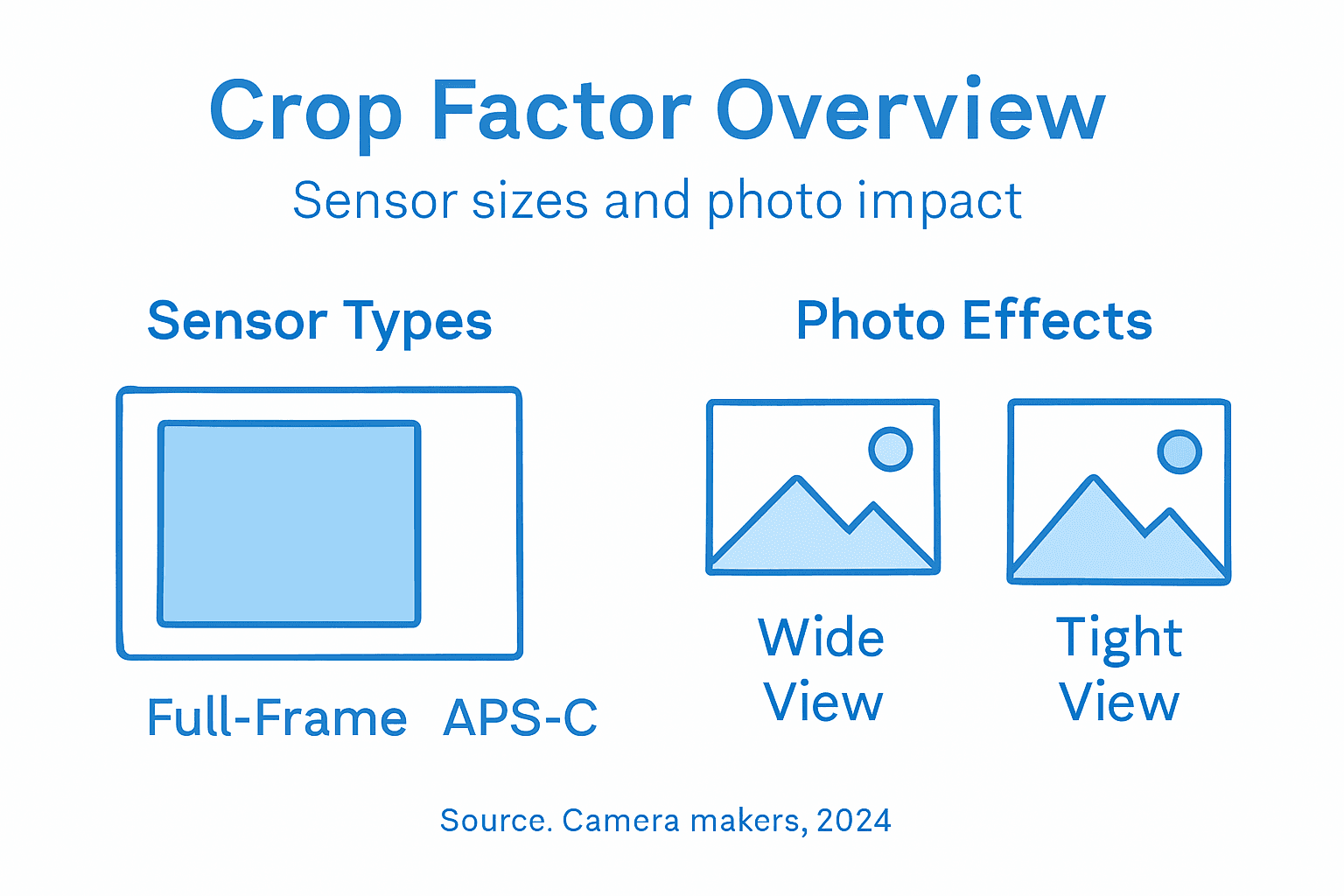
Why does sensor size matter beyond just the crop factor number? Because it directly affects what you can capture and how your equipment behaves. With a smaller sensor, you’re literally capturing a smaller slice of the image circle that your lens projects. Imagine your lens as a spotlight throwing light onto a wall. A full-frame sensor captures the entire bright circle. An APS-C sensor only catches the center portion of that circle.
A Four Thirds sensor captures even less. This is why the same 50mm lens on a full-frame camera shows a wider view than the same 50mm lens on an APS-C camera. The lens hasn’t changed, but the sensor size determines how much of what the lens can see actually gets recorded.
Here’s a practical comparison table to show how different sensor sizes stack up:
| Sensor Type | Dimensions | Crop Factor | Common In |
|---|---|---|---|
| Full-Frame | 36 x 24mm | 1.0x | Professional and enthusiast cameras |
| Canon APS-C | 22.2 x 14.8mm | 1.6x | Canon DSLRs and mirrorless |
| Sony/Nikon APS-C | 23.7 x 15.6mm | 1.5x | Sony, Nikon, Pentax bodies |
| Four Thirds | 17.3 x 13mm | 2.0x | Olympus and Panasonic cameras |
| 1/2.3 inch | 6.2 x 4.7mm | 5.6x | Compact cameras and phones |
The practical takeaway is straightforward. If you’re buying your first camera, sensor size affects your budget and what lenses you’ll need. Full-frame cameras cost significantly more upfront, but APS-C cameras give you excellent image quality at a lower price point. Smaller sensors like Four Thirds are lighter and more compact, making them great for travel.
When you compare lenses across sensor sizes, remember that a 200mm telephoto on APS-C (1.5x crop) gives you the field of view equivalent to a 300mm lens on full-frame. That’s genuinely useful for wildlife and sports photographers working with limited budgets. The sensor size you choose shapes not just your initial purchase decision but your entire gear ecosystem and the creative possibilities available to you.
Pro tip: Create a reference card with your specific camera’s crop factor, then multiply it by your three most-used focal lengths to discover their “effective” field of view equivalents; this single exercise transforms abstract crop factor numbers into real, concrete framing perspectives you can actually visualize when shooting.
How Crop Factor Affects Field Of View
Field of view is the observable angle that your camera sensor captures when you press the shutter button. It’s what you see in your final image, determined by how much of the scene in front of you gets recorded. Crop factor directly controls this. When you use a smaller sensor, you’re physically capturing less of the light that the lens projects onto it. Think of it this way: your lens acts as a window, and your sensor is the wall behind that window.
A full-frame sensor is a large wall that catches everything the lens window shows. An APS-C sensor is a smaller wall positioned in the center of that same window, so it only catches what falls on that smaller area. The lens projects the same image either way, but the smaller sensor misses the edges.
Here’s where the numbers become concrete. A 50mm lens on a full-frame camera has a field of view of about 47 degrees horizontally. That same 50mm lens on an APS-C camera with a 1.5x crop factor produces a field of view equivalent to about 75mm on full-frame, or roughly 32 degrees horizontally. You’re seeing less width. A 200mm telephoto lens on an APS-C body gives you the field of view of a 300mm lens on full-frame.
The focal length on the lens barrel still reads 200mm, but because your sensor is smaller, you end up with a narrower view. This is why different focal lengths create such different framing possibilities across sensor sizes. The effective viewing angle narrows as your crop factor increases, which affects every compositional choice you make when framing your shot.
This field of view change has real consequences for how you photograph. Wide-angle lenses become less wide on crop sensors, which frustrates landscape photographers who feel they lose the expansive vista they wanted. Telephoto lenses gain reach without you buying more expensive glass, which thrills wildlife and sports shooters. Standard prime lenses shift their behavior too.
A 35mm lens on APS-C behaves more like a 50mm on full-frame, giving it a slightly tighter perspective. Portrait photographers sometimes prefer this natural focal length compression, while others find themselves stepping back when they don’t want to. Understanding these shifts helps you choose lenses strategically and compose more intentionally.
The critical insight is this: crop factor doesn’t change your lens’s optical properties or how it focuses. It simply changes what portion of the image your sensor captures. When you look through your viewfinder or at your LCD screen, you’re looking at the view your specific sensor size creates with your specific lens. It’s not better or worse than what a full-frame photographer sees with the same lens. It’s different.
Once you accept that your 18mm wide-angle captures more like a 27mm on full-frame, you stop fighting against it and instead compose knowing exactly what framing you’ll get. You become more deliberate with your positioning and subject placement.
Pro tip: Before your next shoot, pick one lens you use regularly and calculate its effective focal length on your camera, then compare that value to what full-frame photographers achieve with their lenses; this single act transforms abstract crop factor math into actual compositional awareness, making you more intentional about how you frame every shot.
Calculating Equivalent Focal Lengths
The formula for calculating equivalent focal length is straightforward: multiply your lens’s actual focal length by your camera’s crop factor. That’s it. Actual Focal Length × Crop Factor = Equivalent Focal Length.
This simple math converts what your lens is actually rated at into what it behaves like on your specific camera compared to full-frame standards. If you’re shooting a 50mm lens on an APS-C camera with a 1.5x crop factor, your equivalent focal length is 50 × 1.5 = 75mm. That 200mm telephoto on the same camera becomes 200 × 1.5 = 300mm equivalent.
Your 18mm wide-angle becomes 27mm equivalent. These equivalent focal lengths tell you the field of view you’re getting, making it easier to compare your setup to what full-frame photographers achieve. The metric helps you understand lens behavior across different camera systems and make informed decisions about which lenses to buy.
Why should you care about this calculation? Because it directly impacts your creative choices and gear decisions. When you’re shopping for lenses, knowing the equivalent focal length helps you pick the right tool for your vision. A beginner looking for a standard portrait lens might think a 50mm prime is what they need, but on a 1.6x crop Canon, that 50mm actually gives them a 80mm equivalent, which is tighter than they might want for full-body portraits.
They’d be better served by a 35mm lens (56mm equivalent) or even a 24mm (38mm equivalent). For wildlife photography, a 1.5x crop factor becomes your friend. A 400mm telephoto lens on APS-C gives you 600mm equivalent reach, which costs far less than buying a 600mm lens for full-frame. Understanding focal length behavior across sensor sizes prevents costly mistakes and helps you build a smarter lens collection.
Let’s look at some practical examples that show how this math plays out in real shooting scenarios:
- You have a Canon APS-C (1.6x crop) and want wide-angle landscapes. Your 16mm ultra-wide lens gives you 16 × 1.6 = 25.6mm equivalent. That’s still fairly wide, but not as expansive as a 16mm on full-frame would be.
- You’re using a Sony APS-C (1.5x crop) for street photography. Your 35mm prime lens becomes 35 × 1.5 = 52.5mm equivalent, which is close to the classic 50mm portrait focal length, giving your street work a slightly compressed perspective.
- You own a Four Thirds Olympus (2x crop) for birding. Your 300mm telephoto lens becomes 300 × 2 = 600mm equivalent. That’s serious reach for wildlife without needing a massive, expensive lens.
The real power of this calculation is that it removes confusion when you’re comparing your results to others’ work. Instead of wondering why your 50mm doesn’t look like someone else’s 50mm, you can instantly calculate that theirs is on full-frame (50mm equivalent) while yours is 75mm equivalent on APS-C. The difference is explained.
You’re not missing something, the sensors are simply different sizes. This clarity helps you stop second-guessing your gear and start focusing on composition and technique, which actually matter far more than equipment specs.
Pro tip: Calculate the equivalent focal length for your three most-used lenses and write them on small stickers you attach to each lens barrel, then reference these numbers before every shoot to anticipate framing and avoid being surprised by how wide or tight your field of view actually is.
Practical Impacts On Lens Choice And Results
Your crop factor directly shapes which lenses you need to buy and how you’ll use them. The field of view narrowing that comes with smaller sensors means you’ll need to make deliberate adjustments to your lens strategy. If you’re shooting landscapes on an APS-C camera and want that expansive wide-angle look, a 24mm lens won’t cut it like it would on full-frame.
You’d need something wider, maybe 16mm or even 12mm, to capture the same scene width. This forces you into buying different glass than what full-frame photographers use for identical results. Wide-angle lenses become more critical investments.
Conversely, if you’re photographing wildlife or sports, that crop factor works in your favor. A 300mm telephoto lens on your 1.5x crop sensor gives you 450mm equivalent reach without the weight, cost, and optical complexity of a true 450mm lens. Your existing telephoto glass stretches farther than it would on full-frame, which means you can reach distant subjects more easily and often with less expensive equipment. This advantage makes crop sensors genuinely appealing for certain genres.
The practical lens choices change genre by genre. For portrait work, crop factor means your classic 85mm portrait lens becomes 127.5mm equivalent on 1.5x APS-C, which is tighter than ideal for full-body shots and borders on uncomfortably compressed for head-and-shoulders work.
Portrait photographers on crop sensors typically opt for 50mm or 55mm lenses instead to get more comfortable framing. Street photographers find that their standard 35mm lens behaves like a 52mm on crop, giving them that slightly tighter perspective they might actually prefer for candid work.
Macro photographers appreciate that crop sensors amplify magnification without special equipment, though understanding lens characteristics becomes critical when mixing crop and full-frame systems in the same kit. Video creators often prefer crop sensors because that natural telephoto effect reduces the need for gimbal stabilization and gives them better subject isolation at reasonable distances.
Beyond lens choice, crop factor affects your actual shooting results in subtle but important ways. You’ll compose differently because you see a narrower frame in your viewfinder. Your depth of field perception changes too. Although the actual depth of field at a given aperture doesn’t mathematically change, the equivalent focal length means you’re often using wider apertures on crop sensors to achieve the same shallow depth of field effect that full-frame photographers get.
A crop sensor shooter using an f/2.8 aperture at 75mm equivalent gets similar background blur to a full-frame photographer using f/4 at 100mm equivalent.
This affects your camera settings and flash usage. Low-light performance shifts because you might find yourself hunting for wider aperture lenses. Image quality considerations emerge too. Your crop sensor demands sharper lenses to achieve the same apparent sharpness, since any optical flaws get magnified slightly when viewed at the same print size. Building your lens collection around crop factor reality instead of fighting against it makes you a smarter buyer and more intentional photographer.
Pro tip: Before investing in any new lens, calculate what that lens will behave like on your specific camera using the crop factor, then find sample images shot with that equivalent focal length on full-frame to visualize the actual framing you’ll get and ensure you’re making an informed purchase decision.
Here’s how crop factor influences lens choice for popular photography genres:
| Genre | Typical Lens on Full-Frame | Equivalent Lens on APS-C (1.5x) | Impact on Framing |
|---|---|---|---|
| Landscape | 16-24mm wide-angle | 10-16mm wide-angle | Wider lens needed for same view |
| Portrait | 85mm prime | 50-55mm prime | Avoid excessive compression |
| Wildlife | 300-400mm telephoto | 200-270mm telephoto | Achieve longer reach cheaply |
| Street | 35mm prime | 23-35mm prime | Tighter, more intimate perspective |
Avoiding Mistakes With Crop Sensors
The biggest mistake crop sensor photographers make is assuming the crop factor changes their lens’s focal length. It doesn’t. Your 50mm lens is still a 50mm lens. The focal length is an optical property built into the lens design, not something that changes based on sensor size. What changes is the field of view. This confusion leads to real problems. You might buy a lens thinking it will behave one way, only to find it captures a much narrower view than expected.
You might blame your equipment for producing tight framing when the real issue is your understanding of how crop factor works. Stop fighting against your sensor size and start composing around it. Accept that your 18mm lens captures like a 27mm on full-frame, then use that knowledge intentionally instead of wishing it performed differently. This mental shift alone prevents countless frustrating shots and wasted lens purchases.
Another common pitfall is mismatching your lens strategy to your shooting genre. Beginners on crop sensors often buy wide-angle lenses rated for full-frame users without calculating equivalent focal lengths. You grab an 18mm thinking it will give you dramatic landscapes, but on your 1.5x APS-C camera, that’s really a 27mm equivalent, which is barely wider than a standard lens. Meanwhile, you might overlook that your 200mm telephoto becomes 300mm equivalent, a genuine advantage you’re not leveraging.
Landscape photographers should prioritize ultra-wide lenses in the 10mm to 14mm range. Wildlife photographers should embrace telephoto lenses knowing they get free magnification. Portrait photographers need shorter focal lengths than full-frame colleagues to achieve the same framing. When you understand common photography mistakes, you realize many stem from equipment choices that didn’t align with actual crop factor behavior.
A third mistake involves exposure and depth of field assumptions. Many beginners think crop sensors automatically give them shallower depth of field at the same aperture, which isn’t true. The actual depth of field at f/2.8 on a crop sensor is identical to f/2.8 on full-frame with the same focal length. However, to match the depth of field effect of a full-frame photographer using a 85mm lens, you’d need to use a 56mm lens on APS-C, which naturally has less background blur at the same aperture.
This leads people to buy expensive wide-aperture lenses hunting for bokeh they can’t achieve without switching focal lengths. Understanding this prevents wasteful gear purchases and corrects unrealistic expectations about what your camera can deliver.
Final mistakes include not adjusting your composition strategy for the narrower field of view. You position yourself as you would on full-frame, then wonder why your framing feels tighter. Crop sensors require you to move closer or reposition more intentionally.
You also might overlook the advantage of cropped magnification for macro work. Your crop sensor naturally magnifies subjects, meaning you achieve closeup magnification without expensive macro lenses. Once you stop treating crop factor as a limitation and start treating it as a design characteristic, you compose smarter, buy lenses strategically, and produce better images aligned with your equipment’s actual capabilities.
Use this quick reference to avoid common crop sensor mistakes:
| Mistake | Cause | How to Prevent |
|---|---|---|
| Thinking focal length changes | Misunderstanding lens specs | Always calculate field of view |
| Choosing wrong lens for genre | Ignoring crop factor math | Use equivalent focal length charts |
| Expecting different depth of field | Aperture/focal length confusion | Match effective focal length, not just aperture |
| Composing for full-frame | Not considering viewfinder framing | Move with intent, check cropping before shooting |
Pro tip: Create a simple reference sheet with your camera’s crop factor and the equivalent focal lengths of your five most-used lenses, then keep it accessible during shoots so you can glance at it before composing and avoid the shock of mismatched framing between what you envisioned and what your camera actually captures.
Master Your Crop Factor Knowledge and Elevate Your Photography
Understanding how crop factor influences your field of view and lens choices can feel overwhelming but it is key to unlocking your camera’s full creative potential. This article highlights common challenges such as confusing focal length with field of view and mismatching lenses for your sensor size.
If you have ever been frustrated by unexpectedly tight framing or struggled to pick the right lens to achieve your vision then you are not alone. Many amateur photographers face those hurdles and miss out on powerful techniques that crop sensors uniquely offer.
Take charge of your photography journey today by exploring practical guidance that simplifies complex concepts like crop factor and sensor size. At Amateur Photographer Guide, you will find expert insights, easy-to-follow tutorials, and detailed buying advice tailored for enthusiasts like you.
Start by comparing your effective focal lengths or discovering how to choose lenses that truly match your shooting style. Act now to transform confusion into confidence with resources designed to help you compose smarter, shoot better, and select gear more wisely. Visit Amateur Photographer Guide to get started and see your shots in a whole new light.
Frequently Asked Questions
What is crop factor in photography?
Crop factor is the ratio between the size of a camera’s sensor and a standard full-frame sensor (36mm x 24mm). It determines how much of the scene is captured in the frame and affects the effective focal length of lenses.
How does crop factor affect my lens’s focal length?
The crop factor does not change the actual focal length of the lens; it alters the field of view. For example, a 50mm lens on a camera with a 1.5x crop factor behaves like a 75mm lens in terms of the field of view because the smaller sensor captures less of the image projected by the lens.
Why are crop sensors beneficial for photographers?
Crop sensors offer practical advantages such as more affordable camera bodies and greater effective focal lengths, which are helpful for capturing distant subjects without needing expensive lenses. They are particularly appealing for genres like wildlife and sports photography.
How should I adjust my lens choices based on crop factor?
When choosing lenses, consider the equivalent focal lengths based on your camera’s crop factor. For wide-angle shots on a crop sensor, opt for a wider lens than you would on a full-frame camera. This ensures you achieve the desired framing and perspective for your compositions.
Recommended
- Focal Plane in Photography: Why It Matters For Better Photos
- what do different focal lengths do?
- Focal Length in Photography
- Turn Your Photo Into a Painting
Last update on 2026-03-15 / Affiliate links / Images from Amazon Product Advertising API