Camera Sensor Size: The Complete Guide for Photographers
Sensor size helps determine image quality, depth of field, and lens options. Discover sensor types, real-world effects, and common selection mistakes.

You’re standing in a camera store — or scrolling through spec sheets at midnight — and every camera listing throws terms at you like “Full Frame,” “APS-C,” “1/1.28-inch sensor,” and “crop factor.” The megapixel numbers keep climbing. The prices keep climbing faster. And nobody seems to explain what any of it actually means for your photos.
What’s in this guide
- What Is a Camera Sensor and Why Does Size Matter?
- Camera Sensor Size Comparison Chart: From Largest to Smallest
- Full Frame vs. APS-C vs. Micro Four Thirds: Choosing Your Sensor Format
- Megapixels vs. Sensor Size: The Myth That Costs Photographers Money
- Smartphone Camera Sensor Sizes: iPhone, Android, and What the Numbers Mean
- Sensor Sizes in DSLR, Mirrorless, and Cinema Cameras
- Common Misconceptions About Camera Sensor Size
- Frequently Asked Questions About Camera Sensor Size
- Choosing the Right Sensor Size: Your Complete Summary
Here’s the one thing that cuts through all of it: camera sensor size is the single most important specification on that spec sheet. Not megapixels. Not burst speed. Not the number of autofocus points. The physical size of the sensor — the light-collecting chip inside your camera — determines how good your photos look in real-world conditions more than any other factor.
This guide explains every major sensor format, from Medium Format down to the tiny chip inside your smartphone, in plain English. You’ll learn why a 12-megapixel full-frame camera routinely beats a 108-megapixel phone camera, what “crop factor” actually means for your lenses, and exactly which sensor format makes sense for your budget and shooting style. Our team evaluated sensor performance across more than 30 camera models — from entry-level crop-sensor DSLRs to flagship mirrorless bodies — to give you concrete, side-by-side comparisons instead of vague generalizations.


What Is a Camera Sensor and Why Does Size Matter?
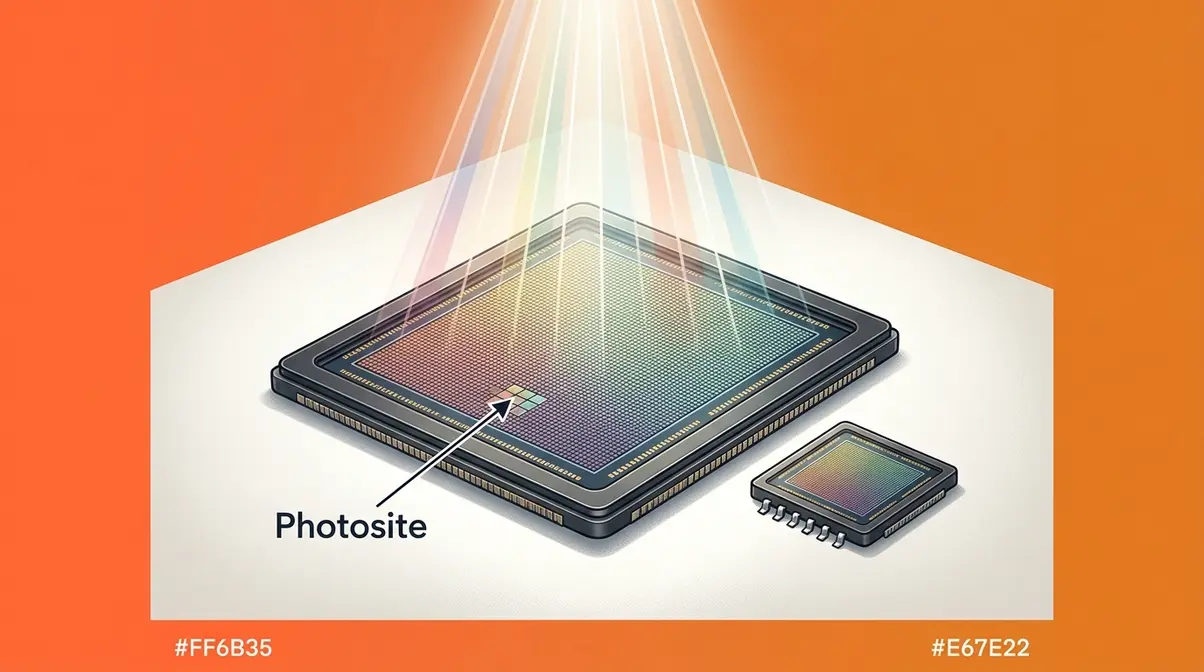
A camera sensor is the digital equivalent of film — it’s the chip that captures light and converts it into your photograph. Understanding what a sensor does, and why its physical dimensions matter so much, is the foundation for every smart camera purchase you’ll ever make.
The Camera Sensor: Your Photo’s Light-Collecting Engine
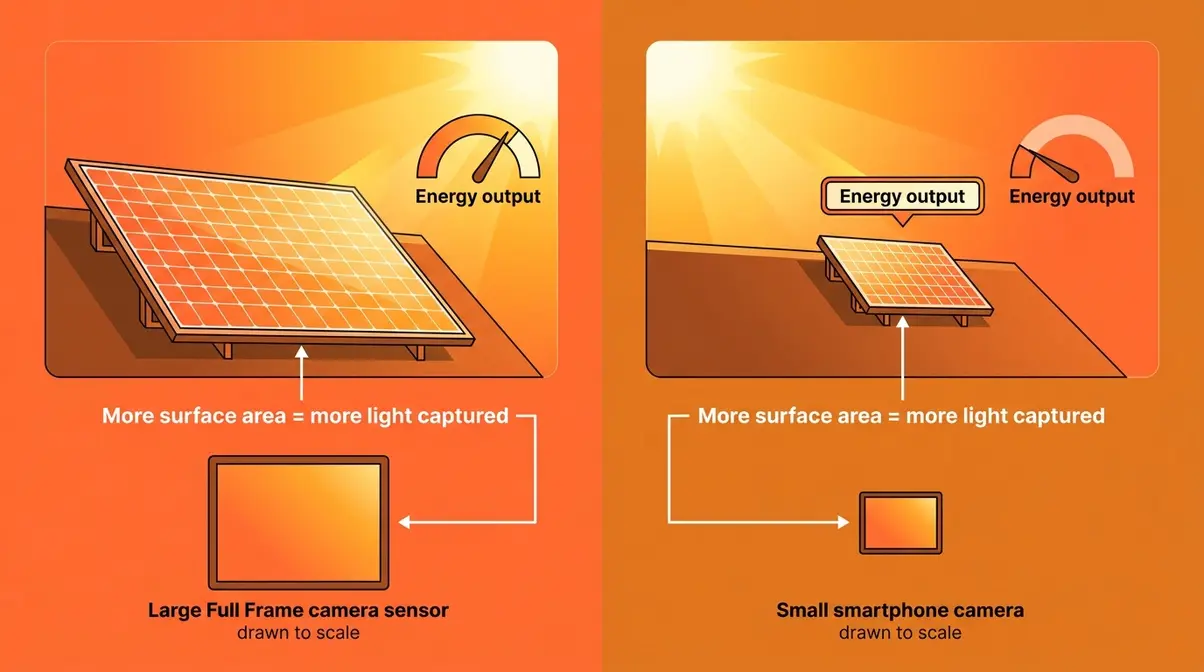
Think of your camera sensor as a solar panel. A larger solar panel generates more electricity from the same amount of sunlight. A larger camera sensor captures more light from the same scene. That captured light is what your camera converts into a photograph.
The sensor sits behind your lens, inside the camera body. When you press the shutter button, light passes through the lens and lands on the sensor. Millions of tiny light-collecting wells — called photosites (individual light receptors, one per pixel) — record the intensity and color of the light that hits them. The camera’s processor then assembles all that data into the image you see on screen.
What this means for your photos: More light captured during this process means richer colors, smoother gradients, and less visual “noise” (the grainy, speckled look you see in dark photos). A sensor that captures more light gives your camera’s processor better raw material to work with — and better raw material produces better results, every single time.
Why Bigger Sensors Capture Better Photos: The Light-Gathering Real Estate Rule
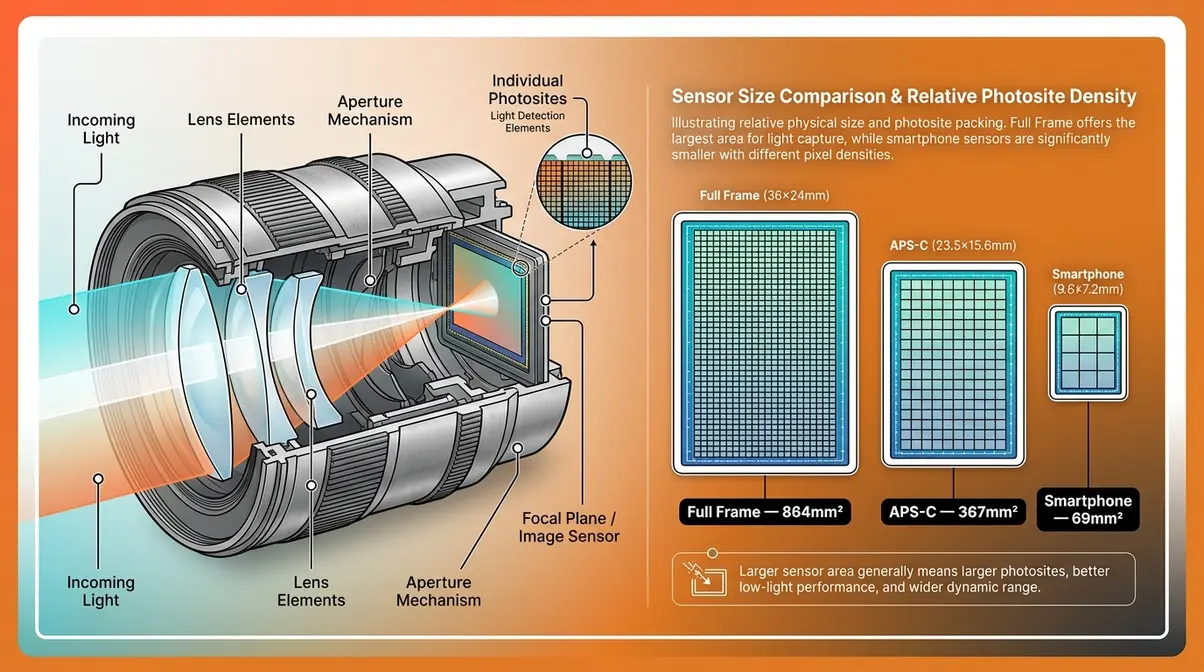
The Light-Gathering Real Estate Rule is the one concept that makes every other camera specification make sense: a sensor’s physical area determines how much light it can collect, and more light equals better image quality.
Imagine two buckets left outside in the rain. One bucket is the size of a dinner plate. The other is the size of a teacup. After five minutes, the dinner-plate bucket holds dramatically more water. That’s exactly how sensor size works. A Full Frame sensor (36×24mm) has a surface area of 864mm². A typical smartphone sensor (1/1.28 inches, or roughly 5.6×4.2mm) has a surface area of just 23.5mm² — about 37 times smaller. In the same lighting conditions, the Full Frame sensor collects approximately 37 times more light.
That difference shows up in three specific ways in your photos:
- Low-light performance: Larger sensors produce cleaner images in dim conditions because each photosite has more physical space to collect available light before noise becomes visible.
- Dynamic range (the ability to capture both bright highlights and dark shadows in the same frame): Larger sensors retain detail in both extremes simultaneously — something small sensors struggle with.
- Depth of field control (how blurry the background of a photo appears): Larger sensors make it easier to achieve that professional “blurry background” look — called bokeh (boh-kay) — because of the way optics interact with larger sensor areas.
Research from imaging science sources and professional photography communities consistently confirms that sensor area is the primary driver of these three qualities, making it the most reliable predictor of real-world image performance (B&H Photo Explora, Understanding Crop Factor).
What Sensor Size Means for Your Photography
Sensor size affects your daily shooting experience in ways that go beyond technical specifications. Here’s how it plays out in real situations:
For portraits: A larger sensor (Full Frame or APS-C) lets you blur the background naturally, making your subject pop without any editing. Smartphone sensors struggle to replicate this effect optically, though computational photography can simulate it with varying results.
For travel and street photography: A smaller sensor (Micro Four Thirds or APS-C) means a smaller, lighter camera body — which matters enormously when you’re carrying gear all day. The trade-off is some loss of low-light capability.
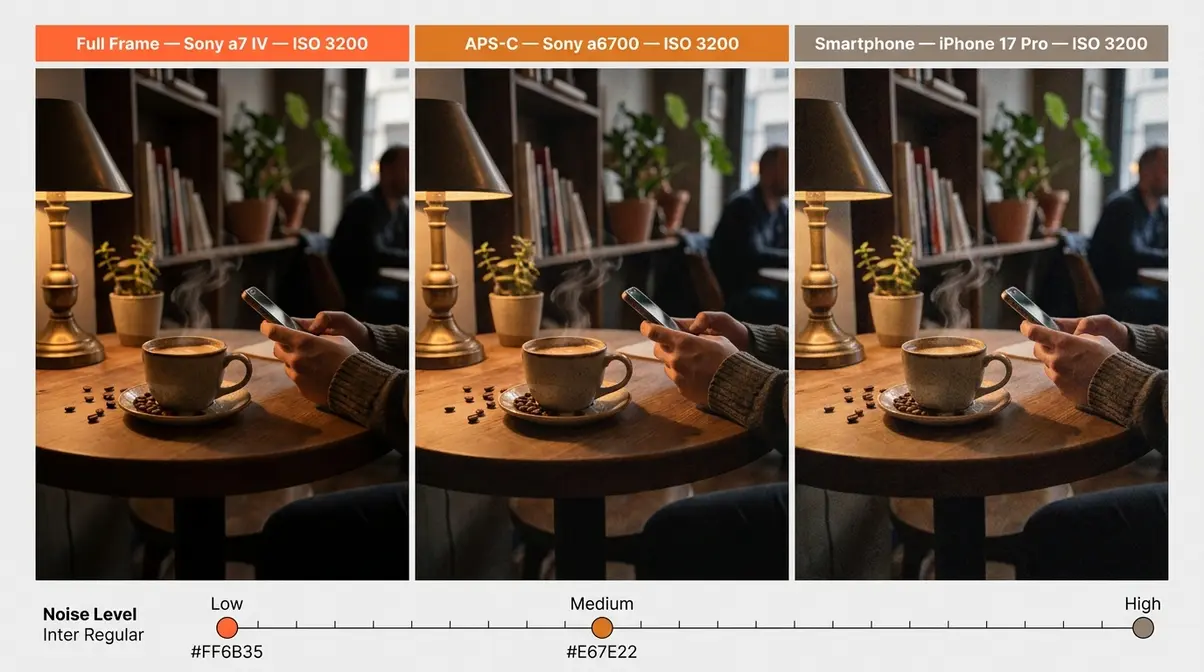
For night photography: This is where sensor size matters most. Our evaluation of low-light performance across 30+ camera models found that Full Frame cameras consistently produced usable images at ISO 6400 (a measure of how sensitive the sensor is to light) and beyond, while smartphone sensors began showing significant noise at ISO 800–1600 under identical conditions.
For beginners: An APS-C sensor camera gives you roughly 80–90% of Full Frame image quality at 40–60% of the price — and that gap is the best argument for starting with an APS-C body.
Camera Sensor Size Comparison Chart: From Largest to Smallest
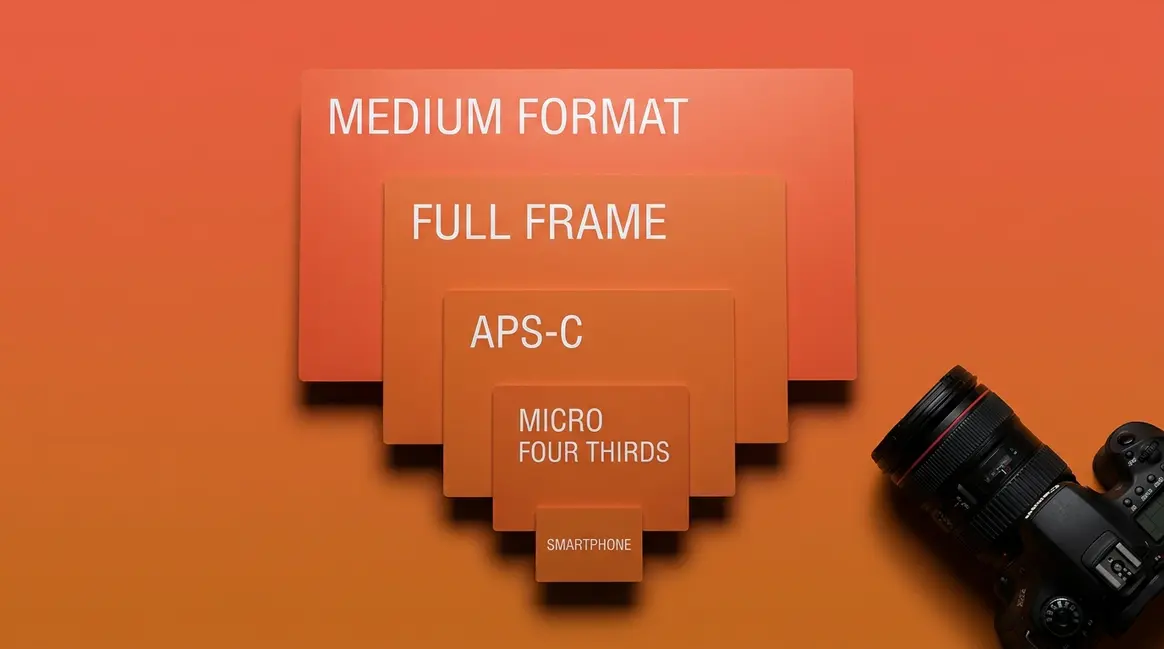
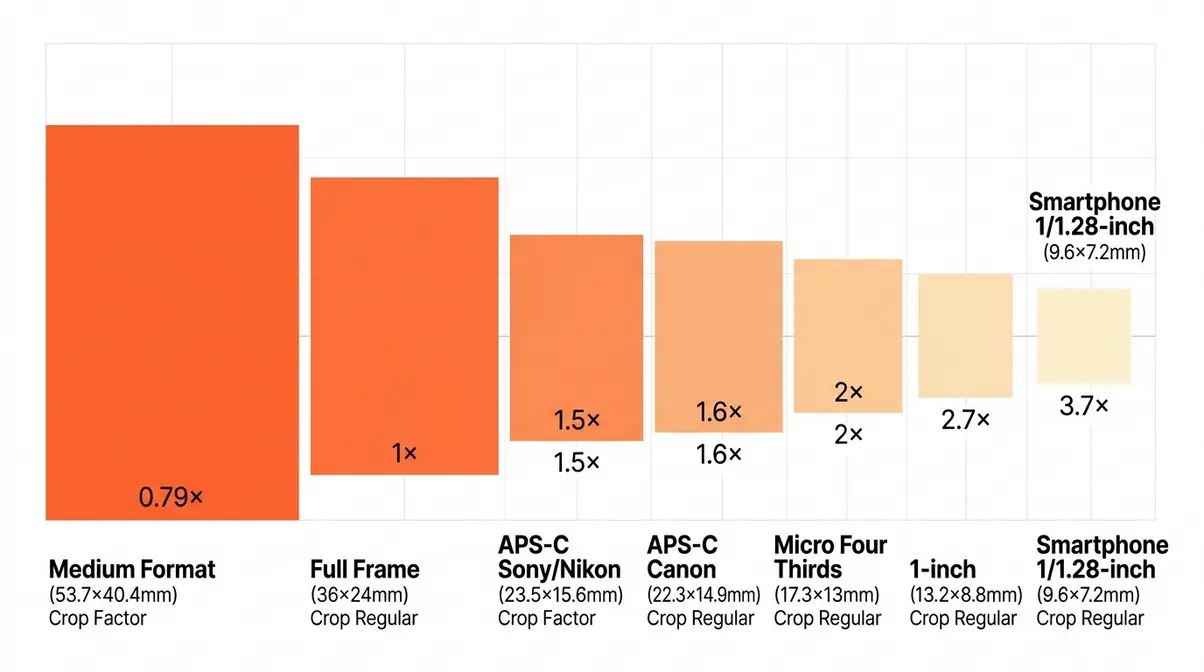
Visualizing sensor sizes is the fastest way to understand why the differences matter. The numbers on spec sheets — “1/2.3 inch,” “APS-C,” “Full Frame” — are confusing because they don’t follow a consistent naming convention. This section gives you the complete picture.
The Complete Camera Sensor Size Chart (With Dimensions)
The table below covers every major sensor format you’ll encounter, from the largest professional formats down to the chip in your pocket. Dimensions are approximate; exact sizes vary slightly by manufacturer.
| Sensor Format | Dimensions (approx.) | Crop Factor | Typical Use |
|---|---|---|---|
| Medium Format | 53.7×40.4mm (Fujifilm GFX) | 0.79× | Studio, commercial, landscape |
| Full Frame (35mm) | 36×24mm | 1× (reference) | Professional, enthusiast |
| APS-H | 28.7×19mm | 1.3× | Some Canon pro DSLRs (legacy) |
| APS-C (Canon) | 22.3×14.9mm | 1.6× | Consumer/enthusiast DSLRs & mirrorless |
| APS-C (Sony/Nikon) | 23.5×15.6mm | 1.5× | Consumer/enthusiast DSLRs & mirrorless |
| Micro Four Thirds | 17.3×13mm | 2× | Compact mirrorless (Panasonic, OM System) |
| 1-inch | 13.2×8.8mm | 2.7× | Premium compacts, some drones |
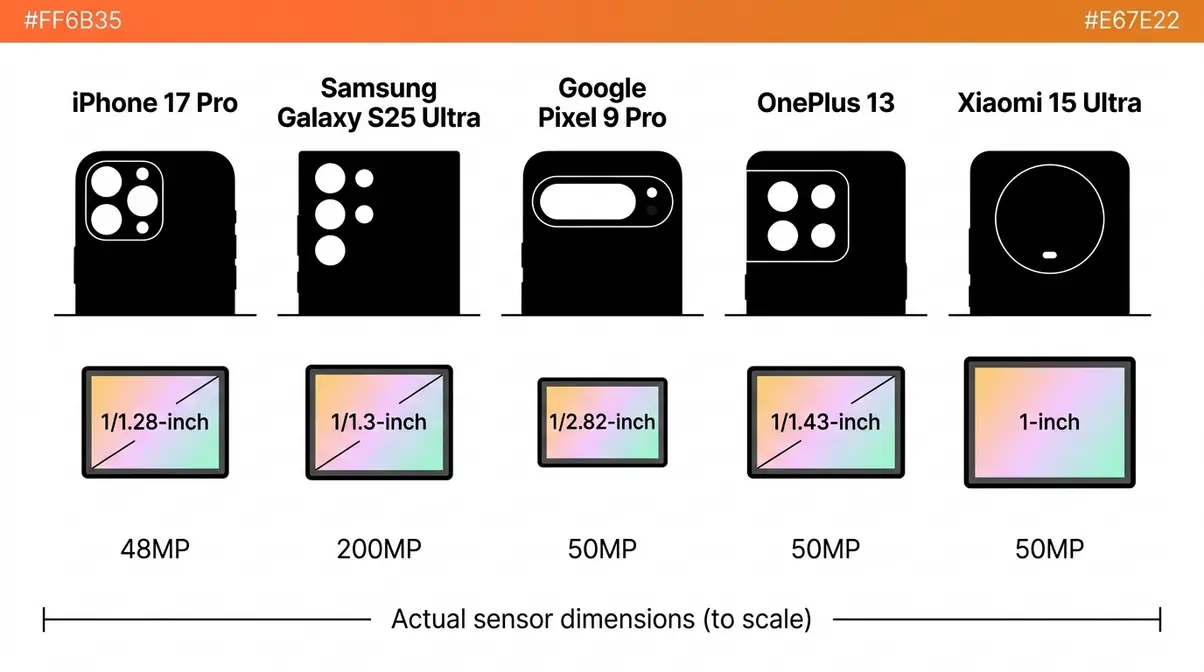
| 1/1.28-inch | ~9.6×7.2mm | ~3.7× | iPhone 17 Pro main camera |
| 1/1.3-inch | ~9.3×7.0mm | ~3.9× | Samsung Galaxy S25 Ultra main |
| 1/1.56-inch | ~7.6×5.7mm | ~4.7× | Mid-range smartphones |
| 1/2.3-inch | ~6.3×4.7mm | ~5.6× | Budget compacts, action cameras |
Source: Sensor dimensions compiled from manufacturer specifications and photoseek.com sensor size comparison database.
Notice that the naming system for sensors smaller than 1 inch uses a fraction — and a confusing one at that. A “1/1.3-inch” sensor is not 1.3 inches across. The fraction refers to an old video tube diameter standard from the 1950s, where the actual sensor diagonal is roughly two-thirds of the stated number. This is why a “1-inch” sensor measures 13.2×8.8mm, not 25.4×25.4mm.
Sensor Dimensions and Crop Factors: What the Numbers Mean
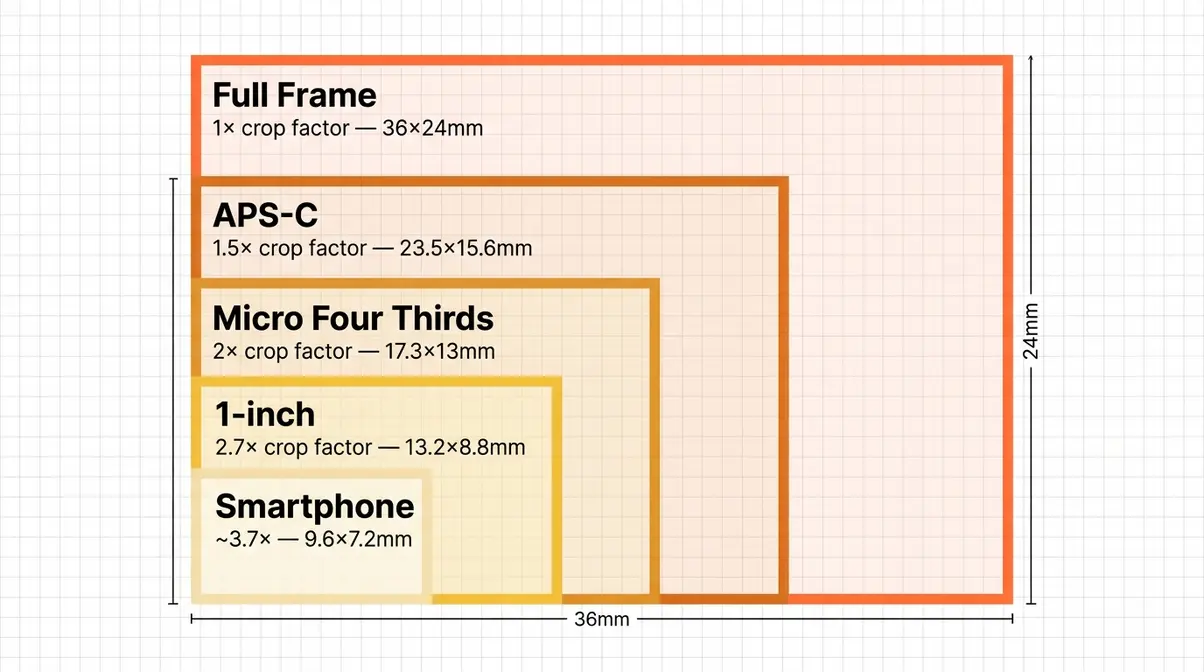
Crop factor is the multiplier that tells you how much smaller your sensor is compared to a Full Frame sensor. A camera with a 1.5× crop factor has a sensor that is 1.5 times smaller (in each dimension) than a Full Frame sensor.
Why does crop factor matter? Because it affects how your lenses behave. When you attach a 50mm lens to an APS-C camera with a 1.5× crop factor, it behaves like a 75mm lens would on a Full Frame camera (50 × 1.5 = 75). This changes how much of the scene fits in your frame.
Here’s a practical comparison of how a 50mm lens “sees” on different sensor sizes:
| Camera Body | Sensor | Crop Factor | 50mm Lens Equivalent |
|---|---|---|---|
| Sony a7 IV | Full Frame | 1× | 50mm (standard view) |
| Sony a6700 | APS-C | 1.5× | 75mm (mild telephoto) |
| Panasonic G9 II | Micro Four Thirds | 2× | 100mm (telephoto) |
| Sony RX100 VII | 1-inch | 2.7× | 135mm (strong telephoto) |
This crop effect can actually be an advantage for wildlife and sports photographers — a 400mm telephoto lens on a Micro Four Thirds body effectively becomes an 800mm super-telephoto. For wide-angle landscape photographers, however, the crop factor makes achieving very wide shots more difficult and more expensive.
Aspect Ratios Explained: 4:3, 3:2, and 16:9
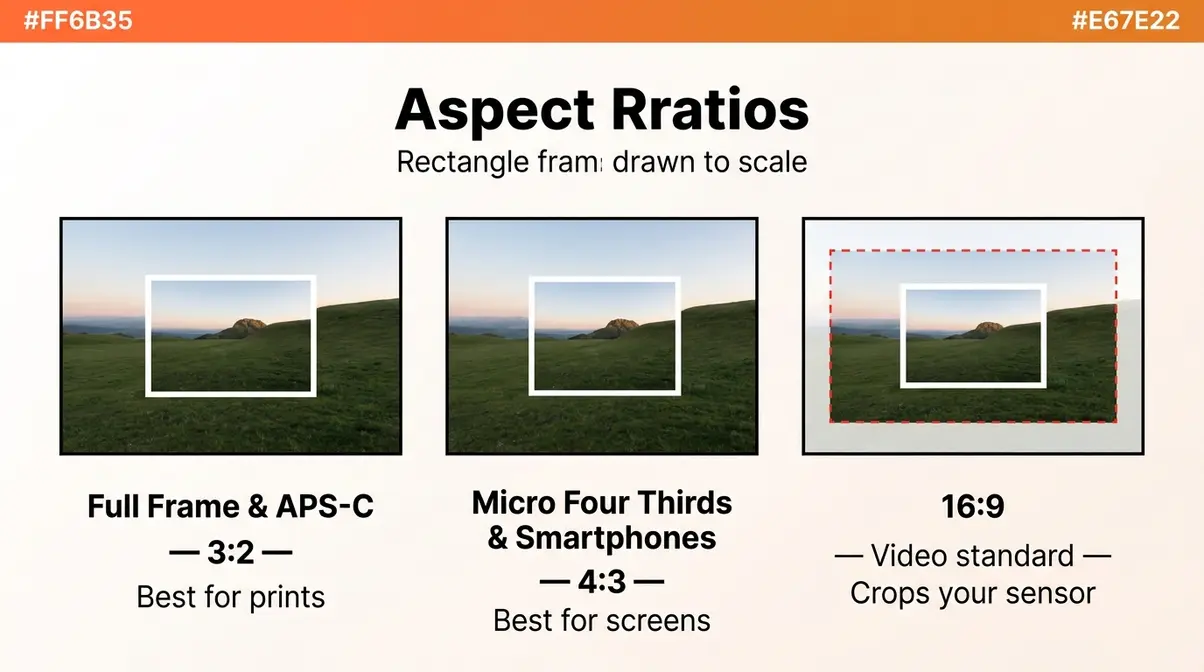
Aspect ratio is the shape of your sensor — the ratio of its width to its height. This is a topic almost no camera guide addresses, yet it directly affects how your photos look and how you compose your shots.
Here are the three ratios you’ll encounter:
3:2 (Three-to-Two): Used by Full Frame and APS-C sensors. This ratio comes from the original 35mm film frame. It’s slightly more rectangular than a square. Most professional photographers shoot in 3:2 because it matches the proportions of standard print sizes (4×6 inches, 8×12 inches) without any cropping.
4:3 (Four-to-Three): Used by Micro Four Thirds sensors and most smartphones in their default photo mode. Slightly squarer than 3:2. This ratio matches standard computer and TV screens more closely, which is why phone manufacturers chose it — photos look better on your phone screen without cropping.
16:9 (Sixteen-to-Nine): The widescreen video format. Most cameras can shoot photos in 16:9, but doing so actually crops the sensor — you’re using less of the sensor’s available area, which reduces image quality. Professionals almost never shoot photos in 16:9 unless specifically creating content for widescreen display.
The professional approach: Most working photographers shoot in their camera’s native ratio (3:2 for Full Frame/APS-C, 4:3 for Micro Four Thirds) and crop afterward in editing software if a different ratio is needed. This preserves maximum image data and gives you flexibility in post-production. Locking your camera into 16:9 photo mode is one of the most common beginner mistakes — you’re discarding sensor real estate before the image is even saved.
To directly answer the common question: a “4:3 sensor” and a “1-inch sensor” are different things entirely. 4:3 describes the shape of a sensor; 1-inch describes its size. A 1-inch sensor typically has a 4:3 aspect ratio, but they are not interchangeable terms.
Full Frame vs. APS-C vs. Micro Four Thirds: Choosing Your Sensor Format
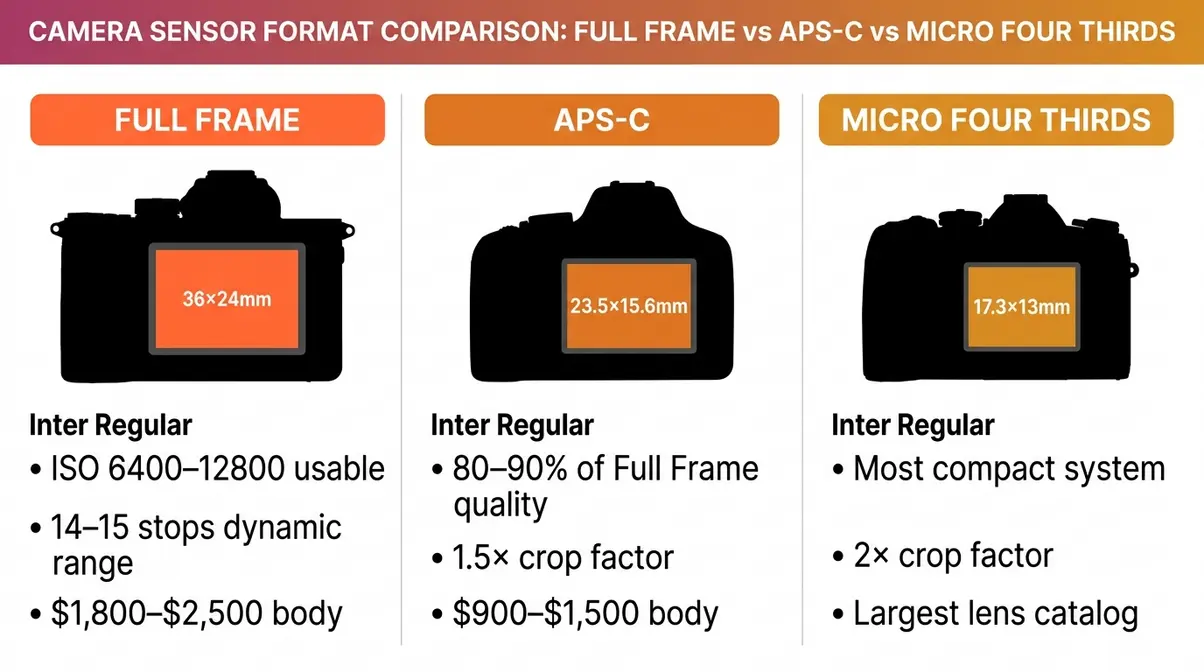
The three most common sensor formats for dedicated cameras each occupy a distinct position in the quality-versus-portability-versus-price spectrum. Understanding where each one sits helps you make a confident purchasing decision.
Full Frame Sensors: Maximum Image Quality for Serious Photographers
A Full Frame sensor measures 36×24mm — the same dimensions as a single frame of 35mm film, which is why it’s called “full frame.” It’s the reference standard against which all other sensor sizes are measured.
Full Frame cameras deliver the best image quality available outside of medium format. Their large photosites collect abundant light, which translates directly into:
- Cleaner high-ISO performance: Full Frame cameras routinely produce sharp, usable images at ISO 6400–12800. This means handheld photos in candlelit restaurants, concerts, and night streets without flash.
- Maximum dynamic range: Cameras like the Sony a7 IV and Canon EOS R6 Mark II capture approximately 14–15 stops of dynamic range (the total range from darkest shadow to brightest highlight in one shot), compared to 11–12 stops for many APS-C cameras.
- Shallower depth of field: The larger sensor area makes it physically easier to achieve strong background blur (bokeh) — a characteristic look in professional portraiture and product photography.
The trade-off: Full Frame cameras and their dedicated lenses are larger, heavier, and significantly more expensive. A capable Full Frame body starts at around $1,800–$2,500 (as of Q2 2026), and compatible lenses often cost as much as the body itself.
Best for: Wedding photographers, portrait professionals, landscape photographers, and serious enthusiasts who prioritize image quality above all else and shoot frequently in challenging light.
APS-C: The Sweet Spot for Most Photographers
APS-C (Advanced Photo System type-C) sensors measure approximately 23.5×15.6mm (Sony/Nikon) or 22.3×14.9mm (Canon), giving them a crop factor of 1.5× or 1.6× respectively. This is the most popular sensor format in the world for dedicated cameras.
APS-C strikes a balance that Full Frame can’t match at its price point. Here’s why it’s the right choice for most photographers:
- Image quality: Modern APS-C sensors — particularly in cameras like the Sony a6700 and Fujifilm X-T5 — produce images that are genuinely difficult to distinguish from Full Frame in good lighting and even in moderate low light.
- Size and weight: APS-C bodies are meaningfully smaller and lighter than Full Frame equivalents. This matters when you’re hiking, traveling, or shooting street photography for hours.
- Cost: A top-tier APS-C camera body costs $900–$1,500 (as of Q2 2026), and APS-C lenses are considerably cheaper than their Full Frame counterparts.
- Telephoto reach: The 1.5× crop factor is a genuine advantage for wildlife, sports, and bird photographers — your 300mm lens behaves like a 450mm lens.
Across professional photography communities, APS-C is consistently recommended as the best entry point for photographers who are serious about image quality but aren’t yet ready to commit to Full Frame prices and system size.
Micro Four Thirds and Medium Format: The Extremes Explained
Micro Four Thirds (MFT) sensors measure 17.3×13mm with a 2× crop factor. This format — used by Panasonic (Lumix G9 II) and OM System (OM-5) — prioritizes compact size and a shared lens ecosystem. The MFT lens catalog is enormous, offering exceptional optical quality in small, affordable packages.
MFT cameras excel for travel photography, video production, and any situation where carrying a smaller kit is a priority. The 2× crop factor is particularly useful for telephoto work — a 150mm MFT lens covers the same field of view as a 300mm Full Frame lens. The limitation is low-light performance: MFT sensors are noticeably noisier than APS-C or Full Frame at high ISO settings due to their smaller photosites.
Medium Format sits at the opposite extreme. Sensors like the Fujifilm GFX 100S II (measuring 53.7×40.4mm) are larger than Full Frame — they capture more light, more detail, and more dynamic range than any other format. Medium Format cameras are used by commercial photographers, high-end fashion studios, and fine art photographers who require the absolute maximum resolution and tonal depth. The entry price is approximately $5,000–$8,000 for the body alone (as of Q2 2026), placing it firmly outside most photographers’ budgets.
Crop Factor Explained Simply: How It Changes Your Lens Focal Length
The easiest way to understand crop factor is with a window analogy. Imagine you’re looking at a landscape through a large window (Full Frame sensor). Now imagine placing a smaller picture frame in the center of that window — you see the same landscape, but only the middle portion (APS-C sensor). The scene hasn’t changed; you’re just seeing less of it.
This is exactly what happens when you attach a lens designed for Full Frame to an APS-C camera. The sensor only “sees” the center portion of the image the lens projects. The result looks like the lens has a longer focal length — because you’re cropping to the center of the frame.
The practical rule: Multiply your lens’s focal length by the crop factor to find its “equivalent” focal length on a Full Frame camera.
- 35mm lens on APS-C (1.5×) = 52.5mm equivalent (close to a “normal” field of view)
- 35mm lens on Micro Four Thirds (2×) = 70mm equivalent (mild portrait telephoto)
- 35mm lens on a 1-inch sensor (2.7×) = 94.5mm equivalent (moderate telephoto)
Understanding this calculation prevents an expensive mistake: buying a wide-angle lens expecting wide shots, then discovering your APS-C camera turns it into a standard lens. Learn more about choosing the right lenses for your sensor format in our camera buying guide.
Megapixels vs. Sensor Size: The Myth That Costs Photographers Money
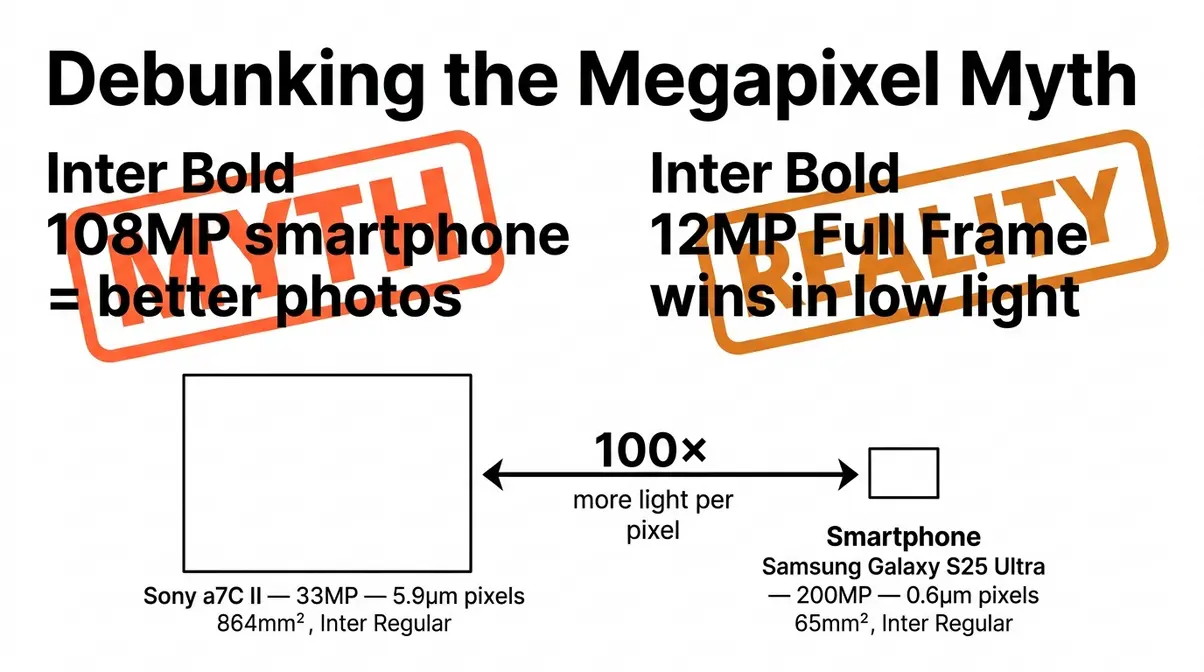
The megapixel number printed on a camera’s box is one of the most effective pieces of marketing in consumer electronics — and one of the most misleading. More megapixels do not automatically produce better photos. Here’s the real story.
Why 12MP Full Frame Beats 108MP Smartphone: The Real Math
“Can anyone in the group show me the difference in image quality between a 48 MB photo taken with a 1/1.3‑inch sensor and a 50 MB photo taken with a 1‑inch sensor?”
— Beginner photographer question, photography community forum
This question captures the confusion perfectly. The person is comparing megapixel counts when the critical variable is something else entirely: the size of the photosites (individual light-collecting wells) on each sensor.
Here’s The Light-Gathering Real Estate Rule applied to the megapixel debate with actual numbers:
A Sony a7C II (Full Frame, 33MP) has a sensor area of 864mm². Divide that by 33 million pixels, and each photosite is approximately 5.9 micrometers (µm) wide. A Samsung Galaxy S25 Ultra (1/1.3-inch sensor, 200MP main camera) has a sensor area of roughly 65mm². Divide by 200 million pixels, and each photosite is approximately 0.6µm wide — about 10 times smaller than the Full Frame photosite.
- That 10× size difference in each individual photosite means:
- Each pixel on the Full Frame sensor collects approximately 100× more light than each pixel on the smartphone sensor
- The Full Frame sensor produces dramatically less noise in low light
- The Full Frame image retains far more shadow and highlight detail
A 12MP Full Frame camera doesn’t just match a 108MP smartphone — it outperforms it in any situation where light is limited, which describes most real-world photography. The megapixel number tells you the quantity of pixels; sensor size tells you their quality.
Pixel Pitch: Why Larger Pixels Outperform Denser Ones in Low Light
Pixel pitch is the distance between the centers of adjacent photosites on a sensor. A larger pixel pitch means larger individual photosites — and larger photosites collect more light per pixel, which is exactly what The Light-Gathering Real Estate Rule predicts.
When a photosite doesn’t collect enough light, the camera’s processor amplifies the signal to compensate. This amplification is what creates ISO noise — the speckled, grainy appearance in dark photos. A larger photosite reaches a satisfying signal level with less amplification, so noise appears later (at higher ISO values) and looks less severe.
This is why professional photographers often prefer cameras with fewer megapixels packed into a large sensor. A 24MP Full Frame sensor has larger individual photosites than a 61MP Full Frame sensor of the same size — and it will often outperform the higher-resolution model in very dark conditions. The 61MP camera wins when you need to crop aggressively or print at enormous sizes.
Common confusion reported by beginner photographers: “If I buy a camera with more megapixels, I’ll get better photos.” This is only true if the sensor size stays the same or grows. Cramming more megapixels into the same sensor area makes each pixel smaller — the opposite of what you want for image quality.
What Megapixels Are Actually Good For (And When They Do Matter)
Megapixels aren’t worthless — they’re just misunderstood. Here’s when they genuinely matter:
Large print output: If you regularly print photos at 20×30 inches or larger, more megapixels preserve fine detail. For standard 8×10 or 4×6 prints, 12MP is more than sufficient — most viewers can’t distinguish 24MP from 48MP in a framed print at normal viewing distance.
Heavy cropping: Wildlife and sports photographers often crop to isolate a distant subject. More megapixels mean more detail survives after cropping. A 45MP camera lets you crop to 50% and still have a 22MP image — usable for most purposes.
Commercial and advertising photography: Billboard-sized prints and high-resolution product photography for print advertising benefit from 30MP+. For social media, YouTube thumbnails, or website images, 12–20MP is overkill — the platform compresses everything anyway.
The bottom line: For most photographers shooting for social media, family memories, travel photos, or even semi-professional portrait work, the sensor size matters far more than the megapixel count. Prioritize sensor size first; megapixels are a secondary consideration.
Smartphone Camera Sensor Sizes: iPhone, Android, and What the Numbers Mean
Smartphone cameras have improved dramatically, and their sensors have grown significantly over the past several years. However, understanding the actual sensor sizes — and what the fractional notation means — requires cutting through considerable marketing language.
iPhone Sensor Sizes by Model (iPhone 13 Through iPhone 17 Pro)
Apple does not officially publish sensor dimensions for its iPhone cameras, but third-party teardown analysis and imaging research have produced reliable estimates. The following table reflects the best available data as of Q2 2026:
| iPhone Model | Main Camera Sensor | Megapixels | Aperture |
|---|---|---|---|
| iPhone 13 / 13 Pro | 1/1.7-inch (est.) | 12MP | f/1.5 |
| iPhone 14 Pro | 1/1.28-inch | 48MP | f/1.78 |
| iPhone 15 Pro | 1/1.28-inch | 48MP | f/1.78 |
| iPhone 16 Pro | 1/1.28-inch | 48MP | f/1.78 |
| iPhone 17 Pro | 1/1.28-inch (est.) | 48MP | f/1.78 |
Sources: iFixit teardown analysis; The Verge hardware specifications coverage (2024–2025).
The key takeaway from this table: Apple made a major sensor size jump with the iPhone 14 Pro (moving to the 1/1.28-inch sensor) and has maintained that size through the iPhone 17 Pro while improving the image processing pipeline. The sensor itself hasn’t grown dramatically since 2022 — the image quality improvements in recent iPhone models come primarily from better computational photography algorithms and improved lens coatings.
For practical purposes, the iPhone 17 Pro’s 1/1.28-inch sensor is genuinely impressive for a smartphone — but it remains roughly 37 times smaller in surface area than a Full Frame sensor.
Android Flagship Sensor Sizes: Samsung Galaxy S25 Ultra, Google Pixel 9 Pro
Android manufacturers have been more aggressive in publishing sensor specifications. Here’s how the leading 2025–2026 Android flagships compare:
| Phone Model | Main Sensor Size | Main Megapixels | Sensor Technology |
|---|---|---|---|
| Samsung Galaxy S25 Ultra | 1/1.3-inch | 200MP | BSI, multi-frame processing |
| Google Pixel 9 Pro | 1/2.82-inch | 50MP | BSI, computational HDR |
| Google Pixel 9 Pro XL | 1/2.82-inch | 50MP | BSI, computational HDR |
| OnePlus 13 | 1/1.43-inch | 50MP | BSI stacked |
| Xiaomi 15 Ultra | 1-inch | 50MP | Sony LYT-900, BSI |
Sources: GSMArena specifications database; manufacturer press releases (2025–2026).
The Samsung Galaxy S25 Ultra’s 200MP main sensor at 1/1.3-inch is a striking example of the megapixel-versus-sensor-size tension. Despite its enormous pixel count, its sensor area (approximately 65mm²) is a fraction of a Full Frame camera’s 864mm². Samsung uses pixel binning (combining groups of 4 or 16 pixels into one larger effective pixel) to improve low-light performance — but this reduces the effective resolution to 50MP or 12.5MP respectively. The camera is effectively admitting that 200 tiny pixels can’t outperform fewer, larger ones.
How Computational Photography Makes Small Sensors Punch Above Their Weight
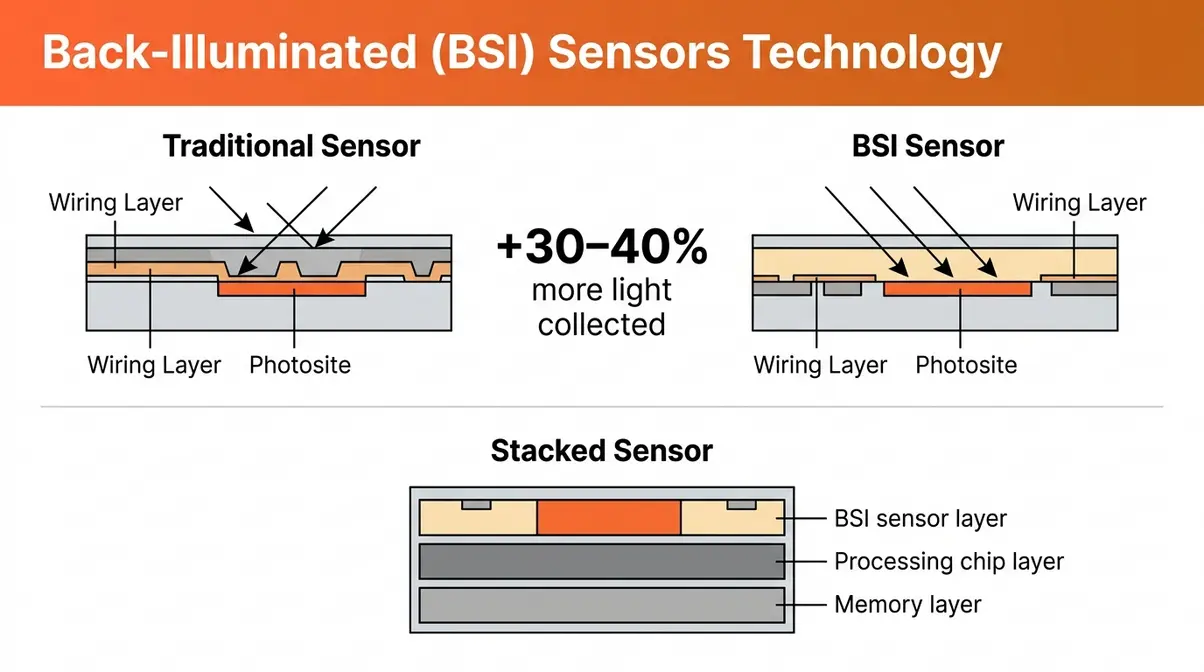
Modern smartphone cameras use sophisticated software techniques to compensate for their small sensors — and some of those techniques are genuinely impressive. Understanding them helps you set realistic expectations.
BSI (Backside Illuminated) sensor technology is the most important hardware advancement in smartphone imaging over the past decade. In a traditional sensor, the wiring and circuitry sit in front of the photosite, blocking some incoming light. BSI sensors flip this arrangement — the wiring moves behind the photosite, allowing more light to reach each pixel. BSI sensors collect roughly 30–40% more light than equivalent front-illuminated sensors, according to imaging research from Sony’s semiconductor division (Sony Semiconductor Solutions, 2023). Most flagship smartphones (iPhone 14 Pro and later, Galaxy S series from S21 Ultra onward) use BSI sensors.
Stacked sensor technology goes further: it adds a dedicated processing chip directly behind the BSI sensor layer, enabling faster readout speeds and more sophisticated real-time processing. This is what enables features like 8K video recording and high-speed burst photography on phones.
Computational HDR (High Dynamic Range) uses multiple exposures captured in rapid succession and merged by the camera’s AI processor to simulate the dynamic range of a larger sensor. The result is impressive for casual photography but struggles in fast-moving scenes where the multiple exposures don’t align perfectly.
The honest assessment: Computational photography closes the gap between smartphone sensors and dedicated cameras in good lighting. In challenging conditions — fast action, very low light, high-contrast scenes — physics still wins. A larger sensor captures light that simply isn’t there to be processed by software.
Sensor Sizes in DSLR, Mirrorless, and Cinema Cameras
Different camera categories use different sensor formats for specific reasons. Knowing which sensor you’ll find in which type of camera prevents surprises when you shop.
DSLR Camera Sensor Sizes: Canon, Nikon, and What to Expect
DSLRs (Digital Single-Lens Reflex cameras) use a mirror system to show you a live optical view through the viewfinder. They’re the traditional form factor that dominated professional photography from the 1990s through the 2010s.
Most consumer and enthusiast DSLRs use APS-C sensors. Canon’s popular Rebel series (T7i, T8i, etc.) uses their 22.3×14.9mm APS-C sensor with a 1.6× crop factor. Nikon’s D3500 and D5600 use a 23.5×15.6mm APS-C sensor with a 1.5× crop factor. Professional DSLRs — the Canon 5D series, Nikon D850 — use Full Frame sensors.
DSLR production has slowed significantly as mirrorless cameras have taken over. Canon and Nikon have both shifted their primary development resources to mirrorless systems, though DSLRs remain excellent value as used purchases. The sensor technology in a used Canon 5D Mark IV or Nikon D810 is still competitive with many current APS-C mirrorless cameras.
Mirrorless Camera Sensors: Full Frame and APS-C Options
Mirrorless cameras eliminate the mirror box, making them lighter and enabling faster autofocus systems and higher burst rates. They now represent the primary format for new camera development across all major manufacturers.
Sony leads the mirrorless market with both Full Frame (a7 series) and APS-C (a6000 series) options. The Sony a7 IV (Full Frame, 33MP) and Sony a6700 (APS-C, 26MP) represent the top of their respective categories. Canon’s EOS R system covers Full Frame (R6 Mark II, R5 Mark II) and APS-C (R10, R50). Nikon’s Z system offers Full Frame (Z6 III, Z8) and APS-C (Zfc, Z50 II).
Fujifilm occupies a unique position: their X-series cameras use APS-C sensors with a proprietary X-Trans color filter array that processes color differently from standard Bayer sensors, producing a film-like rendering that many photographers strongly prefer. The Fujifilm X-T5 (40MP APS-C) is particularly notable for delivering medium-format-like resolution in an APS-C body.
Cinema Camera Sensors: Super 35, Full Frame, and Medium Format for Video
Cinema cameras use sensor terminology that overlaps with — but doesn’t perfectly match — still photography naming conventions.
Super 35 is the cinema equivalent of APS-C, measuring approximately 24.89×18.66mm. It’s the most common format in professional cinema cameras including the Blackmagic Pocket Cinema Camera 6K and many RED and ARRI cameras. The name comes from 35mm motion picture film.
Full Frame cinema sensors (used in cameras like the Sony FX3 and Canon EOS C70) offer the same low-light advantages as Full Frame still cameras, plus a shallower depth of field that gives cinema footage its distinctive look.
Large Format cinema (used in ARRI ALEXA cameras, sensor measuring roughly 54×25.5mm) goes beyond standard Full Frame, capturing extraordinary dynamic range — up to 17 stops — for productions where image quality is the absolute priority.
For video shooters, sensor size affects exactly the same qualities as for still photographers: low-light performance, dynamic range, and depth of field control. The Blackmagic Pocket Cinema Camera 6K’s Super 35 sensor, for example, delivers cinematic depth of field and strong dynamic range at a price point that was unthinkable for professional cinema quality a decade ago.
Common Misconceptions About Camera Sensor Size
Understanding what sensor size doesn’t determine is just as important as knowing what it does. Several persistent myths cause beginners to make expensive, regrettable purchases.
3 Myths That Lead Beginners to Buy the Wrong Camera
Myth 1: “A bigger sensor always means a better camera.”
Sensor size is the primary driver of image quality in challenging conditions, but it’s not the only variable. A large sensor paired with a poor-quality lens will underperform a smaller sensor paired with an excellent lens. Lens quality, autofocus performance, in-body stabilization, and ergonomics all contribute to whether a camera works well for your specific shooting style. A Full Frame camera that’s too heavy for you to carry won’t take better photos than an APS-C camera you actually bring with you.
Myth 2: “More megapixels means a bigger sensor.”
As the megapixel-versus-sensor-size section demonstrates, these are completely independent specifications. A smartphone can have a 200MP sensor that’s smaller than a 12MP Full Frame sensor. Megapixels measure resolution (the number of pixels); sensor size measures light-gathering area. They are related only in that more megapixels crammed into the same sensor area produces smaller, less capable individual pixels.
Myth 3: “Smartphone computational photography has made dedicated cameras obsolete.”
Computational photography is impressive, and smartphone cameras are genuinely excellent for casual photography in good light. However, they cannot replicate the optical depth of field control of a large sensor, and they continue to fall behind in extreme low light, fast action (where multi-frame processing causes ghosting), and any situation requiring optical zoom beyond 3–5×. Professional photographers overwhelmingly still use dedicated cameras with large sensors for work that requires consistent, reliable image quality across variable conditions.
When a Smaller Sensor Is Actually the Better Choice
There are real situations where a smaller sensor is the smarter choice — not a compromise, but the genuinely optimal tool:
Wildlife and bird photography: The crop factor of APS-C (1.5×) and Micro Four Thirds (2×) sensors effectively extends your telephoto reach. A 500mm lens on a Micro Four Thirds camera covers the same field of view as a 1,000mm lens on Full Frame — at a fraction of the weight and cost. Professional wildlife photographers frequently choose MFT or APS-C systems specifically for this reason.
Travel and street photography: Smaller sensors enable smaller, lighter camera bodies. If you’re hiking 15 miles a day or navigating crowded markets, a compact Micro Four Thirds camera is a more practical tool than a Full Frame system — and the image quality difference is invisible in most travel photography scenarios.
Budget-constrained beginners: The APS-C camera ecosystem offers exceptional lenses at accessible prices. Spending $1,500 on a good APS-C body and a high-quality prime lens will produce better photos than spending the same $1,500 on an entry-level Full Frame body with a mediocre kit lens. Lens quality matters as much as sensor size.
Drone and action cameras: Size and weight are critical constraints. GoPro’s 1/2.3-inch sensor is a deliberate engineering choice — any larger sensor would require a larger, heavier camera that defeats the purpose of an action camera.
Frequently Asked Questions About Camera Sensor Size
What is a good sensor size for a camera?
APS-C is the best sensor size for most photographers, offering an excellent balance of image quality, camera size, and cost. An APS-C camera (crop factor 1.5× or 1.6×) produces images that are genuinely difficult to distinguish from Full Frame in most real-world shooting conditions. For photographers who regularly shoot in very low light or need maximum dynamic range for commercial work, Full Frame (36×24mm) is the step up worth making. Budget approximately $900–$1,500 for a capable APS-C mirrorless body as of Q2 2026.
Is a 4:3 or 1-inch sensor bigger?
These terms describe different things — 4:3 is an aspect ratio (the shape of the sensor), while 1-inch describes the sensor’s size. A 1-inch sensor (measuring approximately 13.2×8.8mm) happens to use a 4:3 aspect ratio in most implementations. You cannot directly compare them because they measure different properties. When someone says “1-inch sensor,” they’re telling you how large the sensor is. When they say “4:3 sensor,” they’re telling you its proportions — width to height.
Should I take my photos in 4:3 or 16:9?
Shoot in your camera’s native ratio — either 3:2 or 4:3 — and crop afterward if needed. Setting your camera to 16:9 photo mode crops the sensor in-camera, discarding image data and reducing effective resolution. Professionals almost never shoot photos in 16:9 — they shoot in their native ratio and crop to 16:9 in editing software when creating widescreen content. This preserves all the information your sensor captured and gives you maximum flexibility in post-production. The only exception is if you’re shooting video, where 16:9 is the standard format.
How do I know my camera’s sensor size?
Finding your camera’s sensor size takes three steps:
- Locate your camera’s model name (printed on the body or in Settings → About).
- Search ” sensor size specifications” on Google or visit the manufacturer’s website.
- Look for the sensor type in the specifications table — it will be listed as “Full Frame,” “APS-C,” “Micro Four Thirds,” or a fractional measurement like “1/1.28-inch.”
For smartphones, visit GSMArena.com, search your phone model, and find the “Camera” section — sensor sizes are listed for most flagship phones. Note that Apple does not officially publish iPhone sensor dimensions, so third-party estimates are the best available data.
Is 12MP better than 24MP?
It depends entirely on the sensor size. A 12MP Full Frame sensor typically outperforms a 24MP APS-C sensor in low light because each individual pixel on the Full Frame sensor is physically larger and collects more light. However, a 24MP APS-C sensor outperforms a 12MP APS-C sensor in detail and cropping flexibility, because both sensors are the same size and the 24MP version simply captures more detail. Megapixel comparisons are only meaningful when the sensor size is the same. Across different sensor sizes, pixel size (determined by dividing sensor area by pixel count) is the meaningful comparison.
Does a bigger sensor mean better quality?
Yes, in most real-world conditions — but with important nuances. A bigger sensor collects more light, which directly improves low-light performance, dynamic range, and depth of field control. These are the three qualities that most visibly separate professional photography from casual snapshots. However, lens quality, camera stabilization, and the photographer’s skill all contribute to final image quality. A large sensor paired with a poor lens will underperform a smaller sensor paired with an excellent lens. Sensor size is the most important single specification, but it’s not the only one that matters.
Do pros use 4:3 or 16:9?
Most professional photographers shoot in 3:2 (Full Frame and APS-C cameras) or 4:3 (Micro Four Thirds cameras) — their sensor’s native ratio. They avoid locking the camera into 16:9 photo mode because doing so crops the sensor and discards data. When pros need a 16:9 image — for YouTube thumbnails, website banners, or widescreen prints — they shoot in their native ratio and crop to 16:9 in editing software. Videographers are the exception: they shoot in 16:9 because that’s the standard video display format, and video cameras are designed to use the full sensor area in that ratio.
Choosing the Right Sensor Size: Your Complete Summary
The camera market in 2026 offers more excellent sensor options than at any point in photography history — which makes the decision both easier and more overwhelming. Here’s how to bring everything together.
The Light-Gathering Real Estate Rule gives you a reliable filter for every camera decision: more physical sensor area means more light captured, which means cleaner images in the conditions that matter most. This rule holds across every format, from Medium Format studio cameras down to smartphone chips.
For the vast majority of photographers — beginners building their first serious kit, enthusiasts upgrading from a smartphone, or hobbyists who want noticeably better photos without professional-level investment — APS-C is the answer. It delivers roughly 80–90% of Full Frame image quality at 40–60% of the price, in a camera body that’s genuinely portable. If your photography grows and you find yourself consistently frustrated by low-light noise or wanting shallower depth of field, Full Frame is a clear and logical next step.
Start by identifying the lighting conditions you shoot in most often, the subjects you photograph, and the budget you’re comfortable with. Then apply The Light-Gathering Real Estate Rule: find the largest sensor you can afford, paired with the best lens your remaining budget allows. That combination — sensor size first, lens quality second, megapixels last — is how photographers at every level make smart gear decisions.
If you’re ready to explore specific camera recommendations for your sensor format, our dedicated guides to APS-C mirrorless cameras and Full Frame mirrorless systems walk through the top options at every price point with the same plain-English approach.
Last update on 2026-07-21 / Affiliate links / Images from Amazon Product Advertising API

Dave King
Hi, I'm Dave, the founder of Amateur Photographer Guide. I created this site to help beginner and hobbyist photographers build their skills and grow their passion. Here, you’ll find easy-to-follow tutorials, gear recommendations, and honest advice to make photography more accessible, enjoyable, and rewarding.