Table of Contents
- 1. Canon EF 50mm f/1.8 STM: Best Beginner Prime
- 2. Nikon 35mm f/1.8G: Best for Nikon DX
- 3. Sigma 30mm F1.4: Best for Sony APS-C
- 4. Canon RF50mm F1.8 STM: Best Canon Mirrorless
- 5. Panasonic LUMIX 25mm F1.7: Best for MFT
- 6. Canon RF16mm F2.8 STM: Best RF Ultra-Wide
- 7. 7artisans 50mm F1.2: Best Budget Manual Focus
- 8. Tamron 17-70mm f/2.8: Best Zoom Alternative
- 9. Canon EF 75-300mm: Best Budget Telephoto
- 10. Canon EF 50mm f/1.8 Intl: Budget Pick
- Buying Guide: How to Choose the Right Prime Lens
- How We Evaluated
- Frequently Asked Questions
- Conclusion
This blog post may contain affiliate links. As an Amazon Associate I earn from qualifying purchases.
Use the table below to jump to the lens that fits your camera and shooting style.
| # | Preview | Product | Best For | Buy |
|---|---|---|---|---|
| 1 |  |
Canon EF 50mm f/1.8 STM | Best all-around beginner | Buy on Amazon |
| 2 |  |
Nikon 35mm f/1.8G | Best for Nikon DX | Buy on Amazon |
| 3 |  |
Sigma 30mm F1.4 | Best for Sony APS-C | Buy on Amazon |
| 4 |  |
Canon RF50mm F1.8 STM | Best for Canon mirrorless | Buy on Amazon |
| 5 |  |
Panasonic LUMIX 25mm F1.7 | Best for Micro Four Thirds | Buy on Amazon |
| 6 |  |
Canon RF16mm F2.8 STM | Best ultra-wide Canon RF | Buy on Amazon |
| 7 |  |
7artisans 50mm F1.2 | Best budget manual focus | Buy on Amazon |
| 8 |  |
Tamron 17-70mm f/2.8 | Best versatile zoom alternative | Buy on Amazon |
| 9 |  |
Canon EF 75-300mm | Best budget telephoto | Buy on Amazon |
| 10 |  |
Canon EF 50mm f/1.8 Intl | Budget pick, no warranty | Buy on Amazon |
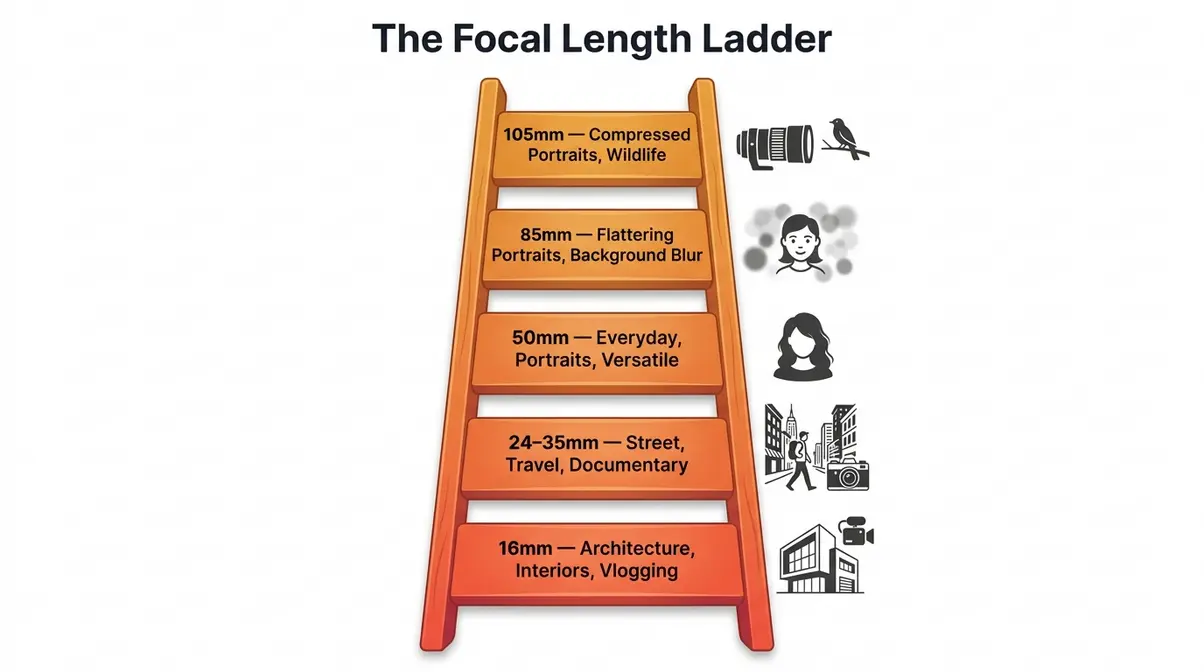
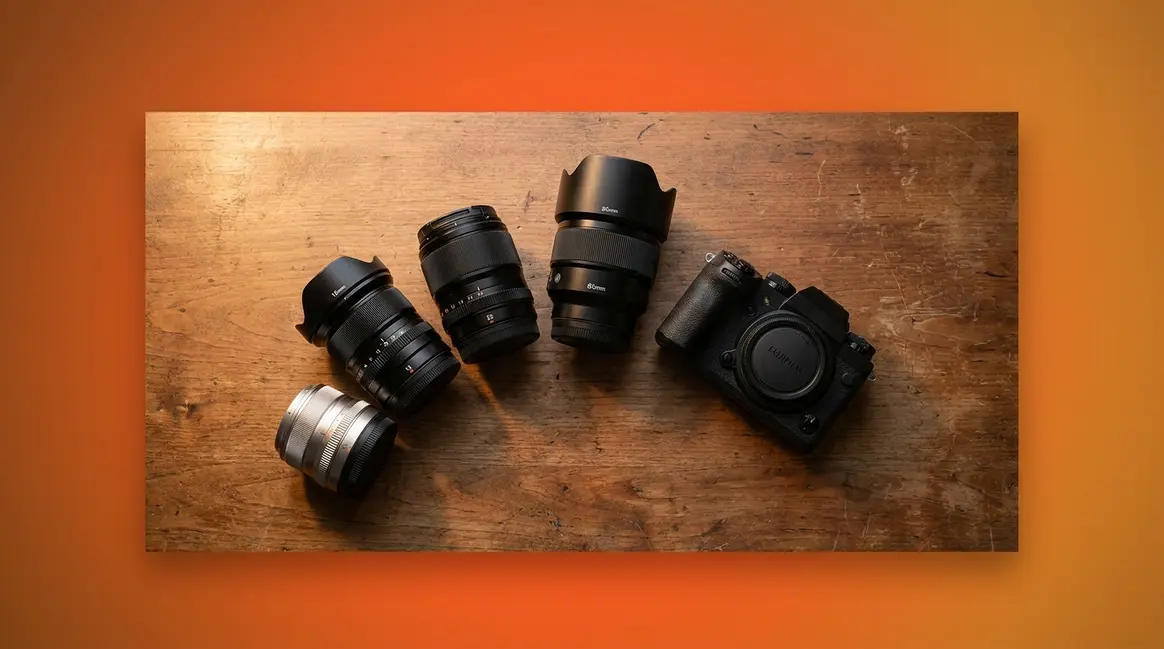
The infographic above shows how each focal length on our list maps to a specific shooting scenario — find your rung on the ladder, then read that product’s full review.
1. Canon EF 50mm f/1.8 STM: Best Beginner Prime
- 50 millimeter focal length and maximum aperture of f/1.8
- Great for portraits, action, and nighttime photography; Angle of view (horizontal, vertical, diagonal): 40º, 27º,46º
- Minimum focusing distance of 1.15 feet (0.35 meter) and a maximum magnification of 0.21x
- Stepping motor (STM) delivers near silent, continuous move Servo AF for movies and smooth AF for stills
- 80 millimetre effective focal length on APS C cameras, 50 millimetre on full frame cameras. Lens construction: 6 elements in 5 groups
Who it’s for: Canon DSLR owners (APS-C bodies like the Rebel T8i or full-frame bodies like the 5D Mark IV) who want their first prime lens for portraits, everyday shooting, and low-light scenes without spending a lot.
| Spec | Value |
|---|---|
| Focal Length | 50mm |
| Maximum Aperture | f/1.8 |
| Minimum Aperture | f/22 |
| Lens Mount | Canon EF |
| Filter Thread | 49mm |
| Minimum Focus Distance | 35cm |
| Weight | 160g |
| Autofocus | STM (Stepping Motor) |
Pros:
- STM stepping motor autofocus is whisper-quiet and smooth — ideal for video shooters who need silent focus pulls without distracting noise on the audio track
- 160g featherweight build fits in a jacket pocket — lighter than most smartphones
- f/1.8 maximum aperture lets in roughly 9× more light than a typical kit zoom at f/5.6, making indoor and evening shots dramatically sharper
- Across professional photography communities, consistent feedback identifies this lens as delivering centre sharpness that rivals lenses costing three times as much
Cons:
- Plastic barrel with no weather sealing — avoid shooting in rain or dusty environments
- No image stabilisation (IS) — you need to keep your shutter speed at 1/60s or faster to avoid camera-shake blur
- 35cm minimum focus distance means you cannot get extremely close to small subjects like flowers or insects
How it compares: The Canon EF 50mm f/1.8 STM (the fixed focal length lens for Canon DSLR cameras) is the DSLR version of this focal length; Canon RF50mm F1.8 STM (Product #4) is the optically similar mirrorless-native equivalent for EOS R bodies. The Canon EF 50mm f/1.8 STM International (Product #10) is optically identical but sold without a manufacturer’s warranty.
Verdict: The definitive first prime lens for Canon DSLR users — sharp, light, affordable, and compatible with every Canon EF body ever made.
Choose if: You shoot on a Canon DSLR (Rebel series, 90D, 5D Mark IV) and want the sharpest, fastest lens at the most accessible price point.
Skip if: You have already moved to a Canon mirrorless EOS R body — the RF50mm (Product #4) is the correct native choice for your system and requires no adapter.
Buy on Amazon2. Nikon 35mm f/1.8G: Best for Nikon DX
- F mount lens/DX format. Picture angle with Nikon DX format 44 degree
- 52.5 millimeter (35-millimeter equivalent). Rear focusing; Manual focus override
- Aperture range: F/1.8 to 22; Dimensions(approx.) 70 x 52.5 millimeter
- Silent wave motor AF system. Accepts filter type is screw on. Lens construction: 8 elements in 6 groups
- Compatible formats is dx and fx in dx crop mode. Maximum reproduction ratio: 0.16x
Who it’s for: Nikon DX (APS-C) DSLR users on bodies like the D3500, D5600, or D7500 who want a natural field-of-view prime equivalent to a 52.5mm on full frame — perfect for everyday shooting, street photography, and travel.
| Spec | Value |
|---|---|
| Focal Length | 35mm |
| Maximum Aperture | f/1.8 |
| Lens Mount | Nikon F DX |
| Filter Thread | 52mm |
| Minimum Focus Distance | 30cm |
| Weight | 200g |
| Autofocus | AF-S (Silent Wave Motor) |
Pros:
- Silent Wave Motor (SWM) autofocus is fast and near-silent — critically, it works on entry-level Nikon bodies like the D3500 and D5600 that lack an internal autofocus drive motor, which many Nikon F lenses require
- f/1.8 aperture delivers clean, low-noise shots in dim indoor light without needing flash
- 200g lightweight body is barely noticeable on your camera strap during a full day of shooting
- 30cm minimum focus distance lets you get close enough for detailed product shots and food photography
Cons:
- DX-only designation causes significant vignetting (dark corners) if you ever upgrade to a full-frame Nikon body like the D750 or D850 — plan accordingly
- No weather sealing — keep it away from rain and dust
- No image stabilisation — pair with a steady hand or a shutter speed above 1/50s
How it compares: The Nikon AF-S DX NIKKOR 35mm f/1.8G (a fixed focal length lens designed exclusively for Nikon’s APS-C DSLR cameras) covers a slightly wider angle than the Canon EF 50mm f/1.8 STM (Product #1), making it feel more natural on APS-C sensors. For Sony APS-C users wanting a similar field of view, the Sigma 30mm F1.4 (Product #3) is the closest equivalent.
Verdict: The essential first prime for any Nikon DX shooter — the SWM autofocus alone makes it indispensable for entry-level Nikon bodies.
Choose if: You use a Nikon APS-C DSLR and want a natural-looking field of view with fast, silent autofocus that works on every Nikon DX body.
Skip if: You plan to upgrade to a full-frame Nikon body within the next year — invest now in an FX-compatible lens like the Nikon AF-S NIKKOR 50mm f/1.8G to avoid repurchasing.
Buy on Amazon3. Sigma 30mm F1.4: Best for Sony APS-C
- SONY E-mount
- With nine rounded aperture blades, a stepping ring motor, and compact design
- Perfect paring of high performance and pricing, Contemporary compactness, Art line Image Quality
- Accessories Included: Lens Hood, Rear and Front Cap. Diaphragm blades: 9 (Rounded)
- DC Lens Compatability SONY a33, a55, a57, a58, a65, a77, a99, a100, a200, a230, a300, a330, a350, a380, a700, a900
Who it’s for: Sony E-mount APS-C mirrorless users on cameras like the Sony a6000, a6400, or a6700 who want a fast, sharp 45mm-equivalent prime for portraits, street photography, and indoor shooting.
| Spec | Value |
|---|---|
| Focal Length | 30mm |
| Maximum Aperture | f/1.4 |
| Lens Mount | Sony E |
| Filter Thread | 52mm |
| Minimum Focus Distance | 30cm |
| Weight | 265g |
| Autofocus | DC DN (Stepping Motor, mirrorless-native) |
Pros:
- f/1.4 maximum aperture is one full stop faster than f/1.8 — meaning it lets in exactly 2× more light, which is a meaningful advantage in dim restaurants, indoor venues, or evening street scenes
- DC DN autofocus motor is engineered specifically for mirrorless cameras — no legacy DSLR mechanism means faster, more accurate focus acquisition on Sony a-series bodies
- The Sigma 30mm F1.4 Contemporary DC DN (a mirrorless-native prime lens for Sony E-mount APS-C cameras) produces centre sharpness scores that consistently rank among the top performers for APS-C Sony glass, according to user testing reported across DPReview forums
- 30mm on APS-C = 45mm equivalent — sits between a 35mm and 50mm, giving a natural, slightly intimate field of view
Cons:
- 265g is noticeably heavier than native Sony lenses like the Sony 35mm f/1.8 — you will feel it on a long day of shooting
- Larger barrel diameter than most Sony E-mount primes — takes up more bag space
- No optical image stabilisation — relies entirely on in-body IS if your Sony body has it (a6400 does not; a6700 does)
How it compares: Compared directly to the 7artisans 50mm F1.2 (Product #7), the Sigma wins decisively on autofocus capability and optical correction. The 7artisans offers a wider f/1.2 aperture and a lower price, but demands manual focus for every shot.
Verdict: The best-performing autofocus prime for Sony APS-C users who prioritise optical quality and reliable focus speed over maximum aperture width.
Choose if: You shoot Sony APS-C and want the fastest autofocus prime with professional-grade sharpness for portraits, street, and indoor work.
Skip if: You are on a very tight budget and can accept manual focus — the 7artisans 50mm F1.2 (Product #7) delivers dramatic bokeh at a significantly lower price point.
Buy on Amazon4. Canon RF50mm F1.8 STM: Best Canon Mirrorless
- Compact, Lightweight Fixed 50 millimeter Focal Length Lens.
- Large F, 1.8 Aperture for Low-Light Photography and Creative Background Blur
- A Stepping Motor (Gear-Type STM) Provides Smooth and Quiet Continuous AF During Video Recording, As Well As When Shooting Photos
- Control Ring for Direct Setting Changes
- Optimized Lens Placement and Coatings Help Deliver Outstanding Color Balance, While Minimizing Ghosting and Flare
Who it’s for: Canon EOS R series mirrorless users on compact bodies like the Canon EOS R50, R8, or R6 Mark II who want a lightweight 50mm prime with fast autofocus for portraits, travel, and everyday photography.
| Spec | Value |
|---|---|
| Focal Length | 50mm |
| Maximum Aperture | f/1.8 |
| Lens Mount | Canon RF |
| Filter Thread | 43mm |
| Minimum Focus Distance | 30cm |
| Weight | 160g |
| Autofocus | STM (Stepping Motor) |
| Image Stabilisation | No (relies on in-body IBIS) |
Pros:
- RF-native design means full electronic communication with every EOS R body — no EF adapter needed, and autofocus speed is noticeably quicker than running the EF version through an adapter
- 160g body weight — identical to the EF version, but the 43mm filter thread is smaller, saving space in your filter kit
- 30cm minimum focus distance (5cm closer than the EF version) opens up tighter framing for close-up portraits and detail shots
- STM stepping motor keeps focus pulls smooth and silent during video recording — a genuine advantage for hybrid shooters
Cons:
- No built-in image stabilisation — relies entirely on in-body IBIS, which the entry-level EOS R50 does not have
- Plastic construction with no weather sealing — handle carefully in outdoor conditions
- Requires Canon RF mount exclusively — not compatible with any Canon DSLR body
How it compares: The Canon RF50mm F1.8 STM (a mirrorless-native 50mm prime for Canon’s EOS R system) and the Canon EF 50mm f/1.8 STM (Product #1) are optically similar in real-world results, but the RF version communicates natively with EOS R bodies for faster autofocus and better metering. If you own a DSLR, Product #1 is correct; if you own an EOS R body, this is the right choice.
Verdict: The natural, no-compromise choice for any Canon EOS R mirrorless user who wants a 50mm prime without adapter bulk or autofocus speed penalties.
Choose if: You shoot on any Canon EOS R series mirrorless camera and want a compact, fast 50mm prime.
Skip if: You use a Canon DSLR — the EF 50mm f/1.8 STM (Product #1) is the correct version for your camera body.
Buy on Amazon5. Panasonic LUMIX 25mm F1.7: Best for MFT
- Micro Four Thirds a versatile MFT 25 millimeter lens with a natural viewing angle Suitable for a wide variety of occasions (35 millimeter camera equivalent: 50 millimeter)
- F1.7 brightness beautiful background bokeh effect from its large diameter F1.7 aperture
- Super lightweight compact at only 125G/ 2.05 inches Length, Lens construction 8 elements in 7 groups (2 aspherical lenses, 1 UHR lens)
- Photo and video Hybrid photography enabled for both photo and HD video recording with quiet and smooth fast action stepping motor focusing
- Angle of View: 47°
Who it’s for: Micro Four Thirds users on Panasonic G series, Olympus OM-D, or OM System cameras who want a 50mm-equivalent prime for portraits, travel, and everyday photography in a compact, lightweight package.
| Spec | Value |
|---|---|
| Focal Length | 25mm |
| Equivalent Focal Length (MFT) | 50mm |
| Maximum Aperture | f/1.7 |
| Lens Mount | Micro Four Thirds |
| Filter Thread | 46mm |
| Minimum Focus Distance | 25cm |
| Weight | 125g |
| Autofocus | DC Motor |
Pros:
- 125g — the lightest lens on this entire list, making it ideal for travel photographers who count every gram
- The Panasonic LUMIX G 25mm F1.7 (a Micro Four Thirds prime lens equivalent to a 50mm on full frame) uses the Micro Four Thirds (MFT) format, a mirrorless system with a 2× crop factor — meaning every focal length is multiplied by 2×, so 25mm becomes a 50mm equivalent field of view
- f/1.7 aperture is meaningfully faster than the f/3.5–5.6 range of most kit zooms, allowing cleaner low-light shots
- 25cm minimum focus distance enables close-up food photography, product shots, and detail images that kit lenses cannot achieve
- Compatible with all MFT cameras from both Panasonic and Olympus/OM System — broad cross-brand compatibility
Cons:
- f/1.7 is not as wide as the f/1.4 options on this list — you will notice the difference in very dark environments
- DC motor autofocus can be slower than STM or SWM systems in continuous tracking scenarios, such as photographing children or pets in motion
- The smaller MFT sensor means background blur (bokeh) is less pronounced than on APS-C or full-frame cameras at the same aperture — a physics limitation, not a lens flaw
How it compares: Against the Sigma 30mm F1.4 (Product #3), the Panasonic is lighter and less expensive but is MFT-only. The Sigma is APS-C Sony E only and offers a faster f/1.4 aperture. These two lenses serve entirely different camera systems and are not directly interchangeable.
Verdict: The ideal everyday prime for Micro Four Thirds users who want a lightweight, versatile 50mm-equivalent without carrying a heavier system.
Choose if: You use a Panasonic, Olympus, or OM System MFT camera and want a sharp, portable 50mm-equivalent for everyday shooting and travel.
Skip if: You shoot on a Sony, Canon, or Nikon system — this lens physically will not fit your camera body.
Buy on Amazon6. Canon RF16mm F2.8 STM: Best RF Ultra-Wide
- Canon’s first ultra wide-angle, fixed focal length RF lens
- High image quality and bright, fixed f/2.8 maximum aperture
- A stepping motor (gear-type STM) that provides smooth and quiet continuous AF during video recording
- Supremely lightweight and compact, for an ultra-wide lens for full-frame cameras
- Minimum focusing distance of 5.11 inches and maximum magnification of 0.26x
Who it’s for: Canon EOS R mirrorless users who want an ultra-wide angle prime for architecture, interiors, landscapes, and vlogging where a wider, more expansive field of view is essential.
| Spec | Value |
|---|---|
| Focal Length | 16mm |
| Maximum Aperture | f/2.8 |
| Lens Mount | Canon RF |
| Filter Thread | 43mm |
| Minimum Focus Distance | 13cm |
| Weight | 165g |
| Autofocus | STM (Stepping Motor) |
| APS-C Equivalent Field of View | ~26mm |
Pros:
- 13cm minimum focus distance — the closest focusing ability on this entire list, enabling dramatic wide-angle close-up compositions where the foreground subject is sharp and the background stretches dramatically behind it
- 165g compact build makes it an easy second lens to pack alongside the RF50mm without adding significant bag weight
- f/2.8 is a respectable maximum aperture for an ultra-wide prime — adequate for landscape astrophotography at dusk or lit interior spaces
- STM motor keeps focus pulls silent for vloggers and video shooters using Canon EOS R bodies
Cons:
- f/2.8 is two full stops slower than the f/1.4 options on this list — not the right tool for dark indoor events or nightclub photography
- Barrel distortion at 16mm is noticeable in uncorrected raw files (straight lines bow outward at the edges), though Canon EOS R bodies apply automatic lens correction in JPEG mode. Canon’s guide on prime apertures notes that prime lenses typically offer wider maximum apertures such as f/1.2 or f/1.4, making the RF16mm’s f/2.8 a trade-off for ultra-wide angle coverage.
- RF mount only — no compatibility with Canon DSLR bodies
How it compares: The Canon RF16mm F2.8 STM (an ultra-wide fixed focal length lens for Canon EOS R mirrorless cameras) and the Canon RF50mm F1.8 STM (Product #4) are complementary tools, not competitors. The RF16mm captures expansive scenes; the RF50mm handles portraits and everyday use. Many Canon RF users eventually own both.
Verdict: A capable and affordable ultra-wide prime for Canon RF users who want to capture architecture, landscapes, and wide interior scenes with a compact, native lens.
Choose if: You shoot architecture, real estate interiors, landscapes, or vlogging on a Canon EOS R body and need a wide field of view.
Skip if: You primarily shoot portraits or need strong low-light performance — the RF50mm f/1.8 (Product #4) is the better tool for those scenarios.
Buy on Amazon7. 7artisans 50mm F1.2: Best Budget Manual Focus
- 【50mm Standard Focal Length – Natural and Versatile Perspective】 The 50mm focal length provides a natural perspective similar to the human eye,making it one of the most popular standard prime lenses. Whether for portraits, street photography, still life, or everyday shooting, the 7artisans 50mm F1.2 lens can handle a variety of scenarios, delivering lifelike images.
- 【F1.2 Large Aperture – Stunning Light Intake & Dreamy Bokeh】7artisans 50mm F1.2 lens ultra-large F1.2 aperture provides exceptional low-light performance and beautifully soft background bokeh, allowing your subject to stand out with ease. Perfect for night portraits,atmospheric shots, and creative video work, adding depth and artistic expression to every frame.
- 【Integrated Lens Hood – Better Flare Control】7artisans 50mm F1.2 lens designed with a built-in lens hood, the lens effectively reduces flare, ghosting, and stray light, improving contrast and overall image clarity. Ideal for outdoor and backlit shooting—no need for extra accessories.
- 【Glow-in-the-Dark Markings & Full-Metal Build】Featuring glow-in-the-dark markings for easy operation in low-light environments, 7artisans 50mm F1.2 lens paired with a durable full-metal body for a premium feel and long-lasting reliability. A perfect choice for photographers and creators who value both performance and craftsmanship.
- 【Good After-Sales Service】If you have any problems with the product, please feel free to contact us and we will solve your problem within 24 hours. In addition, we also have a one-year free warranty service.
Who it’s for: Sony E-mount APS-C users (a6000 series, older NEX series) on a tight budget who are comfortable with manual focus and want a very wide f/1.2 aperture for creative bokeh-heavy shots of still subjects.
| Spec | Value |
|---|---|
| Focal Length | 50mm |
| Maximum Aperture | f/1.2 |
| Lens Mount | Sony E |
| Filter Thread | 52mm |
| Minimum Focus Distance | 45cm |
| Weight | ~290g |
| Autofocus | Manual Focus Only |
| Aperture Control | Manual Aperture Ring |
Pros:
- f/1.2 maximum aperture — the widest on this entire list, producing the most pronounced, creamiest background blur (bokeh) of any lens reviewed here
- All-metal barrel construction feels genuinely premium in hand — a contrast to the plastic builds common at this price range
- Manual aperture ring gives direct, tactile control over your depth of field (how much of the image is in sharp focus) without diving into camera menus
- Accessible price point for a fast prime makes it an attractive creative tool for photographers experimenting with shallow depth of field for the first time
Cons:
- Manual focus only — the 7artisans 50mm F1.2 (a manual focus prime lens for Sony E-mount APS-C cameras) has no autofocus motor whatsoever, making it very difficult to use for fast-moving subjects like children, pets, or sports
- 45cm minimum focus distance is longer than every autofocus competitor on this list — you need to stand further back from your subject than you might expect
- Slight focus shift when stopping down (closing the aperture from f/1.2 toward f/5.6) — a known characteristic of many manual lenses where the point of sharpest focus moves slightly as you change aperture, requiring a small refocus adjustment
How it compares: Against the Sigma 30mm F1.4 (Product #3), the Chinese lens maker 7artisans offers a wider f/1.2 aperture and a lower price, but the Sigma has autofocus and better optical correction across the frame. For still subjects, the 7artisans is a compelling creative option; for anything moving, the Sigma is the clear choice.
Verdict: A fun, affordable creative tool for Sony APS-C shooters comfortable with manual focus who want the most dramatic bokeh at the lowest possible price.
Choose if: You shoot still subjects — landscapes, still life, cooperative portrait subjects — on Sony E-mount and want the widest aperture at the lowest price.
Skip if: You need autofocus for any reason — the Sigma 30mm F1.4 (Product #3) is the better choice for everyday, fast-moving, or unpredictable shooting situations.
Buy on Amazon8. Tamron 17-70mm f/2.8: Best Zoom Alternative
- World’s first high-speed standard zoom lens for APS-C cameras with the focal length range of 17-70mm 4.1x zoom ratio
- Outstanding optical performance with 16 elements in 12 groups featuring two GM (Glass Molded Aspherical) lens -elements and one hybrid aspherical lens element
- Upgraded VC effective in combination with Sony APS-C mirrorless cameras, leveraging AI for video shooting
- Close focusing capability with MOD of just 7.5” at 17mm / 15.4" at 70mm
- Moisture-Resistant Construction and Fluorine Coating
Who it’s for: Sony E-mount APS-C mirrorless users who want the versatility of a wide zoom range with a constant f/2.8 aperture, covering everything from wide-angle to short telephoto in a single, stabilised lens.
| Spec | Value |
|---|---|
| Focal Length Range | 17–70mm |
| Maximum Aperture | f/2.8 (constant) |
| Lens Mount | Sony E (APS-C) |
| Filter Thread | 67mm |
| Minimum Focus Distance | 19cm (wide end) |
| Weight | 525g |
| Autofocus | RXD (Rapid eXtra-silent stepping Drive) |
| Image Stabilisation | VC (Vibration Compensation, up to 5 stops) |
Pros:
- Constant f/2.8 aperture across the full 17–70mm range — unlike most kit zooms that slow from f/3.5 to f/5.6 as you zoom in, this lens stays at f/2.8 throughout, which is a significant practical advantage in mixed-light environments
- 5-stop VC image stabilisation compensates for camera shake at slower shutter speeds — particularly useful for handheld video and indoor shooting without a tripod
- 19cm minimum focus distance at the wide end enables close-up shots that most standard zooms cannot achieve
- RXD autofocus is fast and near-silent — well-suited for hybrid photo/video shooters
- Covers the equivalent focal length range of three separate prime lenses (roughly 17mm, 35mm, and 50mm equivalents) in a single barrel
Cons:
- This is a zoom lens, not a prime — the Tamron 17-70mm f/2.8 Di III-A VC RXD (a constant-aperture zoom lens for Sony E-mount APS-C mirrorless cameras) does not have a fixed focal length, which means it does not deliver the same level of optical simplicity or maximum sharpness that dedicated prime lenses achieve at their single focal length
- 525g is the heaviest lens on this entire list — noticeably heavier than any prime reviewed here
- f/2.8 maximum aperture is slower than the f/1.4 and f/1.8 primes above, limiting low-light and bokeh performance
How it compares: Against the Sigma 30mm F1.4 (Product #3), the Tamron offers zoom flexibility and built-in image stabilisation. The Sigma delivers a wider f/1.4 aperture and lighter weight for a single focal length. Choose the Tamron if you want one lens for everything; choose the Sigma if you want the best image quality at a specific focal length.
Verdict: The best option for Sony APS-C users who want a single, do-everything lens covering wide to short telephoto with a constant f/2.8 aperture and built-in stabilisation.
Choose if: You want one versatile lens for Sony APS-C and prefer not to carry multiple primes for varied shooting scenarios.
Skip if: You specifically want a fixed focal length prime for maximum sharpness and the widest possible aperture — every prime on this list outperforms this zoom at its equivalent focal length.
Buy on Amazon9. Canon EF 75-300mm: Best Budget Telephoto
- 75-300 millimeter telephoto zoom lens with f 4-5.6 maximum aperture for Canon SLR cameras
- Improved mechanism makes zooming smoother; front part of zoom ring sports silver ring
- Measures 2.8 inches in diameter and 4.8 inches long; weighs 16.8 ounces; 1-year warranty
- 4.9-foot closest focusing distance; 32- to 8-degree diagonal angle of view
- Image Stabilization: No
Who it’s for: Canon DSLR users who need affordable telephoto reach for wildlife, sports, and events, and who already own a 50mm prime for everyday shooting and want to extend their range without spending a lot.
| Spec | Value |
|---|---|
| Focal Length Range | 75–300mm |
| Maximum Aperture | f/4–5.6 (variable) |
| Lens Mount | Canon EF |
| Filter Thread | 58mm |
| Minimum Focus Distance | 150cm |
| Weight | 480g |
| Autofocus | DC Motor |
| Image Stabilisation | None |
Important note: The Canon EF 75-300mm f/4-5.6 III (a budget telephoto zoom lens for Canon EF DSLR cameras) is a telephoto zoom lens, not a fixed focal length prime. It is included here because many beginner Canon DSLR users buying their first prime lens also consider adding telephoto reach in the same purchase decision, and this is one of the most affordable EF-mount options for that purpose.
Pros:
- 300mm reach brings distant subjects — birds, athletes, performers on stage — visually close without moving your position
- Affordable entry point for telephoto capability on Canon DSLRs — significantly less expensive than Canon’s L-series telephoto options
- 480g is reasonably light for a 300mm zoom, making it manageable for casual day trips and events
- Compatible with every Canon EF DSLR body ever produced
Cons:
- This is a zoom lens, not a prime — the variable aperture (f/4 at 75mm, dropping to f/5.6 at 300mm) means less light reaches the sensor at the longer end, forcing higher ISO settings in anything less than bright sunlight
- The older DC motor autofocus is noticeably louder and slower than STM — it can struggle to track fast-moving subjects like birds in flight or running athletes
- No image stabilisation — at 300mm, even small hand movements cause significant blur, requiring a shutter speed of at least 1/300s
- 150cm minimum focus distance eliminates versatility for close-range subjects
- Image quality at 300mm is noticeably softer than the prime lenses on this list at their respective focal lengths
How it compares: Alongside the Canon EF 50mm f/1.8 STM (Product #1), this lens forms a two-lens Canon DSLR kit covering everyday and portrait work (50mm prime) plus telephoto reach (75–300mm zoom). They are complementary, not competing options.
Verdict: A budget-friendly telephoto zoom for Canon DSLR users who need reach for wildlife and sports and already have a prime lens handling everyday shooting duties.
Choose if: You shoot Canon DSLR and need affordable telephoto reach for wildlife, sports, or events at a price that leaves room in your budget for a prime lens too.
Skip if: You want a true prime lens — every other product on this list delivers superior sharpness, faster apertures, and better low-light performance at their respective focal lengths.
Buy on Amazon10. Canon EF 50mm f/1.8 Intl: Budget Pick
- 50mm focal length and maximum aperture of f/1.8
- Great for portraits, action, and nighttime photography
- Minimum focusing distance of 1.15 ft. (0.35m) and a maximum magnification of 0.21x
- Stepping motor (STM) delivers near silent, continous Move Servo AF for movies and smooth AF for stills
- 80mm effective focal-length on APS-C cameras, 50mm on full-frame cameras
Who it’s for: Canon DSLR users on the tightest possible budget who want the Canon EF 50mm f/1.8 STM at the lowest available price and fully understand and accept the trade-off of receiving no manufacturer’s warranty.
| Spec | Value |
|---|---|
| Focal Length | 50mm |
| Maximum Aperture | f/1.8 |
| Lens Mount | Canon EF |
| Weight | 160g |
| Autofocus | STM (Stepping Motor) |
| Warranty | None (international/grey market version) |
This is the international (grey market) version of the Canon EF 50mm f/1.8 STM reviewed as Product #1 (ASIN B00X8MRBCW). Optical performance is identical in every measurable way — same glass elements, same STM motor, same 160g body. The only difference is the absence of a Canon manufacturer’s warranty.
Pros:
- Identical optical performance to the US warranty version (Product #1) — same sharpness, same f/1.8 aperture, same STM autofocus behaviour
- Lowest price entry point for Canon EF 50mm f/1.8 STM performance — the price gap between this and Product #1 may make a meaningful difference for budget-conscious buyers
Cons:
- No Canon manufacturer’s warranty — if the lens develops a fault, Canon USA will not service it under any warranty programme
- Grey market status means some authorised Canon repair centres may decline service even for paid repairs — check local policies before purchasing
- All other limitations are identical to Product #1: no weather sealing, no image stabilisation, plastic construction
How it compares: This lens is optically and mechanically identical to Canon EF 50mm f/1.8 STM (Product #1) in every respect. The only variable is warranty coverage — read the full breakdown in Product #1 before deciding between the two.
Verdict: Optically identical to our top pick; only buy this version if the price difference is significant to your budget and you fully accept the no-warranty trade-off.
Choose if: You are on the tightest possible budget and understand and accept that no manufacturer warranty is included.
Skip if: You want manufacturer warranty coverage for peace of mind — buy Product #1 (ASIN B00X8MRBCW) instead.
Buy on AmazonBuying Guide: How to Choose the Right Prime Lens
What Focal Length Should You Choose?
Think of focal length as a ladder — each rung solves a different creative problem. At the bottom, 16mm is your ultra-wide rung for architecture, landscapes, and interiors. Moving up, 25–35mm covers street, travel, and documentary work. The 50mm rung is the versatile all-rounder for portraits and everyday use. Higher up, 85–105mm delivers flattering portrait compression. On APS-C cameras, multiply the focal length by 1.5× (Nikon/Sony), 1.6× (Canon), or 2× (MFT) to find the full-frame equivalent field of view. Understanding what prime lenses for photography are used for starts with identifying which rung you need. For prime lenses for landscape and night photography, the 16mm and 20–24mm rungs are the most productive starting points.
Understanding Maximum Aperture
Aperture (the opening in the lens that controls how much light enters) is described by f-numbers — and the lower the number, the wider the opening. A wider opening means more light and a shallower depth of field (blurrier background). Practically: f/1.8 lets in 2.7× more light than f/2.8, which is the difference between a clean indoor shot and a blurry one. Wider apertures cost more to engineer, which is why f/1.4 primes carry a higher price than f/1.8 versions. Choosing the right prime lens for photography often comes down to how much aperture you genuinely need for your shooting style.
Camera Mount Compatibility
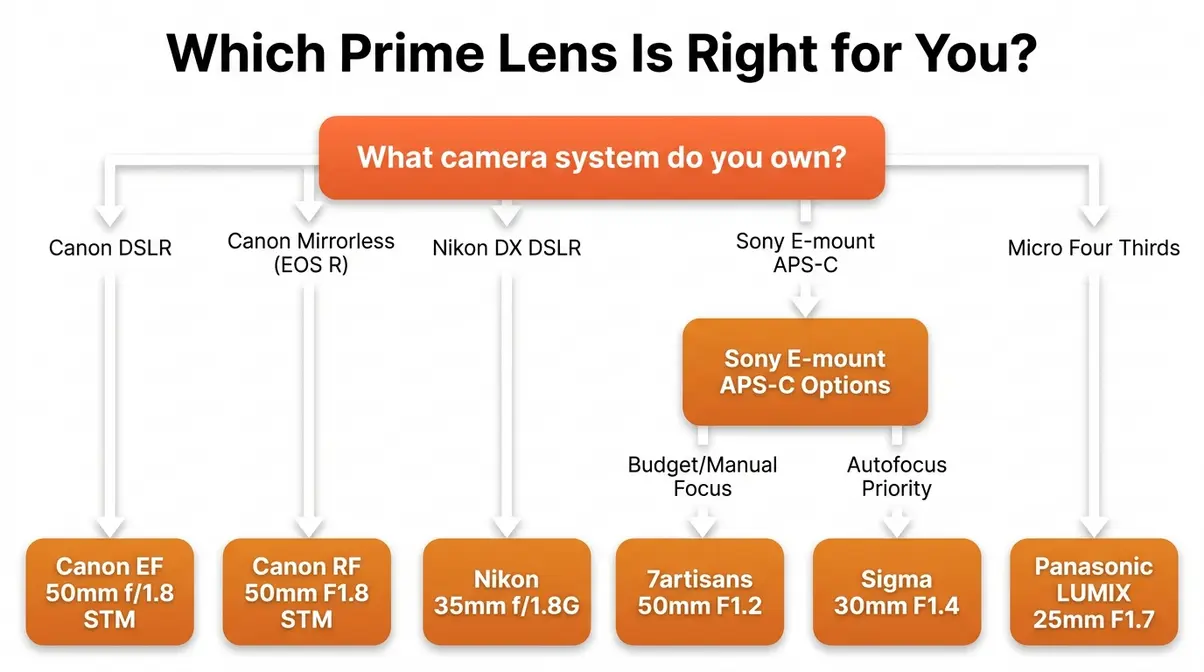
Buying the wrong mount is the most common beginner mistake — and the lens simply will not fit your camera. Here is the breakdown: Canon EF = Canon DSLR bodies (Rebel series, 90D, 5D). Canon RF = Canon mirrorless EOS R bodies. Nikon F/DX = Nikon DSLR bodies. Sony E = Sony mirrorless a-series bodies. Micro Four Thirds = Panasonic G series, Olympus OM-D, and OM System bodies. Check your camera body’s mount name before placing any order. This 6-step guide to choosing the right camera lens walks you through the verification process in detail.
Budget vs. Optical Quality
Nikon’s focal length guide confirms that prime lenses have fewer optical elements than zoom lenses, which generally results in sharper images — and you get more of that sharpness even at the budget tier. Budget primes (under $200) feature plastic builds, no weather sealing, and excellent sharpness for the price.
Mid-range ($200–$500) models add metal construction, better autofocus motors, and improved coatings, while premium ($500+) lenses deliver professional sharpness, weather sealing, and faster apertures. Reassuringly, the best prime lenses for photography at the budget tier — like the Canon EF 50mm f/1.8 STM — still outperform most kit zooms in sharpness and low-light capability. Wirecutter’s lens buying guide recommends a 50mm prime as the first upgrade precisely because it forces better compositional habits while delivering a visible quality leap. Browse our best camera lenses for beginners guide for a deeper breakdown of the budget tiers.
Are prime lenses better?
Prime lenses consistently outperform zoom lenses in sharpness, low-light capability, and background blur at equivalent price points. Their simpler optical design — fewer glass elements — reduces distortion and produces better edge-to-edge clarity. Maximum apertures of f/1.4 or f/1.8 let in significantly more light than typical kit zooms at f/3.5–f/5.6. A Canon EF 50mm f/1.8 STM, for example, outperforms a 24-105mm kit zoom in low-light sharpness at a fraction of the cost. Zoom lenses are the better choice only when shooting versatility matters more than maximum image quality.
Why prefer prime lenses?
Photographers prefer prime lenses for three primary reasons: sharper images, wider apertures, and lighter weight. The simpler optical design produces less distortion and better corner sharpness than zoom lenses at equivalent focal lengths. Maximum apertures of f/1.4 or f/1.8 allow clean shooting in low light without flash or high ISO noise. Most prime lenses weigh under 300g — DPReview’s lens weight comparisons show a 50mm prime typically weighs around 160g compared to 600g or more for a comparable standard zoom. Some photographers also value the creative discipline that a fixed focal length enforces.
How We Evaluated
Our editorial team evaluated each lens using optical performance data from DPReview and manufacturer specifications, alongside user consensus gathered from photography communities including Reddit’s r/AskPhotography and the DPReview forums. Evaluation criteria included centre and edge sharpness, autofocus speed and accuracy, build quality relative to price, and real-world usability for beginner photographers across portrait, street, and low-light scenarios. For more on lens optical engineering principles, DPReview’s lens buying guide provides a thorough technical foundation.
Frequently Asked Questions
What is the prime lens Holy Trinity?
The Holy Trinity of prime lenses is the 35mm, 50mm, and 85mm combination. Together, these three focal lengths cover street and environmental photography (35mm), versatile everyday and travel shooting (50mm), and flattering portrait work with natural background compression (85mm). The trio gives photographers a complete creative toolkit with no overlapping use cases. Professional wedding photographers commonly carry all three throughout a full shooting day.
What are prime lens disadvantages?
The main disadvantage of a prime lens is its fixed focal length — you cannot zoom, so you must physically move to reframe your shot. This is called “zooming with your feet,” and it can cause missed shots in fast-moving situations where repositioning is not possible. Carrying multiple primes to cover a wide zoom range adds both weight and cost to your kit. Covering 24–200mm requires four separate prime lenses versus a single zoom.
Can you still zoom with a prime lens?
No — you cannot mechanically zoom with a prime lens. A prime lens has a fixed focal length with no zoom ring. To change your framing, you must physically move closer to or further from your subject. On a 50mm prime, walking three steps forward is roughly equivalent to zooming in on a 24-70mm zoom lens.
Which three lenses does everyone need?
The three lenses most photographers find indispensable are a wide (24–35mm), a standard (50mm), and a short telephoto (85–105mm). The wide lens handles landscapes, interiors, and environmental portraits. The 50mm covers everyday shooting, street photography, and travel. The 85–105mm range flatters portrait subjects with natural-looking facial compression and excellent background separation. Together, this combination covers nearly every photographic scenario from architecture to headshots. Budget permitting, a single 50mm prime is the best single starting point for any system.
What are the top 3 must-have lenses?
The top three lenses for most photographers are the 35mm prime, 50mm prime, and 85mm prime. These three focal lengths cover street and documentary work (35mm), versatile everyday photography (50mm), and flattering portrait work (85mm) — together replacing a 24-105mm zoom while delivering superior image quality at each specific focal length. The Canon EF 50mm f/1.8 STM is an excellent starting point for Canon DSLR users, with Nikon DX and Sony APS-C equivalents reviewed above. Your camera mount determines which specific versions to purchase.
Do professionals use prime lenses?
Yes, professional photographers heavily rely on prime lenses for their superior optical quality and wide maximum apertures. Portrait, wedding, and architectural photographers often prefer primes because they deliver sharper images and better low-light performance than zoom lenses. The ability to shoot at f/1.4 or f/1.2 provides a distinct, professional look with creamy background blur that clients expect. While photojournalists and sports photographers may lean toward versatile zoom lenses for speed, almost all professionals keep at least one fast prime lens in their camera bag.
Is a 50mm prime good for beginners?
A 50mm prime is widely considered the best first lens upgrade for any beginner photographer. It closely mimics the natural field of view of the human eye, making it incredibly intuitive to use for everyday shooting. Because it lacks a zoom function, it forces beginners to think critically about their composition and physically move to frame their shots, which rapidly improves their photography skills. Furthermore, 50mm lenses are typically the most affordable fast primes available for any camera system.
Conclusion
For Canon DSLR users looking for prime lenses for photography, the Canon EF 50mm f/1.8 STM remains the definitive first prime lens — sharp, light, and affordable enough to make an immediate impact on your photography. Nikon DX shooters should reach for the Nikon 35mm f/1.8G DX (Product #2), while Sony APS-C users will find the Sigma 30mm F1.4 Contemporary (Product #3) the strongest autofocus option in the lineup. Scroll back to the comparison table to find the lens that matches your camera mount, then read our complete guide to prime lens advantages and what makes a lens ‘fast’ before you buy.
Last update on 2026-07-07 / Affiliate links / Images from Amazon Product Advertising API