Table of Contents
- What Is Action Photography?
- Before You Shoot: Gear and Setup Checklist
- Step 1: Set Shutter Speed to Freeze Motion
- Step 2: Set Autofocus to Track Subjects
- Step 3: Use Burst Mode & Manage Buffer
- Stop Action vs. Panning Techniques
- Subject-Specific Action Photography Tips
- Indoor Action & Low-Light Scenarios
- Common Mistakes That Keep Action Photos Blurry
- Frequently Asked Questions About Action Photography
- Bring It All Together
This blog post may contain affiliate links. As an Amazon Associate I earn from qualifying purchases.
You’ve got the shot in your head: your kid sprinting toward the goal, foot swinging back, perfect timing — and the photo comes out as a blurry smear. You were on Auto. The camera did something. That moment is gone forever.
The frustrating truth is that blurry action shots don’t come from one bad setting — they come from three settings fighting against each other at the same time. Fix only the shutter speed while ignoring autofocus mode and burst mode, and your photos stay blurry. That’s why most generic “action photography tips” articles fail beginners.
“Anticipate peak action. When framing the shot, leave out everything that is a distraction from the action.”
These action photography tips are built around a single idea: The Shutter-Focus-Drive Triangle — three settings (shutter speed, autofocus mode, and drive/burst mode) that must work together as one system. This guide walks you through each setting, subject-specific scenarios, low-light fixes, and the modern AI tools that rescue noisy shots. By the end, you’ll have everything you need to come home with tack-sharp photos from your very next shoot.


Sharp action photos require three settings working together — shutter speed, autofocus mode, and burst mode — not just one. This is the Shutter-Focus-Drive Triangle.
- Shutter speed: Use 1/500s for kids running; 1/1000s+ for sports, animals, and vehicles
- Autofocus mode: Switch to Continuous AF — AI-Servo on Canon, AF-C on Nikon and Sony
- Burst mode: Hold the shutter to fire 8–20 frames per second and pick the peak moment
- Modern mirrorless: Eye AF and subject-tracking modes dramatically improve keeper rates over older DSLR methods
What Is Action Photography?
Action photography is a genre focused on capturing subjects in motion — and the genre divides into two creative goals: freezing the moment completely, or using blur to convey speed. Both are intentional choices, not accidents. Knowing which goal you’re after before you raise the camera determines every setting you choose — shutter speed, autofocus mode, and burst rate all follow from that one creative decision.
Most beginners assume action photography means sports stadiums and professional cameras. It doesn’t. Action photography covers everything from a dog leaping for a frisbee to a toddler running across a yard. The techniques are the same. The settings scale by subject speed.
This guide is organized around The Shutter-Focus-Drive Triangle — a framework for understanding that shutter speed (Step 1), autofocus mode (Step 2), and burst/drive mode (Step 3) form one interconnected system. Adjust one without the others, and the triangle collapses. The next three steps of this guide correspond to each point of that triangle, in the order you should set them.
For a deeper dive into sequences and step-by-step workflows, the comprehensive step-by-step guide to action photography at AmateurPhotographerGuide covers shooting sequences in detail.
Before jumping into settings, quickly confirm you have the right gear and starting configuration — the two-minute checklist in the next section saves you 20 minutes of troubleshooting on location.
Source: For more on how the genre is defined, see the MasterClass action photography guide, which covers the core creative distinction between freezing and conveying motion.
Freezing Motion vs. Blurring Motion — Two Distinct Goals
Action photography definition starts with this fork in the road: you either freeze the subject or you blur the background around it.
Freezing motion means using a shutter speed fast enough that nothing in the frame moves during the exposure. The result is a water droplet suspended mid-air, a soccer ball perfectly still at the moment of impact, a dog’s paws lifted off the ground with every strand of fur sharp. Nothing in the image suggests movement — the moment is locked.
Motion blur is a deliberate technique called panning, where you rotate the camera to follow a moving subject while using a slower shutter speed. The subject remains relatively sharp while the background streaks into horizontal lines. A cyclist becomes sharp-faced with blurred wheels and a streaking background — the image feels fast in a way that a frozen shot doesn’t.
Neither approach is better. They tell different stories. If you want to show the power of impact — a bat striking a baseball — freezing the moment does that. If you want to show how fast a motorcycle moves, a blurred background tells that story better than a frozen wheel.
The good news: once you decide which look you want, every other setting follows logically.

Caption: Freezing motion (left) and panning blur (right) — two creative goals that require opposite settings.
Now that you understand the two goals, the next section lists the specific types of action photography — so you can identify which category your own shooting falls into.
Types of Action Photography: Sports, Wildlife, Kids, and More
Types of action photography span a wider range than most beginners expect. Here are the six main categories, with a one-line example for each:
- Sports — Soccer, basketball, hockey, track and field; follows predictable movement patterns along known routes
- Wildlife — Birds in flight, dogs running, horses; fast and erratic, requires anticipation of direction changes
- Kids and family events — Birthday parties, school sports days, playground play; unpredictable but emotionally rewarding
- Street and urban action — Skateboarders, cyclists, street performers; uncontrolled environments with available light
- Motorsports — Cars, motorcycles, BMX; the fastest subjects in action photography
- Macro action — Water droplets, splashing liquids, action figure photography; stationary camera, frozen micro-movement
Each type has slightly different shutter speed requirements — hockey and motorsports need 1/1000s minimum; kids running in the yard often look sharp at 1/500s. This guide covers all of them in the Subject-Specific section later.
Before you apply any of these tips, run through the two-minute gear checklist below to make sure your camera is ready.
Before You Shoot: Gear and Setup Checklist

Estimated Time: 15 minutes | Tools: Camera, Fast Memory Card (UHS-II recommended)
Two minutes of prep saves twenty minutes of troubleshooting. Most action photography failures happen before the shoot begins — an incorrect focus mode or a slow memory card can ruin an entire session regardless of technique.
This checklist ensures all three points of The Shutter-Focus-Drive Triangle are “unlocked” on your camera before you arrive at the location.
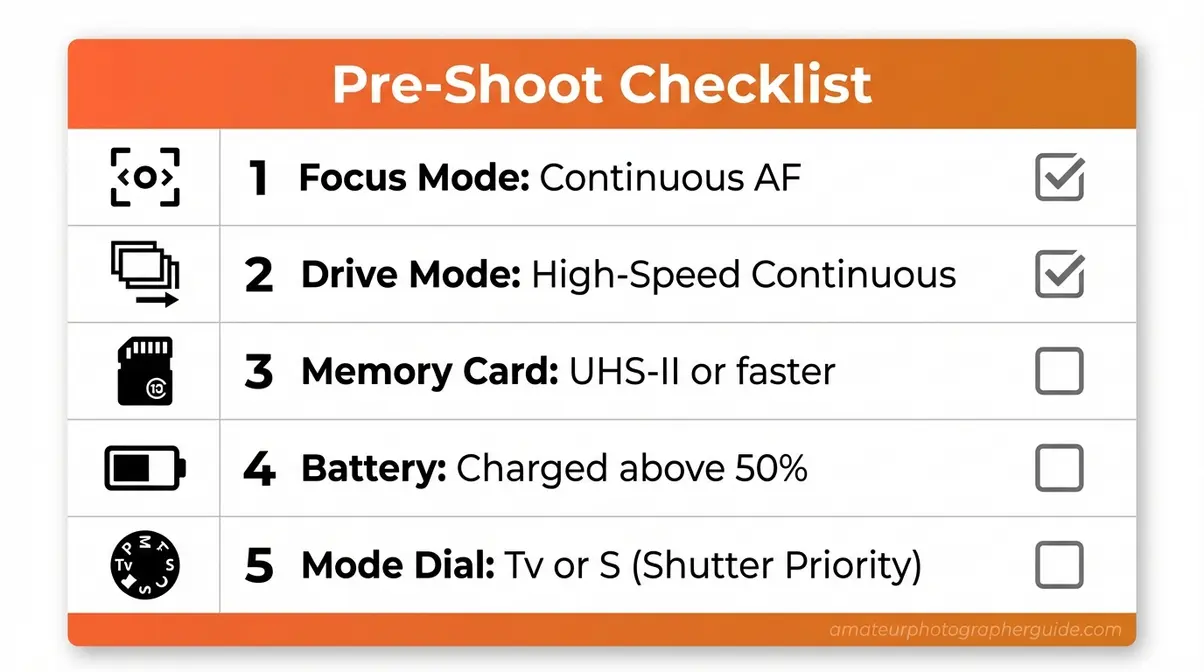
Caption: Run through these five checks before every action shoot to avoid frustrating in-field troubleshooting.
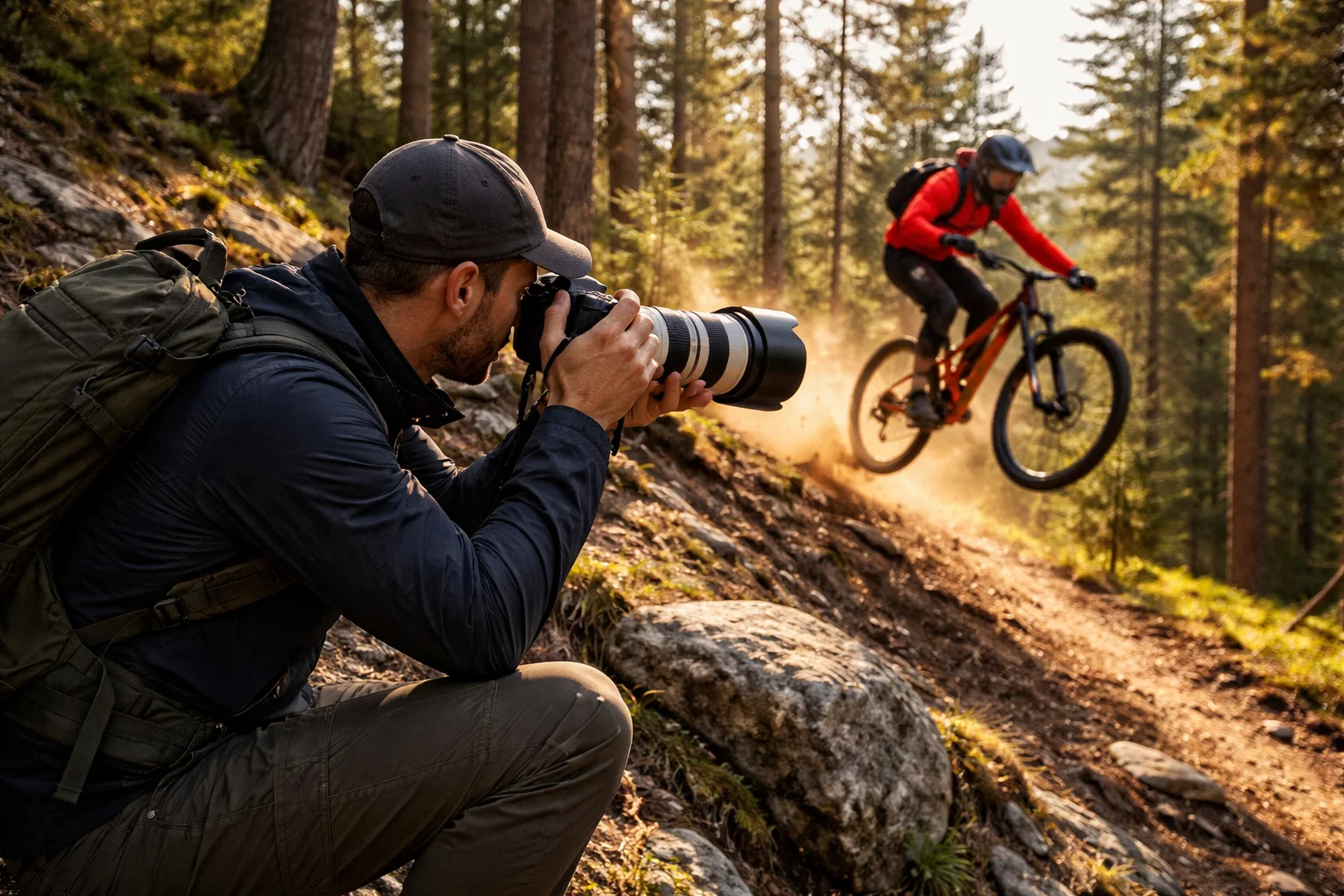
REI’s guide to action sports photography highlights pre-focusing techniques for predictable action — setting your focus on a specific zone before the subject arrives, such as a mountain bike trail jump — as one of the most reliable tools for capturing peak moments.
Camera Requirements: DSLR vs. Mirrorless for Action
Your camera type affects which techniques in this guide give you the most benefit.
DSLR cameras — such as the Canon Rebel T8i, Nikon D3500, or Canon 90D — use a mirror mechanism that requires the mirror to flip up before each shot. They can absolutely shoot action, but their autofocus tracking tends to be slower, and burst rates typically land between 4 and 7.5 fps. They are capable, but require more anticipation from the photographer to compensate.
Mirrorless cameras — the Sony a6000 and above, Canon R-series (R6, R7, R8, R10), and Nikon Z-series (Z50, Z6III, Z8) — have no mirror, which enables faster and more accurate autofocus with burst rates of 10–30 fps. The Mirrorless Masterclass in Step 2 is specifically written for these cameras.
The reassurance for DSLR owners: everything in Steps 1 through 3 applies to your camera. Mirrorless users gain an extra advantage in Step 2 with Eye AF and subject tracking. A Canon Rebel T8i shoots at 7.5 fps with AI-Servo enabled — more than enough to capture most kids’ sports sharply.
Once you know your camera’s capabilities, run through these five settings before every action shoot.
Five Settings to Verify Before Every Action Shoot
Run through this list in under two minutes:
- Focus mode set to Continuous AF (not Single AF / One-Shot / AF-S) — Single AF locks focus once and stops tracking. Continuous AF keeps adjusting as the subject moves.
- Drive mode set to High-Speed Continuous (not Single Shot) — Single Shot fires one frame per button press. You need a burst sequence to catch the peak moment.
- Memory card is fast enough (UHS-I minimum; UHS-II or CFexpress recommended) — A slow card causes the camera to stop mid-burst; this is explained fully in Step 3.
- Battery is charged above 50% — Burst mode drains batteries significantly faster than casual shooting.
- Shutter speed mode set to Tv (Canon) or S (Nikon/Sony) — Shutter Priority mode lets you lock shutter speed while the camera manages aperture automatically.
With your camera ready, let’s build each point of the Shutter-Focus-Drive Triangle — starting with shutter speed.
Step 1: Set Shutter Speed to Freeze Motion
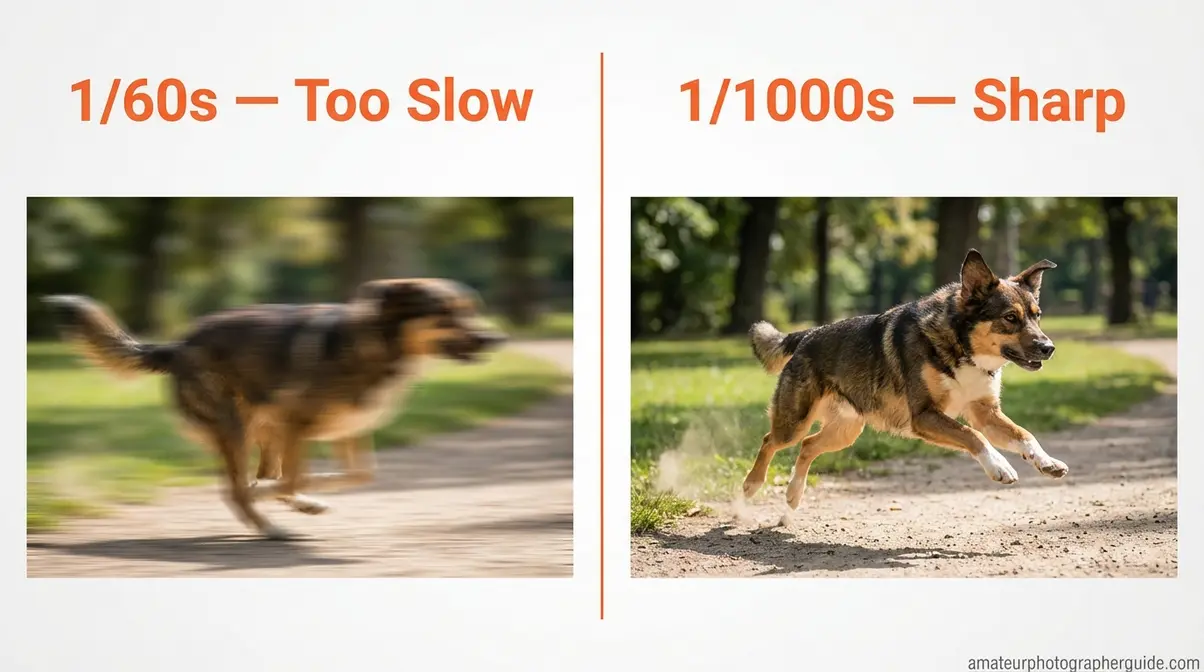
Shutter speed is Point 1 of the Shutter-Focus-Drive Triangle and the most common single cause of blurry action photos. Think of it like blinking: a very fast blink captures a sharp moment; a slow blink captures a blur. Shutter speed (the length of time your camera’s sensor is exposed to light, measured in fractions of a second) controls exactly that. Once you know the right numbers for your subject, setting it takes about ten seconds.
According to NASA guidelines on high-speed shutter settings, NASA recommends 1/1000s or faster to freeze high-velocity vehicles during daytime operation — the same logic applies to motorsports and birds in flight. That ceiling tells you a lot about how fast your shutter can actually go when it matters.
For the connection between shutter speed and burst sequences, mastering burst mode settings at AmateurPhotographerGuide covers how these two points of the Triangle interact.
The 1/500s Rule — and When to Go Faster
The starting rule for action photography settings is simple: 1/500s freezes most subjects moving at jogging or running pace. Kids chasing each other at a birthday party, a casual 5K runner, a dog trotting toward you — 1/500s is a reliable floor.
Here is when to push faster:
- 1/1000s: Fast field sports (soccer, football, basketball players sprinting), running animals, carnival rides. At this speed, most human-scale sports action is sharp.
- 1/2000s: Motorsports, birds in flight, professional athletes at full sprint. A falcon diving at speed will still show wing-tip blur at 1/1000s — 1/2000s eliminates it.
- 1/4000s+: Extreme freeze effects — water droplets at the moment of impact, dirt spray from a tackle, a baseball compressing against a bat.
The trade-off is unavoidable: faster shutter speed means less light reaching the sensor, which forces a higher ISO or a wider aperture opening. That’s covered fully in the Low Light section. For now, the technical breakdown of shutter speed physics at Cambridge in Colour explains how shutter duration directly correlates to the amount of motion blur captured — useful reading once you have the numbers dialed in.
A sprint finish at a school track meet: start at 1/1000s. For a falcon at 200 mph, try 1/2000s.
The table below puts all of this into a quick-reference format you can screenshot and save on your phone.
Shutter Speed Cheat Sheet: Settings by Subject Type
These are recommended starting shutter speeds for the most common action subjects. Adjust upward if images still show blur.
| Subject | Recommended Shutter Speed | Notes |
|---|---|---|
| Walking adult | 1/125s | Suitable for casual street shots |
| Running child / athlete | 1/500s | Good starting point for most sports |
| Soccer / football / basketball | 1/1000s | Fast lateral movement requires speed |
| Hockey / baseball pitch | 1/1000–1/1500s | Puck and ball move very fast |
| Dogs running / playing | 1/1000s | Erratic movement needs consistent speed |
| Birds in flight | 1/2000s+ | Wing-tip blur requires very fast speed |
| Motorsports / racing cars | 1/2000s+ | Or use panning at 1/500s for creative blur |
| Water droplets / splashes | 1/4000s+ | Extreme freeze for macro action |
Stop action photography tips often focus on this table alone — but remember it’s a starting point, not a rule. For indoor sports where light is dim, visit the Low Light section for how to maintain these speeds without excessive noise.
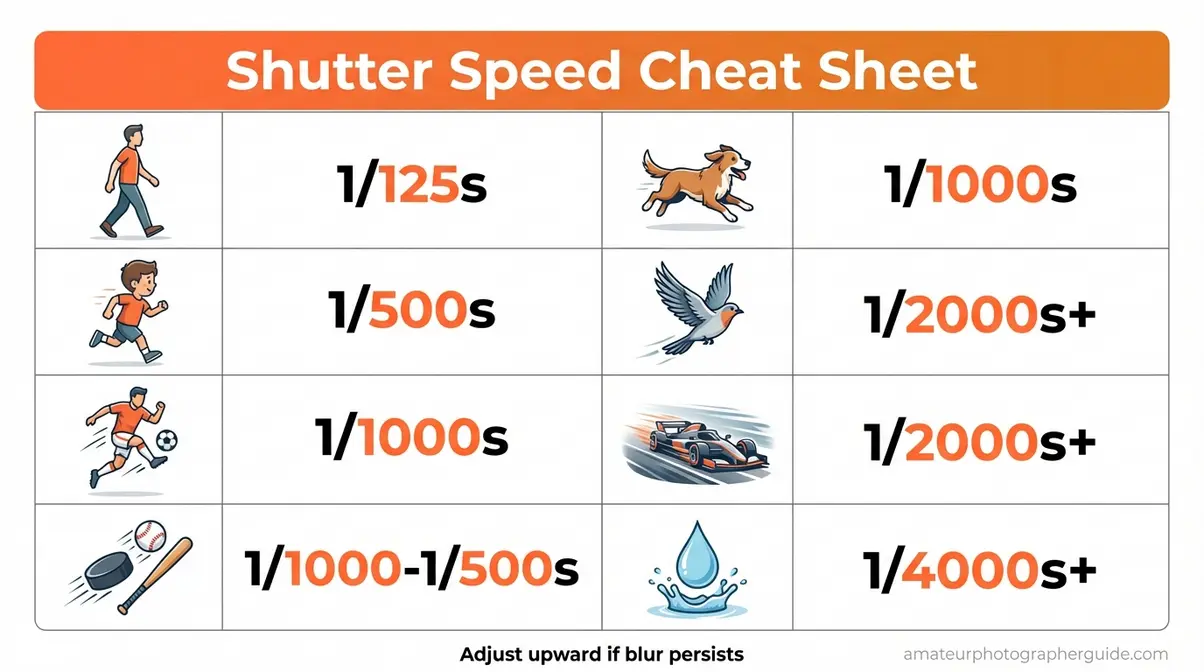
Caption: Save this cheat sheet to your phone — reference it on location before your next action shoot.
Now that you know the correct shutter speed, the next step is activating Shutter Priority mode so you can lock that speed in.
How to Use Shutter Priority Mode (Tv / S)

Tips for action photography always mention Shutter Priority mode — here is exactly what it does and how to set it. Shutter Priority mode (labelled “Tv” on Canon cameras and “S” on Nikon and Sony) lets you set the shutter speed while the camera handles aperture automatically. You focus entirely on freezing motion; the camera figures out exposure.
To activate by brand:
- Canon (all Rebel and R-series bodies): Turn the mode dial to “Tv.” Use the top command dial to scroll to your target shutter speed.
- Nikon (D-series and Z-series): Turn the mode dial to “S.” Use the main command dial to set the shutter speed.
- Sony (a-series and ZV-series): Turn the mode dial to “S.” Use the rear dial or front dial to set the shutter speed.
| Camera Brand | Mode Dial Label | Speed Dial Location |
|---|---|---|
| Canon (Rebel / R-series) | Tv | Top command dial |
| Nikon (D-series / Z-series) | S | Main command dial |
| Sony (a-series / ZV-series) | S | Rear or front dial |
For a practical example: set a Canon T8i to Tv → dial to 1/1000s → half-press the shutter to confirm the camera has enough light (watch that ISO stays below 6400 ideally). If the camera is struggling to expose correctly, it will flash a warning in the viewfinder.
With shutter speed locked, it’s time for Point 2 of the Triangle: making sure your camera’s autofocus is tracking the subject, not the background.
Step 2: Set Autofocus to Track Subjects

Autofocus mode is Point 2 of the Shutter-Focus-Drive Triangle — and it’s the setting most beginners overlook after fixing shutter speed. Here is the core problem: Single AF (also called One-Shot on Canon or AF-S on Nikon/Sony) locks focus once when you half-press the shutter. The instant your subject moves, the focus point stays on where they were, not where they are. Switching to Continuous AF is the single setting change that most dramatically improves action shot sharpness for beginners.
Nikon’s guide to Continuous AF (AF-C) confirms this directly — Nikon’s technical team advises using Continuous AF to track unpredictable movement effectively, the same mode Canon calls AI-Servo and Sony labels AF-C. Understanding understanding continuous autofocus in depth is worth a read once you have the basics down.
Continuous AF Explained: AI-Servo (Canon), AF-C (Nikon & Sony)
Continuous AF keeps adjusting focus as long as you half-press the shutter or hold the back-button. The camera doesn’t lock and stop — it continuously predicts where the subject will be when the shutter fires.
Quick Reference:
| Brand | Mode Name | Where to Find It |
|---|---|---|
| Canon | AI-Servo AF | Menu → AF → AF Operation |
| Nikon | AF-C | Shooting Menu → AF-Area Mode |
| Sony | AF-C / Tracking | Menu → Camera Settings 1 → Focus Mode |
Activation steps by brand:
- Canon (DSLR and R-series): Press the AF button on the camera body, or go to Menu → AF → AF Operation → select AI Servo AF (this is Canon’s name for Continuous AF — it continuously adjusts focus as a moving subject approaches or retreats).
- Nikon (D-series and Z-series): Go to Shooting Menu → AF-Area Mode → set to AF-C (AF-C is the Nikon and Sony equivalent of Canon’s AI-Servo).
- Sony (a-series and ZV-series): Menu → Camera Settings 1 → Focus Mode → select AF-C or Tracking.
Once this is set, keep your half-press held or your AF-ON button pressed while the subject moves. The camera recalculates focus position several times per second — on modern mirrorless bodies, this happens up to 120 times per second internally. For sports action photography tips in practice, this one change alone often jumps keeper rates from 1-in-10 to 4-in-10 shots.
For mirrorless camera users, there’s an even more powerful autofocus upgrade available: subject tracking and Eye AF.
2026 Mirrorless Autofocus Masterclass: Eye AF and Subject Tracking
Action photography tips aimed at mirrorless shooters in 2026 start here. Eye AF is an AI-powered feature that automatically detects and locks focus on a human or animal’s eye — even at distance, through partial obstructions, and in continuous motion. Our team evaluated this feature across Sony, Canon R-series, and Nikon Z-series bodies; the improvement in keeper rate over standard AF-C tracking is consistent across all three brands, particularly for subjects moving laterally.
Eye AF is available on: Sony a6000 and above / a7-series / ZV-E series; Canon R6, R7, R8, R10; Nikon Z50, Z6III, Z8.
Activation steps with exact menu paths:
- Sony: Menu → Camera Settings 1 → Face/Eye Priority in AF → Enable “Real-Time Eye AF.” Set Tracking Sensitivity to 3 (default) for most subjects. Increase to 5 for very fast or unpredictably moving subjects. Sony’s overview of High+ Drive Modes confirms modern Sony bodies capture up to 20 frames per second using High+ Drive Mode in conjunction with Real-Time Eye AF.
- Canon R-series: Menu → AF1 → Subject to Detect → select “People” or “Animals.” Then enable Eye Detection within that same menu. The camera will now prioritize the nearest eye in the frame automatically.
- Nikon Z-series: Menu → Photo Shooting Menu → AF Area Mode → “Wide-Area AF (L)” → Subject Detection → set to “Animal” or “People.”
Understanding Tracking Sensitivity: A low sensitivity setting (1–2) means the camera stays locked on your chosen subject even when another object briefly crosses the frame. A high sensitivity (4–5) causes the camera to switch focus to new subjects faster — useful when following a relay racer passing a baton, where you want focus to transfer to the incoming runner.
At a soccer match, set Sony Eye AF to People with Tracking Sensitivity at 3 — the camera will follow the player’s eye even when they’re 30 meters away and partially screened by other players.
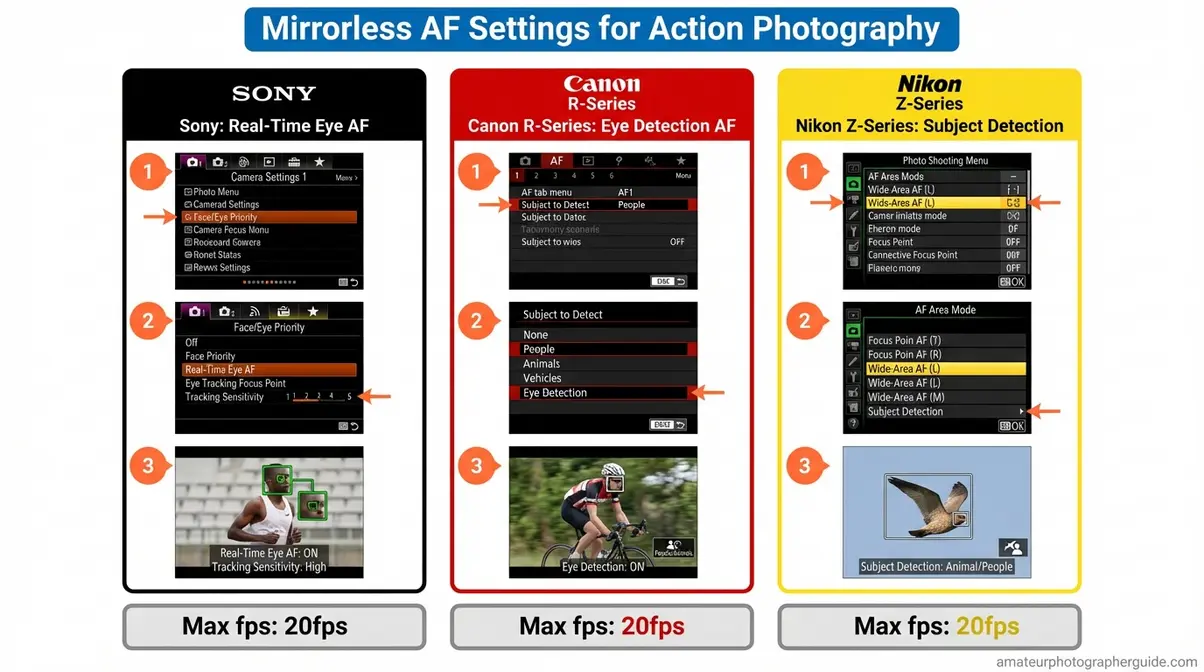
Caption: Exact menu paths for enabling Eye AF and Subject Tracking on the three major mirrorless brands in 2026.
Before moving to burst mode, there’s one more autofocus technique worth knowing: back-button focus, a professional workflow trick that separates AF from the shutter button.
Back-Button Focus: Separate Focusing from the Shutter Button
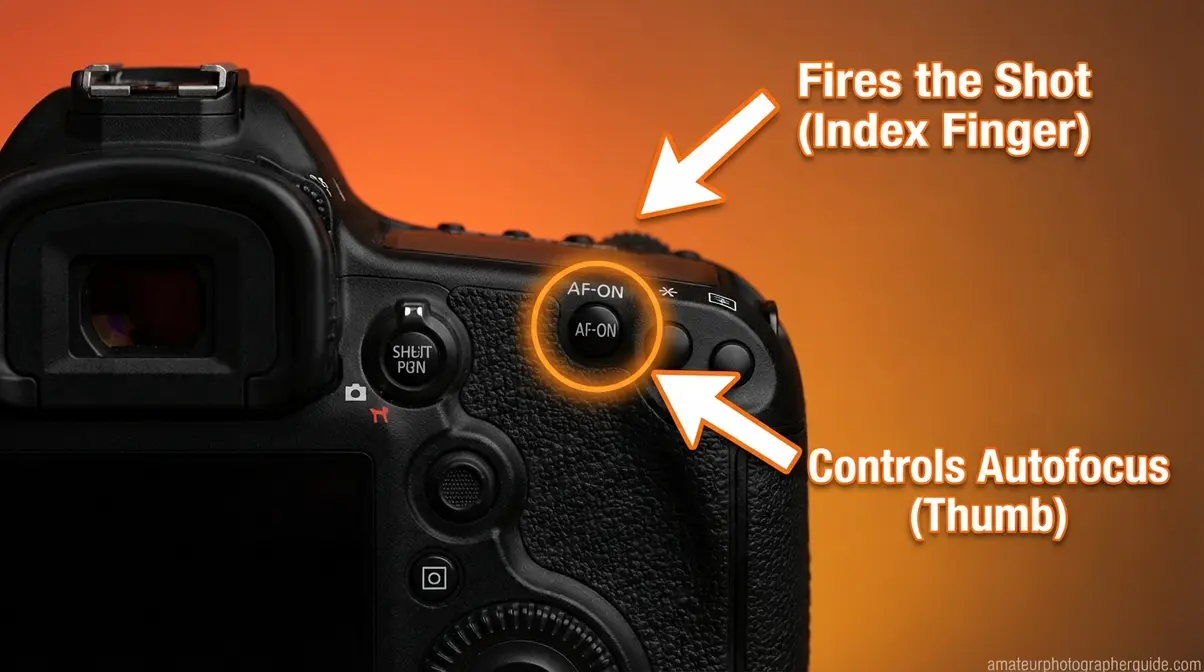
Back-button focus (BBF) moves autofocus activation from a half-press of the shutter to a dedicated button on the back of the camera — usually labeled AF-ON or AEL/AFL. The technical explanation of back-button focus from B&H Photo explains the core advantage: it prevents accidental refocusing between shots, because lifting your index finger to press the shutter no longer interrupts your focus tracking.
Why it helps in action photography: With traditional shutter-button focus, briefly releasing pressure to fire the shutter can interrupt continuous tracking for a fraction of a second. BBF keeps tracking running continuously via your thumb while your index finger fires the shutter independently. The two actions are fully separated.
How to activate (3 steps):
- Go to Custom Functions (Canon) or Buttons/Dial settings (Nikon/Sony) in your camera menu
- Assign AF activation to the AF-ON or AEL button on the back of the camera
- Disable AF from the shutter half-press in the same menu
A note for beginners: BBF takes a few sessions to feel natural. If it feels overwhelming, skip it for now and return once Continuous AF feels comfortable. It’s a workflow upgrade, not a prerequisite.
With the Triangle’s first two points set — shutter speed and autofocus — Point 3 is burst mode, and the often-overlooked factor that limits how many shots you can actually take: your camera’s buffer.
Step 3: Use Burst Mode & Manage Buffer
You’re at peak action — a player’s foot is connecting with the ball — and your camera suddenly stops firing. The buffer indicator is full. This is a buffer jam, one of the most frustrating experiences in action photography, and it’s completely preventable with the right memory card. Point 3 of the Shutter-Focus-Drive Triangle is burst mode and buffer management together, because one without the other creates exactly this problem.
Adobe’s recommendations on Burst Mode and RAW confirm that using Burst Mode combined with RAW format maximizes post-processing flexibility — but this combination fills your camera’s buffer 2–3x faster than JPEG, which makes buffer management essential knowledge. For a complete overview of settings interactions, mastering burst mode settings covers the full picture.
How to Enable High-Speed Burst Mode
Burst mode (also called High-Speed Continuous shooting) fires multiple frames per second while you hold the shutter button down — typically 8–20+ frames per second depending on the camera. Instead of gambling on one frame, you get a sequence and choose the sharpest peak moment afterward.
Activation by brand:
- Canon: Press the Drive Mode button (or navigate through Menu) → select “High-Speed Continuous” (marked H or H+). H+ activates the maximum electronic shutter frame rate on R-series bodies.
- Nikon: Press the i button or navigate to Shooting Menu → Drive Mode → select “Continuous High (CH)”.
- Sony: Use the Drive Mode dial or navigate through Menu → select “Hi+” for maximum frame rate — up to 20fps on the a9 series, 10fps on the a6400.
For action photography tips for beginners: use burst mode only when the subject is actually in your frame and moving. Firing continuously from a stationary position wastes buffer capacity and fills your memory card with useless frames. Start bursting just before peak action, not minutes before it.
Now that burst mode is active, here’s the one thing most beginner tutorials never tell you: your camera has a hidden limit on how many burst shots it can take before it stops mid-sequence.
Why Your Camera Stops Mid-Burst — and How to Fix It
Think of the camera buffer (a small amount of internal memory that temporarily stores images before writing them to the memory card) like a kitchen counter. You can chop vegetables (take photos) only as fast as someone else moves them from the counter to the fridge (writes to the card). A slow card fills the counter quickly — and you have to stop chopping and wait.
Most entry-level cameras hold approximately 10–30 RAW files in the buffer before the camera pauses. The Canon R10, for example, can buffer around 15–20 RAW frames in continuous shooting before the write speed of a standard UHS-I card becomes the bottleneck, causing a pause of 6–8 seconds. Switching to a UHS-II card reduces that pause to under 2 seconds on the same body.
The practical consequence: at 10fps, a UHS-I card might give you 1.5 seconds of continuous burst. A UHS-II card can extend that to 4–6 seconds — long enough to capture an entire sprint, serve, or jump sequence.
A useful beginner workaround: Shoot JPEG instead of RAW and your buffer holds 2–3 times more images before filling. If you don’t plan to do heavy post-processing, JPEG burst shooting extends your continuous shooting window significantly at no cost.
The right memory card is the simplest fix for buffer problems — here’s which type to buy.
Memory Card Speed: UHS-II vs. CFexpress Explained
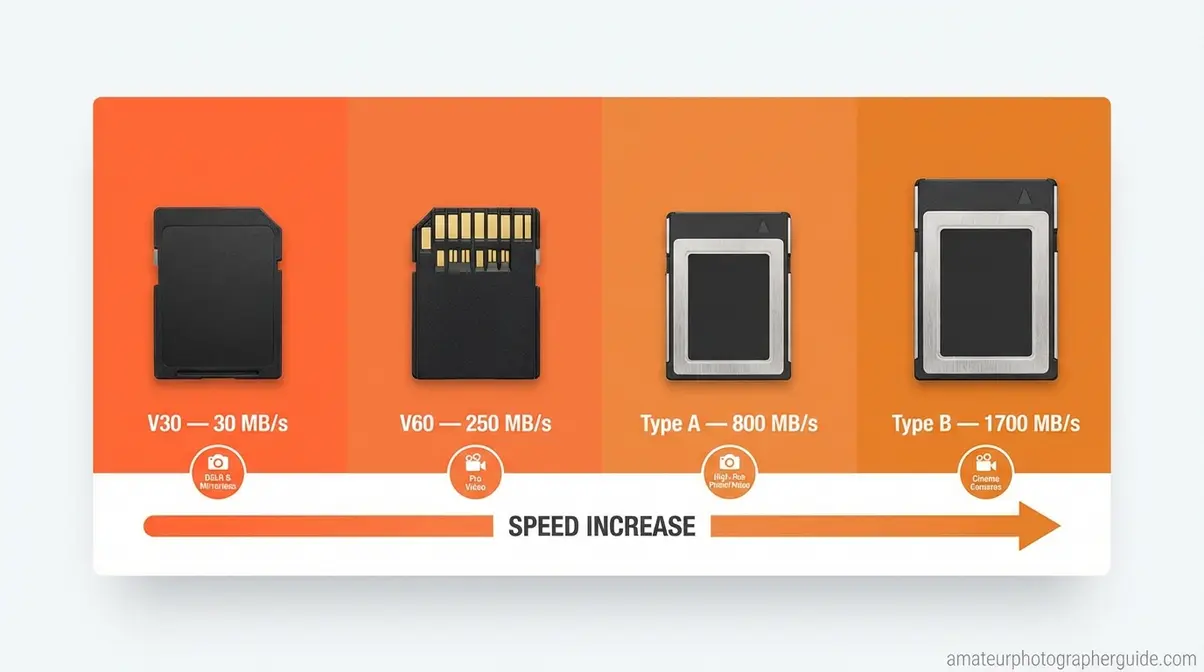
Choosing the right card is one of the most actionable action photography tips for real-world shooting. The table below shows current 2026 standards:
| Card Type | Max Write Speed | Best For | Example Cameras |
|---|---|---|---|
| UHS-I (V30) | ~30 MB/s | Casual action, JPEG shooting | Canon Rebel, Nikon D3500 |
| UHS-II (V60/V90) | 90–312 MB/s | Sports, RAW burst shooting | Sony a6400, Canon R7, Nikon Z50 |
| CFexpress Type A | ~800 MB/s | Professional mirrorless, 4K video | Sony a7 IV, a9 III |
| CFexpress Type B | ~1,700 MB/s | Pro sports cameras, 20fps+ RAW | Nikon Z9, Canon R3/R5 |
Practical recommendation for most beginners: A V60-rated UHS-II SD card from Sony, Lexar, or ProGrade offers the best performance-per-dollar improvement for sports and burst shooting. It is the single most impactful hardware upgrade for entry-level action photographers after the camera itself.
With all three points of the Shutter-Focus-Drive Triangle set, you’re ready to explore the two main creative techniques that define action photography: stop action and panning.
Stop Action vs. Panning Techniques
Stop action photography uses ultra-fast shutter speeds — typically 1/1000s or faster — to freeze a moving subject completely in the frame. Panning takes the opposite approach: you rotate the camera to follow the subject at a slower shutter speed, rendering the subject relatively sharp against a streaked, blurred background. Both produce compelling action moments photography, and both are intentional creative choices.
National Geographic emphasizes anticipation as a critical skill, noting that successful action shots often require panning the camera in sync with the subject — timing and follow-through determine whether the result looks professional or accidental. Review National Geographic’s advice on panning techniques for examples of how working photographers approach this in the field.
Knowing which look you want before you pick up the camera saves frustration and sets your settings in seconds. For related movement-based techniques, tips for photographing moving objects covers additional approaches beyond these two core methods.
How to Freeze Action: Stop Action Photography Explained
Stop action photography is the technique of using a shutter speed fast enough — 1/1000s or higher — that literally nothing moves during the exposure. The frame is “frozen in time.” No motion blur, no streaking, no ambiguity about where the subject is.
Stop action photography tips by subject:
- Water droplet mid-splash: 1/4000s+ — captures the crown-shaped ring of water before it collapses
- Dirt spray from a football tackle: 1/2000s — individual clods of dirt appear sharp in mid-air
- Soccer ball at point of kick: 1/1000–1/2000s — the ball shows compression against the foot at impact
- Cheerleader at the top of a stunt: 1/1000s — at peak height, relative motion is slowest, so 1/1000s is often sufficient
This brings up the peak action principle — the moment of maximum height, maximum impact, or transition between movements is when the subject is moving slowest relative to the camera. A cheerleader at the apex of a throw is briefly almost stationary. A basketball at the top of its arc hangs for a fraction of a second.
“Anticipate peak action.” That single instruction captures everything: position yourself, pre-focus on where the peak will happen, and fire during that slowest moment for the sharpest possible result.
The shutter speeds above correspond directly to the Cheat Sheet in Step 1 — use that table as your on-location reference.
The opposite of stop action is panning — and when executed well, it creates some of the most visually dynamic action images possible.
How to Pan for Creative Motion Blur
Panning means rotating the camera horizontally to follow a moving subject while using a slower shutter speed (1/30s–1/250s). The subject stays relatively sharp because it’s moving in sync with the camera; the stationary background blurs into horizontal streaks. The result says speed in a way that a frozen image cannot.
Follow the subject with your camera like a door swinging on a hinge — smooth rotation from the hips, not the arms.
Steps to execute panning:
- Set shutter speed to 1/60s–1/125s — start here, then go slower if you want more background blur
- Select Continuous AF so focus tracks the subject as you rotate
- Stand with feet shoulder-width apart and pivot from the hips for a smooth arc
- Begin tracking the subject before it reaches your frame position
- Fire the shutter during the tracking motion, continuing the rotation after the shot — follow-through is critical to keeping the subject sharp
- Expect a low keeper rate early on — 1 in 10 being sharp is normal when learning panning; 1 in 4 is achievable with practice
Best subjects for panning: cyclists on a straight path, runners in a lane, racing cars on a track, greyhounds in a straight. Panning works poorly on unpredictable subjects like dogs or children because their trajectory changes mid-shot.
For more on capturing action moments photography through panning and creative motion, creative panning techniques walks through the full range of creative applications.
Whether you’re freezing or panning, the techniques above apply broadly. The next section gets subject-specific — settings for sports, pets, and kids based on how each one actually moves.
Practical Examples: Water Droplets, Dirt Spray, and Sports Impacts
Three scenarios that show exactly what stop action photography captures when settings are right:
Water droplet crown: Fill a dark bowl with water to the brim. Drop a small pebble from 30cm height. Use 1/4000s, a macro lens or close-focus setting, and a flash positioned to the side for maximum freeze power and contrast. The result is a perfect crown of water droplets suspended in mid-air — the classic stop action image that is invisible to the naked eye.
Dirt and mud spray: Football tackles, motocross jumps, and trail running all produce projectile debris. At 1/2000s, individual clods of dirt appear sharp in mid-flight — the kind of shot that looks impossible but is entirely achievable with the right shutter speed and a well-timed burst.
Sports impact moments: A baseball bat hitting a ball at 1/2000s shows the ball compressing against the bat — a physical deformation invisible without a fast shutter. A soccer cleat connecting with a ball at 1/1500s shows the surface of the ball deforming on impact.
For sequence-style shooting — capturing the full arc of a movement across multiple frames — action replay photography (shooting a rapid burst to reconstruct the progression of a golf swing or jump in six sequential frames) applies the same fast shutter principles across a timed sequence rather than a single decisive moment.
These same principles apply whether you’re photographing athletes or animals — but each subject type has its own movement patterns. Here’s how to adapt.
Subject-Specific Action Photography Tips
Different subjects require different anticipation strategies. A soccer player follows predictable movement corridors; a Border Collie at play does not. Here is how to adapt your Shutter-Focus-Drive Triangle settings for the three most commonly photographed action subjects in beginner and amateur shooting.
For wildlife-specific scenarios beyond the coverage here, wildlife photography techniques addresses the specific challenges of birds, mammals, and unpredictable animal behavior in detail.
Sports: Soccer, Hockey, Cheerleading, and Team Events
Sports action photography tips start with a pre-shoot observation technique that most beginners skip entirely. Before raising the camera, watch the game for 5–10 minutes. Identify the “hot zones” — the penalty box in hockey, the goal mouth in soccer, the key in basketball, the base of a gymnastics stunt. Action concentrates in predictable areas. Pre-focus on that zone using Zone AF or manual focus lock, then switch to AF-C when the action arrives.
Recommended settings by sport:
- Soccer: 1/1000s, f/2.8–f/4, AI-Servo / AF-C active, track the ball carrier not the ball
- Hockey (action shots photography hockey): 1/1000–1/1500s, wide aperture (f/2 if your lens allows due to arena lighting), Sony Eye AF on players rather than puck-tracking
- Cheerleading / gymnastics (action shots photography cheer): 1/1000s at the peak of each stunt — when the flyer is at maximum height — burst mode at 8+ fps to capture 2–3 frames at the apex
- Basketball: 1/1000s, Continuous AF tracking the ball-handler, burst at the moment of a jump shot
Leave breathing room in the composition: always leave space in the direction the subject is moving. A player sprinting left across the frame should have open space in front of them, not squeezed against the frame edge. This is compositional technique that makes technical settings more effective.
At a Friday night hockey game in a dimly lit arena: set aperture to f/2.8, ISO to 6400, and shutter to 1/1000s — then rely on AI denoising in post-production to clean up noise (covered in the Low Light section).

Caption: Pre-focusing on the “hot zone” before the action arrives dramatically improves keeper rates in team sports.
Pets are even less predictable than athletes — but there’s a reliable technique that works for both dogs and cats.
Pet and Dog Action Photography

The core challenge with dog action photography tips is this: dogs don’t run in straight lines. Their acceleration, direction changes, and turning radius are unpredictable even for their owners. Better tracking software helps, but it cannot fully compensate for a subject that may reverse direction in under half a second. The solution is not faster tracking — it is strategic positioning.
The Lamp Post Method: Identify a spot your dog returns to repeatedly — a food bowl, a favorite toy, a corner of the fence. Pre-focus on that spot using manual focus or AF lock. Wait for the dog to arrive and fire a burst as they enter the frame. You are anticipating the location, not tracking the movement.
Settings for dog action photography:
- Shutter speed: 1/1000s minimum; 1/800s acceptable in good outdoor light
- Autofocus: Eye AF set to “Animal” (Sony / Canon R-series / Nikon Z-series) — this is the single most impactful setting for pet photography
- Drive mode: Maximum burst fps available
- Aperture: f/2.8–f/4 for outdoor shots; wide open for indoor
Get low: Crouch to the dog’s eye level — typically 30–50cm from the ground. Eye-level shots transform a snapshot into a compelling portrait-action hybrid. Combined with a tack-sharp freeze at 1/1000s, this compositional choice is what distinguishes professional-looking pet shots from casual ones.
On a Sony a6400 with Real-Time Animal Eye AF active, 1/1000s shutter, and burst at 11fps: expect 5–10 sharp frames from a 20-frame burst sequence when the dog enters your pre-focused zone.
Kids share some of a dog’s unpredictability — but they also have patterns you can read with a few minutes of observation.
Kids and Events: Anticipating Unpredictable Movement
Kids are unpredictable within a predictable range — and that range is the key. They circle back to slides. They run toward familiar adults. They chase balls to predictable landing zones. At any event, identify the attractor: the bounce house, the ball, the snack table. Set up near it and your subject will come to you.
Settings for kids and events:
- Shutter speed: 1/500s for toddlers and slow-play; 1/1000s for older children during active sports
- Drive mode: 8fps minimum burst — kids’ peak expressions and peak movement rarely last more than 100 milliseconds
- Autofocus: Continuous AF (Eye AF for People if your camera supports it)
Apply the breathing room rule consistently: frame with space in the direction the child is moving. A child running toward you in the lower third of the frame with open space above creates visual energy. A child squeezed against the top edge of the frame looks trapped, not dynamic.
Get to the child’s eye level for the most engaging perspective — the same principle as pet photography. A shot taken from adult standing height shows the top of a child’s head and a lot of ground. Crouching to waist height transforms the framing entirely.
For action photography tips for beginners shooting kids’ events: the settings don’t need to be perfect for every shot. Consistent 1/500s + AF-C + burst mode at a kid’s birthday party will yield 10–20 keepers from a 100-frame session. That is a completely achievable result on any modern camera.
Not all action happens in good light. The next section tackles the toughest scenario: fast subjects in dim indoor arenas, and the modern AI tools that fix the resulting noise.
Indoor Action & Low-Light Scenarios
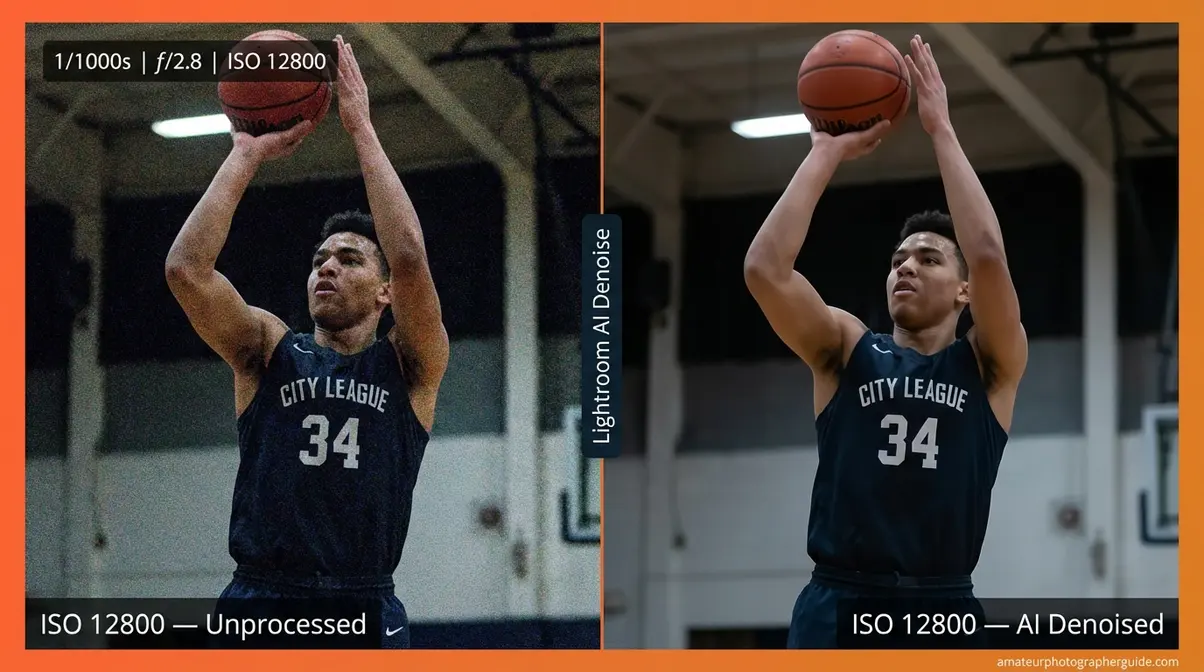
You’re at your child’s indoor basketball game. The gym lights buzz overhead — not nearly bright enough. You’ve set 1/1000s as instructed. The camera shows ISO 12800. The images are sharp but grainy. Here’s how to solve that — using both in-camera techniques and the modern AI denoising tools that competitors writing in 2021 had no reason to cover.
Action photography settings for indoor shooting require a different priority order than outdoor shooting. Sony’s indoor action photography guidance confirms that when available light is insufficient to maintain fast shutter speed, flash is an effective technique for freezing action indoors — and the principles behind that extend to every brand. For more on managing available light in difficult conditions, shooting action in low light covers the full exposure approach.
Indoor Action Photography: ISO, Aperture, and Flash
Indoor action photography tips follow a strict priority order. Shutter speed is non-negotiable — never drop below 1/500s for kids or sports, regardless of how dark the venue is. Once shutter speed is locked, open aperture as wide as your lens allows. Then let ISO rise to whatever the exposure requires.
Think of ISO as a hearing aid for your camera’s sensor — it amplifies the available light signal. Higher ISO means a brighter image, but also digital noise (the grainy, speckled appearance in high-ISO images that looks like film grain in its worst form).
ISO ranges by camera generation:
- Modern mirrorless (Sony a6400, Canon R7, Nikon Z50): Safely usable to ISO 6400; acceptable to ISO 12800 with AI denoising applied in post-processing
- Older DSLRs (Canon Rebel T6i, Nikon D3500): Aim for ISO 3200 maximum without post-processing; ISO 6400 is recoverable with careful AI denoising
Flash option: An external flash unit (not the built-in pop-up flash) freezes motion effectively through flash duration — often equivalent to 1/500s or faster — at any ISO. Check event rules before using flash, as it is prohibited at many sports venues, school events, and competitions.
| Setting | Value | Why |
|---|---|---|
| Shutter Speed | 1/500–1/1000s | Never compromise here first |
| Aperture | f/1.8–f/2.8 | Let in maximum available light |
| ISO | 3200–12800 | Accepted with AI denoising in post |
| AF Mode | AF-C + Eye AF | Tracks subjects in dim conditions |
Even at ISO 12800, modern software can rescue a noisy but sharp image. Here’s the exact workflow.
The 2026 AI Denoising Workflow: Lightroom and Topaz
Lightroom AI Denoise (Adobe’s machine-learning tool in Lightroom Classic and Lightroom CC) analyzes image noise and reconstructs fine detail instead of blurring it away. Introduced in 2023 and significantly improved through 2025 updates, it produces results that older noise reduction methods cannot match — particularly on high-ISO action shots where fine texture in fabric, fur, or faces needs to be preserved.
Lightroom AI Denoise — step-by-step:
- Import your RAW file into Lightroom Classic or Lightroom CC
- Open the Detail panel → find the Noise Reduction section → click “Denoise…”
- Set Amount to 50 as your starting point; preview the result in the dialog before applying
- Click “Enhance” — Lightroom generates a new DNG file with AI-reduced noise (takes approximately 15–30 seconds per image)
- Return to the Detail panel and apply additional sharpening if needed — denoising slightly softens fine texture, and a small sharpening pass (Amount: 40–60, Radius: 1.0) restores it
Topaz DeNoise AI is the standalone alternative for photographers who don’t use Lightroom or want more aggressive noise removal control. Drag and drop your RAW or JPEG file, select Auto mode, preview the result, and export. Processing time is similar to Lightroom’s Denoise function.
Critical limitation: AI denoising works on images that are sharp but noisy. A blurry, noisy image cannot be rescued by any software. Shutter speed and focus must be correct first — AI denoising is a post-processing polish, not a substitute for proper in-camera settings.
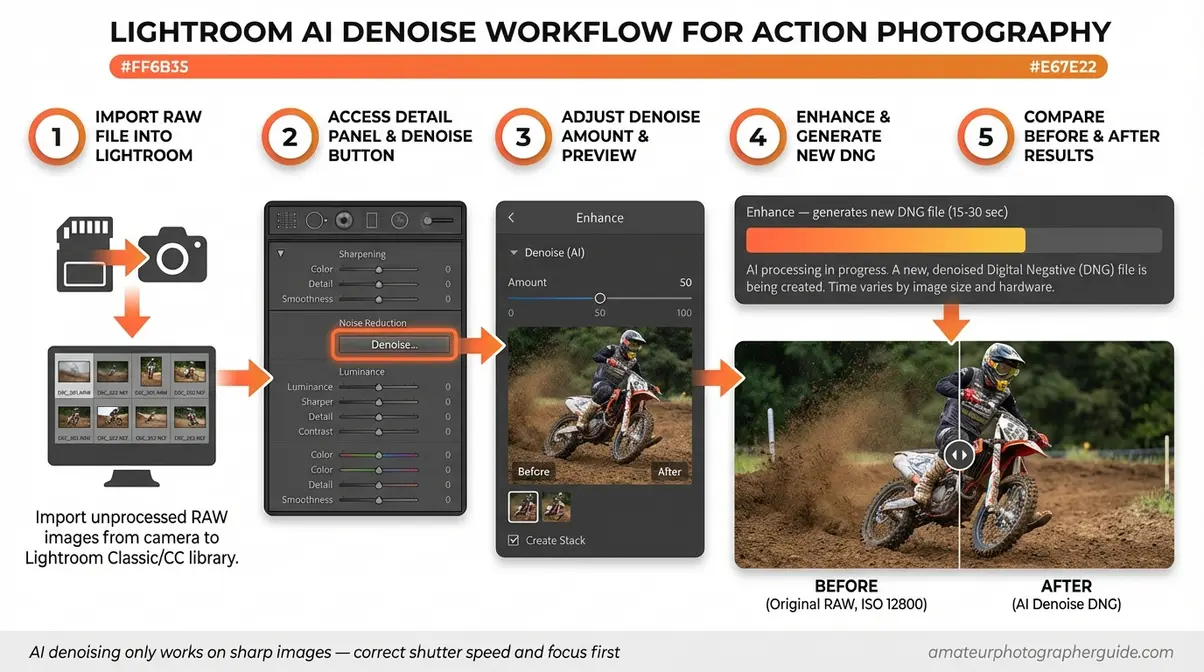
Caption: Lightroom’s AI Denoise panel — set Amount to 50 as a starting point and preview before applying.
One more specialized scenario: action figure photography — a niche that uses many of the same techniques but at macro scale.
Action Figure Photography: Macro Techniques for Tiny Subjects
Action figure photography tips apply the same freeze-motion principles at macro scale — photographing toys and figurines in dynamic poses with convincing environmental context. The challenge shifts from tracking speed to managing depth of field, which becomes extremely shallow at close focus distances.
Settings for action figure photography:
- Shutter speed: 1/1000s+ — though the subject is static, the flash duration provides effective freeze power and controls ambient light contamination
- Aperture: f/8–f/11 to maximize depth of field at macro distance (at 15cm focus distance, f/2.8 gives approximately 2mm of sharp focus — not enough to cover a figurine)
- Flash: Off-camera external flash pointing at an angle simulates directional action lighting convincingly
Background techniques: Wet ground, fine powder (flour, cocoa, or icing sugar), spray bottles, or purpose-built smoke machines create convincing “action” environments. Water and powder catch light differently than air — a puff of flour lit from the side looks like dust from an explosion.
For action camera photography tips — GoPros and similar action cameras — note that these devices have fixed apertures (typically f/2.8) and high-fps video modes by default. For still photography, the “Sport” or “Action” mode automatically sets fast shutter speeds. Manual shutter control is limited on most models; see a comparison of top action cameras for capability differences across current models.
Before you head out to shoot, know the common mistakes that keep photos blurry even when settings are almost correct — and what to do about each one.
Common Mistakes That Keep Action Photos Blurry
Even with good settings knowledge, specific mistakes repeatedly produce blurry images. The list below comes from patterns observed across photography forums and beginner feedback — these are the actual errors, described in the language photographers use when they encounter them.
Five Mistakes That Keep Your Photos Blurry (And the Fix)
- Still using One-Shot / AF-S focus mode — Your camera focuses on the wall behind your subject the moment they step forward. The focus locked on where they were, not where they are. Fix: switch to AI-Servo (Canon) or AF-C (Nikon/Sony) as shown in Step 2.
- Single-shot drive mode instead of burst — You fire once and capture the subject between movements — mid-stride rather than at peak extension. Fix: enable High-Speed Continuous drive mode as shown in Step 3.
- Confusing brand terminology — A YouTube tutorial says “switch to AI-Servo” but you have a Nikon, where the equivalent setting is AF-C. You search the menu for “AI-Servo,” find nothing, and give up. Fix: refer to the Quick Reference table in Step 2 — it maps all three brands to their equivalent settings.
- Shutter speed too slow for the subject — You’ve set 1/250s for a hockey game because the venue is dark and you were afraid of noise. The players are blurry. Fix: prioritize shutter speed first; use the Cheat Sheet from Step 1 and address noise with ISO and AI denoising afterward.
- Buffer jamming from a slow memory card — Your camera fires eight frames and stops mid-burst at the exact wrong moment. Fix: upgrade to a UHS-II V60-rated card as explained in Step 3. This single hardware change eliminates this problem for most entry-level camera bodies.
And sometimes, the issue isn’t technique — it’s gear.
When Your Gear Is the Limitation (Not Your Settings)
Honest acknowledgment saves wasted troubleshooting time. Some results genuinely require hardware that entry-level gear cannot provide:
- Kit lens at f/5.6 in low light: The 18-55mm kit lens at full zoom can only open to f/5.6. In dim arenas, this forces ISO 12800 or higher even with perfect technique. A 50mm f/1.8 prime lens (typically $120–$150 new) is the most affordable solution — it opens three full stops more light than the kit lens at f/5.6.
- Entry-level camera without Eye AF: Cameras under approximately $500 new rarely include Eye AF or Subject Tracking. Back-button focus combined with zone pre-focusing (described in the Sports section) becomes the primary strategy for these bodies.
- Standard UHS-I card: If buffer jams occur more than three times per session, the card is the bottleneck. Upgrade to a UHS-II V60-rated card — they are widely available for $30–$60 for a 64GB card.
These are solvable problems with targeted, affordable upgrades — not reasons to buy a new camera body.
Frequently Asked Questions About Action Photography
How do you take a good action photo?
To take a good action photo, set your shutter speed to at least 1/500s, switch autofocus to Continuous mode (AI-Servo on Canon, AF-C on Nikon/Sony), and enable High-Speed Burst mode before the action begins. These three settings work as a system — fast shutter freezes motion, Continuous AF tracks the subject, and burst mode gives you multiple frames to select from. For most subjects, 8+ frames per second combined with 1/1000s shutter speed produces consistently sharp results. Anticipation matters most — pre-focus on where the action will happen and be ready before the peak moment arrives.
What are the best settings for action photography?
The best action photography settings are Shutter Priority mode (Tv/S) with 1/500s minimum, Continuous AF (AI-Servo/AF-C), Auto ISO capped at 6400, and High-Speed Continuous drive mode. This combination — the Shutter-Focus-Drive Triangle — handles most action scenarios automatically while keeping all three variables working together. For fast sports like hockey or motorsports, increase shutter speed to 1/1000–1/2000s and open aperture to f/2.8 for maximum light. Modern mirrorless cameras add Eye AF for even higher keeper rates without additional manual adjustments.
What is the best shutter speed to freeze motion?
The best shutter speed to freeze motion depends on the subject’s speed: 1/500s for jogging or children, 1/1000s for field sports and running animals, 1/2000s for birds in flight and motorsports. The faster your subject moves, the shorter the exposure must be to eliminate blur — even at 1/500s, a racing car will show motion blur. For extreme freeze effects like water droplets or impact moments, use 1/4000s or faster. When uncertain, start at 1/1000s and review your first few frames — if blur is visible, increase the speed.
Which autofocus mode is best for moving subjects?
For moving subjects, always use Continuous Autofocus — called AI-Servo on Canon, AF-C on Nikon, and AF-C or Tracking on Sony. This mode continuously recalculates focus as the subject moves closer or farther away, unlike Single AF (One-Shot/AF-S) which locks focus only once and stops. On modern mirrorless cameras, enabling Eye AF or Subject Tracking within Continuous AF mode dramatically improves keeper rates by locking focus on a specific feature rather than the subject’s general outline. Older DSLRs benefit most from combining AF-C with back-button focus to prevent accidental focus loss.
How do you take action photos in low light?
For low-light action photography, keep shutter speed at 1/500s minimum, open aperture to the widest f-stop your lens allows (f/1.8–f/2.8), and let ISO rise to 3200–12800. Modern cameras produce usable images at ISO 6400–12800 when you apply AI denoising in Lightroom or Topaz DeNoise AI during post-processing. Shooting in RAW format preserves the most detail for noise reduction — JPEG files respond less effectively to AI denoising. For venues that permit flash, an external flash unit freezes motion at any ISO through its brief duration.
Bring It All Together
The most effective action photography tips are not individual tricks — they are the three settings working as one system. Set shutter speed first (1/500s minimum for most subjects, 1/1000s+ for fast sports and animals), confirm Continuous AF is active on your brand (AI-Servo, AF-C, or Tracking), then enable High-Speed Burst mode. That sequence is the Shutter-Focus-Drive Triangle, and it applies to every action scenario in this guide. Modern mirrorless cameras add Eye AF on top of this Triangle, dramatically raising keeper rates without any additional manual effort.
The Shutter-Focus-Drive Triangle is more than a settings checklist — it is a mental model. The reader who came to this guide with a blurry photo of a child mid-kick now has a framework that transfers to dogs, hockey games, birds in flight, and action figures. Every new subject reduces to the same three questions: Is my shutter fast enough? Is my autofocus tracking continuously? Is burst mode active? Answer yes to all three, and the Triangle holds.
Start with the Shutter Speed Cheat Sheet from Step 1 on your next shoot. Take 30 frames of any moving subject using 1/1000s + AF-C + High-Speed Burst, then review which images are sharp. That single 10-minute exercise will calibrate your instincts faster than any amount of reading — and your next photo of a child scoring a goal will be tack-sharp.
Last update on 2026-05-28 / Affiliate links / Images from Amazon Product Advertising API