Black and White Photography Guide: Complete 2026 Tutorial
Master striking images with this step-by-step black and white photography guide for amateurs. Learn setup, capture, edit, and review techniques easily.

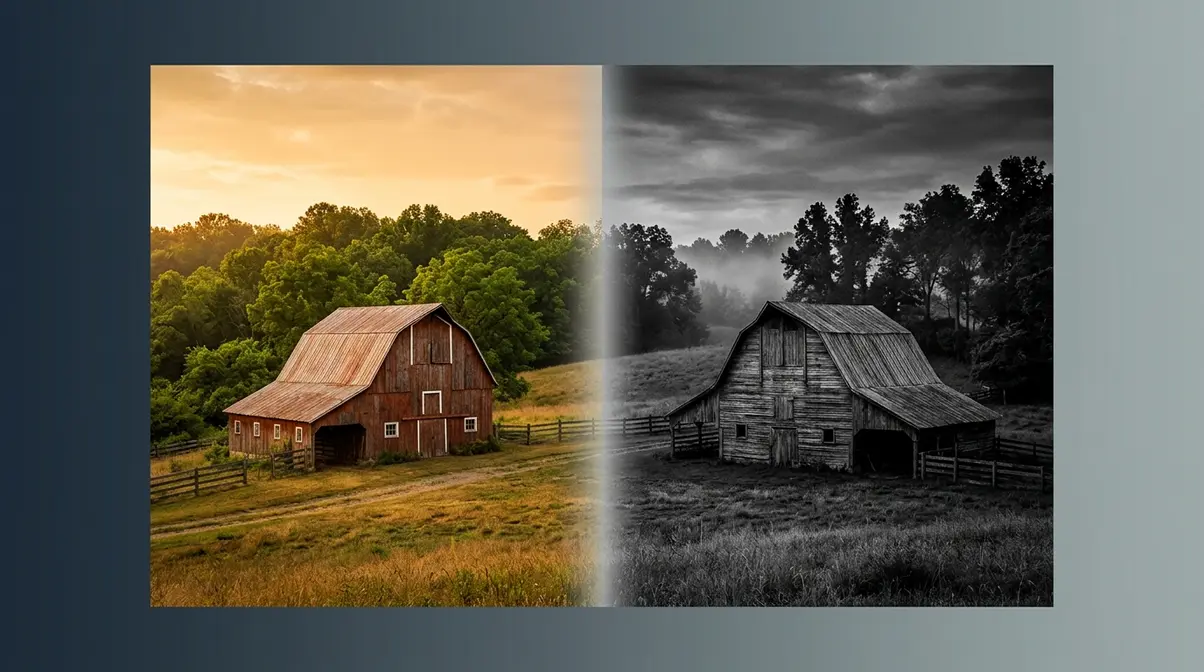
You know the feeling. You’re standing in front of a weathered barn at golden hour, fog rolling through the trees behind it, and something whispers: this should be black and white. But then doubt creeps in. Should it? What exactly are you looking for?
What’s in this guide
- What's in This Guide
- What You'll Need Before You Start
- Why Black and White Photography Works {#why-bw-works}
- Core Techniques for Monochrome Images {#core-techniques}
- Post-Processing Your Black and White Photos {#post-processing}
- Famous Black and White Photos {#famous-bw}
- Buying, Selling, and Displaying Prints {#prints-resources}
- Common Mistakes and How to Avoid Them {#common-mistakes}
- Frequently Asked Questions {#faqs}
- Conclusion {#conclusion}
“I enjoy nature scenes and experiment a bit with different techniques but never know when to go black and white. Is there something to look for in the…”
Yes — there is. And this black and white photography guide will show you exactly what.
Every time you convert a photo to black and white and it looks flat or lifeless, you’re not missing talent. You’re missing a system. Color gives your eye an easy shortcut. Remove it, and suddenly your viewer’s brain has to work with tone, texture, and light alone — which is either powerful or disappointing, depending on whether the scene was ready for it.
In this black and white photography guide, you’ll learn a step-by-step framework called The Digital Zone System — a modern adaptation of Ansel Adams’ original tonal control method — for deciding when to shoot in monochrome, how to expose it correctly in-camera, and how to edit it to a dramatic final image using Lightroom’s 2026 AI tools. We’ll cover the fundamentals of why B&W works, core shooting techniques, post-processing workflows, inspirational master photographers, and how to print and display your work.
What’s in This Guide
What You’ll Need Before You Start
- A digital camera — DSLR, mirrorless, or a smartphone with RAW capability (such as an iPhone shooting ProRAW or an Android with a dedicated RAW mode)
- A memory card with enough storage — RAW files are large, typically 20–40MB each, so a 64GB or 128GB card is a practical minimum
- Adobe Lightroom (a free trial is available at adobe.com) or a free alternative such as RawTherapee or Darktable
- Basic familiarity with your camera’s shooting menu — you don’t need to be an expert, but knowing how to change file format to RAW matters here
- An open mind — black and white photography is as much about seeing differently as it is about technique
Why Black and White Photography Works {#why-bw-works}
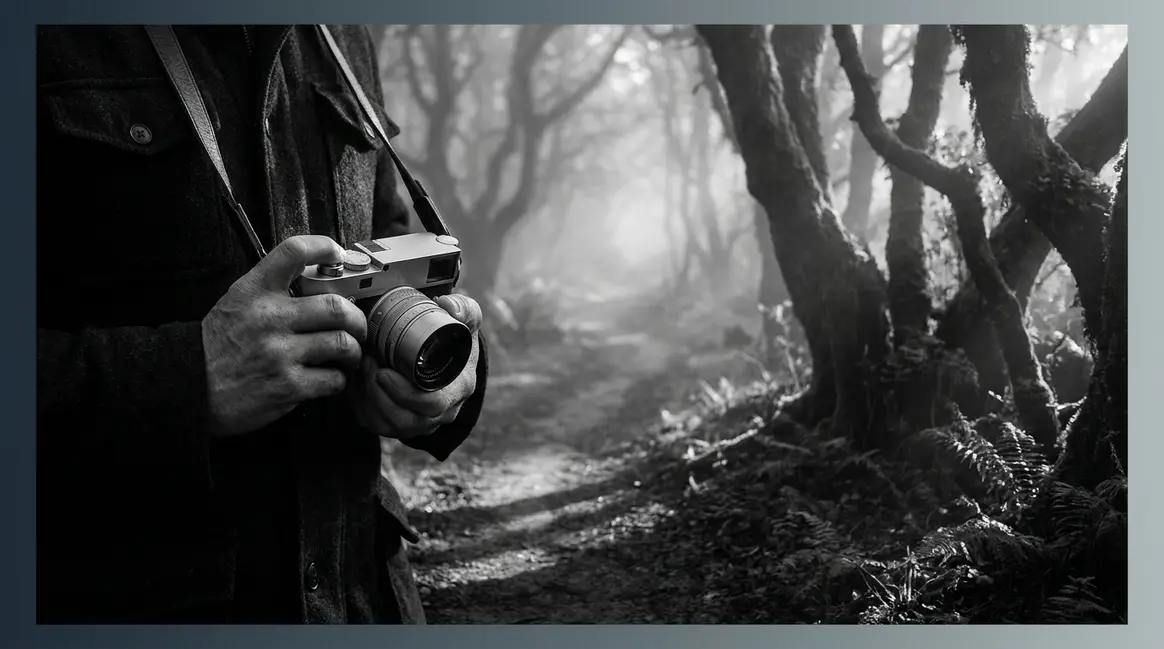
Black and white photography works because it removes the shortcut. Color gives the human eye an instant, effortless path to meaning — a red apple, a blue sky, a green field. Strip that away, and the viewer is forced to engage with a photograph’s underlying architecture: its light, its shadows, its textures, and the shapes within it. That deeper engagement is why monochrome images so often feel more serious, more timeless, and more emotionally resonant than their color counterparts.
Research in visual perception suggests that the human brain processes luminosity (brightness) and form separately from color, meaning a black and white image activates a fundamentally different mode of looking (BBC Culture, 2018). When you understand this, you stop treating B&W as a stylistic filter and start treating it as a deliberate compositional choice.
Throughout this guide, we’ll use a framework called The Digital Zone System — a modern adaptation of Ansel Adams’ original method — to help you make every B&W decision with confidence. We’ll introduce it fully in the next section. For now, know this: tone is the currency of black and white photography, and the histogram (the graph your camera and Lightroom use to show brightness distribution) is your guide.
What makes a good black and white photo?
A great black and white photo has strong tonal range, clear compositional structure, and a subject that benefits from the absence of color. Specifically, look for: a wide spread from deep shadows to bright highlights (not all middle grey), strong directional light that creates shadow and reveals texture, clear geometric forms or leading lines to guide the eye, and a subject whose essential quality — emotion, age, texture, drama — is clarified rather than diminished by removing color. If you can describe the image’s most important quality without mentioning any color, it’s a strong B&W candidate.
Elements of Great Monochrome Photos
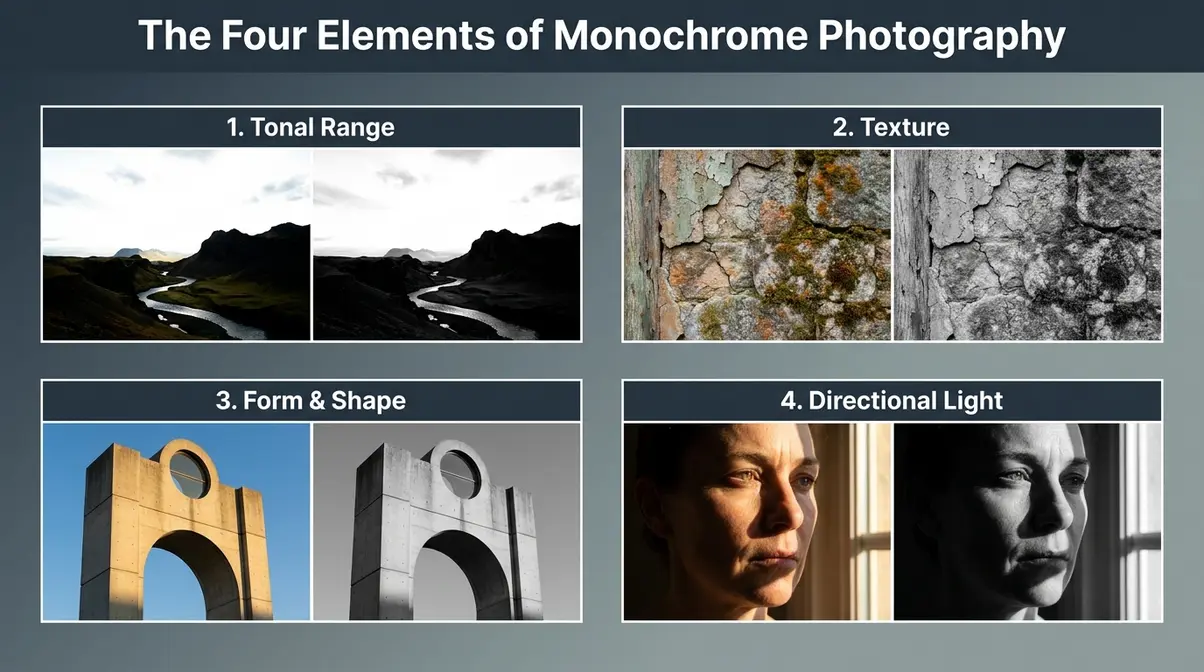
Photographers who consistently produce powerful black and white images aren’t guessing. They’re looking for a specific set of qualities before they even raise the camera. Across photography communities and educational resources, the consensus points to four core elements.
1. Tonal Range
Tonal range is the distance between the lightest and darkest parts of a photo — think of it like the difference between a white piece of paper and a black shadow on a wall. A great monochrome image typically spans most of that distance. A photo that sits entirely in the middle greys looks muddy and flat. Common pain points reported by beginners include flat-looking conversions — and this is almost always the culprit.
2. Texture
Texture is what your fingertips would feel if you could touch the subject. Rough bark, weathered stone, crinkled fabric, a face lined with age — these surfaces sing in black and white because they create micro-shadows that color would normally overwhelm. When you’re scanning a scene and asking “should this be monochrome?”, run a quick mental texture check.
3. Form and Shape
Without color, shapes become the primary visual language. Strong geometric forms — arches, triangles, leading lines, circular patterns — carry a photograph when color is absent. This is why architectural photography and portraiture translate so naturally into B&W.
4. Light Direction
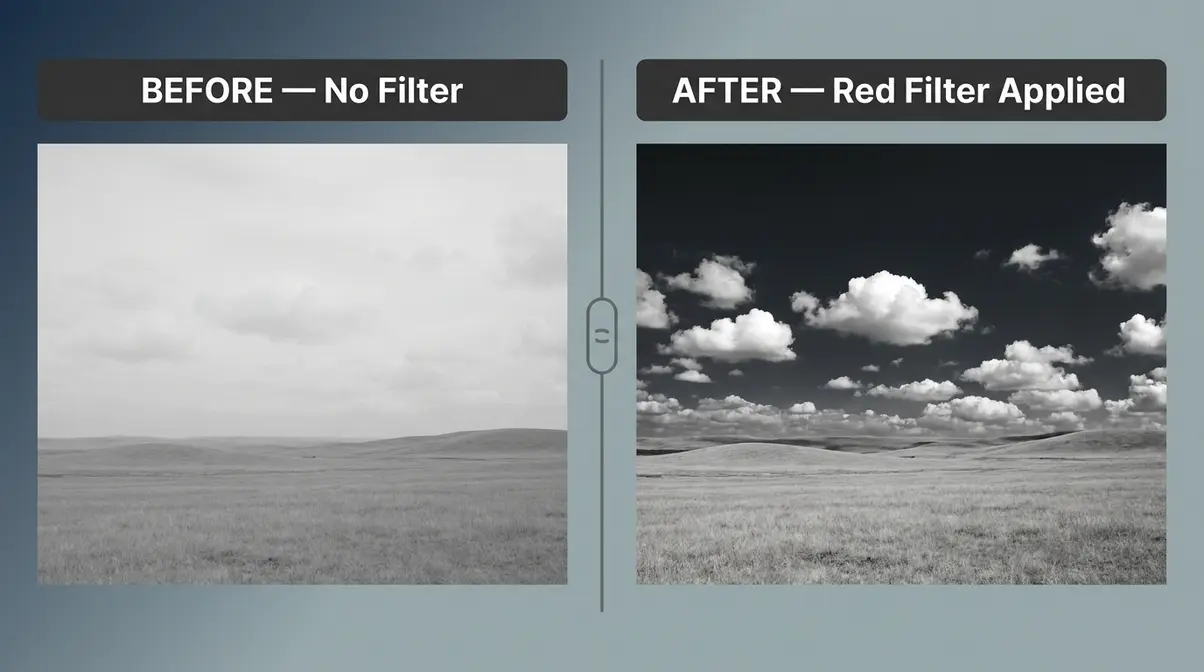
Side-lighting and backlighting create shadows that reveal form and texture. Flat, frontal light (like an on-camera flash) flattens everything. The more directional your light source — morning sun raking across a field, a single window illuminating a face — the more drama you have to work with in monochrome.
How to Start “Seeing” in Black and White
“Seeing in monochrome” sounds like a mystical skill, but it’s actually a trainable habit. Most beginners struggle because their eye is wired to notice color first. The goal is to temporarily disable that reflex and evaluate a scene by its tonal structure instead.
Practical Exercise: The Squint Test
Squint at a scene until it blurs slightly. This reduces color information and forces your eye to read the scene in broad light-and-dark masses. If the resulting blurred image has interesting contrast — bright areas separated by dark areas, with clear shapes — it will likely work in black and white. If everything blurs into the same middle-grey soup, the scene lacks the tonal separation you need.
Use Your Camera’s Monochrome Preview
Most modern DSLRs and mirrorless cameras let you set the Picture Style (Canon) or Picture Control (Nikon) to Monochrome. This shows you a black and white preview on your LCD screen — even while you’re shooting in RAW color. This is one of the most powerful training tools available, and it costs nothing. Photographers consistently report that using this preview for even a few weeks dramatically accelerates their ability to pre-visualize monochrome scenes.
Look for Emotional Resonance
Ask yourself: what is this photograph about? If the answer involves mood, age, weight, solitude, or drama — emotions that feel weighty or timeless — black and white often serves them better. If the answer is “the incredible turquoise of that Caribbean water,” color is the point. Keep color.
When to Choose Monochrome Over Color
Black and white photography works best when color is a distraction rather than a contribution. This is the clearest decision rule available, and no competitor in this space states it this plainly.
Here’s a practical framework — your first taste of The Digital Zone System thinking:
| Shoot in B&W When… | Keep Color When… |
|---|---|
| The scene has strong shadow/highlight contrast | Color is the subject’s defining feature (sunsets, autumn leaves) |
| Texture or form is the main subject | Multiple competing colors create visual interest |
| The mood is somber, timeless, or dramatic | Soft pastels or subtle hues are part of the story |
| Harsh or mixed lighting would look ugly in color | The light is golden, warm, and flattering |
| You want to emphasize emotion over environment | Geographic or cultural context depends on color cues |
The Smithsonian American Art Museum, one of America’s foremost collections of photographic art, notes in its educational resources that the most enduring monochrome images share a common trait: the removal of color clarifies the image’s primary subject rather than stripping it of information.
A useful rule of thumb: if you can describe a scene’s most important quality without mentioning any color, it’s a strong B&W candidate. “The wrinkles on her face.” “The fog filling the valley.” “The shadow of the fire escape on the brick wall.” None of those descriptions need color. That’s your signal.
Download our free Black and White Photography Cheat Sheet — a one-page visual guide to the key principles in this section. Bookmark this page and refer to it in the field.
Core Techniques for Monochrome Images {#core-techniques}
Knowing when to go black and white is only half the equation. The other half is capturing the image in a way that gives your editing software — and your eye — the best possible material to work with. This section covers the four fundamental in-camera techniques that separate flat, forgettable monochrome shots from images with real depth and drama.
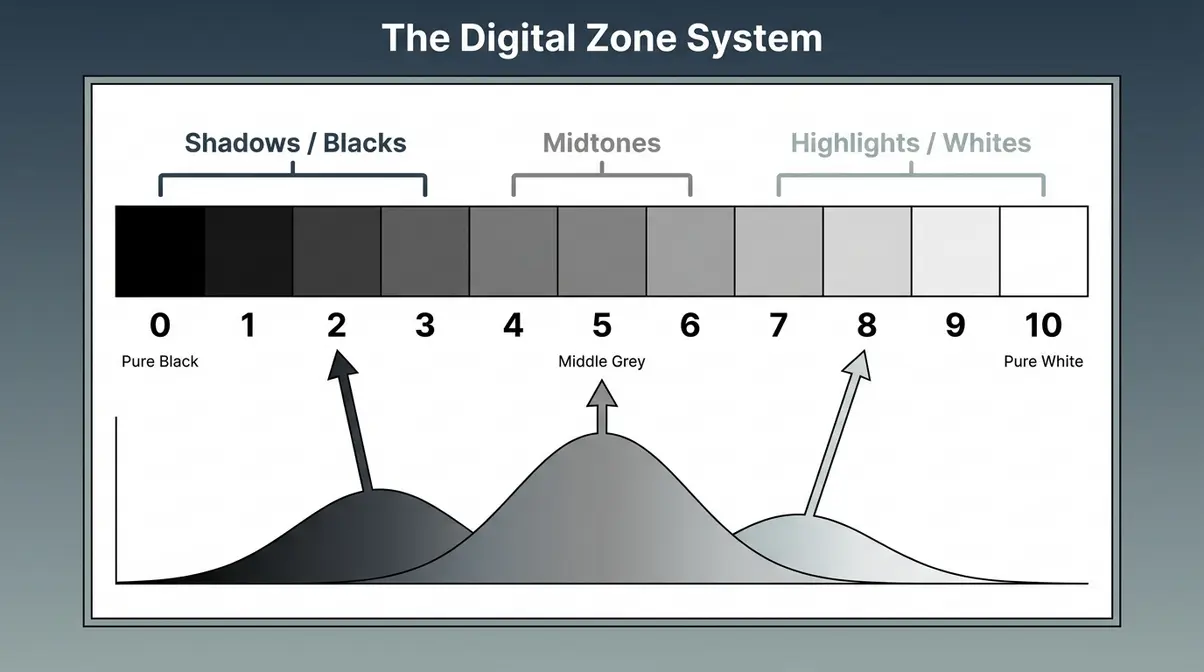
Before we get into each technique, this is the moment to properly introduce The Digital Zone System.
What is the Zone System in photography?
The Zone System is a tonal control framework developed by Ansel Adams in the 1940s that divides the tonal range of a photograph into 11 zones, numbered 0 (pure black) to 10 (pure white). Zone 5 is middle grey — the “neutral” exposure your camera’s meter targets by default. By pre-visualizing where different elements of a scene will fall on the zone scale, photographers can make deliberate exposure decisions to place tones exactly where they want them — protecting highlight detail in Zone 7-8, or allowing shadows to fall into Zone 1-2 for dramatic effect. The Digital Zone System, as presented in this guide, adapts this framework to the digital histogram for modern photographers.
Mastering Light and Shadow
Light is not just illumination in black and white photography — it is the subject. Without color to differentiate objects, light and shadow become the primary tools for creating depth, separation, and visual interest.
The Direction of Light
Side-lighting (light coming from a 45–90 degree angle to your subject) is the single most powerful tool for black and white photographers. It rakes across surfaces, revealing texture and creating shadows that define form. Think of late-afternoon sun hitting the side of a building, or a single window lighting half a face in a portrait. These directional shadows do the heavy compositional lifting that color would otherwise provide.
Backlighting creates dramatic silhouettes and rim-lighting effects that are uniquely powerful in monochrome. When the light source is behind your subject, you lose detail but gain powerful graphic shapes — which are exactly the strong forms that make great B&W compositions.
Harsh vs. Soft Light
Beginners are often taught to avoid harsh midday sunlight in color photography — and for good reason. But in black and white, harsh light creates strong shadows and high contrast, which can be exactly what you want. Overcast days, conversely, produce soft, even light with gentle gradations — ideal for portraits and detail shots where you want smooth tonal transitions rather than dramatic contrast.
Practical Application
Before you shoot, identify: where is the light coming from? Where are the deepest shadows falling? Using The Digital Zone System, estimate where those shadows sit on the tonal scale. If they’re falling into Zone 0–1 (pure black with no detail), decide whether that lost detail serves your composition or hurts it. If it hurts it, adjust your position or exposure.
Using Physical Color Filters
One of the most powerful — and most overlooked — tools in black and white photography is the physical color filter. This technique comes directly from the film era but remains fully relevant for digital shooters, and it’s something you can implement for under $30.
How Color Filters Work in Monochrome
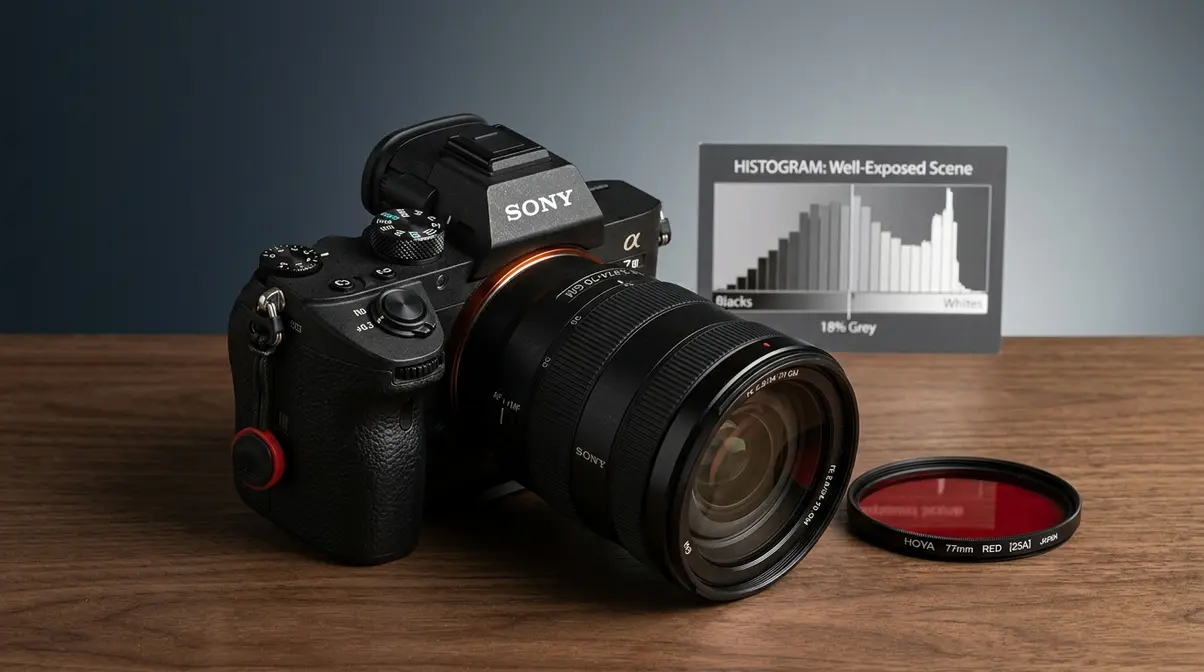
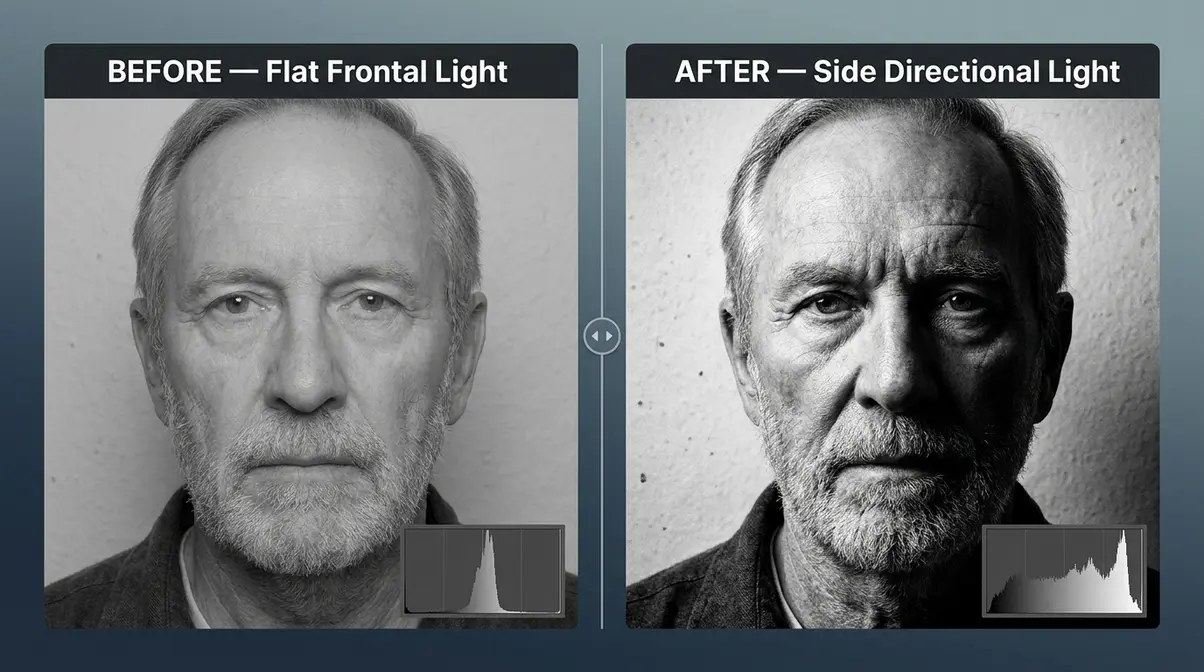
When you place a colored filter in front of your lens, it blocks certain wavelengths of light. The colors that match the filter pass through easily and appear lighter in the final black and white image. Colors opposite to the filter (complementary colors) are blocked and appear darker. This gives you precise control over how different colored elements in your scene render as grey tones.
The Four Essential Filters
| Filter Color | Lightens | Darkens | Best Use Case |
|---|---|---|---|
| Yellow | Yellow, orange tones | Blue sky | Slight sky contrast, natural skin tones |
| Orange | Orange, red tones | Blue sky, green foliage | Dramatic sky, architectural detail |
| Red | Red tones | Blue sky, green foliage | Maximum sky drama, high-contrast landscapes |
| Green | Green foliage, skin | Red tones, blue sky | Portraits, foliage detail |
Practical Example: Balancing the Contrast in a Sky
One of the most common challenges beginners face is “balancing the contrast” between a bright sky and a darker foreground. In color, you’d use a graduated ND filter. In black and white, a red filter dramatically darkens the blue sky — turning it nearly black — while keeping the foreground lighter. The result is an image with extreme tonal separation that would be impossible to achieve in-camera any other way.
You can achieve similar results in post-processing using Lightroom’s HSL panel (covered in the next section), but a physical filter captures the effect optically at the moment of exposure — meaning you’re working with the actual light, not a digital approximation.
Camera Settings for B&W
Getting your in-camera settings right for black and white photography isn’t radically different from color — but the tolerances shift in important ways. Specifically, how you handle highlights and shadows matters more, because you have no color information to rescue a poorly exposed shot.
ISO (Your Camera’s Sensitivity to Light)
ISO is your camera’s sensitivity to light — a higher number means more sensitivity, which lets you shoot in darker conditions, but also introduces grain (digital noise — the speckled texture you see in dark areas of a photo). In black and white photography, grain is not necessarily a bad thing. Film photographers deliberately used high-ISO equivalents to create a gritty, textured look. Experiment with ISO 800–3200 in low light — the grain can add character rather than destroy it.
Aperture (The Size of Your Lens Opening)
Aperture controls both exposure and depth of field (how much of the scene is in sharp focus from front to back). A wide aperture (small f-number, like f/1.8 or f/2.8) creates a shallow depth of field — your subject is sharp, the background blurs. A narrow aperture (large f-number, like f/11 or f/16) keeps everything in focus from foreground to background. For B&W landscapes with strong tonal structure, narrower apertures often work best. For B&W portraits emphasizing a face against a blurred background, wide apertures shine.
Exposure: Don’t Blow Out Your Highlights
“Blowing out” highlights means overexposing the brightest parts of your image so severely that they become pure white with no recoverable detail. In color photography, you can sometimes recover blown highlights from RAW files. In black and white, blown highlights become pure white zones — Zone 10 in our system — with no texture or detail. This is often fatal to an image.
The practical rule: expose to protect your highlights. Use your camera’s highlight warning (the “blinkies” — areas that flash on your LCD when overexposed) or your histogram. In The Digital Zone System terms, aim to keep important highlight detail no brighter than Zone 8. This might mean slightly underexposing — which is recoverable in RAW editing — rather than overexposing, which often is not.
Recommended Settings Starting Point
| Setting | Recommendation | Why It Matters |
|---|---|---|
| File Format | RAW (not JPEG) | Preserves all tonal data for editing |
| ISO | 100–400 (clean) / 800–3200 (grain texture) | Match to available light and desired look |
| Aperture | f/8–f/11 for landscapes | Maximum sharpness throughout frame |
| Aperture | f/1.8–f/2.8 for portraits | Subject separation from background |
| Exposure | Expose to protect highlights | Recover shadows in editing; blown highlights are lost |
| Picture Style/Control | Set to Monochrome | Preview B&W on LCD while shooting RAW color |
Composition Rules for Monochrome
Composition in black and white photography follows the same fundamental rules as any other photography — but with one critical difference: without color to guide the eye, compositional structure must do all the work. Weak composition that color might paper over becomes immediately obvious in monochrome.
Rule of Thirds
Divide your frame into a 3×3 grid (most cameras display this as an overlay option). Place your primary subject — or the horizon line — along one of the grid lines rather than dead center. This creates visual tension that makes the image more engaging. In B&W, where the eye moves through an image differently, placing your brightest tonal area along a grid intersection creates a natural focal point.
Leading Lines
Lines that draw the eye from the foreground into the depth of a scene are powerful in any photography. In black and white, they become even more important because the contrast between the line and its surroundings (a road against dark fields, a fence against a bright sky) creates the visual movement. Look for roads, fences, rivers, shadows, and architectural edges.
Negative Space
Negative space — large areas of relatively uniform tone surrounding a subject — creates a sense of isolation, scale, or stillness that works beautifully in monochrome. A single dark figure against a pale, foggy sky. A bare tree against a white winter field. The empty space is part of the composition.
Patterns and Repetition
Repeating shapes — a row of arches, a grid of windows, ripples on water — create rhythm that is especially satisfying in black and white. The removal of color makes the pattern itself the entire subject.
Post-Processing Your Black and White Photos {#post-processing}
Capturing a great black and white image in-camera is only the beginning. Post-processing is where you take the raw tonal material you’ve captured and sculpt it into a final image that matches your creative vision. This section walks you through the complete editing workflow — from why RAW matters, through a step-by-step Lightroom conversion, to advanced dodging and burning, and finally to the AI-powered tools that define editing in 2026.
Why Shooting in RAW Changes Everything
Shooting in RAW is the single most important technical decision you can make for black and white photography. A RAW file is your camera’s unprocessed data — every photon that hit the sensor, recorded without any in-camera compression or processing. A JPEG, by contrast, is a processed, compressed version of that data, with much of the tonal information permanently discarded.
Why does this matter for black and white? Because the entire art of monochrome editing is tonal control — adjusting the relationship between shadows, midtones, and highlights with precision. With a RAW file, you have full access to all of that data. With a JPEG, you’re working with a fraction of it.
Practically speaking: a RAW file typically captures 12–14 stops of dynamic range (the full spread from darkest shadow to brightest highlight). A JPEG captures roughly 8 stops. Those extra 4–6 stops are where the detail lives — in the deep shadows and the bright highlights. When you’re dodging and burning a black and white portrait in Lightroom, you’ll feel that difference immediately.
Learn how to set up your camera for RAW shooting in our complete camera settings guide.
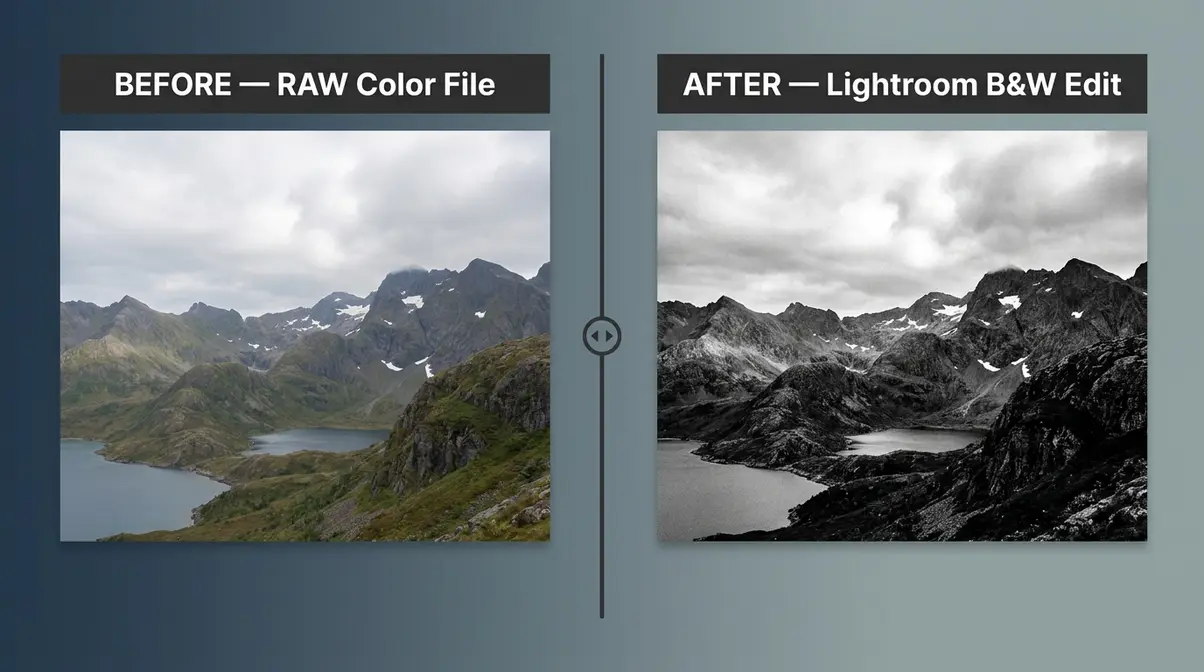
Lightroom B&W Conversion Steps
Adobe Lightroom remains the industry standard for black and white conversion, and its 2026 feature set — particularly the AI-powered masking tools — makes it more powerful than ever for monochrome work. Here is the complete conversion workflow.
Tools you’ll need: Adobe Lightroom (Classic or the cloud version), your RAW file, approximately 15–20 minutes per image to start.
Step 1: Import Your RAW File
Open Lightroom and import your image. In the Library module, click Import and navigate to your file. Always import as RAW — not as a copy converted to DNG unless you have a specific reason.
Step 2: Go to the Develop Module
Click “Develop” in the top-right navigation. This is where all editing happens.
Step 3: Convert to Black and White
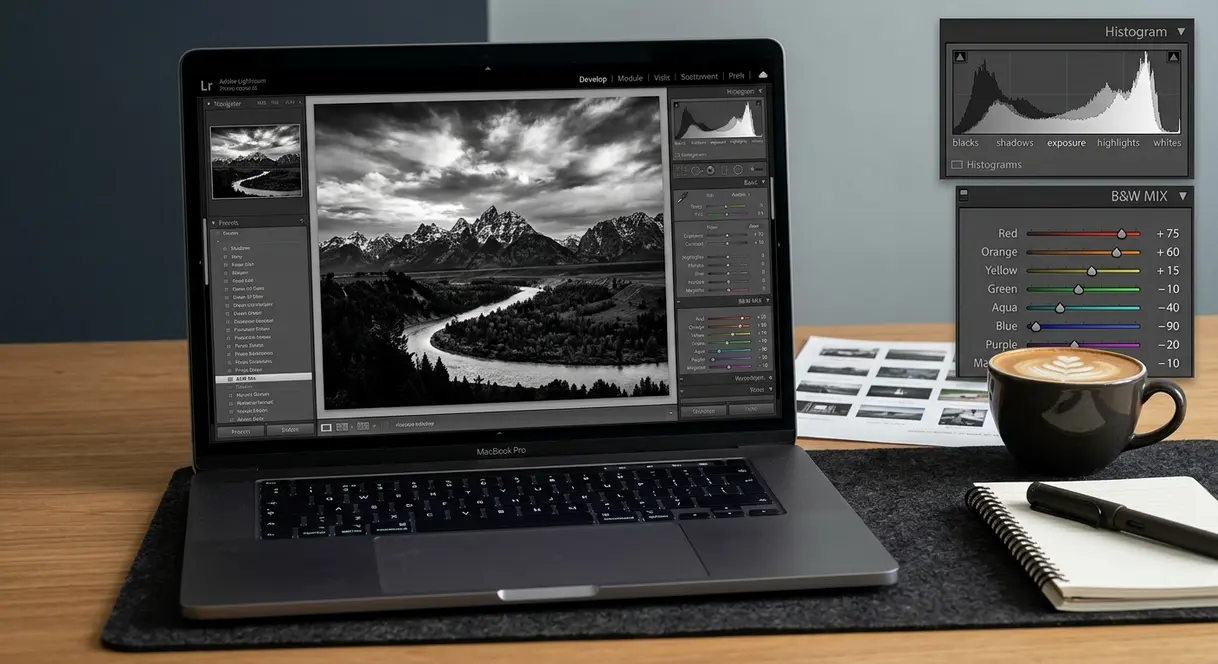
In the Basic panel on the right, click the “B&W” button next to “Color” at the top. This is Lightroom’s primary conversion switch. Alternatively, press the keyboard shortcut V. Your image instantly converts to monochrome.
Why this works: Lightroom applies a default conversion that maps each color in the original image to a grey value. But the default mapping is rarely optimal — that’s what the next steps fix.
- Step 4: Adjust the Basic Panel
- With your image now in B&W, use the Basic panel sliders:
- Exposure: Overall brightness — use The Digital Zone System to guide you. Is your histogram too far left (underexposed, dark) or too far right (overexposed, bright)?
- Highlights: Drag left to recover bright areas and protect Zone 7–8 detail
- Shadows: Drag right to open up dark areas and reveal Zone 2–3 detail
- Whites and Blacks: Hold Alt (Windows) or Option (Mac) while dragging these sliders — the screen turns black or white and shows you exactly where clipping begins
Step 5: Open the B&W Mix Panel (HSL/Color Panel)
This is the most powerful and most underused tool in Lightroom’s B&W workflow. The B&W Mix panel shows you eight color sliders — Red, Orange, Yellow, Green, Aqua, Blue, Purple, Magenta. Each slider controls how bright or dark pixels of that original color appear in your black and white conversion.
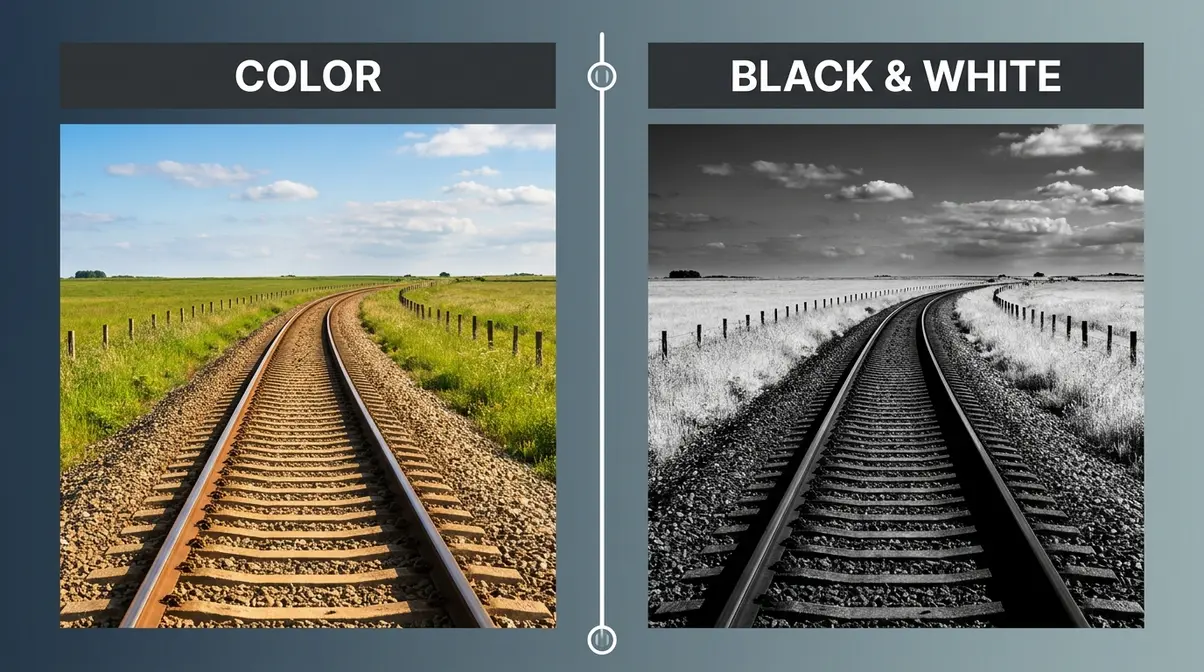
Drag the Red slider right to lighten skin tones and red subjects. Drag the Blue slider left to darken skies. Drag the Green slider to control foliage. This is the digital equivalent of physical color filters — and it’s fully adjustable after the fact.
Step 6: Adjust Contrast and Tone Curve
Open the Tone Curve panel. For classic B&W contrast, apply a gentle S-curve — lift the highlights slightly, deepen the shadows slightly. This adds “punch” to the image without blowing out highlights or crushing blacks.
Step 7: Add Calibrated Grain (Optional)
Navigate to Effects → Grain. Adding a small amount of grain (Amount: 15–25, Size: 25–30, Roughness: 50) gives your image a film-like quality that many B&W photographers prefer. It also helps disguise digital noise in shadow areas.
Step 8: Export
File → Export. For web use, export as JPEG at sRGB color profile, 2000px on the long edge, 80–90% quality. For printing, export as 16-bit TIFF at the full native resolution.
Dodging, Burning, and HSL Panel
Once you’ve completed your basic conversion, dodging and burning give you the ability to control the brightness of specific areas of your image — rather than adjusting the whole frame at once. This is the technique that Ansel Adams used in the darkroom to make his Zone System prints sing.
Dodging means lightening a specific area. Burning means darkening it. In Lightroom, you access these tools through the Masking panel (keyboard shortcut: Shift + W).
How to Dodge and Burn in Lightroom 2026
- Open the Masking panel (Shift + W)
- Select “Brush” from the masking options
- Paint over the area you want to adjust — Lightroom creates a mask (a selection) of that area
- Use the sliders that appear (Exposure, Highlights, Shadows) to lighten (dodge) or darken (burn) just the masked area
- Repeat for each area you want to adjust separately
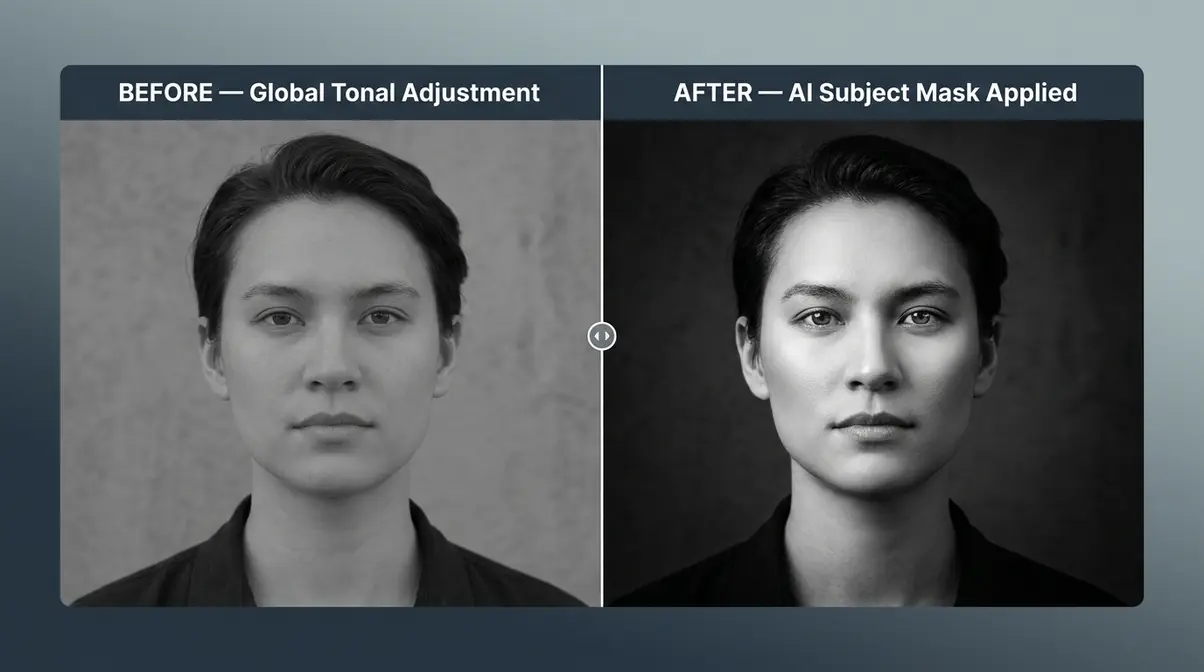
Common dodging/burning applications in B&W portraits: slightly darken the background to separate it from the subject; slightly lighten the catchlights (reflections) in the eyes; deepen the shadows under the chin and cheekbones for sculpted definition.
For the HSL panel (the B&W Mix panel described in Step 5 above), an advanced technique is to use it in combination with a mask. Select a specific area of the image with a mask, then adjust the B&W Mix sliders — this lets you change how a color converts to grey in one part of the image without affecting the rest.
Learn more about masking techniques in our advanced Lightroom editing guide.
Using AI Tools in Lightroom (2026)
The most significant development in Lightroom’s 2026 feature set for black and white photographers is the maturation of its AI-powered masking and subject selection tools. These features — which were rudimentary in earlier versions — now deliver precision that previously required hours of manual work.
AI Select Subject
In the Masking panel, “Select Subject” uses Adobe’s Sensei AI to automatically detect and mask the primary subject in your frame — a person, an animal, a prominent object. For black and white portrait photographers, this means you can isolate your subject from the background in seconds and apply separate tonal adjustments to each. Previously, this required careful manual brush work.
Photographers consistently report that the 2026 version of Select Subject handles complex edges — hair, fur, fine fabric — with substantially greater accuracy than earlier versions, reducing the need for manual edge refinement by an estimated 60–70% for typical portrait scenarios.
AI Select Sky
For landscape photographers, “Select Sky” automatically masks the sky in your image — even across complex treelines and horizon variations. Once masked, you can use the B&W Mix sliders to darken the sky independently of the foreground, replicating the effect of a physical red or orange filter without any in-camera commitment.
AI Adaptive Presets
Lightroom’s 2026 AI adaptive presets can analyze your image and suggest a starting-point B&W conversion that accounts for the specific tonal distribution of that image. These are not replacements for manual adjustment, but they dramatically accelerate the starting point — particularly useful when editing a large batch of images from a single shoot.
Denoise AI
Adobe’s Denoise AI (accessible via Photo → Enhance → Denoise) uses machine learning to reduce digital noise while preserving detail. For high-ISO black and white images — where grain is often desirable but harsh digital noise is not — running Denoise at 30–50% strength (rather than the maximum) reduces the harshest noise artifacts while retaining a pleasing, organic texture.
| AI Tool | What It Does | B&W Application |
|---|---|---|
| Select Subject | Auto-masks primary subject | Separate subject/background tonal control |
| Select Sky | Auto-masks sky area | Independent sky darkening (replaces red filter) |
| Adaptive Presets | Suggests starting conversion | Faster workflow, especially for batch editing |
| Denoise AI | Reduces noise, preserves detail | Cleans high-ISO grain without destroying texture |
See Adobe’s official documentation for the full Lightroom AI masking feature set.
Famous Black and White Photos {#famous-bw}
Understanding the history of black and white photography isn’t just an academic exercise. The photographers who defined this medium solved the same problems you’re working through now — how to create depth without color, how to make a face feel alive in grey tones, how to make a landscape feel vast when reduced to light and shadow. Studying their solutions is one of the fastest ways to accelerate your own vision.
Masters Who Defined Monochrome
Ansel Adams (1902–1984)
Adams is the most technically influential black and white photographer in history. His Zone System — the direct ancestor of The Digital Zone System framework in this guide — was developed to give photographers systematic control over the tonal output of their images. His photographs of Yosemite, the American Southwest, and the Sierra Nevada demonstrate what is possible when tonal precision meets compositional mastery. The Ansel Adams Archive is held by the Center for Creative Photography at the University of Arizona, which maintains an extensive educational resource on his methods.
Adams famously said that a photograph is “not taken, it’s made” — meaning the creative work happens as much in the darkroom (or today, in Lightroom) as it does in the field. That philosophy is the foundation of this entire guide.
Dorothea Lange (1895–1965)
Where Adams mastered tonal precision, Lange mastered emotional truth. Her 1936 photograph Migrant Mother — a portrait of Florence Owens Thompson, a 32-year-old pea picker in California — is one of the most reproduced photographs in history. It demonstrates that black and white photography’s power isn’t only technical. It strips away the distraction of color to place the viewer in direct contact with human experience. The FSA/OWI collection at the Library of Congress, which includes Lange’s Depression-era documentary work, comprises approximately 175,000 black and white photographs and represents the largest curated archive of monochrome documentary photography in the world (Library of Congress, 2026).
Henri Cartier-Bresson (1908–2004)
Cartier-Bresson defined street photography. His concept of the “decisive moment” — capturing the precise instant when the visual and emotional elements of a scene align — is the compositional philosophy behind every great candid B&W image. He shot almost exclusively in black and white throughout his career, and his work for Magnum Photos established the visual language of street photography that still dominates the form.
Explore the history and techniques of master photographers at Photography Life.
Portraits, Landscapes, and Street
Each major photographic genre has its own relationship with black and white. Understanding those relationships helps you decide not just whether to shoot monochrome, but how to approach it within a specific context.
Portraits in B&W
Black and white portraits are powerful because they direct attention entirely to the face — its structure, its expression, its light. Without skin color to process, the viewer reads micro-expressions and emotional states more acutely. The most effective B&W portraits use strong directional light (Rembrandt lighting, split lighting, or butterfly lighting) to sculpt the face with shadow, and they tend to use wide apertures to separate the subject from a blurred background.
Common pain points reported by beginners in portrait B&W include muddy skin tones. The fix is almost always in the B&W Mix panel — dragging the Orange and Red sliders right to lighten skin, and ensuring the background tones are darker to create separation.
Landscapes in B&W
Landscape photography in black and white demands strong compositional structure because you lose the color drama that often carries a landscape image. The most successful B&W landscapes feature: a clear foreground element, a defined horizon, and dramatic sky contrast (achieved with red or orange filters, or Lightroom’s Select Sky tool). Time of day matters enormously — the golden hour and blue hour create the directional, raking light that reveals terrain texture.
Street Photography in B&W
Street photography’s documentary tradition is almost synonymous with black and white. The monochrome removes temporal markers (the color of clothing, the hue of neon signs) and places images in a kind of timeless present. High contrast, deep shadows, and the interplay of light and dark on urban surfaces are the primary visual tools. Shooting at higher ISOs in street photography is common and accepted — the resulting grain adds to the documentary feel.
The Power of Old B&W Photos
Old black and white photographs hold a particular power that even technically superior modern images sometimes can’t match. Understanding why helps you harness the same emotional qualities in contemporary work.
Temporal Distance Creates Intimacy
When we look at old black and white photos from the 1930s, 1940s, or 1950s, the absence of color is part of what signals their age — and their authenticity. We know these images were not staged for Instagram. They are records of actual moments. That authenticity creates a sense of intimacy and trust that color images from the same era rarely achieve.
Grain as Texture
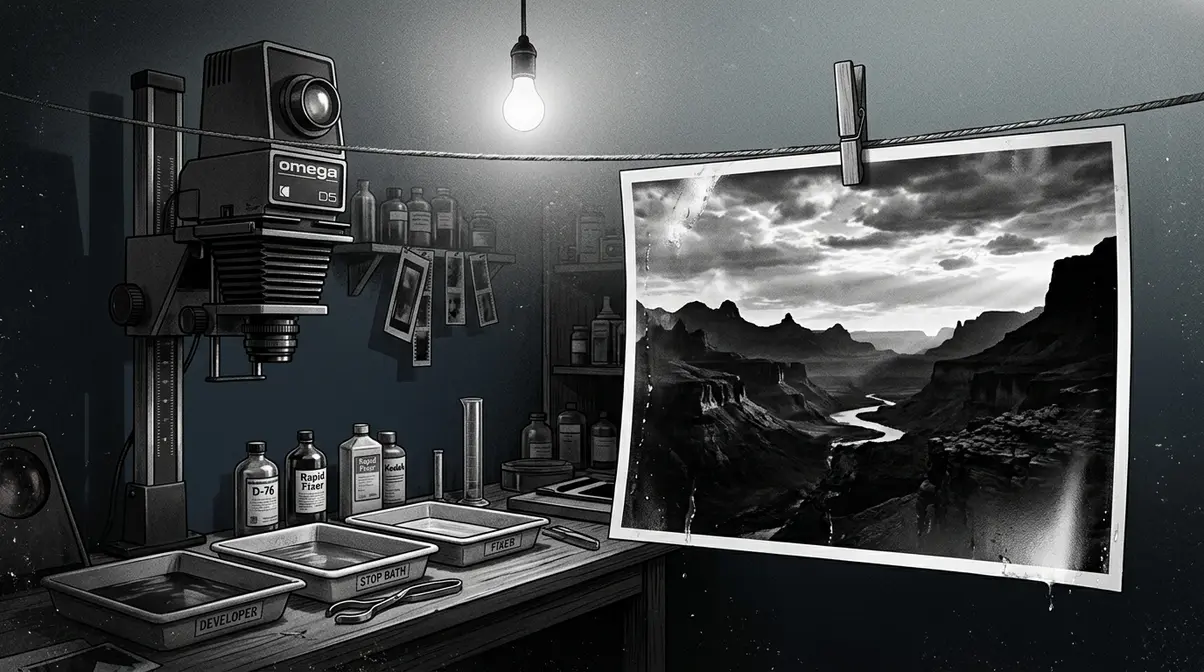
Film grain in vintage photographs functions as a kind of visual texture that modern digital sensors don’t naturally produce. It gives images a tactile quality — you feel the physical process of the photograph’s creation. This is why so many contemporary photographers deliberately add grain in post-processing. It’s not nostalgia for its own sake. It’s a recognition that grain adds a quality of presence.
Reduction as Meaning
The most enduring old black and white photos work because they reduce a complex world to its essential elements. A face. A shadow. A gesture. A crowd. The removal of color is the removal of noise — and what remains is what matters.
Explore the historical context of black and white photography through BBC Culture’s arts archive.
Buying, Selling, and Displaying Prints {#prints-resources}
The final step in any black and white photograph’s life is output — whether that means displaying it on your own wall, selling it to a collector, or buying a print that speaks to you. This section covers all three scenarios, along with a recommended resources table for photographers serious about advancing their craft.
What to Look for When Buying B&W Prints
Buying a black and white photography print is a different experience from buying color art. The tonal subtleties that make a great monochrome image are highly sensitive to printing quality — a print that looks stunning on a calibrated monitor can look flat and lifeless on cheap paper.
Paper Type
The most important variable in a B&W print is the paper. Look for:
- Baryta paper: A fiber-based paper with a barium sulfate coating that mimics the look and feel of traditional darkroom FB (fiber-base) paper. Baryta papers produce rich, deep blacks and subtle highlight gradations that are the hallmark of fine art monochrome printing. Brands like Ilford Galerie Gold Fibre Silk and Canson Baryta Photographique are widely regarded as benchmarks.
- Fiber-Base (FB) paper: The traditional choice for archival fine art prints. Heavier, with a slightly textured surface that adds to the tactile quality of the image. Archival FB prints, when properly processed, can last 100+ years.
- Resin-Coated (RC) paper: More affordable, faster to process, but considered less archival. Fine for casual display, but not the choice for investment-grade prints.
Tonal Range and D-Max
Ask (or look for) the print’s D-max — the maximum density of black the paper can achieve. A high D-max (typically 2.0 or above) means the shadows in the print will be genuinely deep and rich, not muddy grey. This is the single most important quality indicator for a black and white print.
Edition Size and Provenance
For collectible prints, look for limited editions with clear documentation — edition number, print date, photographer’s signature, and certificate of authenticity. Open editions (unlimited prints) are generally less valuable as collectibles, though they may still be beautiful prints.
Archival Framing and Presentation
Beyond the paper itself, consider how the print is finished. Archival framing is non-negotiable for investment pieces. Look for acid-free, 100% cotton rag mat boards that prevent yellowing over time. Additionally, museum-grade UV-protective glass or acrylic is essential to prevent fading, especially since monochrome prints rely entirely on delicate tonal balances that UV light can easily degrade. Fine art monochrome prints represent a tangible legacy, transforming fleeting digital files into enduring physical artifacts that can appreciate in value over generations.
Resources for B&W Photographers
Current as of January 2026
| Resource | Type | Why It’s Valuable |
|---|---|---|
| Ansel Adams Archive, Center for Creative Photography | Historical Archive | Primary source for Zone System study; original prints and notes |
| Library of Congress FSA/OWI Collection | Photo Archive | ~175,000 historical B&W images; free, high-res downloads |
| Adobe Lightroom (Official) | Editing Software | Industry standard; AI masking, B&W Mix panel, Denoise AI |
| RawTherapee | Free Editing Software | Full-featured RAW editor; excellent B&W conversion tools |
| Darktable | Free Editing Software | Open-source Lightroom alternative; strong monochrome module |
| Ilford Photo | Paper & Film | Industry-leading baryta and fiber-base B&W papers |
| Photography Life | Educational Resource | Comprehensive technique articles; strong historical context |
| Digital Photography School | Educational Resource | Beginner-friendly tutorials with practical exercises |
How to Sell Monochrome Images
If you’ve developed a body of black and white work and want to begin selling it, the path forward is more accessible than ever — but it requires deliberate preparation.
- Prepare Your Files
- Before selling any print, ensure your files are:
- Exported at full native resolution (typically 24–45MP for modern mirrorless cameras)
- Saved as 16-bit TIFF files for print use (not JPEG, which compresses tonal data)
- Color-profile tagged as Adobe RGB (1998) for print workflows, or sRGB for web display
- Edited on a calibrated monitor — if your monitor isn’t calibrated, what you see is not what the printer will produce
Choose Your Platform
Several platforms serve different markets:
- Fine Art America / Pixels: Print-on-demand; you set your markup; the platform handles printing and shipping. Low barrier to entry, lower margins.
- Saatchi Art: Curated online gallery; stronger collector audience; requires application and approval process.
- Etsy: Strong market for signed, limited-edition prints; direct relationship with buyers; you handle printing and shipping.
- Your own website: Maximum control and margin; requires the most marketing effort to drive traffic.
Price Your Work
Pricing fine art photography is notoriously difficult. A useful starting framework: calculate your printing cost (paper + ink or lab fee), multiply by 3–5x for open editions, and by 5–10x for limited editions. Edition size inversely affects price — a 1/10 edition print commands significantly more than a 1/100.
Marketing and Portfolio Strategy
Marketing your monochrome work requires a distinct approach. Because black and white photography often appeals to a more traditional art-buying audience, building a cohesive portfolio centered around a specific theme—such as urban architecture or intimate portraits—creates a stronger narrative than a random assortment of images. Consider offering tiered editioning: a highly limited run of large-format prints (e.g., editions of 5 or 10) at a premium price point, alongside an open edition of smaller prints to capture casual buyers. Always include a signed Certificate of Authenticity detailing the paper type, printer used, and edition number to build trust with collectors.
Explore composition principles that strengthen your portfolio in our guide to photography composition.
Common Mistakes and How to Avoid Them {#common-mistakes}
Pitfalls That Trap Most Beginners
Even with a solid framework, certain mistakes appear consistently across the work of photographers learning black and white. Recognizing them early saves months of frustration.
Mistake 1: Converting Every Photo to B&W
The most common beginner mistake is treating black and white as a universal improvement filter. Not every image benefits from monochrome. If color is the point of the image — a field of wildflowers, a brilliant sunset, a colorfully dressed subject — removing it doesn’t add drama. It removes information. The decision framework in H2 #1 exists precisely to prevent this. Ask: “What does removing color add to this image?”
Mistake 2: Ignoring Tonal Separation
A black and white image where all the elements are similar in tone — all middle grey — looks flat and uninteresting. This is the “it looks lifeless” complaint that many beginners experience. The fix is to ensure your scene has genuine tonal contrast before you shoot, or to use the B&W Mix panel in Lightroom to artificially create separation between elements that were similar in tone in the original color image.
Mistake 3: Blowing Out Highlights Without Intent
Overexposing highlights to pure white (Zone 10) loses all detail in those areas permanently. Sometimes this is a deliberate artistic choice — a high-key portrait with pure white backgrounds, for example. But accidental highlight clipping, especially in textured subjects like clouds, skin, or fabric, is almost always damaging. Use the histogram and highlight warnings consistently.
Mistake 4: Shooting JPEG Instead of RAW
If you shoot JPEG and then convert to black and white, you’re working with heavily compressed tonal data. The B&W Mix panel adjustments that should give you fine control over how colors convert to grey will have limited effect because much of the color information has already been discarded. Always shoot RAW for serious B&W work.
Mistake 5: Skipping the B&W Mix Panel
Many beginners convert to black and white by simply desaturating the image (removing all color) rather than using Lightroom’s B&W Mix panel. Desaturation maps all colors to grey based purely on their luminosity — it ignores hue entirely. The B&W Mix panel lets you independently control how each color converts, giving you the equivalent of physical filter control in post. The difference in output quality is substantial.
When to Seek Additional Guidance
Some challenges in black and white photography are better addressed with hands-on help than with written tutorials alone.
If you find that your images consistently look flat despite following these steps, consider: a monitor calibration issue (your screen is not showing you accurate tones), a print calibration issue (your printer profile doesn’t match your paper), or a compositional issue that would benefit from a portfolio review. Photography communities like r/analog, r/photography, and local camera clubs offer constructive critique from experienced photographers. For technical printing issues, a professional print lab consultation — most offer free or low-cost consultations — can identify calibration problems quickly.
See our full guide to photography post-processing for deeper editing techniques.
Frequently Asked Questions {#faqs}
What settings are best for B&W?
For black and white photography, shoot in RAW format at the lowest ISO your light allows, then convert in post-processing rather than in-camera. Set your camera’s Picture Style or Picture Control to Monochrome so you see a B&W preview on your LCD while retaining full color data in the RAW file. Use aperture to control depth of field (f/8–f/11 for landscapes, f/1.8–f/2.8 for portraits) and expose to protect your highlights — a slightly underexposed image is far more recoverable than a blown-out one. Start there and refine as you develop your eye.
How to convert photos in Lightroom?
Converting to black and white in Lightroom is a multi-step process that goes well beyond pressing the B&W button. Start by pressing V (or clicking B&W in the Basic panel) to convert, then open the B&W Mix panel — this is where the real work happens. Each of the eight color sliders controls how pixels of that original color render as grey. Drag Red and Orange right to lighten skin tones, drag Blue left to darken skies. Then use the Tone Curve to add contrast, and optionally add grain via Effects → Grain for a film-like quality. The full step-by-step workflow is covered in the Post-Processing section above.
Can I shoot black and white with any camera?
Yes — virtually any digital camera, including modern smartphones, can produce excellent black and white images, provided you shoot in RAW format. The quality of the sensor matters for high-ISO performance (grain character and noise levels), but even entry-level APS-C sensors in cameras like the Canon Rebel series or Nikon D3500 produce more than enough resolution and dynamic range for compelling B&W work. Dedicated monochrome cameras — like the Leica M11 Monochrom, which removes the color filter array from the sensor entirely — offer a technical advantage, but at a substantial price premium that beginners don’t need to consider.
Does black and white photography require a special lens?
No, black and white photography does not require a special lens, as any modern lens capable of capturing sharp color images will perform beautifully for monochrome. However, lenses with excellent micro-contrast and sharpness tend to produce superior black and white results because they render textures and tonal gradations more clearly. Many monochrome enthusiasts prefer prime lenses (like a 35mm or 50mm) over zooms for their superior sharpness and wider maximum apertures, which help isolate subjects using depth of field.
Should I use a high ISO for black and white photos?
Using a high ISO for black and white photos is often encouraged because the resulting digital noise closely mimics the aesthetic of classic film grain. Unlike in color photography, where high ISOs introduce ugly color noise and banding, monochrome conversions transform that noise into a pleasing texture that adds grit and character to the image. For street photography or moody portraits, don’t hesitate to push your ISO to 1600, 3200, or even higher, depending on your camera’s sensor capabilities.
Conclusion {#conclusion}
Black and white photography rewards patience and intention. When you strip color from an image, you’re not simplifying it — you’re clarifying it, forcing every other element to carry its own weight. The tonal range, the texture, the composition, the light direction: these are what remain, and they either make the image or expose its weaknesses. That’s why a strong monochrome image feels so authoritative. Nothing is hiding behind a beautiful color.
The Digital Zone System gives you the mental model to navigate those decisions with confidence. Think in zones — shadows at 0–3, midtones at 4–6, highlights at 7–10. Read your histogram before you shoot. Use the B&W Mix panel in Lightroom to control how each color in your original scene translates to grey. Dodge and burn to guide the viewer’s eye. And study the masters — Adams, Lange, Cartier-Bresson — not to imitate them, but to understand the problems they solved and the solutions they found.
Your next step is simple: take your camera out this week and set your Picture Style to Monochrome. As you apply the lessons from this black and white photography guide, remember that you don’t need to master everything before you start. Spend one shooting session looking at scenes through the lens of tone, texture, and form rather than color. Notice what your eye gravitates toward. Notice what the squint test reveals. The system is here whenever you need it.
Deepen your skills with our photography composition fundamentals guide.

Dave King
Hi, I'm Dave, the founder of Amateur Photographer Guide. I created this site to help beginner and hobbyist photographers build their skills and grow their passion. Here, you’ll find easy-to-follow tutorials, gear recommendations, and honest advice to make photography more accessible, enjoyable, and rewarding.