Table of Contents
- Key Takeaways
- Burst Mode Defined and Common Misconceptions
- Types of Burst Mode Across Devices
- How Burst Mode Works Technically
- Practical Uses for Burst Shooting
- Risks, Limitations, and What to Avoid
- Alternatives to Burst Mode for Action
- Master Burst Mode and Elevate Your Action Photography Today
- Frequently Asked Questions
- Recommended
This blog post may contain affiliate links. As an Amazon Associate I earn from qualifying purchases.
Capturing your child’s big jump or a bird taking flight often means reacting in a split second, and missing the moment can be frustrating for any photographer. Understanding burst mode makes these high-speed scenes more approachable, allowing you to take several images in quick succession just by holding down the shutter button. This article offers clear answers for those curious about how burst mode truly works, why it matters for action shots, and the best ways to use it—helping you stop missing the magic in fast-paced moments.



Key Takeaways
| Point | Details |
|---|---|
| Understanding Burst Mode | Burst mode allows for rapid sequential shooting, essential for capturing fast-moving subjects. It is not just a feature but a crucial technique for all photographers. |
| Device Variations | Burst mode capabilities differ significantly across devices, such as consumer cameras, DSLRs, and smartphones. Each type offers unique features and rates, making it vital to select the appropriate one for your needs. |
| Limitations and Risks | Burst mode can lead to storage overload and processing challenges. Photographers should use it strategically to avoid redundant images and maintain high quality. |
| Alternatives | Techniques like panning and high-speed shutter settings can produce intentional and artistic images. Combining different methods can enhance overall photographic skill and outcomes. |
Burst Mode Defined and Common Misconceptions
Photographers often misunderstand burst mode as just another camera feature, but it’s actually a powerful technique for capturing fast-moving subjects with precision. At its core, burst mode allows photographers to take multiple images in rapid succession by holding down the camera’s shutter button, creating a sequence of shots that freeze dynamic moments.
The technical definition reveals some interesting nuances about how burst mode actually works. Continuous shooting mode enables a camera to capture several photographs within a very short timeframe, typically measured in frames per second (fps). Most modern digital cameras offer burst rates between 3-8 fps, though professional-grade equipment can achieve even higher speeds:
- Standard consumer cameras: 3-5 fps
- Mid-range DSLRs: 5-7 fps
- Professional sports photography cameras: 10-20 fps
Contrary to popular belief, burst mode isn’t just for professional sports photographers. Amateur photographers can leverage this technique in numerous scenarios like:
- Capturing children’s unpredictable movements
- Documenting wildlife in motion
- Recording action sequences during family events
- Capturing split-second expressions during portraits
Many photographers mistakenly think burst mode will automatically guarantee perfect shots. However, the technique requires practice and understanding. The camera continues capturing images until the memory buffer becomes full or the battery runs out, which means selective editing is crucial afterward.
Burst mode isn’t about taking hundreds of identical images, but capturing the perfect moment within a sequence.
Mechanical limitations also play a significant role in burst mode performance. Each camera has a maximum continuous shooting rate determined by its sensor, processor, and mechanical shutter design. Higher-end cameras typically offer more robust burst capabilities with faster processing and larger memory buffers.
Pro tip: Practice burst mode in well-lit environments to maximize your camera’s capture speed and image quality.
Types of Burst Mode Across Devices
Burst mode isn’t a one-size-fits-all feature, but a diverse technology that varies dramatically across different types of cameras and devices. From professional DSLRs to smartphone cameras, each platform offers unique burst mode capabilities designed to capture fast-moving subjects with remarkable precision.
Digital cameras typically offer several distinct burst mode variations:
- Standard Burst Mode: Captures a fixed number of images when the shutter is held down
- High-Speed Burst: Achieves 10-30 frames per second (fps) for rapid action
- Continuous High/Low (CH/CL): Allows photographers to select shooting speed
- Pre-Burst Mode: Captures frames before and after the shutter is pressed
Smartphone cameras have revolutionized burst photography with their electronic shutters, enabling incredibly fast capture rates. Unlike mechanical cameras with physical shutter limitations, smartphones can achieve stunning burst rates:
- Entry-level smartphones: 10-15 fps
- Mid-range smartphones: 20-30 fps
- High-end smartphones: Up to 60-90 fps
Electronic shutters in smartphones have transformed burst mode from a professional technique to an accessible feature for everyone.
Professional cameras offer the most sophisticated burst mode options. Digital SLRs provide advanced features like:
- Adjustable frame rates
- Large memory buffers for continuous shooting
- High-speed mechanical shutters
- Professional sports and wildlife photography modes
Understanding the nuanced differences between device types helps photographers select the right burst mode for their specific shooting scenario. While smartphones excel at ultra-fast captures, professional cameras provide more control and higher image quality.
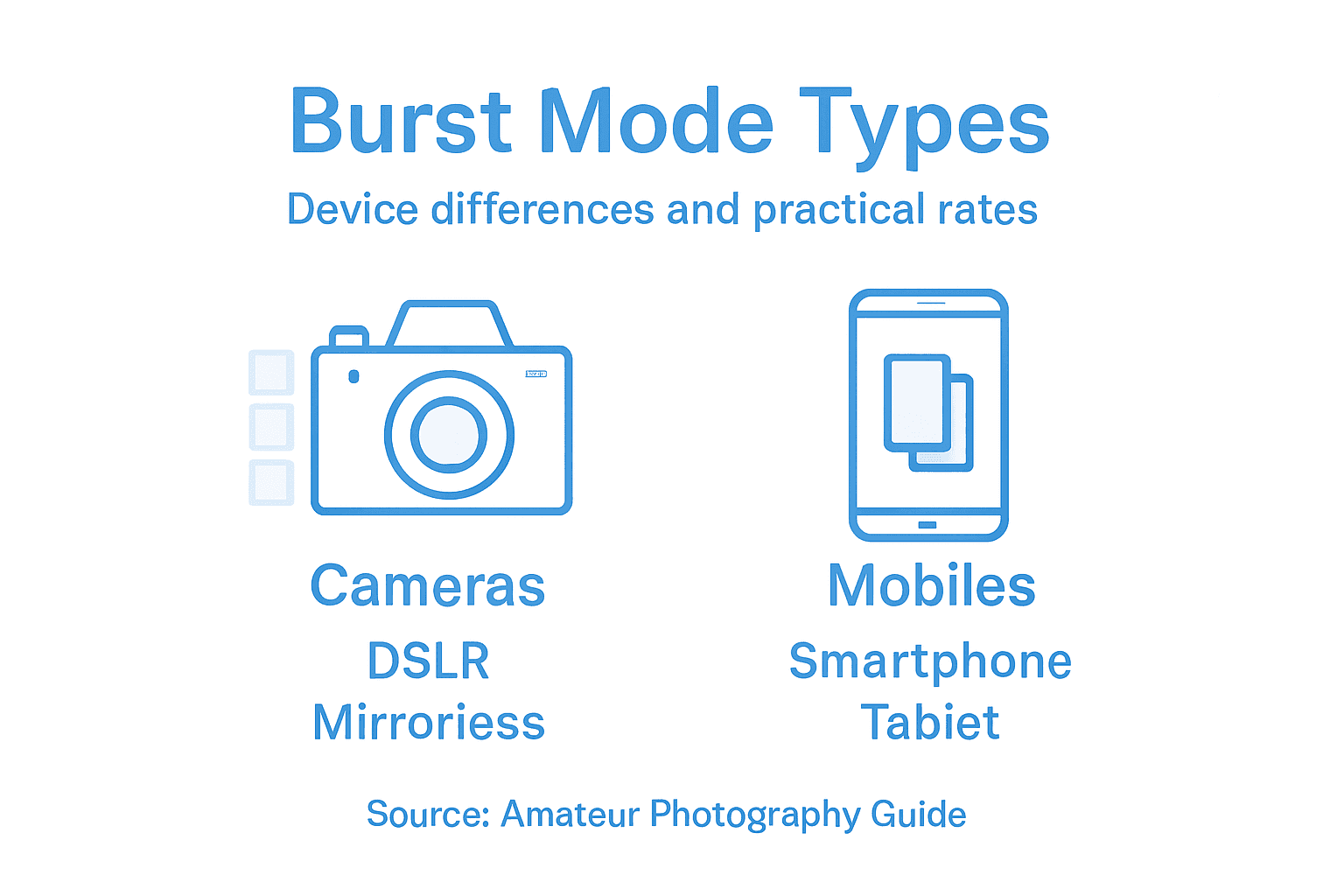
Here’s a comparison of burst mode capabilities by device type:
| Device Type | Typical Burst Rate | Special Features |
|---|---|---|
| Consumer Cameras | 3-5 fps | Basic continuous shooting |
| Mid-Range DSLRs | 5-7 fps | Selectable burst speed |
| Pro Sports Cameras | 10-20 fps | Large buffer, fast autofocus |
| Entry Smartphones | 10-15 fps | Electronic shutter, fast shots |
| High-End Smartphones | Up to 90 fps | Pre-burst, advanced processing |
Pro tip: Always check your device’s specific burst mode capabilities and practice in different lighting conditions to understand its performance limits.
How Burst Mode Works Technically
Burst mode is a complex technological dance between hardware and software components, transforming split-second moments into a sequence of capturable images. At its core, burst mode relies on sophisticated interactions between the camera’s image sensor, processor, and memory buffer to capture multiple photographs in rapid succession.
The technical process of burst mode involves several intricate steps:
- Image Sensor Activation: Rapidly captures light and converts it into electronic signals
- Image Processing: Camera’s processor quickly converts raw signals into digital images
- Temporary Storage: Images are temporarily stored in the camera’s memory buffer
- Sequential Capture: Repeats the process until buffer is full or shutter is released
The speed and efficiency of burst mode depend entirely on the synergy between hardware components.
The memory buffer plays a critical role in burst mode performance. This temporary storage area determines how many images can be captured before the camera needs to pause and write images to the memory card. Different factors impact buffer capacity:
- Image file format (JPEG vs RAW)
- Image resolution
- Camera’s processing speed
- Autofocus complexity
Modern cameras implement advanced continuous autofocus technologies that further enhance burst mode capabilities. These systems track moving subjects, maintaining sharp focus across multiple rapid-fire images. This allows photographers to capture fast-moving scenes with unprecedented precision.
Understanding the technical mechanics helps photographers optimize their burst mode performance. The interplay between sensor speed, processor efficiency, and memory buffer determines how effectively a camera can freeze dynamic moments.
Pro tip: Choose lower resolution or JPEG formats to maximize your camera’s burst mode performance and buffer capacity.
Practical Uses for Burst Shooting
Burst mode isn’t just a fancy camera feature—it’s a powerful technique that transforms how photographers capture dynamic moments across numerous scenarios. From sports photography to wildlife documentation, burst shooting offers unprecedented opportunities to freeze fleeting actions with remarkable precision.
Photographers leverage burst mode in various specialized contexts:
- Sports Photography: Capturing athletes mid-motion
- Wildlife Documentation: Tracking unpredictable animal behaviors
- Wedding Ceremonies: Catching candid, emotional moments
- Children’s Photography: Documenting rapid, spontaneous interactions
- Automotive Racing: Recording high-speed vehicle movements
In action photography scenarios, burst mode becomes an indispensable tool for capturing sequences that human reflexes would typically miss. Professional photographers rely on this technique to select the most compelling image from a series of rapid shots, ensuring they never miss a critical moment.
Burst mode transforms photographers from passive observers to active storytellers, allowing them to capture split-second narratives.
Unique photographic scenarios particularly benefit from burst shooting techniques:
- Wildlife Tracking: Following animal movements through complex environments
- Extreme Sports: Documenting high-intensity athletic performances
- Event Photography: Capturing unpredictable human interactions
- Scientific Research: Recording precise sequential movements
The versatility of burst mode extends beyond traditional photography. Researchers, documentarians, and even forensic experts use this technique to analyze motion, document complex processes, and create comprehensive visual records of rapidly changing scenes.
Pro tip: Experiment with different burst mode settings in various lighting conditions to understand your camera’s specific capabilities and limitations.
Risks, Limitations, and What to Avoid
Burst mode might seem like a photography superpower, but it comes with significant technical and creative limitations that photographers must carefully navigate. Understanding these potential pitfalls can help you use this technique more strategically and avoid common mistakes that compromise image quality and photographic skill.
Photographers should be aware of several critical limitations:
- Storage Overload: Rapid image capture fills memory cards quickly
- Processing Challenges: Large volumes of images increase post-production workload
- Battery Drain: Continuous shooting consumes significant battery power
- Autofocus Inconsistencies: Not all frames may be perfectly focused
- Performance Restrictions: Camera buffer limits burst duration
Burst mode is a tool, not a substitute for photographic skill and intentional composition.
The technical risks associated with burst mode can significantly impact image quality and photographic workflow:
- RAW image formats dramatically reduce burst performance
- Continuous autofocus may not work effectively in all scenarios
- Some cameras experience significant slowdown after buffer fills
- Excessive burst shooting can lead to redundant, low-value images
In action photography scenarios, photographers must be particularly cautious about indiscriminate burst mode usage. Relying too heavily on quantity over composition can result in a flood of mediocre images instead of carefully selected, high-quality shots.
Professional photographers recommend using burst mode selectively, primarily for situations involving rapid, unpredictable motion where capturing the perfect moment is challenging. Mindless rapid firing should be avoided in favor of thoughtful, intentional image creation.
Pro tip: Periodically review and delete redundant burst mode images to maintain an organized, high-quality photo collection.
Alternatives to Burst Mode for Action
Action photography demands more than a single technique, and savvy photographers recognize that burst mode isn’t the only method for capturing dynamic moments. Alternative approaches can often provide more intentional, creative, and technically precise results depending on the specific shooting scenario.
Photographers have several strategic alternatives to traditional burst mode:
- Panning Technique: Following moving subjects with camera motion
- High-Speed Shutter: Freezing action with extremely fast shutter speeds
- Pre-focus Method: Anticipating subject movement and setting focus in advance
- Manual Timing: Developing precise timing and anticipation skills
- Single Shot with Strategic Positioning: Selecting optimal shooting location
Mastering multiple techniques transforms photographers from equipment operators to true visual storytellers.
In action photography scenarios, understanding alternative techniques becomes crucial. The panning technique, for instance, creates a sense of motion by moving the camera in sync with the subject, resulting in a sharp subject against a blurred background. This method requires significant practice but can produce more artistically compelling images than rapid-fire shooting.
Advanced photographers often combine multiple techniques to achieve unique results:
- Blending slow shutter speeds with strategic camera movement
- Using manual focus for predictable motion sequences
- Selecting precise moment of peak action
- Experimenting with different compositional angles
While burst mode offers quantity, these alternative approaches emphasize quality and intentionality. Each technique requires developing specific skills like timing, anticipation, and precise camera control. Understanding when to use each method becomes as important as the technique itself.
The table below highlights alternative techniques versus burst mode:
| Technique | Key Benefit | Best For Scenarios |
|---|---|---|
| Burst Mode | Captures rapid sequences | Sports, wildlife, candid shots |
| Panning | Creates motion blur | Racing, moving vehicles |
| High-Speed Shutter | Freezes fast action cleanly | Individual peak action moments |
| Pre-focus | Ensures sharpness at moment | Anticipated subject movement |
Pro tip: Practice alternative action photography techniques in controlled environments to build muscle memory and develop nuanced shooting skills.
Master Burst Mode and Elevate Your Action Photography Today
Capturing fast-moving moments with burst mode can feel overwhelming due to technical limits like buffer size, autofocus challenges, and timing precision. If you want to confidently freeze action sequences and never miss that perfect shot again explore practical advice and expert tips designed specifically for amateur photographers just like you. Discover how to optimize your camera settings and understand alternatives to burst mode by diving into comprehensive guides on burst shooting techniques and action photography strategies.
Take control of your photography journey now with step-by-step tutorials and insider recommendations at Amateur Photographer Guide. Transform your passion into skill and capture stunning action shots that stand out. Visit the site to unlock easy-to-understand content that turns complex concepts like burst mode and high-speed shooting into your creative advantage.
Frequently Asked Questions
What is burst mode in photography?
Burst mode is a camera feature that allows photographers to capture multiple images in rapid succession by holding down the shutter button, making it ideal for freezing fast-moving subjects.
How does burst mode differ across various devices?
Burst mode capabilities can vary widely: consumer cameras typically achieve 3-5 frames per second (fps), mid-range DSLRs 5-7 fps, and high-end smartphones can reach up to 90 fps, enabling diverse shooting scenarios.
What are the common misconceptions about burst mode?
Many photographers mistakenly believe that burst mode guarantees perfect shots. In reality, it requires practice and understanding to effectively capture the best moments, often necessitating careful editing afterward.
What are some practical uses for burst mode?
Burst mode is particularly beneficial for capturing action in sports photography, wildlife documentation, candid moments during events like weddings, and unpredictable actions of children, allowing photographers to select the most compelling images from a series.
Recommended
- Master Action Photo Shooting Steps for Crisp Shots
- Action Photography Techniques Guide for Perfect Motion Shots
- Master Action Photography Step by Step for Stellar Shots
- Tips for Taking Photos of Moving Objects
- 7 Tips for Exciting Photography Scavenger Hunts
Last update on 2026-04-12 / Affiliate links / Images from Amazon Product Advertising API