Table of Contents
- Quick Summary
- Step 1: Assess your photography needs and style
- Step 2: Research lens types and compatibility options
- Step 3: Compare technical specifications and features
- Step 4: Test lens performance in real-world scenarios
- Step 5: Review feedback and verify final lens choice
- Choose the Perfect Lens to Unlock Your Photography Potential
- Frequently Asked Questions
- Recommended
This blog post may contain affiliate links. As an Amazon Associate I earn from qualifying purchases.
Choosing the best camera lenses can feel confusing for photographers exploring new creative possibilities. Whether you dream of capturing dramatic landscapes or expressive street portraits, matching your equipment to your artistic goals is crucial. Understanding your photography needs and style helps simplify lens selection and sets a clear direction for your creative growth. This guide walks you through each step, focusing on practical strategies so you can confidently pick lenses that truly support your unique vision.


Quick Summary
| Key Takeaway | Explanation |
|---|---|
| 1. Understand your photography needs | Define your interests, environment, and goals to simplify lens selection. |
| 2. Research lens types thoroughly | Learn about different lens categories to match specific photographic styles. |
| 3. Check compatibility with your camera | Ensure the lens physically and electronically fits your camera body for optimal usage. |
| 4. Test lenses in real-world settings | Conduct practical tests in various conditions to understand real performance. |
| 5. Gather feedback from multiple sources | Validate your choice by consulting reviews and experiences from other photographers. |
Step 1: Assess your photography needs and style
Selecting the right camera lens begins with a critical yet often overlooked step: understanding your unique photographic goals and creative vision. Your lens choice isn’t just about technical specifications—it’s about matching equipment to your artistic expression.
Photography is a deeply personal journey that requires honest self-reflection about your interests and shooting style. Start by asking yourself these fundamental questions:
- What subjects fascinate you most? (Landscapes, portraits, wildlife, street photography)
- Where do you typically shoot? (Indoor studios, outdoor environments, low light conditions)
- What is your skill level? (Beginner, intermediate, advanced)
- What are your primary photography goals? (Personal passion, potential professional work, documentation)
Understanding these elements will dramatically narrow down your lens selection process. For instance, a landscape photographer will have radically different lens requirements compared to someone shooting indoor portraits or fast-moving wildlife.
Your lens should feel like an extension of your creative vision, not just a technical accessory.
Consider your current camera body and its compatibility with different lens types. Some photographers make the mistake of selecting lenses without considering their existing equipment’s mount system and sensor size. Research lens compatibility with your specific camera model to avoid frustrating and expensive mistakes.
Your photography style will ultimately dictate the ideal lens characteristics. A street photographer might prioritize a compact prime lens with a wide aperture, while a wildlife enthusiast would need a telephoto lens with significant zoom capabilities and image stabilization.
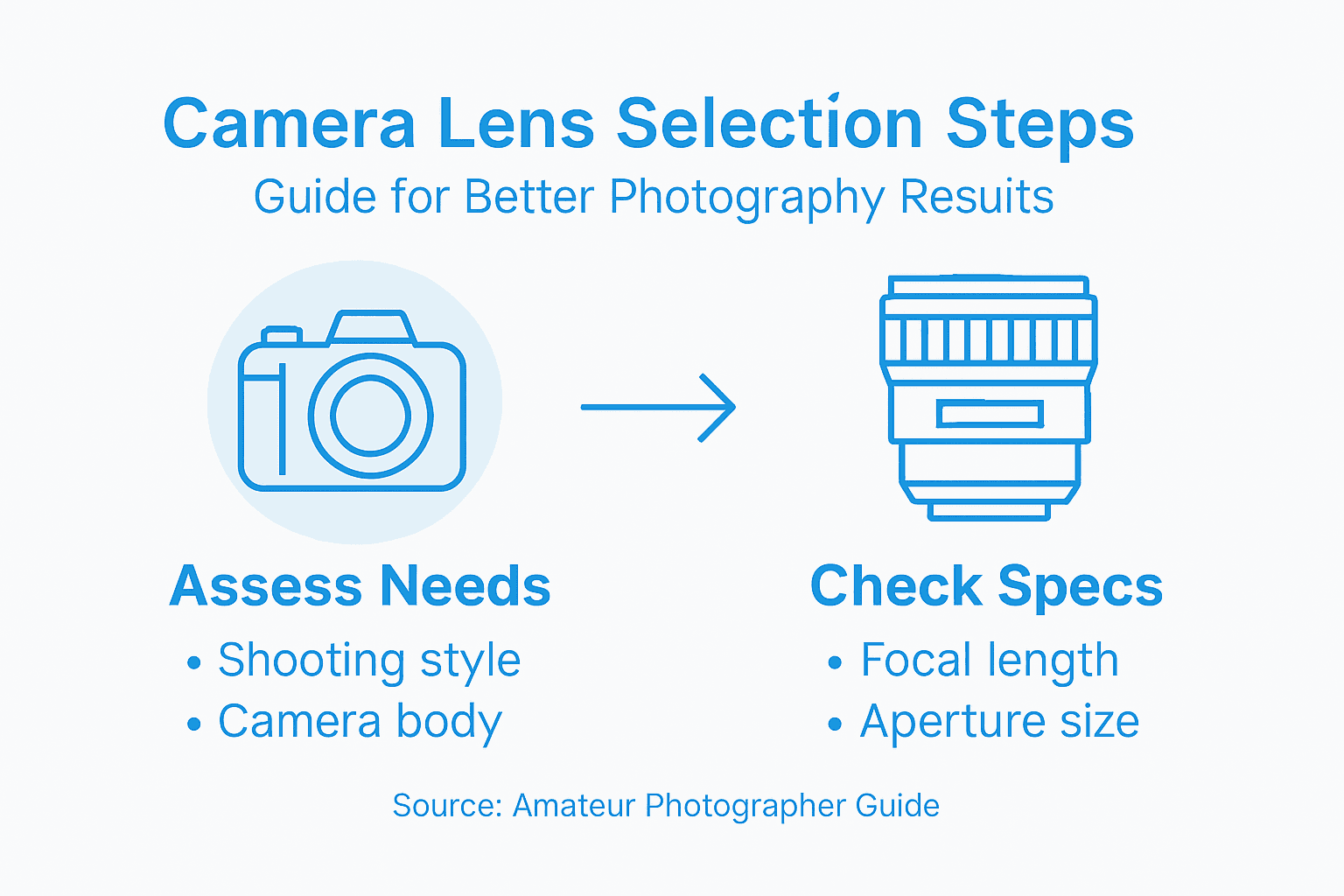
By understanding your photography gear needs, you transform lens shopping from a bewildering experience into a strategic decision aligned with your creative goals.
Pro tip: Keep a photography journal documenting the types of shots you love and the technical challenges you encounter—this will provide invaluable insights into your ideal lens requirements.
Step 2: Research lens types and compatibility options
Now that you understand your photography needs, it’s time to dive deep into the world of lens types and compatibility. This research phase is critical for finding the perfect lens that matches both your creative vision and technical requirements.
Camera lenses come in several primary categories, each designed for specific photographic purposes:
Here’s a quick comparison of common lens types and their ideal use cases:
| Lens Type | Best For | Key Advantage |
|---|---|---|
| Prime Lens | Street, portraits | Sharper images, lighter weight |
| Zoom Lens | Events, travel | Flexible focal length range |
| Wide-Angle Lens | Landscapes, architecture | Captures more of the scene |
| Telephoto Lens | Wildlife, sports | Closer view of distant subjects |
| Macro Lens | Nature, detail shots | Extreme close-up capability |
- Prime lenses: Fixed focal length, typically sharper and with wider maximum apertures
- Zoom lenses: Variable focal lengths offering more flexibility
- Wide-angle lenses: Ideal for landscapes and architectural photography
- Telephoto lenses: Perfect for wildlife and sports photography
- Macro lenses: Specialized for extreme close-up details
Compatibility is perhaps the most crucial technical consideration. Different camera manufacturers use unique lens mount systems that determine which lenses will physically attach to your camera. Canon, Nikon, Sony, and Micro Four Thirds systems each have their own proprietary connections.
Not all lenses are created equal—compatibility goes beyond physical attachment.
Beyond physical mounting, you’ll need to verify electronic compatibility. Modern lenses require communication with your camera body for features like autofocus, image stabilization, and accurate exposure metering. Understanding camera lens compatibility can save you from costly mistakes.
Some photographers use lens adapters to expand their options, but be aware that adapters often compromise functionality. You might lose autofocus capabilities or automatic aperture control when using third-party adapters.
Carefully research the specific lens mount of your camera and cross-reference potential lens purchases to ensure full functionality. Consider factors like sensor size, crop factor, and the specific features you need for your photography style.
Pro tip: Always test or rent a lens before purchasing to verify complete compatibility with your specific camera body and shooting requirements.
Step 3: Compare technical specifications and features
Diving into technical specifications might seem daunting, but understanding these crucial details will help you make an informed lens selection that truly matches your photographic ambitions. Think of lens specs as the DNA of your photographic potential.
Key technical specifications you’ll want to carefully evaluate include:
- Focal length: Determines how much of the scene your lens captures
- Maximum aperture: Controls light intake and depth of field
- Image stabilization: Reduces camera shake in challenging conditions
- Autofocus motor type: Impacts focusing speed and accuracy
- Lens construction: Indicates optical quality and potential image performance
When comparing lenses, pay close attention to optical characteristics that directly impact image quality. The lens’s refractive index, chromatic aberration control, and coating technologies play significant roles in producing sharp, color-accurate images.
Not all technical specifications are created equal—understand which matter most for your specific photography style.
Focal length and aperture are particularly critical. A lens with a wide maximum aperture allows more light and creates beautiful background blur, while different focal lengths dramatically change your compositional possibilities. Exploring lens technical details can reveal nuanced performance differences that significantly impact your photography.
Additional features like weather sealing, weight, and minimum focusing distance can also influence your shooting experience. Professional photographers often create detailed comparison spreadsheets to objectively evaluate potential lens purchases.
Remember that impressive specifications don’t always translate to perfect real-world performance. Read professional reviews, examine sample images, and whenever possible, test the lens personally before making a final decision.
Pro tip: Create a personal scoring system that weights technical specifications against your specific photography needs to make more objective lens comparisons.
Step 4: Test lens performance in real-world scenarios
Specs on paper only tell part of the story. To truly understand a lens’s capabilities, you need to take it out into the world and push its limits across diverse shooting conditions. Real-world testing transforms abstract specifications into tangible photographic performance.
Design comprehensive testing scenarios that challenge different lens capabilities:
- Lighting conditions: Test in bright sunlight, low light, and mixed environments
- Movement scenarios: Capture fast-moving subjects to assess autofocus speed
- Focal length range: Explore performance at different zoom levels
- Depth of field: Evaluate bokeh and background blur characteristics
- Color and contrast: Compare image quality across various shooting conditions
Professional photographers typically conduct systematic lens evaluations that go beyond casual snapshots. Methodical testing involves creating controlled yet diverse scenarios that reveal a lens’s true strengths and potential limitations.
This table summarizes how testing conditions reveal lens strengths:
| Testing Scenario | Reveals | Why It Matters |
|---|---|---|
| Low light | Maximum aperture effectiveness | Shows performance in darkness |
| Fast action | Autofocus speed and accuracy | Vital for motion shots |
| Various distances | Versatility across focal lengths | Ensures compositional options |
| Complex lighting | Color and contrast rendering | Indicates real image quality |
| Outdoor vs. indoor | Image stabilization reliability | Checks handheld usability |
Real-world performance matters more than marketing promises.
Consider exploring advanced lens testing techniques that simulate challenging photographic environments. This might include shooting in high-contrast scenes, rapid movement situations, and environments with complex lighting dynamics.
Don’t just rely on technical measurements. Pay attention to subjective qualities like overall shooting experience, focusing speed, and how the lens feels in your hands. Sometimes, a lens that looks perfect on paper might not match your personal shooting style.
Rent or borrow lenses whenever possible before making a significant investment. Many camera stores and online platforms offer lens rental services that allow you to conduct thorough real-world testing without committing to a purchase.
Pro tip: Create a standardized testing checklist with specific scenarios and image comparison criteria to objectively evaluate each lens’s performance.
Step 5: Review feedback and verify final lens choice
With all your research and testing complete, the final step involves synthesizing your findings and making a confident lens selection. This is where you transform all your previous investigative work into a strategic purchasing decision.
Gather comprehensive feedback from multiple sources to validate your lens choice:
- Professional reviews from reputable photography websites
- User experiences from photography forums and community discussions
- Expert photographer recommendations
- Sample images taken with the specific lens model
- Comparative performance reports
Critical evaluation means looking beyond surface-level recommendations. Detailed analysis requires understanding how other photographers with similar shooting styles have experienced the lens’s performance.
Not all feedback is created equal—prioritize insights from photographers matching your skill level and interests.
Comparing lens performance insights can reveal nuanced details that might not be immediately apparent during your initial testing. Pay special attention to comments about long-term reliability, consistent performance, and potential limitations.
Don’t just read reviews—engage with photography communities. Ask specific questions about the lens’s real-world performance, potential drawbacks, and compatibility with your specific camera system. Photographers are often generous with sharing detailed, practical insights.
Remember that the perfect lens is ultimately the one that helps you achieve your creative vision. Technical specifications and positive reviews matter, but your personal connection and comfort with the lens are paramount.
Pro tip: Create a weighted scoring system that evaluates lens feedback across technical performance, user satisfaction, and alignment with your specific photography goals.
Choose the Perfect Lens to Unlock Your Photography Potential
Selecting the right camera lens can feel overwhelming with so many options and technical details to consider. This article highlights key challenges amateur photographers face such as matching lenses to shooting style, ensuring compatibility with their camera, and evaluating technical features like focal length and aperture. Your goal is to find lenses that not only perform well on paper but truly enhance your creative vision and shooting experience.

Discover practical guidance and expert advice tailored to help you conquer these challenges at Amateur Photographer Guide. Explore in-depth tutorials on camera selection and gear recommendations as well as comprehensive tips for improving shooting techniques. Start mastering the art of lens selection today and transform your photography with confidence and clarity. Visit Amateur Photographer Guide now to get started.
Frequently Asked Questions
How do I assess my photography needs before selecting a lens?
Begin by reflecting on what subjects you enjoy capturing, such as landscapes or portraits. Make a list of your primary photography goals and preferred shooting environments to help narrow down your lens options.
What are the main types of camera lenses and their uses?
Common types of lenses include prime lenses for sharper images in portraits, zoom lenses for versatility at events, wide-angle lenses for landscapes, telephoto lenses for distant subjects, and macro lenses for close-up details. Identify the purpose of your photography to choose the most suitable lens type for your needs.
How do compatibility and specifications affect my lens choice?
Lens compatibility with your camera is crucial; ensure the lens mount fits your camera body and supports electronic functions like autofocus. Review specifications such as focal length and maximum aperture to find a lens that aligns with your photography style and preferences.
What should I focus on when testing a lens in real-world scenarios?
Evaluate a lens in various lighting conditions and while capturing different types of subjects. Pay attention to its autofocus speed and image quality across varying distances to understand its performance in practical situations.
How can I gather feedback to confirm my lens selection?
Look for detailed reviews and user experiences from photographers who have similar shooting styles. Engage in photography communities to ask specific questions about the lens’s performance, ensuring that you feel confident in your final choice.
How can I keep my lens purchase aligned with my creative vision?
Use a photography journal to document your experiences and the types of images you aspire to create. Regularly revisit your goals as you become more experienced to ensure your lens choices continue to support your evolving artistic expression.
Recommended
- Why Upgrade Camera Lenses: Complete Photographer’s Guide
- How to Select Camera Gear for Stunning Photos
- Best Camera Lens for Beginners: Your Complete 2026 Guide
- The Top Camera Lenses for Long-Distance Makes and Models of 2025
Last update on 2026-05-21 / Affiliate links / Images from Amazon Product Advertising API