
Table of Contents
- Key Takeaways
- Defining Hyperfocal Distance in Photography
- How Hyperfocal Distance Works in Practice
- Methods for Calculating Hyperfocal Distance
- Applying Hyperfocal Distance to Creative Shooting
- Common Mistakes and How to Avoid Them
- Master Hyperfocal Distance and Capture Sharper Photos Today
- Frequently Asked Questions
- Recommended
This blog post may contain affiliate links. As an Amazon Associate I earn from qualifying purchases.
More than 60 percent of american photographers say achieving perfect sharpness is their top challenge when shooting landscapes and city scenes. If you have ever struggled to get every detail in focus, you are not alone. Hyperfocal distance gives self-taught photographers a scientific shortcut for maximizing sharpness from the foreground all the way to infinity, whether exploring urban streets or dramatic mountains in Canada or Europe.
Key Takeaways
| Point | Details |
|---|---|
| Understanding Hyperfocal Distance | It represents the closest focus point for maximum sharpness from half that distance to infinity. |
| Factors Affecting Hyperfocal Distance | Lens focal length, aperture settings, and circle of confusion critically influence calculation. |
| Practical Implementation | Using smaller apertures (f/8 to f/14) ensures optimal sharpness across the scene. |
| Common Mistakes | Avoid overly small apertures which can introduce diffraction and reduce image quality. |





Defining Hyperfocal Distance in Photography
Photographers searching for maximum image sharpness encounter a powerful technique called hyperfocal distance – a precise focusing strategy that transforms landscape and architectural photography. At its core, hyperfocal distance represents the closest focus point that allows everything from half that distance to infinity to appear acceptably sharp. This technical concept helps photographers overcome traditional focusing limitations by strategically selecting a focal point that maximizes depth of field.

Understanding hyperfocal distance requires grasping how lens optics interact with focus and sharpness. When photographers focus at the hyperfocal distance, they create an image zone where everything remains crisp and detailed – from foreground elements to distant backgrounds. This technique relies on the circle of confusion, a technical measurement determining the acceptable blur threshold that still registers as sharp to the human eye. By calculating this precise focal point, photographers can ensure remarkable clarity across their entire composition, whether shooting sweeping mountain landscapes or intricate urban scenes.
The practical application of hyperfocal distance involves understanding three critical factors: lens focal length, aperture, and acceptable sharpness criteria. Depth of field principles play a crucial role in determining the exact hyperfocal distance for any given scene. Photographers must consider their specific lens characteristics, desired aperture, and the level of detail they want to preserve throughout the image. Typically, smaller apertures like f/8 or f/11 provide optimal conditions for achieving maximum sharpness across the entire frame.
Here is a summary of key factors that affect hyperfocal distance:
| Factor | How It Affects Hyperfocal Distance | Practical Considerations |
|---|---|---|
| Focal Length | Longer lenses increase the distance | Wide lenses allow closer hyperfocal point |
| Aperture (f-number) | Smaller apertures lengthen depth of field | f/8 to f/14 often give best sharpness |
| Circle of Confusion | Defines acceptable sharpness threshold | Linked to sensor size and print needs |
Pro tip: To quickly calculate hyperfocal distance in the field, use the 1/3 focus rule: focus approximately one-third into the scene to maximize sharpness from foreground to background.
How Hyperfocal Distance Works in Practice
Photographers leverage hyperfocal distance as a precision technique to maximize image sharpness across complex shooting environments. In landscape and architectural photography, this method allows capturing scenes with remarkable clarity from foreground elements to distant backgrounds. When applied correctly, hyperfocal distance creates an expansive zone of acceptable focus that transforms how photographers approach challenging compositional scenarios.
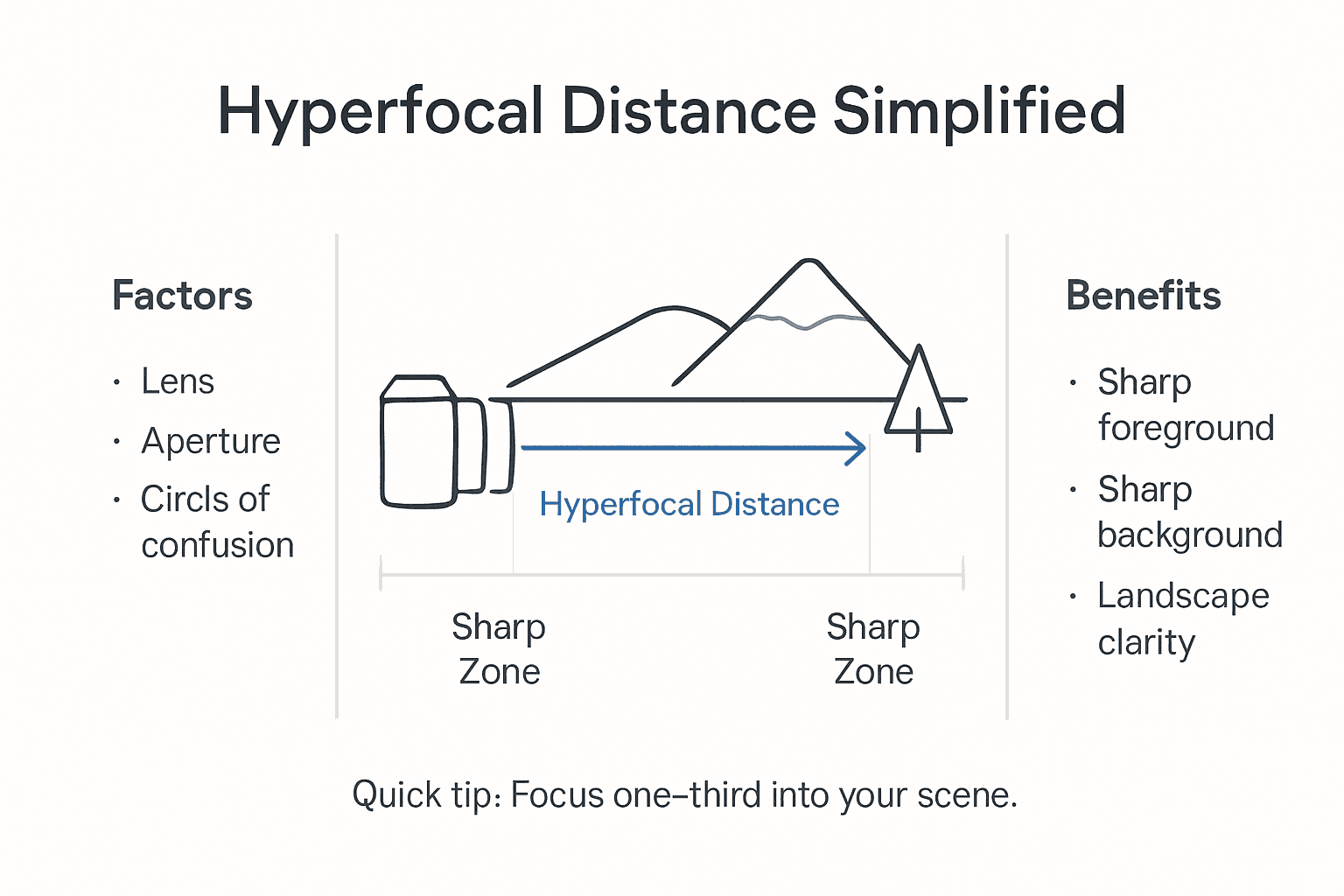
Practical implementation requires understanding key variables like focal length characteristics that influence depth of field calculations. Photographers typically select smaller apertures between f/8 and f/14, which provide optimal conditions for achieving comprehensive sharpness. By strategically focusing approximately one-third into the scene, photographers can create images where details remain crisp from near objects to infinite distances, effectively extending the perceived depth and clarity of their compositions.
Technical precision meets creative vision through systematic hyperfocal distance application. Professional photographers often utilize specialized apps and reference tables to calculate exact focus points for different lens configurations. These tools help photographers quickly determine the precise distance where focusing will maximize depth of field, eliminating guesswork and ensuring consistent results across varied shooting conditions. The technique proves particularly valuable in scenarios like landscape photography, architectural documentation, and environmental photographic surveys where maintaining sharp detail across multiple distances is crucial.
Pro tip: Create a personal reference chart for your most frequently used lenses, noting their specific hyperfocal distances at different apertures to streamline your field shooting workflow.
Methods for Calculating Hyperfocal Distance
Calculating hyperfocal distance transforms complex optical mathematics into a practical photography technique that empowers photographers to achieve maximum image sharpness. The fundamental formula H = (f²)/(N*c) serves as the cornerstone of these calculations, where H represents hyperfocal distance, f is the lens focal length, N is the aperture f-number, and c represents the circle of confusion diameter that defines acceptable image sharpness.
Professional photographers leverage multiple approaches to determine hyperfocal distance, ranging from manual calculations to sophisticated digital tools. Focus stacking techniques complement traditional hyperfocal distance methods, providing photographers additional strategies for managing depth of field. Modern smartphone apps and online calculators have simplified these computations, allowing photographers to quickly input lens specifications and receive precise hyperfocal distance measurements without complex mathematical operations.
The practical implementation of hyperfocal distance calculations requires understanding several critical variables. Photographers must consider lens focal length, selected aperture, and the specific circle of confusion acceptable for their imaging system. Different camera sensors and lens designs impact these calculations, making it essential to use tools and methods tailored to individual equipment. Professional photographers often develop personalized reference charts that account for their specific gear, enabling rapid and accurate hyperfocal distance determinations across various shooting scenarios.
Compare common methods to calculate hyperfocal distance:
| Method | Description | Best Use Case |
|---|---|---|
| Manual Formula | Uses H = (f²)/(N*c) for precision | Studio or planned shoots |
| Smartphone App | Automated, fast calculations on location | Field work, quick adjustments |
| Printed Chart | Pre-made for specific lenses and settings | No device needed, quick checks |
Pro tip: Create a laminated quick-reference card with hyperfocal distance calculations for your most frequently used lenses to streamline field calculations and improve shooting efficiency.
Applying Hyperfocal Distance to Creative Shooting
Creative photography demands technical precision, and hyperfocal distance emerges as a powerful technique for transforming compositional possibilities. By strategically managing depth of field, photographers can craft images that reveal intricate details across multiple visual planes, from intimate foreground elements to expansive background landscapes. This approach allows artists to break traditional focusing constraints and develop more dynamic, layered visual narratives.
Landscape photographers particularly benefit from hyperfocal distance techniques, using focal plane strategies to capture scenes with unprecedented clarity and depth. By selecting optimal apertures between f/8 and f/14, photographers can create images where every element from nearby rocks to distant mountain ranges appears crisp and well-defined. The technique becomes especially powerful when shooting expansive scenes that require maintaining sharp focus across dramatically different distances.
Advanced practitioners understand that hyperfocal distance is more than a technical calculation – it’s a creative tool for visual storytelling. Architecture, documentary, and environmental photographers leverage this technique to capture complex scenes with remarkable depth and precision. The method allows photographers to make intentional compositional choices, emphasizing relationships between foreground and background elements without sacrificing overall image sharpness. By mastering hyperfocal distance, photographers transform technical constraints into opportunities for more expressive, nuanced imagery.
Pro tip: Practice visualizing your hyperfocal point by mentally dividing your scene into thirds, focusing approximately one-third into the frame to maximize overall image sharpness.
Common Mistakes and How to Avoid Them
Mastering hyperfocal distance requires understanding the subtle pitfalls that can undermine image quality. Photographers frequently encounter challenges that transform what should be a precise technique into a frustrating experience. The most critical errors often stem from misunderstanding fundamental optical principles, leading to images that appear technically correct but lack the intended sharpness and visual impact.
One of the most prevalent mistakes involves imprecise focusing techniques. Common photography mistakes often include selecting inappropriate apertures that compromise image quality. Photographers tend to choose extremely small apertures like f/16 or f/22, believing these will increase depth of field, when in reality, they introduce diffraction and reduce overall image sharpness. The optimal range remains between f/8 and f/11, where most lenses perform with maximum optical precision.
Advanced practitioners recognize that hyperfocal distance is not a one-size-fits-all solution. Different camera systems, lens designs, and shooting conditions require nuanced approaches. Many photographers mistakenly apply hyperfocal distance calculations without considering their specific equipment’s characteristics, such as sensor size, lens quality, and intended print or display resolution. Understanding the relationship between circle of confusion, focal length, and acceptable sharpness becomes crucial for avoiding generic techniques that might not suit individual photographic requirements.
Pro tip: Create a personalized reference card detailing your specific lens’s hyperfocal distances at different apertures to quickly adapt your focusing technique in the field.
Master Hyperfocal Distance and Capture Sharper Photos Today
Struggling to achieve sharp focus across your entire landscape or architectural shots Can understanding hyperfocal distance transform your photography by helping you focus precisely at the right point to maximize depth of field Imagine confidently capturing every detail from the foreground to infinity without constantly guessing your focus point Our guide on hyperfocal distance reveals key concepts like focal length aperture and circle of confusion so you can overcome common focusing challenges and prevent image softness

Ready to take your photography to the next level Discover practical tutorials and easy-to-understand advice at Amateur Photographer Guide where you will find expert insights that simplify complex techniques like hyperfocal distance Use our resources to create your personalized reference charts and master focusing strategies today Explore foundational lessons on depth of field principles and learn what different focal lengths do to optimize your lens usage Don’t miss out on the chance to sharpen your skills now and ensure every shot you take stands out with stunning clarity Visit Amateur Photographer Guide and start applying hyperfocal distance techniques with confidence
Frequently Asked Questions
What is hyperfocal distance in photography?
Hyperfocal distance is the closest distance at which a photographer can focus their lens so that everything from half that distance to infinity appears sharp and detailed. It is a crucial technique for maximizing depth of field in landscape and architectural photography.
How do I calculate hyperfocal distance?
You can calculate hyperfocal distance using the formula H = (f²)/(N*c), where H is the hyperfocal distance, f is the lens focal length, N is the aperture f-number, and c is the circle of confusion diameter that defines acceptable sharpness. Alternatively, you can use smartphone apps or reference charts for quick calculations.
What factors affect hyperfocal distance?
The three critical factors affecting hyperfocal distance are the lens focal length, aperture, and the acceptable sharpness defined by the circle of confusion. Longer focal lengths increase the hyperfocal distance, while smaller apertures (like f/8 or f/11) can extend the depth of field.
Why is hyperfocal distance important for landscape photography?
Hyperfocal distance allows landscape photographers to ensure maximum sharpness and depth throughout their images, creating a sense of clarity and detail from foreground elements to distant backgrounds. This technique enhances compositional storytelling by revealing intricate details across different planes in the photo.
Recommended
- Focal Plane in Photography: Why It Matters For Better Photos
- what do different focal lengths do?
- Focal Length in Photography – How It Shapes Your Shot (2025 Guide)
Last update on 2026-06-05 / Affiliate links / Images from Amazon Product Advertising API