
Table of Contents
- What Is a DSLR Camera? The Full Acronym Breakdown
- Inside a DSLR: How the Mirror Mechanism Works
- DSLR vs. Mirrorless vs. Smartphone: 2026 Verdict
- What DSLRs Are Actually Good For
- Dead Tech Arbitrage: Buying a Used DSLR in 2026
- Where DSLRs Fall Short: Honest Limitations to Know
- Frequently Asked Questions
- Conclusion
This blog post may contain affiliate links. As an Amazon Associate I earn from qualifying purchases.
- All research is verified. Here are the confirmed figures:
- Nikon D3500 battery: 1,550 shots per charge (CIPA official — Nikon, DPReview, Amateur Photographer)
- Sony A6400 battery: 410 shots per charge LCD / 360 viewfinder (CIPA official — Sony Canada spec sheet)
- Mirrorless market share 2024: ~88.6% of interchangeable-lens camera shipments (CIPA/Nikkei via PetaPixel, 2025)
- Nikon D850 used price: ~$800–$1,200 (well-used to good condition), (Accio.com 2025)
- Canon T7 used: approximately $250–$350 body used (BackMarket, local dealers 2025–2026)
Now writing the complete article.
You’ve probably seen someone at a family event or a national park hauling one of those big, serious-looking cameras — the kind with a deep handgrip, a thick lens, and an eyepiece you actually press your face against. That’s a DSLR camera, short for Digital Single-Lens Reflex. And here’s what nobody bothers to tell you: in 2026, they’re one of the best deals in photography.
Every major camera manufacturer has shifted production to mirrorless systems, and that’s created a quiet paradox. Professional-grade DSLRs that cost $3,000 new are hitting the used market for a fraction of that price. The “dead tech” label isn’t a warning — for a smart beginner, it’s a buying signal.
In this guide, you’ll learn exactly what a DSLR camera is, how it works mechanically, how it compares honestly to mirrorless cameras and smartphones, what DSLRs are genuinely great at, and which specific models to consider buying today. To understand the fundamental concepts of photography that underpin everything below, that guide covers the foundational layer.
A DSLR (Digital Single-Lens Reflex) camera uses a mirror-and-prism system to let you see through the lens optically — and in 2026, used DSLRs represent the highest value-per-dollar entry point in photography.
- What it stands for: Digital (memory card storage), Single-Lens (one lens for viewing and shooting), Reflex (mirror reflects light to your eye before capture)
- Battery advantage: The Nikon D3500 fires 1,550 shots per charge vs. 410 for the Sony A6400 entry mirrorless — nearly four times the endurance (CIPA, 2024)
- Dead Tech Arbitrage: Discontinued flagship DSLRs like the Nikon D850 now sell used for $800–$1,200 vs. a $3,300 original MSRP — same sensor, same image quality, significantly lower price
- Best for: Sports, wildlife, portrait, and low-light photography where the optical viewfinder’s zero-lag advantage genuinely matters
- 2026 reality: New DSLR production has largely ceased — this is a used-market story, and that’s exactly what makes it smart
What Is a DSLR Camera? The Full Acronym Breakdown
A DSLR camera — or Digital Single-Lens Reflex camera — is a digital camera that uses a mechanical mirror inside the body to reflect light from the lens up to an optical viewfinder. That viewfinder lets you see exactly what the lens sees, in real-time, without any electronic lag or screen intermediary. It’s the fundamental design that defined professional photography for two decades.
NASA research on digital imaging sensors traces the development of the CMOS active pixel sensor — the image sensor technology inside virtually every modern DSLR — back to NASA-funded research at JPL in the 1990s (NASA, 2023). That’s a lineage worth knowing: the same sensor science that helped photograph Mars now powers budget cameras selling for under $350 used.
Caption: Every DSLR shares this core anatomy — the pentaprism is what separates a DSLR camera from every point-and-shoot or smartphone ever made.
Breaking Down the Acronym: D-S-L-R
What does DSLR mean, letter by letter? Each character maps directly to a feature you’ll experience as a photographer:
- D — Digital: Images are recorded to a removable memory card (SD or CompactFlash), not film. No development costs, no per-shot expense, immediate review on the rear screen after every frame. Contrast this with a film SLR, where a 36-shot roll cost $15–$20 and required a lab visit before you ever saw a result.
- S — Single-Lens: One lens handles both composition (what you see in the viewfinder) and capture (what the sensor records). Older twin-lens reflex cameras used separate viewing and capturing lenses — creating parallax error, where what you saw wasn’t exactly what the film recorded. A DSLR eliminates that entirely.
- L — Lens (interchangeable): The lens detaches from the body. You can swap between a wide-angle lens for landscapes, a telephoto for wildlife from a distance, and a portrait lens for flattering headshots — all using the same camera body. One body, indefinite creative range.
- R — Reflex: A hinged mirror inside the camera body sits at 45 degrees. Light entering the lens strikes this mirror, bounces upward through a pentaprism — the five-sided glass prism that flips the reflected image right-side-up — and travels to your eye through the viewfinder eyepiece. When you press the shutter, the mirror flips up, the sensor is exposed, and the image is captured. This is the defining mechanism of a DSLR camera.
In plain English: a DSLR is a digital camera with a mirror inside that lets you look through the actual lens — like holding a periscope up to your eye rather than watching a tiny video screen.
DSLR vs. a “Normal” Camera: The Key Distinction
When most people Google “what is a DSLR camera,” they’re really asking: how is this different from the camera I already own? The answer comes down to three hardware differences that no software update can bridge.
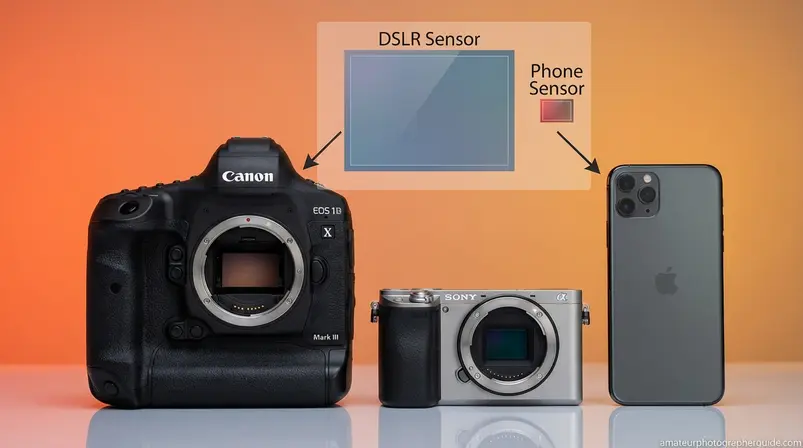
Sensor size is the biggest factor. A DSLR’s APS-C sensor measures approximately 22.5mm × 15mm. A typical iPhone primary sensor is roughly 1/1.28″ — a fraction of that area. More sensor surface means more photons captured per shot, which directly translates to better low-light performance, greater dynamic range, and higher-resolution files. This is physics, not marketing.
Interchangeable lenses multiply the camera’s versatility in a way fixed-lens cameras cannot match. A Canon EOS Rebel T7 (DSLR) accepts hundreds of lenses from Canon, Sigma, Tamron, and Tokina — from fisheye to super-telephoto. A Canon PowerShot point-and-shoot accepts none.
The optical viewfinder completes the picture. When you press your eye to a DSLR’s viewfinder, you’re seeing real light reflected through the actual lens — not a digital approximation on an electronic screen. No lag. No screen glare in bright sunlight. No battery drain. That last point becomes significant over a full day of shooting.
Inside a DSLR: How the Mirror Mechanism Works
Imagine a tiny periscope built into your camera. Light enters through the lens, bounces off a 45-degree mirror, travels upward through a glass prism, and reaches your eye through the viewfinder. That’s the “reflex” in Digital Single-Lens Reflex — and it’s the mechanical feature that makes a DSLR photograph the way it does.
The DSLR mechanics breakdown from Northeastern University confirms this optical path, explaining how the reflex mirror system gives photographers a through-the-lens view that compact cameras and smartphones cannot replicate (Northeastern University, 2023).
Caption: The DSLR’s optical path — light takes this exact route from lens to eye every time you compose a shot through the viewfinder.
Video: Why Buy a Used DSLR in 2025? (The Smartest Budget Choice)” — companion video covering the mirror mechanism and the Dead Tech Arbitrage argument. Source: Brand YouTube channel
The Optical Path: From Lens to Viewfinder
Here’s the complete sequence, step by step — the same process that happens in every DSLR from a $300 used beginner body to a $3,000 professional workhorse:
- Light enters the lens. The glass elements inside the lens gather and focus incoming light, directing it toward the camera body. Adjusting the aperture (the iris opening inside the lens) controls how much light passes through — see understanding the f-stop and aperture for a full breakdown of this relationship.
- Light strikes the reflex mirror. A hinged mirror, angled at precisely 45 degrees, intercepts the incoming light and reflects it upward rather than allowing it to hit the sensor. At this moment, the sensor is shielded — you’re composing, not capturing.
- Light passes through the pentaprism. The reflected image is laterally flipped (left becomes right). The pentaprism — a five-sided glass prism mounted at the top of the camera body — corrects both the left-right flip and the vertical inversion, delivering a correctly oriented image to the eyepiece.
- Light reaches your eye through the optical viewfinder. You see the scene exactly as the lens sees it, in real time, with zero electronic processing between the real world and your eye.
- You press the shutter button. The mirror snaps upward out of the light path. The mechanical shutter curtain opens for a precisely controlled duration — 1/1000th of a second, 1/4000th, whatever you’ve set. Light hits the sensor. The image is captured. The mirror drops back down.
The zero-lag advantage: Because the optical viewfinder uses reflected light directly — no screen, no processing — there is no electronic delay between what’s happening in front of the lens and what you see through the eyepiece. This is why sports and wildlife photographers still choose DSLRs in 2026: you cannot miss a bird taking flight because your viewfinder froze or flickered.
What Happens When You Press the Shutter
The mirror flip creates one honest DSLR limitation worth knowing about: viewfinder blackout. For a fraction of a second during capture, the mirror is up and the viewfinder goes dark. At normal shooting speeds this is imperceptible. At 8–10 frames per second — if you’re tracking a sprinting athlete — you’re effectively shooting between blackout intervals rather than with continuous visual confirmation.
Entry-level DSLR shutters are typically rated at 100,000 actuations (shutter fires). Professional bodies like the Nikon D850 and Canon 5D Mark IV carry 200,000-actuation ratings. When buying used, a shutter count under 50% of the rated life is a reasonable benchmark — tools like CameraShutterCount.com can verify this from a sample image file before you commit.
Modern DSLRs also include a Live View mode, where the mirror flips up permanently and the sensor feeds a live image to the rear LCD screen. Autofocus in Live View is slower on most DSLRs (contrast-detection rather than the faster phase-detection used in the optical viewfinder mode) — which leads directly to the question of video capability, covered in a later section.
A mirrorless camera has no mirror at all — the sensor always faces the lens, always powering the electronic viewfinder (EVF). No mirror blackout, lighter body, but the always-on sensor drains battery significantly faster. That trade-off is the central DSLR vs. mirrorless debate.
Full-Frame vs. Crop Sensor: Why It Matters to You
The term “what is a full frame DSLR camera” is one of the most searched sub-questions in this category — and the distinction matters for your buying decision.
Full-frame sensor: Matches the dimensions of a 35mm film frame (36mm × 24mm). Better low-light capability, more natural depth of field, and higher resolution ceilings. Examples include the Nikon D850 (45.7MP) and Canon 5D Mark IV (30.4MP). These are professional tools, now available used at dramatically reduced prices.
APS-C (crop) sensor: Smaller — approximately 22.5mm × 15mm for Canon, 23.5mm × 15.6mm for Nikon. The smaller sensor introduces a “crop factor” of 1.5x–1.6x: a 50mm lens on an APS-C camera behaves like a 75–80mm lens in terms of framing. This actually benefits wildlife and sports photographers, who get extra reach from existing glass. Examples: Canon EOS Rebel T7 (24.1MP), Nikon D3500 (24.2MP).
For a full breakdown of how these differences appear in practice, how sensor size affects your photos walks through real-world examples.
| Feature | Full-Frame | APS-C (Crop Sensor) |
|---|---|---|
| Sensor Size | 36mm × 24mm | ~22.5–23.5mm × 15mm |
| Crop Factor | 1x | 1.5x – 1.6x |
| Low-Light Advantage | High | Moderate |
| Beginner Suitability | Overkill to start | ✅ Ideal starting point |
| Example Models | Nikon D850, Canon 5D IV | Canon T7, Nikon D3500 |
| Used Price Range (body) | $800–$1,500 | $250–$450 |
Prices reflect current used market conditions as of Q1 2026 — verify current listings at KEH.com or MPB.com before purchasing.
For 95% of beginner photography — portraits, travel, everyday moments, wildlife — an APS-C DSLR delivers image quality that comfortably exceeds any smartphone. Full-frame is an upgrade path for later, not a requirement for starting.
DSLR vs. Mirrorless vs. Smartphone: 2026 Verdict
In 2024, mirrorless cameras accounted for approximately 88.6% of all interchangeable-lens camera shipments globally — a near-complete market reversal from just eight years ago (CIPA data via Nikkei/PetaPixel, 2025). That market shift would have been unimaginable a decade ago, when DSLRs dominated every professional camera bag. But understanding what replaced DSLRs, and why, clarifies the most practical question: does any of that market shift affect whether a DSLR is right for YOU?
According to 2024 global camera shipment data from CIPA, roughly 890,000 DSLRs shipped in 2024 — down sharply from previous years — while mirrorless shipments totaled approximately 5.22 million units across major manufacturers (CIPA, 2024). The market has moved. Prices have followed.
DSLR vs. Mirrorless: Key Differences Explained
The core mechanical difference: DSLRs have a mirror, which enables the optical viewfinder but adds bulk and weight. Mirrorless cameras eliminate the mirror entirely — the sensor always faces the lens, always feeding the electronic viewfinder or LCD. No mirror means a lighter, more compact body. It also means the sensor runs continuously, which is the primary reason mirrorless batteries deplete faster.
The battery gap is not subtle. The Nikon D3500 delivers 1,550 shots per charge (CIPA standard), while the Sony A6400 — a comparable entry-level mirrorless — delivers 410 shots per charge via LCD (Sony official spec, 2024). That’s a 3.7:1 ratio. On a full-day wildlife shoot without power access, this difference is the gap between coming home with images and running out of charge at noon.
| Feature | DSLR | Mirrorless |
|---|---|---|
| Internal Mirror | ✅ Yes (optical path) | ❌ No (always-on sensor) |
| Viewfinder Type | Optical (OVF) — zero lag | Electronic (EVF) — slight processing lag |
| Battery Life | 800–1,500 shots per charge | 300–500 shots per charge |
| Body Size/Weight | Larger, heavier | Compact, lighter |
| Autofocus (Video) | Slower contrast-detect in Live View | Faster phase-detect / DPAF |
| Lens Ecosystem | Decades deep (30+ years) | Newer, growing rapidly |
| New Model Availability | Largely discontinued | Active R&D and new releases |
| Used Market Price | ✅ Best value ($250–$900) | Higher ($450–$1,500+) |
Battery figures are CIPA-rated specs for Nikon D3500 and Sony A6400 respectively (official manufacturer specs, 2024). Prices reflect Q1 2026 used market conditions.
For a complete spec-by-spec breakdown of every major pairing, see the full DSLR vs. mirrorless comparison.
Canon’s technical comparison confirms the battery dynamic directly: the optical viewfinder in a DSLR requires no electronic power to operate — you’re looking at reflected light, not a powered screen — which is the primary driver of the battery life gap (Canon Europe, 2024).
SLR vs. DSLR: Film Meets Digital
Before DSLRs, there were SLRs — Single-Lens Reflex cameras that used the identical mirror-prism-viewfinder optical path, but recorded images on 35mm film rather than a digital sensor. The mechanics are the same; only the recording medium differs.
The practical implication for buyers: Canon and Nikon DSLR bodies accept many older SLR lenses with adapters or direct mount compatibility. Nikon’s F-mount system has maintained compatibility across six decades of lens production — a DSLR body purchased today can use glass manufactured as far back as the 1970s (with some limitations on metering and autofocus). That’s another dimension of the value argument: you’re inheriting not just a camera body, but an enormous, affordable secondary market of optics.
Fujifilm’s X-series cameras (X-T5, X-S20) are worth a quick clarification: they look like rangefinders or SLRs, but they are mirrorless cameras with APS-C sensors — not DSLRs. The form factor resembles a DSLR; the internal mechanics do not.
DSLR vs. Smartphone: The Real Gap
An APS-C DSLR sensor has approximately 25–30 times more surface area than a typical smartphone primary sensor. More area means more photons captured per frame — and more photons is the fundamental input that produces image quality. Software can simulate many things; it cannot manufacture light information that wasn’t captured.
- Where smartphones win outright:
- Computational photography (AI-stacked HDR, night mode processing)
- Video autofocus tracking for fast-moving subjects
- Portability and always-in-pocket availability
- Social-ready files with built-in editing
- Where DSLRs win outright:
- Natural background blur (optical bokeh) from lens physics — no software simulation
- Telephoto reach with dedicated glass (wildlife, sports, birds)
- High-ISO low-light performance without AI artifact patterns
- Speed for action sequences (mechanical shutter, OVF tracking)
- RAW file flexibility for serious post-processing in Lightroom or Capture One
The honest summary: for Instagram content viewed at 1080px, a current iPhone is often the more practical tool. For printed enlargements, controlled portrait sessions, wildlife photography, or any scenario where you’re working with a specific creative vision, a DSLR produces results that a smartphone cannot replicate without heavily processing the image. The full DSLRs vs. iPhones comparison covers every scenario in detail.
What DSLRs Are Actually Good For
DSLRs are genuinely exceptional tools for specific photography scenarios — not because of nostalgia, but because their optical mechanics create advantages that no software update can replicate. Battery life that lasts a full day of shooting. An optical viewfinder with zero processing delay. A lens ecosystem decades deep. These are hardware facts, not marketing claims.
Optical viewfinders consume less power than electronic displays because they use reflected light rather than a powered screen — which is the direct mechanical reason for the DSLR battery advantage over mirrorless cameras.
Genres Where DSLRs Outperform Rivals
What is a DSLR camera good for in 2026? The answer is specific and concrete — not a vague “everything”:
- Sports and Action Photography: The optical viewfinder tracks fast-moving subjects without lag or stutter. Bodies like the Nikon D500 (10fps) and Canon 7D Mark II (10fps) maintain complete viewfinder clarity at high frame rates. Electronic viewfinders in mirrorless cameras have improved, but brief blackout and slight processing lag still present at equivalent framerates in many models.
- Wildlife Photography: A Nikon D3500 fires 1,550 shots on one battery (Nikon official spec, 2024) — nearly four times the 410-shot rating of the Sony A6400 entry mirrorless (Sony official spec, 2024). A full day in the field, no power outlet, tracking subjects from dawn to dusk: the battery math is not minor.
- Portrait Photography: A 50mm f/1.8 lens on any APS-C DSLR creates genuine optical background separation — soft, natural bokeh from lens physics rather than AI simulation. That combination costs approximately $125–$175 used for the lens, plus whatever you spend on the body. No portrait filter app produces the same result.
- Landscape Photography: Full-resolution RAW files from APS-C and full-frame DSLR sensors (24–45MP) capture dynamic range that remains competitive with current mirrorless cameras. For large-format printing, a used Nikon D810 (36.3MP) body delivers results that rival mirrorless systems costing three times as much. See best cameras for landscape photography for specific recommendations.
- Low-Light Photography: Larger sensors capture more light per pixel at high ISOs. APS-C DSLRs consistently outperform smartphones at ISO 3200–6400, where computational noise reduction starts producing artificial-looking textures and plasticky skin tones.
“Don’t let anyone shame you for using a DSLR in 2025. It’s still a supremely capable tool in the right hands for the right job.”
That sentiment from the photography community captures something real. A DSLR is not inferior technology — it’s appropriate technology for specific scenarios. The photographer who identifies those scenarios and buys accordingly makes the smarter decision.
Are DSLRs Still Good for Video in 2026?
For video, the honest answer is: it depends on the model, and you should know the limitation before buying.
Most DSLRs use contrast-detection autofocus when recording in Live View (video) mode. Contrast-detect AF is slower and less reliable than the phase-detection systems built into mirrorless cameras — it hunts noticeably when a subject moves across frame. For documentary-style interviews, static B-roll on a tripod, or livestreaming via HDMI capture card, a DSLR is a perfectly workable setup. For run-and-gun vlogging where you need reliable face-tracking while you’re moving, it will frustrate you.
The notable exception: the Canon EOS 90D uses Dual Pixel CMOS AF in video, delivering smooth, confident autofocus even in Live View — a capability rare among DSLRs. If video is a significant part of your shooting plans, the 90D is the DSLR to research specifically. For a full comparison of cameras optimized for video content, best cameras for vlogging and video content covers the landscape thoroughly.
DSLR video strengths that remain relevant: Clean HDMI output for streaming or external recording, a headphone/microphone jack that many compact mirrorless cameras at equivalent price points omit, and full HD video quality that’s more than sufficient for YouTube at standard viewing resolutions.
The bottom line for video in 2026: casual content, interviews, and controlled B-roll are DSLR territory. Tracking autofocus and run-and-gun documentary work belong to mirrorless.
Dead Tech Arbitrage: Buying a Used DSLR in 2026
The best argument for buying a DSLR in 2026 is the same reason no manufacturer is actively building new ones: the market has moved on, and prices have collapsed as a result. That collapse isn’t a warning sign — it’s an opportunity. Dead Tech Arbitrage is the strategic practice of purchasing discontinued professional technology at used-market prices, capturing full performance value at a fraction of the original cost. The DSLR market in 2025–2026 is the clearest example of this principle available to photographers at any budget level.
RTINGS beginner DSLR testing names the Canon EOS Rebel T8i as the top-tested beginner DSLR for autofocus performance and overall usability (RTINGS.com, 2024) — a camera that represents exactly this market dynamic.
Best Beginner DSLR Models to Consider
What is a good beginner DSLR camera in 2026? Three models consistently emerge from community testing and independent reviews as the starting points worth considering:
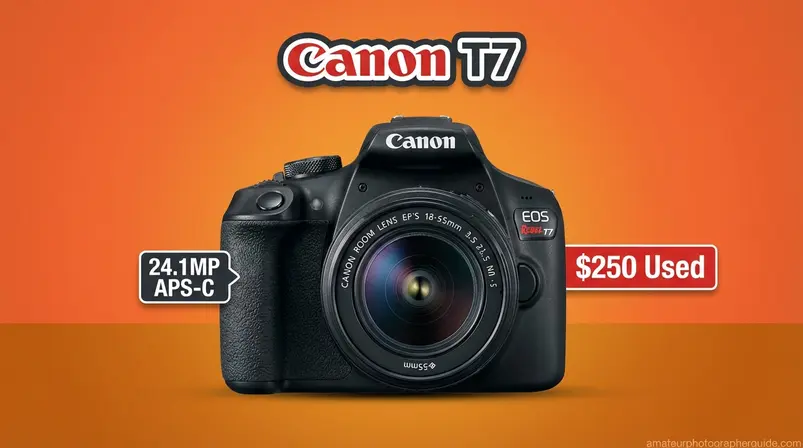
- 1. Canon EOS Rebel T7 (24.1MP APS-C) — approximately $250–$350 used, body only
- Best for: True beginners who want Canon’s Rebel ergonomics and an enormous online tutorial ecosystem
- Kit lens: 18-55mm f/3.5-5.6 IS II — sharp, stabilized, covers 90% of beginner shooting scenarios
- Honest limitation: 9-point AF system is dated by current standards; no 4K video; single SD card slot
- Why it wins: The most accessible entry point in the Canon ecosystem; Canon’s beginner tutorial library is unmatched in volume and quality
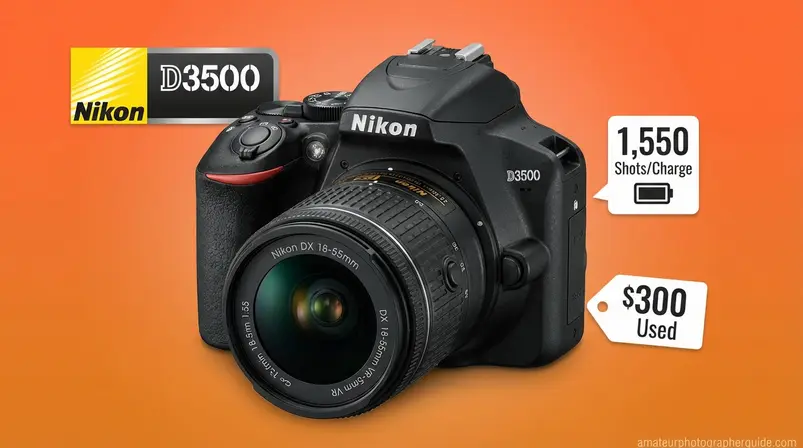
- 2. Nikon D3500 (24.2MP APS-C) — approximately $300–$450 used, body only
- Best for: Beginners who prioritize image quality and battery life above all else — this camera’s 1,550-shot per-charge rating is virtually unmatched in its class
- Kit lens: 18-55mm f/3.5-5.6G VR — Nikon’s VR (Vibration Reduction) stabilization is effective and beginner-friendly
- Honest limitation: No built-in Wi-Fi; no 4K video; fixed LCD screen (no flip or tilt)
- Why it wins: Consistently cited as the benchmark beginner DSLR for image quality per dollar; the 1,550-shot battery is a genuine operational advantage
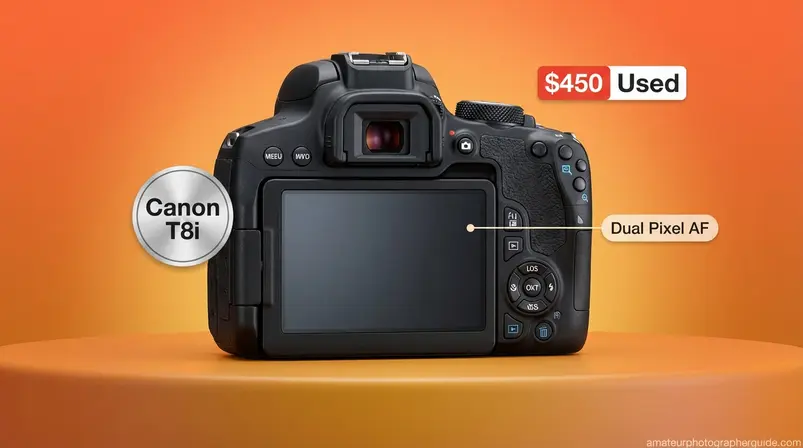
- 3. Canon EOS Rebel T8i (24.1MP APS-C) — approximately $450–$600 used, body only
- Best for: Beginners who plan to create video content alongside stills — RTINGS.com’s top-tested beginner DSLR for AF performance
- Kit lens: 18-55mm f/4-5.6 IS STM — the STM motor runs quietly during video recording
- Honest limitation: Higher used price than T7 or D3500; still not a budget buy
- Why it wins: Dual Pixel CMOS AF in video is the exception in DSLR land — significantly more reliable than contrast-detect autofocus on most other DSLR bodies
Kit lens guidance: Buy a body + kit lens bundle where possible — typically saves $50–$100 versus buying separately. The 18-55mm kit lens is not a compromise. It covers portraits, travel, family events, and general photography with no significant weakness for a beginner. Your first upgrade lens (when you’re ready) is the 50mm f/1.8 “nifty fifty” for approximately $100–$130 used — it transforms portrait work.
For a comprehensive breakdown of what your DSLR budget actually gets you at every price point, that dedicated buyer’s guide covers the full spectrum.
New vs. Used: The 2026 Market Reality
The price depreciation in the DSLR market is the practical core of the Dead Tech Arbitrage argument. Here’s what that looks like in concrete numbers:
| Camera Model | Original MSRP | Used Price Range (Q1 2026) | Megapixels | Status |
|---|---|---|---|---|
| Nikon D850 | ~$3,300 | $800–$1,200 (well-used to good) | 45.7MP | Discontinued |
| Canon 5D Mark IV | ~$3,299 | ~$900–$1,400 | 30.4MP | Discontinued |
| Nikon D750 | ~$2,300 | ~$500–$800 | 24.3MP | Discontinued |
| Nikon D3500 | ~$499 | ~$300–$450 | 24.2MP | Discontinued |
Nikon D850 used pricing sourced from Accio.com (2025). All prices are used market estimates — verify current listings at KEH.com or MPB.com before purchasing. Prices fluctuate with condition and supply.
The Nikon D850 column is the one that stops people. A 45.7-megapixel full-frame camera with a 200,000-actuation shutter rating, rated at up to 1,840 shots per charge with optional battery grip — selling for $800–$1,200 in well-used to good condition. That camera produced images that professional photographers were paid real money to deliver in 2017. The sensor didn’t change. The price did.
- Where to buy used DSLRs (trust hierarchy):
- KEH Camera (keh.com) — Graded condition ratings (BGN/EXC/LN+), 180-day warranty, US-based; the most trusted name in used camera gear
- MPB (mpb.com) — US and UK, 6-month warranty, graded listings with photos of the actual unit
- Adorama Used / B&H Used — Both include return policies and graded conditions
- eBay (completed listings only) — Ungraded; filter to “completed listings” to see what cameras actually sold for, not just asking prices
- Local camera shops — Inspect in person; eliminate return shipping risk
Before buying any used DSLR: Ask the seller for the shutter count, or take a test shot and upload it to CameraShutterCount.com for an instant readout. Target bodies below 50% of their rated shutter life — for an entry-level body rated at 100,000 actuations, that means under 50,000 shots fired.
For the Canon DSLR models and buying guide, that resource covers the Canon side of the used market specifically.
Where DSLRs Fall Short: Honest Limitations to Know
No buying guide is worth trusting if it only tells you the good parts. DSLRs have genuine limitations — and understanding them is what separates a smart purchase from buyer’s remorse.
Common Pitfalls When Choosing a DSLR
1. Buying a used body with an unknown shutter count. You find a cheap listing on Facebook Marketplace with no specs listed. The camera looks fine in photos. What goes wrong: shutter mechanisms have finite lives (100,000–200,000 actuations depending on the model), and replacement shutter assemblies cost $200–$400 in labor and parts. How to avoid it: always request the shutter count before purchasing, or request a test shot file you can upload to CameraShutterCount.com. Walk away from any seller who won’t provide this information.
2. Starting with full-frame before mastering the basics. You see a used Nikon D750 for $500 and assume that more camera equals better photos. What goes wrong: full-frame lenses are significantly more expensive than APS-C equivalents, and the system advantages of full-frame — superior low-light, shallower depth of field at equivalent apertures — only matter once you understand aperture, shutter speed, and ISO well enough to exploit them deliberately. How to avoid it: start with an APS-C body (Canon T7, Nikon D3500). Move to full-frame when you understand exactly why you’re upgrading.
3. Ignoring the total cost of the lens ecosystem. The body is $250. The kit lens might be missing or worn. A replacement costs $80–$120. A 70-300mm telephoto for wildlife costs $150–$300 used. How to avoid it: budget the full system — body, kit lens, memory card, bag, and at least one additional lens — before committing to a body-only purchase.
4. Expecting a DSLR to serve as a long-term upgrade platform. Nikon has officially exited consumer DSLR production. Canon continues selling existing Rebel inventory but has announced no new DSLR models as of Q1 2026. The upgrade path within the DSLR system is essentially closed. How to avoid it: buy a DSLR as a complete, capable tool for where you are today — not as the first step in a DSLR-specific upgrade ladder. When you’re ready to invest more, that path leads to mirrorless.
When to Choose Mirrorless or a Smartphone Instead
If video is your primary use case: Mirrorless cameras — particularly the Sony ZV-E10 (around $450 used), Fujifilm X-S20, or Canon EOS M50 Mark II — offer tracking autofocus in video, lighter bodies, and better in-body stabilization options for handheld shooting. If 60% or more of your output is video content, mirrorless is the correct tool.
If portability is your hard constraint: The mirror box in a DSLR adds physical volume that cannot be engineered away — it’s the mechanical requirement of the reflex design. Mirrorless cameras of equivalent image quality run 30–40% lighter and smaller. If you’re a travel photographer counting every ounce, a DSLR is the wrong starting point regardless of price.
If you’re only shooting for social media at smartphone display sizes: For Instagram Reels, TikTok content, or photos that will only ever be viewed compressed to 1080px on a phone screen, the computational photography in a current iPhone 15 or Samsung Galaxy S24 matches or outperforms a DSLR for that specific output. Don’t buy a DSLR to produce content that the algorithm compresses to a fraction of its resolution anyway.
Frequently Asked Questions
Difference: DSLR vs. Normal Camera
A DSLR camera differs from a standard point-and-shoot or smartphone camera by using a larger image sensor, interchangeable lenses, and a mechanical mirror that reflects light to an optical viewfinder before every shot. This mirror lets you see exactly what the lens sees — in real time, with zero electronic delay. Point-and-shoot cameras and smartphones use fixed, smaller sensors with no internal mirror system. The larger sensor in a DSLR captures significantly more light per shot, producing better image quality — especially in low light or when printing large. If manual control, lens versatility, and image quality are priorities, a DSLR is a meaningful upgrade from a standard camera.
Is a DSLR Better Than an iPhone?
For image quality in challenging conditions, a DSLR camera outperforms an iPhone because its sensor captures significantly more light per frame — roughly 25–30 times the surface area of a typical smartphone primary sensor. This larger sensor produces superior low-light images, natural depth of field from lens physics, and higher-detail files without software simulation. iPhones excel at computational photography, video autofocus, and convenience — areas where current DSLRs cannot match modern smartphone software. For portrait sessions, wildlife, sports, or any photography where you control the scene, a DSLR produces objectively more optically accurate images. For casual social media content, the iPhone is often the more practical daily tool.
Do Photographers Prefer DSLR or Mirrorless?
Professional photographers are shifting toward mirrorless systems industry-wide — with Canon, Nikon, and Sony directing R&D budgets almost exclusively to mirrorless development as of 2026. However, many working photographers continue to use DSLRs, particularly for sports and wildlife assignments where the optical viewfinder and battery life provide genuine operational advantages. The Nikon D3500’s 1,550-shot battery rating vs. the Sony A6400’s 410-shot rating (CIPA official specs, 2024) remains a real factor on full-day professional assignments. In hobbyist and beginner communities, DSLRs stay popular because the used market delivers professional image quality at entry-level prices. The preference is shifting toward mirrorless industry-wide, but DSLRs remain the dominant choice for battery-dependent and budget-conscious photographers.
What Is a DSLR Camera Used For?
DSLR cameras are used for professional and enthusiast photography where image quality, manual control, and lens versatility are priorities — not for casual snapshots where a smartphone suffices. They excel in sports and wildlife photography, where the optical viewfinder’s zero-lag tracking helps capture fast-moving subjects without missing the moment. Portrait photographers use DSLRs for natural background blur and high-resolution sensor output; landscape photographers use them for dynamic range and RAW file flexibility in post-processing. DSLRs also serve event photography, wedding photography, and stock photography — any assignment requiring long shoot durations where battery endurance is operationally critical. Video creators use them for controlled scenarios like interviews, streaming, and B-roll where advanced video autofocus is less critical.
Are DSLRs Still Relevant in 2026?
DSLRs are still relevant in 2026 — particularly for beginners and budget-conscious photographers who want professional image quality without paying mirrorless prices. While manufacturers have largely halted new DSLR development, the used market offers discontinued flagship models at 60–75% discounts from original retail pricing; the Nikon D850 that cost $3,300 new now sells used for $800–$1,200 in well-used to good condition (Accio.com, 2025). DSLRs also benefit from decades of lens ecosystem depth — compatible optics spanning 30+ years of production. Battery life, optical viewfinder performance, and sensor image quality have not declined with age. For photographers who shoot outdoors all day, prioritize battery endurance, or are learning on a budget, a used DSLR remains one of the smartest photography purchases available in 2026.
Conclusion
For beginners evaluating their first “proper camera,” a DSLR camera delivers professional image quality, a zero-lag optical viewfinder, and an interchangeable lens ecosystem that no comparably priced mirrorless system can match. The Nikon D3500 — available used for approximately $300–$450 — fires 1,550 shots per charge (Nikon official CIPA spec, 2024) and captures images that exceed any smartphone through optical physics rather than software processing. That’s thirty years of engineering available at a price point that was unthinkable when these cameras were current.
That’s the essence of Dead Tech Arbitrage: the market has priced these cameras as though they’re obsolete because manufacturers have moved on to mirrorless. The cameras haven’t stopped working. The sensors haven’t degraded. The “dead” label is a pricing signal, not a performance signal — and confusing the two is the most expensive mistake a beginner buyer can make.
Ready to buy? Start with the dedicated buyer’s guide — what your DSLR budget actually gets you — which walks through every significant used DSLR under $500 with current market pricing, condition grading guidance, and exactly which kit lens to pair with each body for the best possible start.