Table of Contents
This blog post may contain affiliate links. As an Amazon Associate I earn from qualifying purchases.
You’ve seen those photos — the ones bathed in a warm, golden glow that makes everything look almost magical. Chances are, they were taken during the golden hour.
Most beginners shoot at midday and wonder why their photos look flat, washed out, or full of harsh shadows. That’s not a camera problem — it’s a lighting problem. The good news? There are two brief windows every single day when the light transforms everything it touches, making even a simple snapshot look stunning.
By the end of this guide, you’ll know exactly what is golden hour photography, when it happens wherever you are, and how to shoot it confidently — even if you’ve never touched a manual camera setting. We’ll cover the science behind the light, tools to calculate your exact window, step-by-step shooting techniques, and even what to wear.
If you are wondering what is golden hour photography, it captures the soft, warm light in the 20–60 minutes after sunrise and just before sunset — and it transforms ordinary scenes into stunning images.
- Golden hour light is soft: The sun travels through more atmosphere at low angles, scattering harsh blue light and leaving warm reds and golds
- Timing varies by location: Near the equator, the window is shorter (~20 min); at higher latitudes, it can stretch to an hour or more
- The Golden Window Framework divides your shooting hour into three phases — Early Light, Peak Gold, and Fading Glow — each needing different settings
- Apps like PhotoPills and The Photographer’s Ephemeris give you the exact time for your GPS location, updated daily
- Earth tones and pastels complement golden hour light best — avoid neons
What Is Golden Hour Photography?

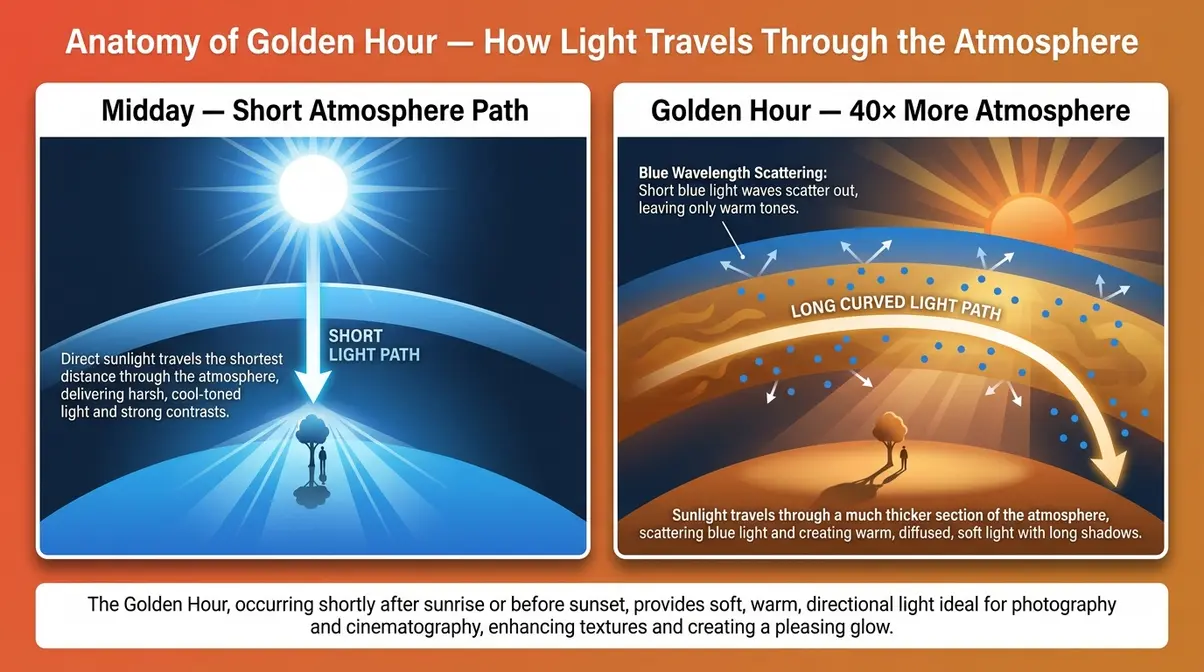
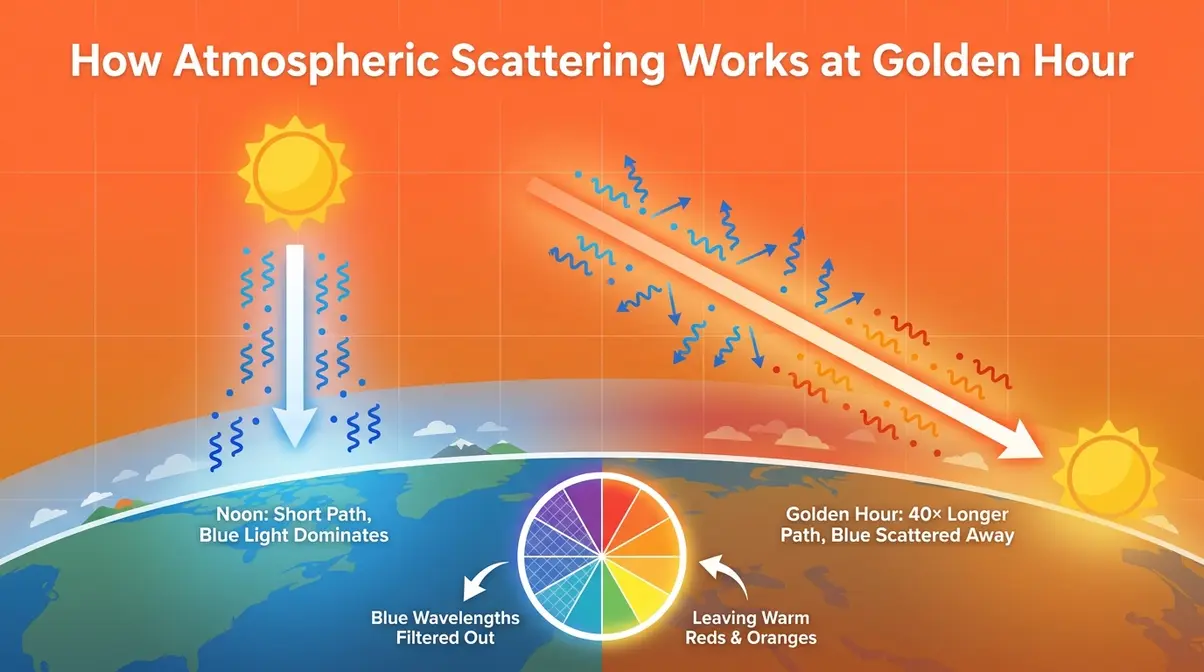
Golden hour photography is the practice of shooting during the brief window of warm, soft light that occurs shortly after sunrise and just before sunset. During this period, sunlight travels through significantly more of Earth’s atmosphere than it does at midday — NOAA SciJinks explains that near the horizon, light passes through up to 40 times more atmosphere, scattering blue wavelengths and flooding your scene with warm reds, oranges, and golds. This creates a diffused, flattering glow that makes faces, textures, and colors look richer without a single filter.
The Science Behind Golden Hour Light
Think about looking through a glass of clear water versus a glass of honey. The water lets everything through cleanly and evenly. The honey filters out certain wavelengths, enriching the color of what passes through. Earth’s atmosphere works the same way when the sun is low on the horizon.
When the sun sits within roughly 6 degrees of the horizon — the trigger zone for golden hour — its light must travel through a much thicker slice of atmosphere to reach your camera. That extra distance scatters the shorter, harsher blue wavelengths away, leaving the longer warm wavelengths (reds, oranges, and golds) to dominate. It’s the same physics that turns every sunset orange. “During golden hour, sunlight travels through up to 40 times more atmosphere than at midday, scattering blue wavelengths and creating the warm, soft glow photographers prize” (NOAA SciJinks).
But warmth is only half the story. The light is also diffused — scattered in multiple directions rather than beaming down in one harsh cone. Think of a softbox in a professional photography studio (a large, fabric-covered light that spreads illumination evenly). Golden hour is essentially a giant natural softbox positioned at a perfect, low angle. The result? No dark shadows under your subject’s eyes, no squinting from overhead glare, no washed-out skin. Just soft, wrapping light that flatters everything it touches.
This means your subject’s skin looks warmer and more flattering — without any filter or editing.
Transition: Understanding the science is one thing — but seeing the difference is what really convinces you. Here’s a direct comparison of what golden hour does to a photo that midday simply can’t replicate.
Why Is Golden Hour So Good for Photos?
Golden hour light is flattering because it’s soft, warm, and directional — three qualities that midday sunlight lacks entirely. The low angle of the sun creates long, sweeping shadows that add depth and texture to scenes. The warm color temperature (around 2,000–3,500K, as noted by The New York Times) makes skin tones glow and colors appear richer. Additionally, the diffused quality of the light wraps around subjects evenly, eliminating the harsh under-eye shadows and squinting that overhead midday light causes. Photographers consistently report needing far less editing time on golden hour images.
Golden Hour vs. Midday Light

The comparison below shows exactly what we mean — same subject, same camera, different light.
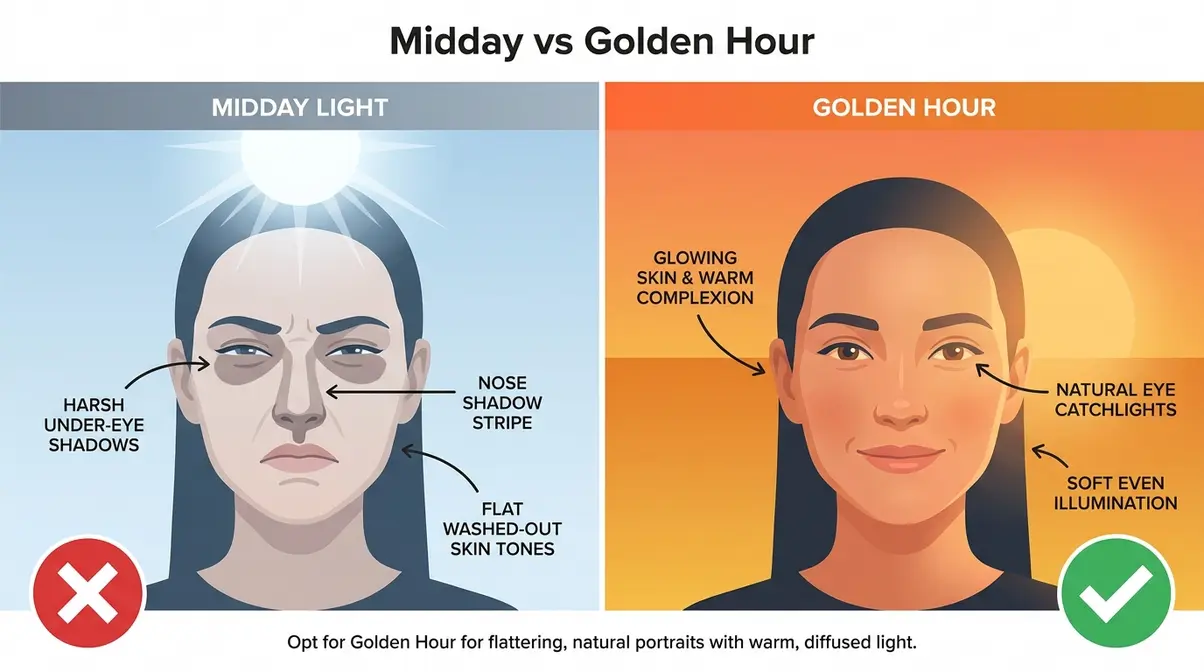
At midday, the sun is directly overhead. Shadows fall straight down — creating dark circles under eyes, a harsh stripe under the nose, and a flattened, unflattering look on almost any face. Colors appear washed out because the light is too bright and too even. Subjects squint. Scenes look flat.
At golden hour, the sun is low on the horizon. Shadows extend horizontally across the scene instead of falling straight down. For portraits, this adds dimension and warmth. For landscapes, it means rocks, sand dunes, grass, and fields show their full texture — the kind of depth that makes a photo look three-dimensional.
Color temperature tells the same story. Midday light measures around 5,500–6,000K (Kelvin — the unit photographers use to describe the “warmth” of light; higher numbers mean cooler, bluer light). Golden hour light drops to around 2,000–3,500K, giving everything that signature orange-gold cast. The New York Times notes that professional photographers favor the golden hour precisely because the low sun casts a uniquely warm and flattering light on subjects — something no amount of post-processing fully replicates.
What does this mean for a portrait? At midday, your subject has dark circles and a washed complexion. At golden hour, they have glowing skin and warm highlights in their hair. No editing required. That’s the magic of golden hour light.
Blue Hour and Magic Hour Explained
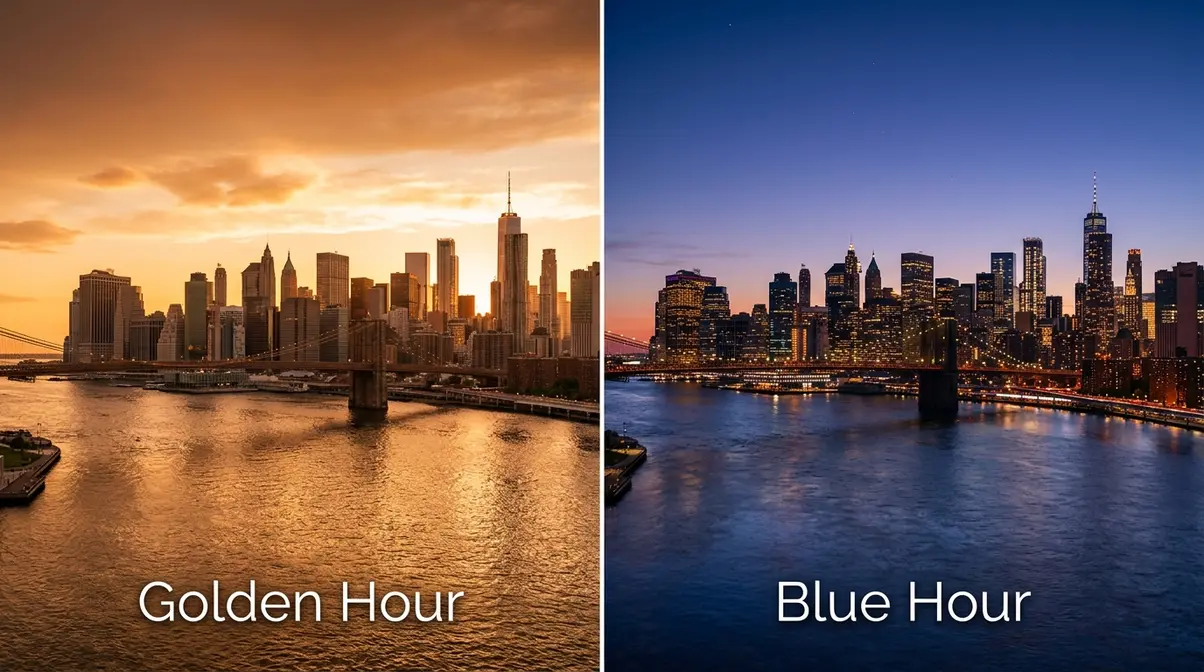
You’ll hear a few related terms thrown around in photography communities. Here’s what they each mean.
Magic hour is a filmmaker’s term for the same golden light window — the warm period just after sunrise or just before sunset. Cinematographers have used the phrase for decades because the light during this window looks almost artificially beautiful on camera. It’s interchangeable with “golden hour” in most photography conversations.
Blue hour is a distinct but equally beautiful window. It’s the cooler, softer light that follows sunset (or precedes sunrise). After the warm golds fade, the sky shifts to deep blues and purples for roughly 20–40 minutes. There’s no direct sun, but the sky itself becomes a giant, even light source — perfect for cityscapes, architecture, and moody portraits.
Civil twilight is the technical term for the period when the sun is between 0 and 6 degrees below the horizon. It’s the scientific bracket that contains both golden hour (as the sun approaches or leaves the horizon) and the early blue hour.
| Term | Light Quality | Best For |
|---|---|---|
| Golden Hour | Warm, orange-gold, directional | Portraits, landscapes, nature |
| Blue Hour | Cool, even, diffused blue | Cityscapes, architecture, moody scenes |
| Magic Hour | Same as Golden Hour | Film, video, creative portraits |
| Civil Twilight | Transition between both | Long exposures, creative experiments |
Why Photographers Love Golden Hour
Photographers don’t just prefer golden hour — many won’t shoot portraits outdoors at any other time of day. Here’s why.
First, the light is genuinely flattering for human subjects. Warm, low-angle light reduces the appearance of skin imperfections, adds a healthy glow to complexions, and creates catchlights (small sparkles of light in the eyes) that make portraits feel alive. Photographers consistently report that golden hour portraits require significantly less editing time because the light does the work for them.
Second, the directionality of the light adds depth that midday shooting simply cannot produce. Low-angle light creates long, sweeping shadows that give scenes a three-dimensional quality. This is the real secret most beginners miss — golden hour isn’t just about color, it’s about shape and depth.
Third, it’s forgiving for beginners. The soft, diffused quality of golden hour light means small exposure mistakes are easier to recover in editing. Harsh midday light creates blown-out highlights and crushed shadows that are much harder to fix.
This is where The Golden Window Framework becomes your practical tool. Rather than treating the golden hour as one uniform block of light, think of it as three distinct phases:
- Early Light (first 15–20 minutes): Diffused warmth, lower contrast, ideal for soft portraits and dreamy scenes
- Peak Gold (middle 20–30 minutes): Maximum warmth, stronger shadows, lens flare potential — the most dramatic phase
- Fading Glow (final 15–20 minutes): Rich, deep shadows, moodier tones, silhouette potential as the sun touches the horizon
Each phase calls for slightly different settings and techniques — which we’ll cover in detail in the shooting section below.
When Is Golden Hour? Finding Your Exact Window
Golden hour occurs twice daily — once after sunrise and once before sunset. The exact time shifts every day based on your location, the season, and your latitude (your distance from the equator). Pinning down that window is the single most important planning step for any golden hour shoot.
How Long Does Golden Hour Actually Last?
Despite the name, golden hour rarely lasts exactly 60 minutes. The actual duration depends heavily on where you are in the world and what time of year it is.
Near the equator (think tropical destinations, equatorial Africa, or Southeast Asia), the sun rises and sets at a steep angle. It crosses the horizon quickly, so your golden hour window can be as short as 20–30 minutes. You need to be ready and shooting before the light arrives.
At higher latitudes — think Scandinavia, Canada, or the northern United States — the sun travels at a shallower angle across the sky. It lingers near the horizon for much longer, and your golden hour can genuinely stretch to 60–90 minutes or more. In midsummer near the Arctic Circle, golden hour can last for hours.
| Location Type | Approximate Duration |
|---|---|
| Equatorial regions (0–15° latitude) | 20–30 minutes |
| Subtropical regions (15–35° latitude) | 30–45 minutes |
| Mid-latitudes (35–55° latitude) | 45–75 minutes |
| High latitudes (55°+ latitude) | 60–120+ minutes |
The season matters too. Summer days have longer golden hours than winter days at the same location because the sun’s path across the sky changes with the seasons.
How Location and Season Affect Timing
Knowing when golden hour starts is only half the challenge — understanding how much it varies saves you from showing up at the wrong time.
“Sun position varies between regions — in some regions, the sun is much lower on the horizon much earlier, or for longer periods.”
This is especially true for photographers in northern Europe, Canada, Alaska, or New Zealand. In June in Norway, the sun barely dips below the horizon, giving photographers an extended, otherworldly golden glow that can last most of the evening. In December in the same location, golden hour arrives in the early afternoon and disappears within 30 minutes.
The key variables are:
- Latitude: Higher latitude = shallower sun angle = longer golden hour
- Season: Summer = longer golden hour (sun path is higher and longer); Winter = shorter golden hour
- Altitude: Shooting from a high mountain changes your effective horizon, shifting your golden hour start time slightly
A practical tip: check your golden hour time at least 24 hours before any planned shoot. Apps update daily and account for all these variables automatically.
The Best Apps to Track Golden Hour
The easiest way to find your exact golden hour window is with a dedicated sun-tracking app. Our photography team evaluated several apps across multiple shooting sessions and seasons. These three stand out as the most reliable for beginners and working photographers alike.
PhotoPills is the most feature-rich option. It shows your golden hour start and end time for any GPS location, includes an augmented reality (AR) sun tracker that shows exactly where the sun will be in the sky at any moment, and lets you plan shoots weeks in advance. It’s a one-time purchase (around $11.99 on iOS and Android) and is widely considered the gold standard among professional photographers. Wired has consistently recommended it as the top planning tool for outdoor and landscape photography.
The Photographer’s Ephemeris (TPE) is the choice for landscape and location photographers. It overlays sun and moon data directly onto a map, so you can see exactly which direction the light will fall on a specific hillside, beach, or building at golden hour. The desktop version is free; the mobile app is a paid upgrade. It’s ideal if your photography involves scouting specific locations in advance.
Golden Hour: One Click Photo is the perfect starter app for absolute beginners. Open it, and it immediately shows you today’s golden hour window based on your current GPS location — no setup required. It’s free, clean, and does exactly one thing well. If you’ve never used a sun-tracking app before, start here.
| App | Platform | Cost | Best For |
|---|---|---|---|
| PhotoPills | iOS / Android | ~$11.99 (one-time) | Full planning, AR sun preview |
| The Photographer’s Ephemeris | iOS / Android / Web | Free (web) / Paid (mobile) | Location scouting, landscapes |
| Golden Hour: One Click Photo | iOS / Android | Free | Beginners, quick daily check |
Using a Golden Hour Calculator
If you want to calculate golden hour times accurately, follow this process. Using PhotoPills as an example, here’s how to find your exact golden hour window in under two minutes:
- Open PhotoPills and tap the “Planner” icon on the main screen
- Set your location — either tap “My Location” for GPS accuracy or search a specific address
- Select your date — tap the calendar icon and choose your shoot date
- Read the golden hour times — the app displays “Golden Hour” as a colored band on the sun arc timeline, showing exact start and end times
- Check the sun direction — note the compass direction the sun will be in during your golden hour window; this tells you where to position your subject
- Save the plan — tap the bookmark icon to save this shoot plan for reference on the day
The whole process takes about 90 seconds. Do this the evening before your shoot, not the morning of — you want time to scout your location while the light is right.
How to Shoot Golden Hour Photos: Settings
Now for the hands-on part. If you want to master golden hour photography techniques, preparation is everything. Before you adjust a single setting, keep one thing in mind: golden hour light changes fast. You’ll have minutes, not hours, to capture each phase of The Golden Window Framework.
- Before You Start — What You Need:
- A camera (smartphone cameras work beautifully for golden hour)
- A sun-tracking app set up for your location and date
- Your location scouted at least 30 minutes before golden hour begins
- A subject or scene chosen in advance (don’t waste golden light deciding what to shoot)
Golden Hour Camera Settings
These are your starting-point settings. Think of them as a baseline — you’ll tweak from here based on your specific scene.
| Setting | Recommended Value | Why |
|---|---|---|
| Aperture | f/1.8–f/2.8 | Wide opening lets in more light; creates soft background blur |
| ISO | 100–400 | Keep it low to avoid grainy images in the bright golden light |
| Shutter Speed | 1/100–1/500 sec | Fast enough to freeze movement; adjust for brightness |
| White Balance | Shade or Cloudy | Enhances warm tones; “Auto” can neutralize the gold you want |
| Exposure Mode | Aperture Priority (Av/A) | Camera handles shutter speed; you control the depth of field |
White balance is the setting most beginners get wrong. Your camera’s “Auto” white balance is designed to neutralize color casts — which means it actively fights the warm, golden tones you’re trying to capture. Switch to “Shade” or “Cloudy” preset to tell your camera to lean into the warmth.
Photographers across online communities consistently report that shooting in RAW format (if your camera supports it) gives you the most flexibility to fine-tune colors in editing afterward. JPEG is fine for beginners, but RAW preserves more image data.
Front Lighting: Warm, Glowing Portraits
Front lighting means the sun is behind you and shining directly onto your subject’s face. It’s the easiest golden hour technique and a great starting point for beginners.
How to shoot front lighting:
- Position yourself so the sun is at your back, low on the horizon
- Face your subject toward the sun — they should be looking roughly in your direction
- Set your aperture to f/2.0–f/2.8 for a soft background
- Check your exposure — meter on your subject’s face, not the bright sky behind you
- Ask your subject to tilt their chin slightly down to catch the warm light on their cheekbones
The result: warm, glowing skin tones, natural catchlights in the eyes, and that classic golden hour portrait look. This is the technique behind most of the golden-toned portraits you’ve admired on social media.
Backlighting and Rim Lighting
Backlighting is the opposite approach — the sun is behind your subject, shining toward your camera. It’s trickier but produces some of the most dramatic and dreamy golden hour images.
How to shoot backlighting:
- Position your subject between you and the sun
- Use exposure compensation — dial it up (+1 to +2 stops) to properly expose your subject’s face, since the bright background will fool your camera into underexposing
- Look for rim lighting — a thin, glowing outline of warm light around your subject’s hair and shoulders (sometimes called a “halo effect”)
- Use a reflector or a white piece of foam board to bounce some sunlight back onto your subject’s face from the front
- Shoot at f/2.0–f/2.8 to keep focus on your subject while the background glows softly
Across photography communities, the consistent feedback is that backlighting requires patience — you’ll take more test shots to nail the exposure. But the dreamy, backlit glow is worth every attempt.
Silhouettes: Bold, Striking Shots
Silhouettes flip the exposure game entirely. Instead of lighting your subject, you deliberately underexpose them against a bright sky. The result is a bold, graphic image where the subject’s shape tells the story.
How to shoot silhouettes:
- Wait for the Fading Glow phase of The Golden Window Framework — when the sun is at or just below the horizon and the sky is most colorful
- Position your subject against the open sky (not trees or buildings)
- Meter on the sky — point your camera at the bright sky and lock that exposure (on most cameras, half-press the shutter to lock)
- Reframe your shot with your subject in the composition
- Shoot at f/8–f/11 for a sharper, more defined silhouette outline
The cleaner and more recognizable your subject’s outline, the stronger the silhouette. Profiles, raised arms, jumping poses, and couples work especially well.
Lens Flare: Embrace the Sun
Lens flare happens when the sun shines directly into your lens, creating streaks, orbs, or a starburst of light across your image. In midday shooting, flare is usually unwanted. During golden hour, it becomes a creative tool.
How to create lens flare intentionally:
- Shoot during Peak Gold phase — when the sun is still visible just above the horizon
- Position the sun partially behind your subject or at the very edge of your frame
- Remove your lens hood (the cylindrical shade that attaches to the front of your lens)
- Adjust your angle slightly until you see a streak or starburst appear in your viewfinder
- Shoot at f/8–f/16 for a defined starburst effect rather than a soft blob of light
A little flare adds atmosphere. Too much washes out your image. Start subtle and experiment.
What to Wear for Golden Hour Pictures?
Wardrobe is one of the most-searched questions about golden hour shoots — and almost no photography guide answers it. Here’s the simple truth: the right colors amplify the warm light, while the wrong ones fight it.
Colors that work beautifully:
- Earth tones: Rust, terracotta, mustard, olive, camel — these echo the warm palette of the light itself
- Soft neutrals: Cream, ivory, soft white, warm beige — they catch the golden light and glow
- Warm pastels: Blush, peach, soft coral — flattering against warm skin tones in golden light
- Deep, rich tones: Burgundy, forest green, navy — provide contrast without clashing
Colors to avoid:
- Neons and bright primaries: Hot pink, electric blue, bright yellow — they clash with the warm palette and draw the eye away from the light
- Cool grays and stark white: They can look slightly blue or washed out in warm golden light
- Heavy black: Absorbs light and can make subjects look flat in low-light conditions
Texture matters too. Flowing fabrics (linen, chiffon, soft cotton) catch the breeze and add movement. Matte fabrics don’t create distracting reflections. Avoid anything shiny or synthetic that might reflect the bright sun harshly.
“Golden Hour” in Other Contexts
If you’ve searched “golden hour” and found results about hospitals or newborns instead of photography, you’re not alone. The term has two well-established medical meanings that are worth knowing — especially if someone in your life mentions it outside a photography context.
The Golden Hour in Trauma Medicine
In emergency medicine, the golden hour refers to the critical 60-minute window immediately following a traumatic injury — particularly severe trauma like car accidents, gunshot wounds, or major falls. The core principle is that patients who receive definitive surgical care within this first hour have significantly better survival outcomes than those who experience longer delays.
The concept was developed by Dr. R Adams Cowley at the University of Maryland Shock Trauma Center in the 1960s and 1970s. Research published via PubMed/NCBI has examined the evidence base extensively — while some studies debate whether exactly 60 minutes is a universal threshold, the underlying principle (faster care = better outcomes for major trauma) is widely accepted in emergency medicine.
If you hear a paramedic or trauma surgeon use the phrase “golden hour,” they’re talking about survival, not sunsets.
The Golden Hour in Neonatal Care
In neonatal medicine (care of newborn babies), the golden hour describes the first 60 minutes after birth — a window that is considered critical for establishing healthy outcomes for premature or at-risk newborns.
During this period, medical teams focus on stabilizing temperature, initiating breathing support if needed, and beginning skin-to-skin contact between mother and baby. Research indexed on NCBI consistently shows that structured neonatal golden hour protocols — a standardized checklist of interventions in that first hour — reduce complications and improve outcomes for premature infants.
For parents who encounter this term in a neonatal intensive care unit (NICU) setting, it refers to this specific clinical protocol, not the photographic concept.
Common Golden Hour Photography Mistakes
Even with the best intentions, beginners make a handful of predictable errors that cost them the shot. Here’s what to watch for — and how to avoid each one.
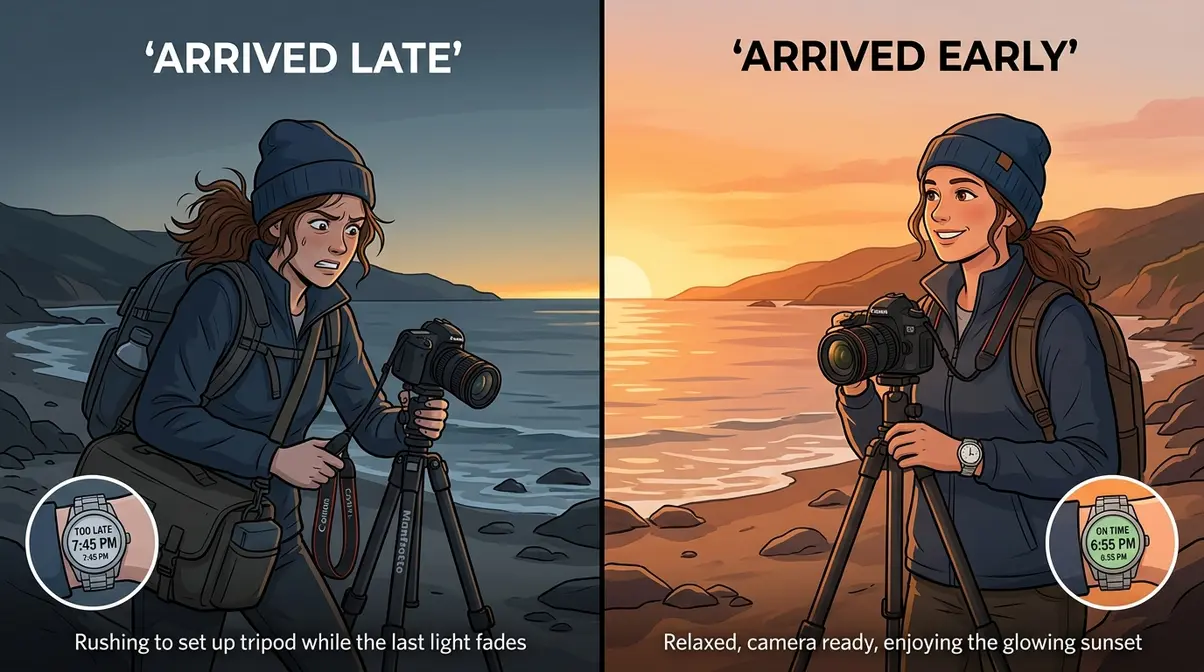
Arriving Too Late (or Too Early)
The most common mistake is treating “golden hour” as a vague suggestion rather than a precise window. Photographers consistently report arriving at their location during golden hour instead of before it — and spending the first 10 minutes setting up while the best Early Light phase disappears.
The fix: Arrive at your location at least 20–30 minutes before golden hour starts. Use your app the night before to know the exact start time. Scout your composition while the light is still neutral, so you’re ready to shoot the moment the warmth arrives.
Getting Your White Balance Wrong
As mentioned in the settings section, “Auto White Balance” actively removes the warm tones you’re trying to capture. This is a surprisingly common mistake — beginners shoot an entire golden hour session and wonder why their photos look flat and cool, only to discover their camera was correcting the warmth away.
The fix: Set white balance to “Shade” or “Cloudy” before you start shooting. If you shoot in RAW format, you can correct this in editing — but it’s better to get it right in-camera so you can see the real colors on your screen while shooting.
When Studio Light Beats Natural Light
Golden hour is extraordinary — but it’s not always the right tool. There are situations where controlled studio lighting genuinely serves you better.
If you’re shooting products that require perfectly even, shadow-free lighting, studio strobes give you control that golden hour can’t match. If your subject needs to be photographed on a specific day and time (a corporate headshot on a Tuesday at 2pm, for example), waiting for golden hour isn’t an option. And if you’re working in a location where the golden hour direction puts the sun in an unhelpful position relative to your subject, you may spend more time fighting the light than using it.
Golden hour is a powerful tool in your kit — not the only one.
Frequently Asked Questions
What is the golden hour in photography?
Golden hour photography is the practice of shooting during the warm, soft light window that occurs in the 20–60 minutes after sunrise and just before sunset. During this period, the sun sits within approximately 6 degrees of the horizon (according to NOAA SciJinks), causing sunlight to pass through significantly more atmosphere. This scatters harsh blue wavelengths and produces the warm, diffused, orange-gold light that photographers prize. The duration varies by location — shorter near the equator, longer at high latitudes.
How long does the golden hour last?
Despite its name, the golden hour rarely lasts exactly 60 minutes. Depending on your latitude and the season, it can last anywhere from 20 minutes near the equator to over a couple of hours near the poles. Using a sun-tracking app helps you pinpoint the exact duration for your location.
Can you shoot golden hour photos on a phone?
Yes, you can absolutely shoot stunning golden hour photos on a smartphone. Modern smartphone cameras automatically adjust to the warm, flattering light. To get the best results, tap on your subject’s face to lock focus and slightly lower the exposure slider to preserve the rich, golden colors.
Why do photographers love golden hour?
Photographers love golden hour because the light does most of the creative work for them. The warm, low-angle light flatters virtually every subject — portraits, landscapes, architecture, even food photography. The soft quality means less editing time and more forgiving exposures. The directionality adds depth and drama that flat midday light cannot produce. Digital Photography School notes that golden hour is the single most-requested shooting condition among portrait clients, precisely because the results look polished and professional with minimal effort.
Wrapping Up: Your First Golden Hour Shoot
For any photographer — beginner or experienced — understanding what is golden hour photography delivers a combination of warm color, soft light, and directional depth that no other time of day can match. The sun travels through up to 40 times more atmosphere near the horizon than at midday, and that physical fact is what turns ordinary scenes into stunning, dreamy images. Start with a free app like Golden Hour: One Click Photo, arrive 20 minutes early, and set your white balance to “Shade.”
The Golden Window Framework gives you a practical structure to work with once you’re there: shoot soft and wide during Early Light, chase warmth and lens flare during Peak Gold, and go bold with silhouettes during Fading Glow. Each phase rewards a different approach — and together they give you a full creative session in under an hour.
Your next step is simple: pick a date this week, check your golden hour time, and get outside with your camera. Start with front lighting (sun behind you, subject facing the light) and just shoot. The warm glow will do more than you expect — and that first golden hour portrait will make you want to come back every evening.