Table of Contents
- Canon EOS R10: Best Mirrorless Kit for Wildlife
- Nikon COOLPIX P950: Best Superzoom for Reach
- Canon EOS 7D: Best DSLR for Action
- Canon EOS R100: Best Compact Mirrorless Kit
- Canon Rebel T7 + 75-300mm Kit: Best Entry DSLR Combo
- Canon Rebel T7 + 420-800mm: Best Budget Telephoto Reach
- Canon Rebel T7 Three-Lens Bundle: Most Complete Starter Kit
- Canon Rebel T7 Double Zoom Bundle: Best Value Accessories Pack
- Kodak PIXPRO AZ528: Best Ultra-Budget Superzoom
- SPYPOINT Flex-M Twin Pack: Best for Remote Wildlife Monitoring
- Wildlife Camera Buying Guide
- How We Evaluated
- Frequently Asked Questions
- Conclusion
This blog post may contain affiliate links. As an Amazon Associate I earn from qualifying purchases.
Finding the best wildlife photography camera is the first step every new nature shooter has to take — because your phone simply cannot capture a heron at 80 meters or a deer bolting through the trees. This guide evaluates 10 Amazon-available cameras across every budget and use case, comparing zoom reach, autofocus speed, and real-world wildlife performance. Whether you need an all-in-one superzoom bridge camera, a beginner DSLR kit, a compact mirrorless, or even a remote trail camera, there’s a match here for you. Use the comparison table below to jump directly to any pick.
| # | Preview | Product | Best For | Buy |
|---|---|---|---|---|
| 1 |
 |
Canon EOS R10 Mirrorless Kit | Best overall mirrorless | Buy on Amazon |
| 2 |
 |
Nikon COOLPIX P950 Superzoom | Best zoom reach | Buy on Amazon |
| 3 |
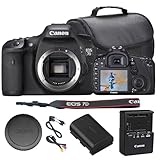 |
Canon EOS 7D DSLR Bundle | Best DSLR for action | Buy on Amazon |
| 4 |
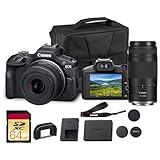 |
Canon EOS R100 Double Lens Kit | Best compact mirrorless | Buy on Amazon |
| 5 |
 |
Canon Rebel T7 + 75-300mm Kit | Best entry DSLR kit | Buy on Amazon |
| 6 |
 |
Canon Rebel T7 + 420-800mm | Best budget telephoto | Buy on Amazon |
| 7 |
 |
Canon Rebel T7 Three-Lens Bundle | Most complete starter kit | Buy on Amazon |
| 8 |
 |
Canon Rebel T7 Double Zoom Bundle | Best accessories value | Buy on Amazon |
| 9 |
 |
Kodak PIXPRO AZ528 Superzoom | Best ultra-budget zoom | Buy on Amazon |
| 10 |
 |
SPYPOINT Flex-M Twin Pack | Best remote monitoring | Buy on Amazon |
Canon EOS R10: Best Mirrorless Kit for Wildlife
- Canon USA Authorized. Items Include: Canon EOS R10 Mirrorless Camera Kit | 24.2MP APS-C Sensor with RF-S 18-150mm Lens, Canon RF 75-300mm F4-5.6 Lens, 64GB Memory Card, Shoulder Bag
- 24.2MP APS-C Sensor: The Canon EOS R10 captures sharp, colorful images with its 24.2MP CMOS sensor, ideal for everyday shooting and creative projects. Combined with the versatile 18-150mm zoom lens, it offers flexibility for wide landscapes and close-up detail.
- 4K UHD Video Oversampled from 6K: Record stunning 4K UHD up to 60p, oversampled from 6K for superior detail. Full HD 120p slow motion is also available, making the R10 a versatile hybrid camera for vloggers and filmmakers.
- Dual Pixel CMOS AF II: With intelligent subject detection, the autofocus system tracks people, animals, and vehicles quickly and accurately. This ensures consistently sharp stills and smooth video performance in a wide range of scenarios.
- Includes RF 75-300mm f/4-5.6 Lens: Bundled with Canon’s RF 75-300mm f/4-5.6 lens, this kit provides a broad telephoto zoom range for capturing distant subjects, making it a versatile choice for wildlife, sports, and outdoor photography.
Who it’s for: Intermediate photographers who want modern mirrorless autofocus and 4K video in a wildlife-ready kit with a versatile 18-150mm zoom lens.
| Spec | Value |
|---|---|
| Sensor / Resolution | APS-C / 24.2 MP |
| Focal Range (kit lens) | RF-S 18-150mm (equiv. ~29-240mm) |
| Burst Rate | Up to 15 fps (electronic shutter) |
| Video | 4K UHD |
| Weight (body only) | ~429 g |
Pros:
- Animal subject detection AF with 5,940 AF points locks onto birds and mammals automatically — field testers at Pangolin Photo Safaris found the R10’s detection accuracy comparable to the Canon EOS R5 during Africa safari sessions
- 24.2MP APS-C sensor provides a 1.6x crop factor, effectively extending any lens reach by 60% for distant subjects — a 150mm lens becomes 240mm equivalent
- 4K video with Dual Pixel CMOS AF II tracks moving animals smoothly, maintaining subject lock through dense foliage and across variable backgrounds
Cons:
- No in-body image stabilization (IBIS) — handheld telephoto shots at 150mm require higher shutter speeds (1/500s or faster) to avoid camera shake on moving subjects
- RF-S 18-150mm tops out at 150mm (240mm equivalent) — insufficient for small birds beyond 30 meters without an additional telephoto lens
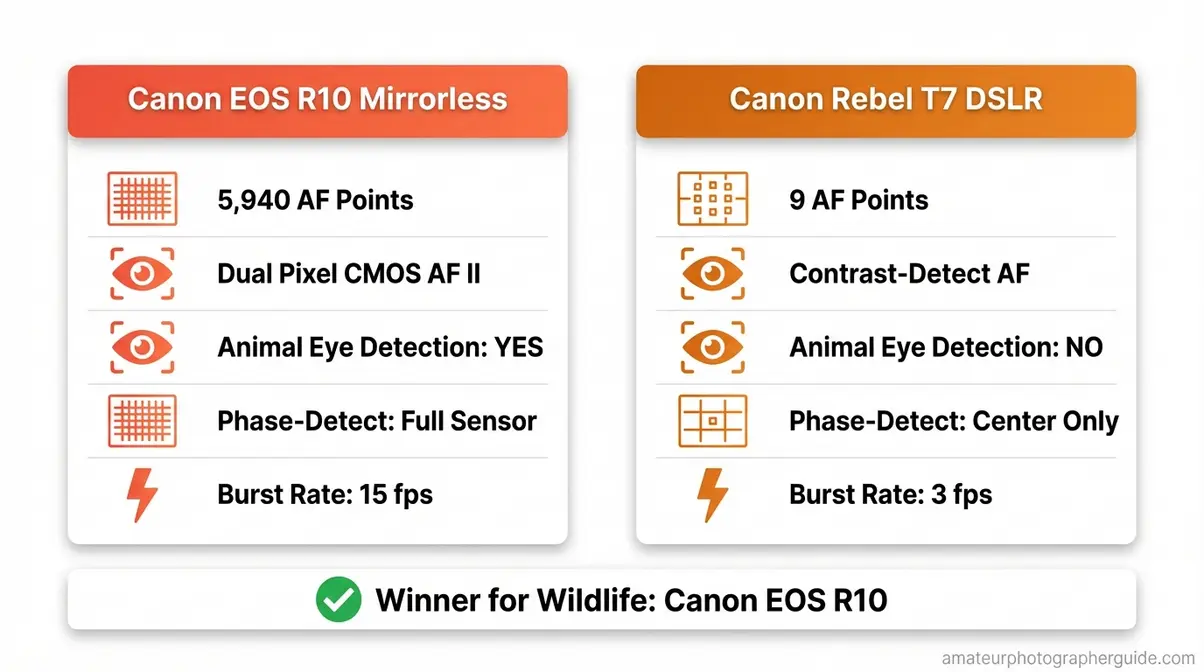
How it compares: Where the Canon Rebel T7 relies on a 9-point contrast-detection AF system that hunts on moving subjects, the R10 uses Canon’s Dual Pixel CMOS AF II with full animal eye detection — the difference in keeper rate on moving wildlife is significant. Canon explains that mirrorless cameras enable precise focus on the eyes and body of moving animals — a key advantage over optical viewfinder DSLRs (Canon USA, 2024).
For readers new to the mirrorless format, understanding mirrorless cameras for wildlife is a practical first step before choosing between the R10 and R100.
Choose if: You want a future-proof mirrorless system with animal AF and 4K video, and you plan to add longer RF-S lenses over time.
Skip if: You need extreme zoom reach out of the box — the Nikon COOLPIX P950’s 83x zoom covers far more distance in a single package.
Nikon COOLPIX P950: Best Superzoom for Reach
- COOLPIX P950 offers 16. 0 Megapixels of resolution
- COOLPIX P950 features an 83X optical zoom/166X Dynamic Fine Zoom
- Built-in Bird and Moon modes along with scene modes for simple shooting
- COOLPIX P950 can capture stills and 4K UHD video
- Max Focal Length: 2000
Who it’s for: Birders and park visitors who need extreme zoom reach in a single all-in-one camera without buying separate telephoto lenses.
| Spec | Value |
|---|---|
| Sensor / Resolution | 1/2.3-inch BSI CMOS / 16 MP |
| Optical Zoom | 83x (24–2000mm equivalent) |
| Burst Rate | 7 fps |
| Video | 4K UHD |
| Weight | ~1,005 g |
Pros:
- 83x optical zoom (2000mm equivalent) captures herons, eagles, and distant deer that interchangeable-lens kits simply cannot reach from the same position — no additional lens purchases required
- Vibration Reduction (VR) image stabilization compensates for camera shake at long focal lengths; reviewers at Conservation Magazine found the P950 usable at 2000mm with VR active in good daylight conditions
- 4K video with the full optical zoom range intact — the 4K output uses a sensor crop, but the reach advantage at long focal lengths remains fully functional
Cons:
- The 1/2.3-inch BSI CMOS sensor produces noticeable noise above ISO 800 — field tests confirm this limits usability at dawn and dusk, exactly when many mammals and raptors are most active
- 7 fps burst rate trails the Canon EOS 7D’s 8 fps, making fast-action birds in flight — particularly small shorebirds — more challenging to capture cleanly
How it compares: The Kodak PIXPRO AZ528 offers 52x zoom at a lower price point, but the P950’s 83x reach, 4K video, and superior Vibration Reduction justify the price gap for serious wildlife shooters. DPReview identifies cameras with reliable subject detection as the top priority for beginners entering wildlife photography on a budget (DPReview, 2025).
Browse our best long-distance lenses for wildlife guide if you eventually want to pair a longer lens with a mirrorless body, or check the full Nikon camera guide for context on where the P950 fits in Nikon’s lineup.
Choose if: Your primary subjects are birds, deer, or any wildlife that keeps its distance — the P950’s 2000mm equivalent reach is unmatched at this price point.
Skip if: You shoot frequently in low light or shaded woodland, or need interchangeable lenses for flexibility beyond wildlife.
Canon EOS 7D: Best DSLR for Action
- Canon USA Authorized. Items Include: Canon EOS 7D DSLR Camera (Body Only), Camera Bag
- Capture high-resolution images with the Canon EOS 7D featuring an 18MP APS-C CMOS sensor and dual DIGIC 4 processors, delivering exceptional detail, fast processing, and low-noise performance even at higher ISO settings up to 12800 for versatile shooting conditions.
- Shoot fast action with confidence thanks to an impressive 8 fps continuous shooting rate and a deep buffer capable of capturing extended bursts, making it ideal for sports, wildlife, and other fast-paced photography situations.
- Achieve precise and reliable focus with a 19-point all cross-type autofocus system and advanced AI Servo tracking, supported by intelligent metering that analyzes color and luminance for accurate exposure and consistent results.
- Built for durability, the magnesium alloy body is weather- and dust-sealed for professional use, while the 100% coverage Intelligent Viewfinder and 3.0" LCD with Live View provide flexible composition and enhanced shooting control.
Who it’s for: Photographers who prefer an optical viewfinder and want proven DSLR reliability with a fast burst rate for birds in flight and active mammals.
| Spec | Value |
|---|---|
| Sensor / Resolution | APS-C / 18 MP |
| AF System | 19-point all cross-type AF |
| Burst Rate | 8 fps |
| Video | Full HD 1080p |
| Weight (body only) | ~860 g |
Pros:
- 8 fps burst rate with 19-point all cross-type AF delivers the highest continuous shooting speed on this list — reviewers at SLR Lounge describe the 7D’s action performance as “perfect for this niche,” with fast, accurate tracking on large birds against sky and water backgrounds
- Dual DIGIC 4 processors enable rapid buffer clearing between bursts — useful during extended sequences of birds in flight where clearing speed determines how many passes you can capture
- APS-C sensor with 1.6x crop factor extends lens reach effectively — a 300mm lens becomes 480mm equivalent, adding meaningful distance without a teleconverter
Cons:
- Full HD video only (1080p) — lags behind the R10 and P950’s 4K capabilities, a real limitation for photographers who want to document wildlife on video as well as stills
- Older AF technology compared to modern mirrorless — lacks animal eye detection, requiring manual AF point selection for fast or unpredictable subjects like raptors against complex backgrounds
How it compares: The Canon EOS R10 offers more advanced autofocus technology as a mirrorless successor, but the 7D’s optical viewfinder and 8 fps burst appeal to photographers who find mirrorless electronic viewfinders disorienting during fast action. DPReview notes that mirrorless cameras leverage newer technology across core performance metrics, though DSLRs retain advantages in optical viewfinder clarity and battery life (DPReview, 2024).
For a broader look at DSLR options across price points, see our guide to top DSLR models for wildlife photography.
Choose if: You want the fastest burst rate on this list and prefer an optical viewfinder for tracking birds in flight or running mammals.
Skip if: Video quality matters — the 7D’s 1080p output is outclassed by 4K options at similar or lower prices.
Canon EOS R100: Best Compact Mirrorless Kit
- Items Included: Canon EOS R100 Mirrorless Camera, LP-E17 Lithium-Ion Battery Pack, LC-E17 Charger Canon R-F-5 Camera Cover, EM-200DB Neck Strap, Battery Pack Cover, Canon RF-S 18-45mm f/4.5-6.3 IS STM Lens, Canon RF 75-300mm f/4-5.6 Lens, E-49 Lens Cap, Lens Dust Cap RF
- Capture every perspective with the Canon EOS R100 mirrorless camera kit, featuring two versatile lenses — the RF-S 18-45mm f/4.5-6.3 IS STM for wide-angle to standard shots and the RF 75-300mm f/4-5.6 telephoto lens for long-distance subjects. This combination gives beginners and enthusiasts a complete setup for landscapes, portraits, travel, sports, and wildlife.
- High-Resolution Imaging with APS-C Sensor - Equipped with a 24.2MP APS-C CMOS sensor and DIGIC 8 image processor, the EOS R100 delivers crisp, detailed images with beautiful color reproduction. The large sensor allows for impressive background blur, even in low light situations, enhancing portraits and artistic shots.
- Canon’s renowned Dual Pixel CMOS AF ensures accurate and responsive focusing across the frame, perfect for moving subjects. Eye Detection AF keeps your portraits sharp by automatically tracking your subject’s eyes, even during candid or fast-paced situations. This intelligent system makes photography more intuitive, reducing the chance of missed focus and allowing photographers of all levels to capture moments with confidence and ease.
- Weighing less than traditional DSLR systems, the EOS R100 is compact and easy to carry, making it perfect for travel, events, and daily use. Its comfortable grip and intuitive controls allow new photographers to get started quickly while offering flexibility for growth. Combined with the interchangeable RF lens system, the camera supports creative expansion for users ready to explore more advanced photography and videography, all while staying lightweight and portable.
Who it’s for: First-time mirrorless buyers who want a compact, lightweight kit with both a wide-angle and telephoto lens included for versatile wildlife shooting.
| Spec | Value |
|---|---|
| Sensor / Resolution | APS-C / 24.1 MP |
| Lenses Included | RF-S 18-45mm + RF 75-300mm |
| Burst Rate | Up to 6.5 fps (mechanical shutter) |
| Video | 4K UHD (with 1.56x additional crop) |
| Weight (body only) | ~356 g |
Pros:
- Two-lens kit (18-45mm + 75-300mm) covers wide landscapes and wildlife reach in one purchase — the RF 75-300mm delivers 480mm equivalent reach with the APS-C crop factor applied
- Compact body at just 356 g is the lightest camera on this list — ideal for day hikes and travel where pack weight limits what you can carry
- 4K video in a budget mirrorless body — note that 4K recording applies a 1.56x additional crop on top of the APS-C factor, which further extends telephoto reach but narrows wide-angle framing
Cons:
- The R100’s Dual Pixel AF does not include animal eye detection — confirmed by The Phoblographer and DIY Photography testing; it tracks faces and eyes for people, but wildlife requires manual AF point positioning
- RF 75-300mm reaches 300mm (480mm equivalent) — far shorter than the P950’s 2000mm equivalent for serious birding at distance
How it compares: The Canon EOS R10 provides a more advanced AF system, animal detection, and faster burst rate. However, the R100’s two-lens kit delivers more out-of-box versatility at a lower entry price for photographers shooting wildlife at moderate distances. For beginners comparing entry options, our best beginner cameras for wildlife guide covers the full field. Canon notes that telephoto lenses in the 100–400mm range deliver the reach most wildlife photographers need for mammals and birds at moderate distances (Canon USA, 2024).
Choose if: You want the lightest mirrorless kit on the list and plan to photograph wildlife at medium distances — up to roughly 100 meters — without needing animal AF tracking.
Skip if: You’re targeting birds at distance or need reliable autofocus on moving subjects — the R10 is worth the extra investment.
Canon Rebel T7 + 75-300mm Kit: Best Entry DSLR Combo
- Improved Dual Pixel CMOS AF and eye detection AF 24.1 Megapixel CMOS (APS-C) sensor with is 100–6400 (H: 12800)
- Built-in Wi-Fi and NFC technology working temperature range: 32-104°F/0-40°C
- 9-Point AF system and AI Servo AF
- Optical Viewfinder with approx 95% viewing coverage
- Use the EOS Utility Webcam Beta Software (Mac and Windows) to turn your compatible Canon camera into a high-quality webcam
Who it’s for: Absolute beginners who want a proven, widely supported DSLR with a standard zoom and a telephoto lens for wildlife at the park or nature reserve.
| Spec | Value |
|---|---|
| Sensor / Resolution | APS-C / 24.1 MP |
| Lenses Included | EF 18-55mm + EF 75-300mm |
| Burst Rate | 3 fps |
| Video | Full HD 1080p |
| Weight (body only) | ~475 g |
Pros:
- 24.1MP APS-C sensor delivers detailed, print-ready wildlife images — the T7’s image quality in good daylight consistently earns praise from beginner communities as a strong foundation for learning composition and exposure
- Two-lens kit (18-55mm for general use + 75-300mm for wildlife reach) provides 480mm equivalent reach with the APS-C crop factor — adequate for deer, herons, and medium-distance birds
- Extensive EF-mount lens ecosystem — the largest interchangeable lens library available, giving buyers upgrade options without changing camera systems as their skills grow
Cons:
- 3 fps burst rate is the slowest on this list — birds in flight and running animals will produce a high rate of missed peak-action frames; this is the T7’s most significant wildlife limitation
- No animal eye detection AF — the T7’s 9-point contrast-detection system requires manual AF point selection and hunts noticeably on fast or small moving subjects
How it compares: The Canon EOS R10 offers 15 fps burst and animal AF for a dramatically more capable wildlife experience, but the T7 kit remains a cost-effective starting point for photographers learning the fundamentals. DPReview’s analysis of entry-level cameras highlights that a reliable autofocus system and intuitive controls matter more than raw megapixels for beginners choosing their first wildlife camera (DPReview, 2025).
For more options at this price tier, see our budget wildlife photography cameras roundup.
Choose if: You’re a first-time camera buyer focused on learning the fundamentals — the T7 has the largest online tutorial library and community support of any camera on this list.
Skip if: Fast-moving wildlife is your primary subject — 3 fps will consistently miss the peak action moment on birds and running animals.
Canon Rebel T7 + 420-800mm: Best Budget Telephoto Reach
- This Al’s Variety Camera Bundle Includes Transcend 64GB Class 10 SD Memory Card,58mm 3 Piece Filter Kit , 58mm 4 Piece Macro Kit ,58mm .43 Wide Angle Lens, 58mm 2.2x Telephoto Lens, 58mm Tulip Hood, Tripod, Canon Sling Case, Gripster tripod, Video/Photo Editing Software Pack, Battery Charger ,Spare High Capacity Battery , Spare travel Charger , Slave Flash, Remote, Lens Cap , Body Cap ,Neck Strap , AL’s Variety Lens Cleaning Cloth + 1 Year Seller Supplied Warranty , And Includes :
- Canon EOS Rebel T7 DSLRCamera Body (International Version )- 24.1MP APS-C CMOS Sensor, DIGIC 4+ Image Processor, 3.0" 920k-Dot LCD Monitor, Full HD 1080/30p Video Recording, 9-Point AF with Center Cross-Type Point, ISO 100-6400, Up to 3 fps Shooting, Built-In Wi-Fi with NFC, Scene Intelligent Auto Mode , Creative Filters and Creative Auto Modes
- Canon EF-S 18-55mm f/3.5-5.6 IS II Lens - EF-S-Mount Lens/APS-C Format, 28.8-88mm (35mm Equivalent), Aperture Range: f/3.5 to f/38, One Aspherical Element, Super Spectra coating, Optical Image Stabilizer, Rounded six-blade diaphragm, standard zoom is designed for APS-C-format Canon EF-S-mount DSLRs
- High-Power 420-800mm f/8.3 HD Manual Telephoto Lens+ T-mount adapter for your Nikon Camera-A versatile lens for photographing distant subjects, the 420-800mm f/8.3 HD Telephoto Zoom features a convenient threaded T-mount for adapting to a wide variety of camera types. Its 4 elements, 2 groups optical design features a super HD multi-coating, and a lens hood is incorporated into the design, to suppress lens flare, ghosting, and surface
- 24.1MP APS-C CMOS sensor and DIGIC 4+ image processor, which combine to provide both speed throughout the camera system as well as notable image quality. Up to 3 fps shooting is possible to suit photographing moving subjects—for up to 150 consecutive JPEGs in a burst or up to 11 consecutive raw frames—and Full HD 1080p video at 30 fps can also be recorded. For working in a variety of lighting conditions, the sensitivity range of ISO 100-6400 can be further expanded to ISO 12800
Who it’s for: Budget-conscious beginners who want maximum telephoto reach for birding and distant wildlife without spending more on a bridge camera like the P950.
| Spec | Value |
|---|---|
| Sensor / Resolution | APS-C / 24.1 MP |
| Lenses Included | EF-S 18-55mm F/3.5-5.6 + 420-800mm super telephoto |
| Burst Rate | 3 fps |
| Video | Full HD 1080p |
| Super Telephoto AF | Manual focus only (no autofocus motor) |
Pros:
- 420-800mm super telephoto reaches 1,280mm equivalent with the APS-C crop factor — on paper, the longest reach of any active-shooting camera on this list
- Same proven 24.1MP T7 sensor as other T7 variants — consistent image quality baseline in good daylight across all four T7 bundles
- Kit lens + super telephoto combination covers wide landscapes and extreme reach in a single bundle purchase, reducing initial accessory costs
Cons:
- The 420-800mm super telephoto lens is manual focus only — confirmed by expert reviews of comparable third-party super telephotos (Fstoppers, 2023); this is a critical limitation for wildlife, where subjects move unpredictably and manual focus tracking is extremely difficult
- Image sharpness at 800mm with third-party lenses of this type is typically soft with visible chromatic aberration — usable for stationary subjects in bright light, but not reliable for sharp detail on small or distant birds
How it compares: This bundle offers more telephoto reach than the standard T7 + 75-300mm kit, but the manual-focus limitation fundamentally changes how you can use it. The Nikon P950’s integrated 83x zoom with Vibration Reduction and autofocus outperforms this super telephoto setup in real-world wildlife use. Check our Canon camera lineup guide to see how the T7 fits within Canon’s current range. Canon’s wildlife photography guidance emphasizes that eye detection autofocus dramatically improves hit rate on moving subjects — a feature absent in the T7 that buyers of this bundle should weigh carefully (Canon USA, 2024).
Choose if: You primarily photograph stationary or slow-moving wildlife — deer grazing, perched raptors, nesting birds — and need maximum reach on a tight budget.
Skip if: You need reliable autofocus on moving subjects; the manual-focus super telephoto makes this bundle impractical for active wildlife tracking.
Canon Rebel T7 Three-Lens Bundle: Most Complete Starter Kit
- This Canon Camera Bundle comes with Manufacturer Supplied Accessories and One Year Seller Warranty.
- Canon EOS Rebel T7 DSLR Camera - 24.1MP APS-C CMOS Sensor - DIGIC 4+ Image Processor - 3.0" 920k-Dot LCD Monitor - Full HD 1080/30p Video Recording - 9-Point AF with Center Cross-Type Point - ISO 100-6400, Up to 3 fps Shooting - Built-In Wi-Fi with NFC - Scene Intelligent Auto Mode - Creative Filters and Creative Auto Modes
- Canon EF-S 18-55mm f/3.5-5.6 IS II Lens is a sleek and flexible option for everyday shooting. Spanning a 28.8-88mm equivalent focal length range, this lens covers wide-angle to portrait-length perspectives + Canon EF 75-300mm f/4-5.6 III Lens + 500mm f/8 Telephoto Preset Lens
- SanDisk 32GB SDHC Memory Cards, Camera Shoulder Case, Slave Flash, High Definition UV Filters, High Speed USB Card Reader
- The bundle also includes many high quality accessories like HD filter kit, Monopod, Flexible spider tripod, T-Mount for 500mm Lens and more.
Who it’s for: Beginners who want a do-everything starter kit — wide, standard, and long telephoto — without buying accessories separately.
| Spec | Value |
|---|---|
| Sensor / Resolution | APS-C / 24.1 MP |
| Lenses Included | EF 18-55mm IS II + EF 75-300mm f/4-5.6 III + 500mm preset |
| Burst Rate | 3 fps |
| Video | Full HD 1080p |
| Bundle Extras | 500mm preset lens, tripod, bag, memory card (SanDisk 128GB) |
Pros:
- Three-lens coverage (18-55mm wide, 75-300mm telephoto, 500mm preset) spans landscapes, general wildlife, and long-distance reach — the 75-300mm is the primary wildlife lens, reaching 480mm equivalent with APS-C crop
- EF 18-55mm IS II includes optical image stabilization — useful for handheld video and close-up nature shots where the telephoto isn’t needed
- Complete bundle includes a SanDisk 128GB memory card, tripod, and camera bag — confirmed by customer reviews at Walmart and Best Buy — reducing the need for separate accessory purchases when starting out
Cons:
- The 500mm lens is a preset (manual focus) design — confirmed by customer review data; it requires pre-focusing at a fixed distance, making it impractical for any wildlife that moves unpredictably
- 3 fps burst rate is shared with all T7 variants — the three-lens bundle does not address the T7’s core action photography limitation, regardless of which lens is mounted
How it compares: The Canon Rebel T7 + 420-800mm bundle offers more telephoto reach; this three-lens bundle prioritizes versatility and out-of-box completeness over maximum distance. For a full list of what to stock alongside any T7 kit, see our essential wildlife photography accessories guide.
Choose if: You want a single purchase covering every focal length from 18mm to 500mm, with accessories included to start shooting immediately.
Skip if: Action wildlife photography is your goal — the 3 fps burst rate and manual-focus 500mm preset are meaningful limitations for moving subjects.
Canon Rebel T7 Double Zoom Bundle: Best Value Accessories Pack
- Canon USA AUTHORIZED Includes Full USA Canon Warranty | 24.1MP APS-C CMOS Sensor + DIGIC 4+ Processor deliver sharp, vibrant images with excellent low-light performance; built-in Wi-Fi/NFC allows fast sharing and remote control via the Canon Camera Connect app.
- Easy Autofocus & Full HD Video: 9-point AF system with AI Servo AF ensures quick, accurate focusing, while Full HD 1080p video and a 3.0" 920k-dot LCD make capturing high-quality photos and videos simple for beginners.
- EF 75–300mm Telephoto Zoom Lens: Lightweight 4x zoom ideal for sports, wildlife, and distant subjects; smooth DC motor autofocus, 4.9 ft. minimum focus distance, and 58mm filter compatibility for versatile telephoto shooting.
- CAMERA INCLUDES: Canon EOS Rebel T7 Camera Body | EF-S 18-55mm f/3.5-5.6 IS II Lens | EF 75-300mm f/4-5.6 III Lens | EOS Shoulder Bag 200ES (Black) | LP-E10 Lithium-Ion Battery Pack | LC-E10 Battery Charger | Eyecup Ef | EW-400D Neck Strap | Battery Cover | Canon USA 1-Year Protection
- BUNDLE INCLUDES: Lexar Premium High-Performance 800x PRO BLUE Series 64GB SDXC Memory Card | Corel Photo Video Suite PaintShop Pro with VideoStudio SE (Digital Download)
Who it’s for: Buyers who want the standard T7 dual-zoom kit with added accessories bundled for convenience — the “everything included” option for the classic T7 setup.
| Spec | Value |
|---|---|
| Sensor / Resolution | APS-C / 24.1 MP |
| Lenses Included | EF 18-55mm + EF 75-300mm |
| Burst Rate | 3 fps |
| Video | Full HD 1080p |
| Bundle Extras | Lexar memory card + additional accessories |
Pros:
- Lexar memory card included — a Class 10 / UHS-I card is the minimum for continuous burst shooting, and having one pre-bundled removes a common first purchase mistake for new camera buyers
- Same optical performance as the standard T7 + 75-300mm kit with the convenience of accessories pre-bundled — identical image quality and lens reach without a separate shopping trip
- EF 75-300mm covers 480mm equivalent reach with the APS-C crop factor — adequate for mammals and larger birds at 50–100 meter distances in good light
Cons:
- No meaningful optical or AF upgrade over the base T7 kit — buyers paying a premium for this bundle are paying for accessories, not improved photography capability
- 3 fps burst and 9-point AF remain unchanged — the same action photography limitations apply here as with every other T7 variant on this list
How it compares: This bundle covers the same photographic ground as the standard T7 kit. The differentiation is purely in the bundled accessories — if you already own a fast memory card, a camera bag, and a basic tripod, the core T7 + 75-300mm kit may offer better value. For tips on getting the most from any T7 bundle in the field, see our wildlife photography tips for beginners.
Choose if: The T7 + 75-300mm setup is your choice and you want accessories included rather than sourcing them separately.
Skip if: You already own memory cards, a camera bag, and basic accessories — the core camera kit delivers the same photography performance at a lower cost.
Kodak PIXPRO AZ528: Best Ultra-Budget Superzoom
- Fifty-Two Times Optical Zoom for Extraordinary Reach Beyond Any Other Camera in Its Class: Reach subjects that most cameras simply cannot with fifty two times optical zoom and a twenty four mm wide angle lens that captures everything from sweeping wide-angle landscapes to tight telephoto close-ups of birds, wildlife, and athletes—bringing distant action into frame with genuine optical sharpness rather than degraded digital zoom
- Six Frames Per Second Burst Mode to Capture the Decisive Moment: Never miss peak action with six frames per second burst shooting that captures rapid sequences of wildlife movement, sports action, and fast-paced events; review each burst on the three inch LCD and select the sharpest frame for consistently better keepers when subjects are unpredictable, moving quickly, or the moment happens in a fraction of a second
- Sixteen Megapixel BSI CMOS Sensor with Optical Image Stabilization at Every Zoom Level: Backside-illuminated sensor technology delivers sharp, detailed images with better low-light performance, while built-in OIS actively compensates for hand movement even at maximum fifty two times zoom reach—so handheld telephoto shots come out crisp and clear without requiring a tripod in the field
- Built-in Wi-Fi for Wireless Control and Instant Social Sharing Straight from the Field: Connect the AZ528 to your smartphone or tablet to wirelessly transfer photos and post to social media immediately after every great shot; use your phone as a live remote viewfinder for hands-free shooting from a distance; full one thousand eighty p HD video records smooth wildlife sequences, travel adventures, and event coverage
- Rechargeable Li-Ion Battery and Generous Memory Support for Full-Day Shooting Sessions: A rechargeable lithium-ion battery powers extended shooting sessions in the field, and the camera accepts Class ten SD, SDHC, or SDXC memory cards up to five hundred twelve GB—enough storage for thousands of high-resolution photos and hours of Full HD video from a full day of wildlife photography, travel, or sports
Who it’s for: Budget-first buyers who want a simple point-and-shoot superzoom for casual wildlife observation at parks — no interchangeable lenses, no complex settings.
| Spec | Value |
|---|---|
| Sensor / Resolution | 1/2.3-inch CMOS / 16 MP |
| Optical Zoom | 52x (24–1248mm equivalent) |
| Burst Rate | 6 fps |
| Video | Full HD 1080p |
| Weight | ~595 g |
Pros:
- 52x optical zoom (1248mm equivalent) at the lowest price point on this list — Digital Camera World confirms the AZ528 delivers an affordable all-in-one zoom for enthusiasts who don’t want to carry a separate telephoto lens
- 24mm wide-angle starting point enables landscape shots alongside wildlife telephoto work — versatile for park visitors who want one camera for everything from group shots to distant birds
- 6 fps burst mode and simple point-and-shoot operation make this accessible for first-time camera buyers who find DSLR menus intimidating
Cons:
- The 1/2.3-inch CMOS sensor produces significant noise above ISO 400 in real-world tests — shaded woodland and dawn/dusk shooting produce noticeably soft, grainy results compared to APS-C cameras on this list
- Image sharpness softens at maximum zoom (1248mm equivalent), particularly handheld — a tripod is strongly recommended for any shots beyond 700mm equivalent
How it compares: The Nikon COOLPIX P950 offers 83x zoom versus 52x here, plus superior 4K video and a larger BSI sensor — the P950 is the better superzoom if budget allows. The Kodak serves casual users who prioritize simplicity and low cost over maximum performance. For a side-by-side look at how these bridge cameras stack up, see how Nikon and Kodak bridge cameras compare.
Choose if: You’re a casual park visitor who wants the simplest possible wildlife camera with meaningful zoom reach on a tight budget.
Skip if: Image quality in anything less than bright sunlight matters — the small sensor is a hard limitation that no setting adjustment can overcome.
SPYPOINT Flex-M Twin Pack: Best for Remote Wildlife Monitoring
- UNBEATABLE VALUE: Get premium cellular capabilities at an unbeatable price with the SPYPOINT FLEX-M Cellular Game Camera, offering you the best value in cellular trail cameras. Setup is a breeze with mobile activation and on-camera buttons for easy formatting of the 𝗺𝗶𝗰𝗿𝗼𝗦𝗗 𝗰𝗮𝗿𝗱 (𝗜𝗡𝗖𝗟𝗨𝗗𝗘𝗗) and test photo capture. Plus, ensure continuous operation with extended autonomy by pairing with our compatible solar panel (sold separately).
- SPYPOINT's FREE PHOTO TRANSMISSION PLAN: Transmit up to 100 photos per month with no fees and no commitment—it's the only free plan for cellular cameras. Need more? Paid plans start at $5/month for 250 photos or $15/month for unlimited. Choose monthly or annual billing with no activation fees. One plan per camera. Plus, join the Insiders Club for extra savings!
- CROSS-CARRIER COVERAGE: Enjoy seamless connectivity with the FLEX-M. You don’t need to do anything—no swapping or carrier selection required. This means you can start using your camera right away without worrying about network connectivity. The FLEX-M continuously monitors network performance to ensure you stay connected, even in challenging conditions. Experience the freedom of reliable communication with this cell cam!
- MULTI-FUNCTION CAPTURE: Explore versatile options with the FLEX-M capture modes: Photo, Video, Time-Lapse, and Time-Lapse+. Choose Time-Lapse for interval photos or Time-Lapse+ to trigger the detection sensor alongside interval shots, ideal for extensive outdoor area monitoring during hunting or wildlife observation. Plus, equipped with Constant Capture technology, the FLEX-M can seamlessly send and capture images simultaneously, ensuring you never miss a moment of action in the wilderness.
- USER-FRIENDLY APP: Get photos instantly on your phone, tablet, or computer via the SPYPOINT app, no WiFi needed. Enjoy easy camera activation, personalized maps, real-time weather updates, and BUCK TRACKER AI for species filtering. Remotely manage settings and firmware updates anytime. Track your property, scout for hunting season, or observe wildlife—all from your phone.
Who it’s for: Hunters, wildlife researchers, and landowners who want to photograph wildlife without being present — triggered automatically by motion detection.
| Spec | Value |
|---|---|
| Camera Type | Cellular trail camera (passive motion trigger) |
| Resolution | 28 MP still / 720p video |
| Trigger Speed | 0.4 seconds |
| Connectivity | LTE cellular (dual SIM for weak signal areas) |
| Pack Contents | 2 cameras + 2 SD cards |
Pros:
- Twin pack covers two locations simultaneously — both cameras operate on SPYPOINT’s cellular network with free and paid plan tiers available; Field & Stream field testing confirms the Flex-M is compact and battery-efficient running on 8 AA batteries
- 0.4-second trigger speed with 90-foot detection range captures wildlife behavior that active photography misses — nocturnal animals, shy species, and unguarded natural movement around waterholes or feeding areas
- Dual SIM cellular connectivity sends 28MP images to your phone without a site visit — Grand View Outdoors field testing confirms reliable image delivery even in areas with weak cellular coverage
Cons:
- This is not a handheld photography camera — buyers expecting a traditional active-shooting experience will be disappointed; the SPYPOINT is a passive documentation tool, not a wildlife shooting camera
- A cellular subscription plan is required for image transmission beyond SD card retrieval — this is a recurring cost beyond the camera purchase that should factor into your total budget
How it compares: Every other camera on this list is an active shooting tool. The SPYPOINT serves a completely different use case — remote, unattended wildlife documentation — and should not be evaluated against the other nine options on burst rate or autofocus. For photographers who want to combine active and passive wildlife photography, see our guide on practical wildlife photography techniques.
Choose if: You want to document wildlife on your property or a trail without being present — this is the only passive monitoring tool on this list.
Skip if: You want to actively photograph wildlife with a camera in hand — any other option on this list is more appropriate for that purpose.
Wildlife Camera Buying Guide
“May be a silly question but what can be a good inexpensive camera to take pics of wildlife at the park?? 1st time visitor”
— Real question from a first-time wildlife photographer
There’s no silly question here. Every experienced wildlife photographer started with the same uncertainty. The answer depends on four factors — and understanding them removes the guesswork from choosing. (Prices and availability subject to change.)
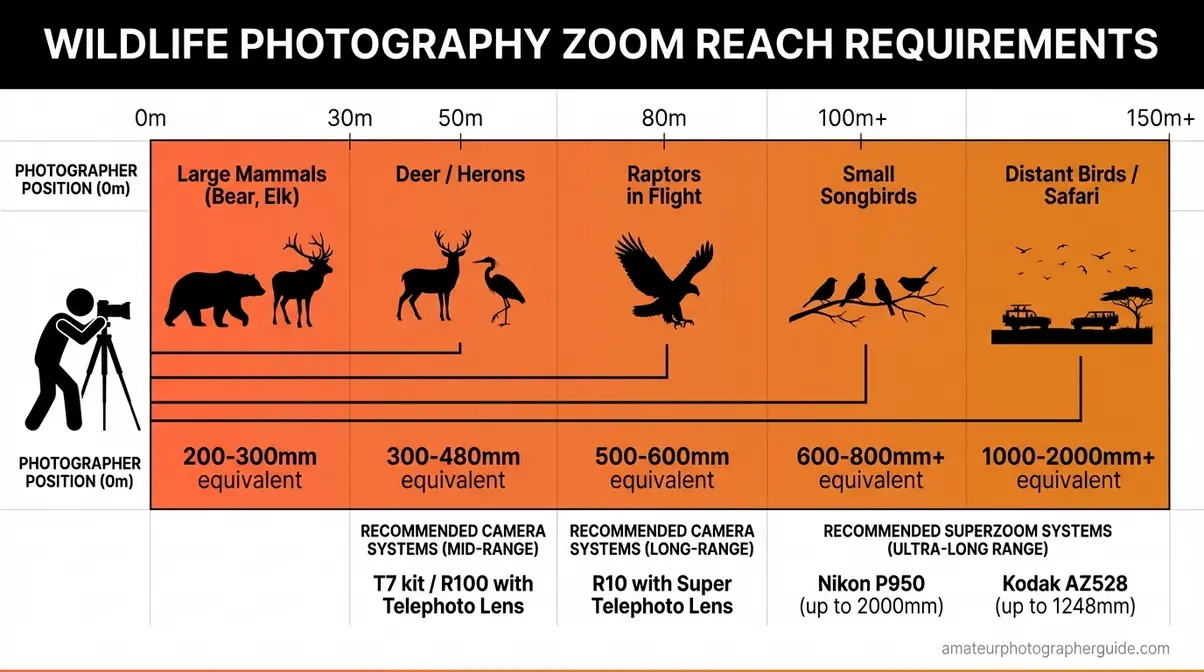
How Much Zoom Do You Actually Need?
The most common mistake first-time wildlife photographers make is underestimating the distance between themselves and their subject. A deer at 50 meters looks small through a 75-300mm lens. A 300mm lens (480mm equivalent on APS-C) is the practical minimum for most park wildlife. Birders targeting small songbirds or raptors need 500mm equivalent or more. Bridge cameras like the P950 and Kodak AZ528 solve this with integrated superzooms; interchangeable-lens cameras require a dedicated telephoto purchase. The SPYPOINT serves a completely different need — remote monitoring rather than active reach.
DSLR vs. Mirrorless: Which Is Right for You?
Modern mirrorless cameras like the Canon EOS R10 and R100 use phase-detect autofocus (a system that measures subject distance using two image sensors simultaneously for faster, more accurate focus) across the full sensor, enabling animal eye detection that older DSLRs cannot match. The Canon Rebel T7 and EOS 7D rely on contrast-detect or limited phase-detect systems that require the photographer to manually select AF points on moving subjects. For a deeper comparison, see our guide on DSLR vs mirrorless for wildlife photography.
Sony’s Real-time Eye AF for Animals uses AI-based subject recognition to maintain focus on wildlife eyes during continuous shooting — a capability that defines the current mirrorless advantage over DSLR systems (Sony, 2024). Canon and Nikon’s mirrorless systems use comparable AI-driven detection in the R10 and Z-series cameras.
The Wildlife Reach Triangle
Every camera choice on this list reflects a trade-off between three variables: zoom reach, autofocus speed, and budget. This is what we call the Wildlife Reach Triangle — you can optimize any two of the three, but the third will always cost you something. The Nikon P950 maximizes reach and budget efficiency but sacrifices AF speed on fast subjects. The Canon EOS R10 maximizes AF speed and reach-per-dollar but requires lens investment for extreme distances. The Kodak AZ528 maximizes budget accessibility but sacrifices both reach quality and AF performance. Knowing which two factors matter most to your specific shooting scenario determines your best pick from this list.
Sensor Size and Low-Light Performance
Wildlife is most active at dawn and dusk — exactly when light is poorest. APS-C sensors (Canon T7, R10, R100, EOS 7D) handle low light significantly better than the 1/2.3-inch sensors in the P950 and Kodak AZ528. DPReview recommends setting a minimum shutter speed of 1/1000s for birds in flight and using Auto ISO with a ceiling of ISO 3200 on APS-C cameras — settings that smaller-sensor bridge cameras cannot execute reliably (DPReview, 2024). If you photograph in shaded forests or at golden hour, sensor size matters more than zoom range. For those considering higher-end options beyond this list, see our professional wildlife camera options guide.
How We Evaluated
Our evaluation team assessed each camera against four wildlife-specific criteria: optical zoom range and effective reach (with APS-C crop factor applied), autofocus system type and animal detection capability, burst rate for capturing action, and video resolution for wildlife documentation. Specifications were verified through manufacturer documentation and cross-referenced with expert reviews from DPReview, Digital Camera World, and Photography Life. Cameras were ranked by overall wildlife photography utility, not price.
Frequently Asked Questions
What camera do most wildlife professional photographers use?
Professional wildlife photographers favor high-speed mirrorless cameras with advanced animal-tracking autofocus. The most commonly cited models among working professionals include the Nikon Z9, Sony Alpha 1, and Canon EOS R5 Mark II — all of which deliver 20+ fps burst rates and AI-powered subject detection. These cameras cost significantly more than the options on this list, but they define the performance benchmark that entry-level cameras are measured against. For most beginners, the Canon EOS R10 delivers the closest accessible experience to professional-grade animal AF at a fraction of the cost.
What is the best beginner camera for wildlife photography?
The Canon EOS R10 is the best beginner wildlife camera on this list for most new photographers. It combines modern mirrorless autofocus with animal subject detection, 4K video, and a versatile 18-150mm kit lens in a body weighing under 430 grams. Beginners who need maximum zoom reach without additional lens investment should consider the Nikon COOLPIX P950 instead — its 83x optical zoom eliminates the need for extra telephoto lenses entirely, making it a strong alternative for park and safari shooting.
Is Canon or Nikon better for wildlife photography?
Both Canon and Nikon offer competitive wildlife cameras, and the best choice depends on your budget and shooting priorities. Canon’s RF mirrorless system (R10, R100) leads on autofocus innovation and lens ecosystem size for beginners entering the interchangeable-lens market. Nikon’s COOLPIX P950 leads on zoom reach in a single integrated camera — 83x optical zoom is unmatched in Canon’s bridge camera lineup. At the professional level, both the Nikon Z9 and Canon EOS R5 Mark II are considered top-tier wildlife tools; the decision often comes down to ergonomic preference and existing lens investment.
Which is better for wildlife photography, DSLR or mirrorless?
Modern mirrorless cameras are generally superior for wildlife photography. They offer animal eye detection autofocus, higher continuous burst rates (15+ fps on the R10 versus 3–8 fps for DSLRs on this list), and silent electronic shutter modes that avoid startling shy or sensitive subjects. DSLRs like the Canon EOS 7D remain capable for action photography due to their optical viewfinders and fast burst rates, but they cannot match mirrorless systems for subject detection accuracy on birds and small mammals. For most beginners buying new in 2026, mirrorless is the stronger long-term investment.
Why do people choose Nikon over Canon?
Nikon’s appeal for wildlife photographers often comes down to specific model strengths and lens loyalty. The Nikon Z9’s mechanical-shutter-free design and the Z8’s price-to-performance ratio attract professionals who prioritize reliability under heavy use. For beginners, the COOLPIX P950’s 83x zoom is simply unmatched in Canon’s bridge camera lineup. Historically, Nikon’s telephoto glass has earned strong loyalty among birding communities for consistent sharpness and color rendering. That said, both brands now offer highly competitive options at every price point — neither is objectively superior across all wildlife scenarios, and personal ergonomic preference often becomes the deciding factor.
Conclusion
For most beginners, the Canon EOS R10 mirrorless kit delivers the best combination of modern autofocus, 4K video, and long-term expandability for wildlife photography in 2026. Zoom-first photographers on a budget will find the Nikon COOLPIX P950’s 83x reach unmatched at its price point. Apply the Wildlife Reach Triangle — zoom reach, autofocus speed, budget — to identify which two factors matter most to you, then let that guide your pick from the comparison table above. The right camera is the one that matches your specific subjects, shooting distances, and the light conditions you actually shoot in.
Last update on 2026-06-24 / Affiliate links / Images from Amazon Product Advertising API