

Table of Contents
- Key Takeaways
- Defining Continuous Autofocus in Photography
- How Continuous Autofocus Works on Cameras
- Main Autofocus Modes and Their Purposes
- When to Use Continuous Autofocus Effectively
- Common Mistakes and Troubleshooting Tips
- Elevate Your Action Photography with Continuous Autofocus
- Frequently Asked Questions
- Recommended
This blog post may contain affiliate links. As an Amazon Associate I earn from qualifying purchases.
Most amateur photographers discover that up to 85 percent of missed shots in action scenes come from poor focus. Whether you are capturing a lively soccer match or a fast-moving bird in flight, sharp images depend on mastering camera settings beyond what many American professionals teach. Unlocking the potential of continuous autofocus means taking control of dynamic environments so your moving subjects stay crisp. This introduction highlights why learning these techniques transforms your results and brings clarity to your action photography goals.
Key Takeaways
| Point | Details |
|---|---|
| Continuous Autofocus Technology | This advanced camera feature tracks moving subjects, continuously adjusting focus for sharp images during action scenes. |
| Importance of Camera Sensors | Modern sensors enhance autofocus capabilities, enabling precise tracking by analyzing multiple movement parameters in real time. |
| Autofocus Modes | Photographers should utilize different autofocus modes based on subject movement; Continuous Autofocus is best for dynamic scenarios. |
| Common Challenges | Address issues like tracking inconsistencies and focus hunting by adjusting settings and expanding focus areas for better performance. |
Defining Continuous Autofocus in Photography
Continuous autofocus represents a sophisticated camera technology designed to dynamically track and maintain sharp focus on moving subjects. Unlike traditional single-shot autofocus systems that lock focus at one moment, continuous autofocus constantly adjusts lens elements to keep subjects crisp and detailed throughout their movement.
Modern cameras equipped with continuous autofocus leverage advanced sensor technology and intelligent tracking algorithms to predict and respond to subject motion in real time. Understanding how autofocus works becomes crucial for photographers seeking to capture dynamic scenes with precision. These systems analyze multiple focus points simultaneously, creating rapid calculations that adjust focus faster than the human eye can perceive.
The core functionality of continuous autofocus involves three primary mechanisms:
- Predictive tracking of subject movement
- Rapid lens element repositioning
- Millisecond-level computational adjustments
Photographers working in fast-paced environments like sports, wildlife, or event photography benefit most from continuous autofocus. The technology allows seamless focus transitions, eliminating the traditional challenges of capturing moving subjects with razor-sharp clarity.
Pro tip: Practice continuous autofocus by setting your camera to AI Servo (Canon) or AF-C (Nikon) mode and tracking moving objects like cars or athletes to develop muscle memory and understanding of the system’s responsiveness.
How Continuous Autofocus Works on Cameras
Camera sensors play a pivotal role in the sophisticated mechanism of continuous autofocus, constantly analyzing and tracking subject movement with remarkable precision. Unlike traditional autofocus methods that capture focus at a single moment, this advanced technology creates a dynamic tracking system that responds instantaneously to changes in subject position and distance.
The core mechanism involves multiple focus points working in concert to detect and predict movement patterns. Photographers mastering camera controls understand that continuous autofocus relies on complex computational algorithms that perform rapid calculations in milliseconds. These algorithms evaluate several key parameters:
- Distance between subject and camera
- Rate and direction of subject movement
- Relative speed of subject trajectory
- Predicted future subject location
Modern cameras employ advanced sensor technologies that use phase detection or contrast detection methods to maintain sharp focus. Phase detection sensors measure light rays entering from different angles, allowing the camera to calculate precise focus adjustments almost instantaneously. This technology enables photographers to capture crisp images of fast-moving subjects like athletes, wildlife, or racing vehicles with unprecedented accuracy.
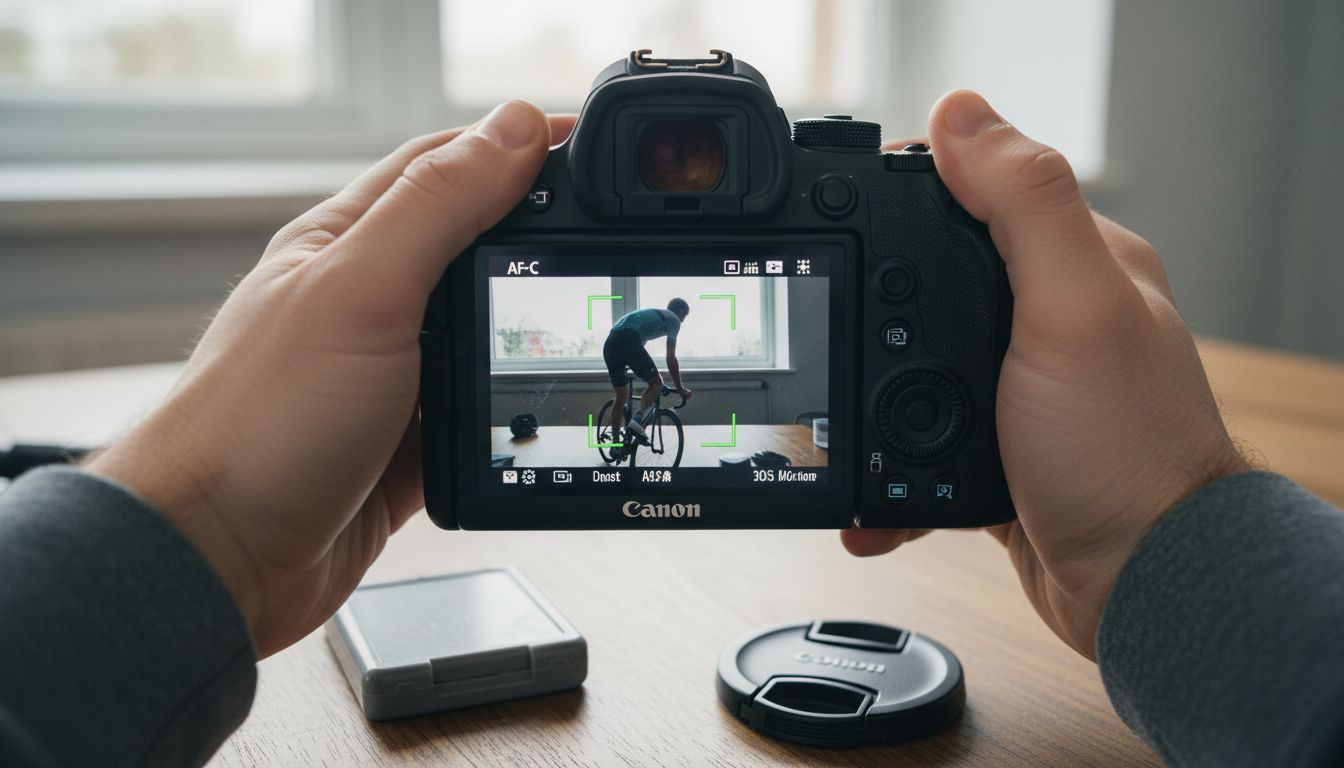
The system’s tracking sensitivity can often be customized, allowing photographers to adjust how aggressively the autofocus responds to subject movement. Some advanced cameras even offer multiple tracking modes that prioritize different movement characteristics, giving photographers greater control over their focusing strategy.
Pro tip: Experiment with your camera’s autofocus tracking settings by practicing on moving subjects like cars or running pets to understand how different sensitivity levels impact image sharpness.
Main Autofocus Modes and Their Purposes
Autofocus modes represent critical tools that help photographers adapt their camera’s focusing strategy to different shooting scenarios. Understanding camera modes becomes essential for capturing images with precision and clarity across various environments and subject types.
The three primary autofocus modes photographers commonly utilize include:
- Manual Focus (MF): Complete user control over lens focusing
- Single Autofocus (AF-S/One-Shot): Locks focus on a stationary subject
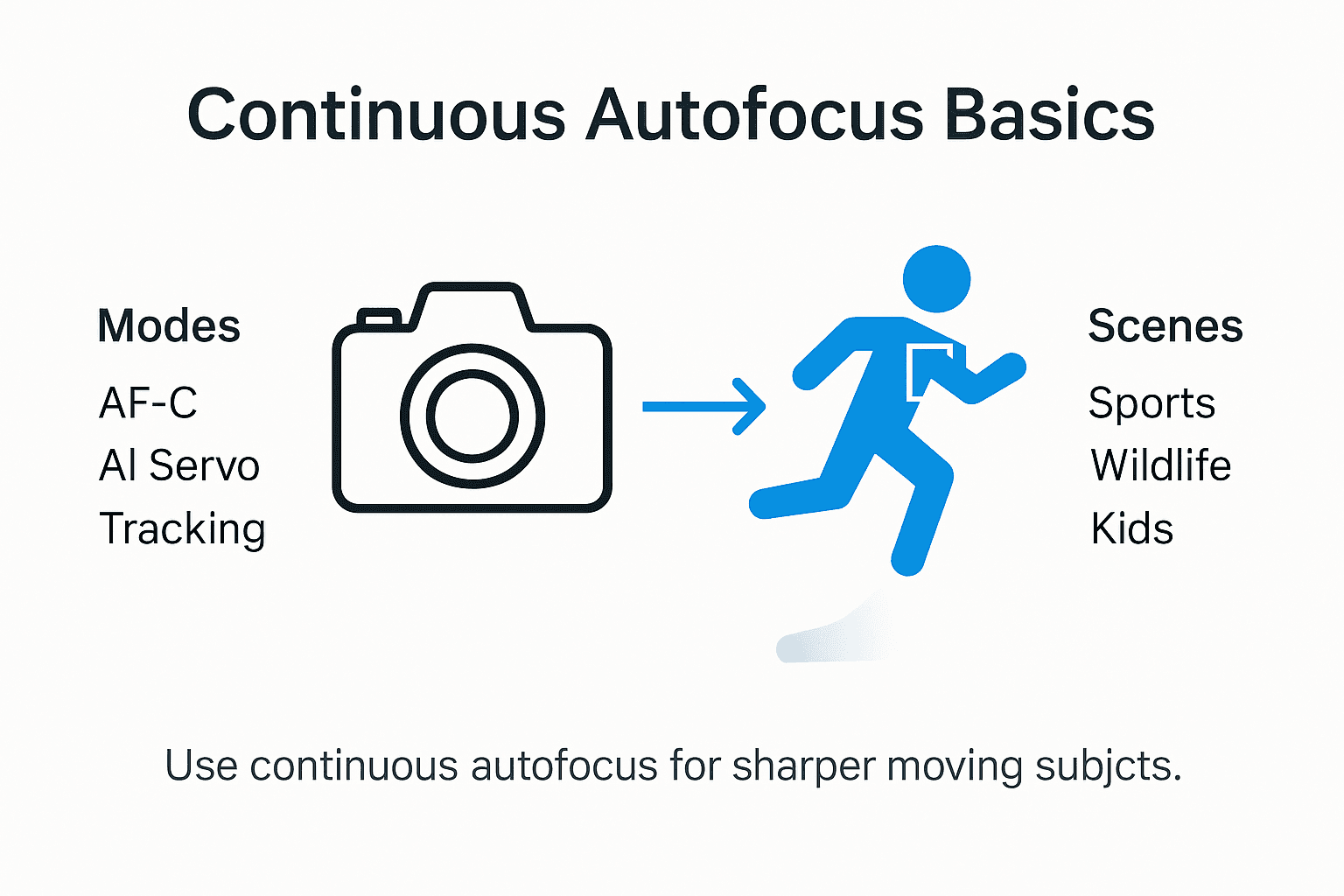
- Continuous Autofocus (AF-C/AI Servo): Tracks moving subjects dynamically
Single autofocus mode works best for static subjects like landscapes, architectural photography, or portraits where the subject remains relatively still. The camera locks focus when the shutter button is pressed halfway, allowing photographers to recompose the shot without losing sharp focus. This mode excels in controlled environments where subject movement is minimal and predictable.
Here’s a quick comparison of autofocus modes and their best use cases:
| Autofocus Mode | Ideal Subject Type | Typical Scenarios | Control Level |
|---|---|---|---|
| Manual Focus (MF) | Static, precise | Still life, macro | Full user control |
| Single AF (AF-S) | Non-moving | Portraits, landscapes | Semi-automatic focusing |
| Continuous AF (AF-C/AI Servo) | Moving, unpredictable | Sports, wildlife, events | Automated tracking |
Continuous autofocus mode becomes invaluable when capturing dynamic scenes involving motion. Sports photographers, wildlife enthusiasts, and action photographers rely on this mode to maintain crisp focus on subjects moving across the frame. The system continuously readjusts focus, predicting subject movement and making rapid calculations to keep the primary subject sharp throughout the shooting sequence.
Pro tip: Practice switching between autofocus modes in different shooting scenarios to develop muscle memory and understand how each mode performs under varying conditions.
When to Use Continuous Autofocus Effectively
Continuous autofocus transforms photography in scenarios where subjects move unpredictably, demanding split-second tracking and precision. Mastering photos of moving objects requires understanding exactly when this focusing mode becomes your most powerful tool.
Photographers should engage continuous autofocus in high-motion environments such as:
- Sports competitions and athletic events
- Wildlife and nature photography
- Street scenes with rapid human movement
- Motorsports and racing events
- Children and pet photography
- Dance and performance stages
The technology excels when subjects demonstrate erratic movement patterns or change speed and direction suddenly. Unlike single autofocus modes, continuous autofocus anticipates motion, making micro-adjustments faster than human reflexes. This means capturing a soccer player mid-kick, a racing car rounding a curve, or a bird in flight becomes dramatically more achievable.
Professional photographers rely on continuous autofocus when documenting dynamic scenes where traditional focusing methods would result in blurred images. The mode’s predictive algorithms analyze subject trajectory, allowing photographers to concentrate on composition while the camera maintains razor-sharp focus across multiple frames.
Pro tip: Before important shoots, practice continuous autofocus tracking by filming moving objects like cars or cyclists to understand your camera’s specific focus sensitivity and response time.
Common Mistakes and Troubleshooting Tips
Continuous autofocus requires nuanced understanding to avoid common pitfalls that can compromise image sharpness. Identifying photography mistakes becomes crucial in mastering this complex focusing technique.
Photographers frequently encounter these critical continuous autofocus challenges:
- Subject tracking inconsistency
- Focus point misplacement
- Unexpected focus hunting
- Inadequate sensitivity settings
- Poor performance in low light conditions
One fundamental error involves selecting too narrow a focus area when capturing rapidly moving subjects. Photographers should expand their focus zone, allowing the camera’s tracking algorithms more flexibility in maintaining sharp focus. This becomes particularly important in scenarios with unpredictable motion like sports photography, wildlife documentation, or crowded street scenes where subjects can quickly change direction.
Technical troubleshooting requires understanding your camera’s specific continuous autofocus capabilities. Each camera model processes motion differently, so experimenting with sensitivity settings and practicing tracking techniques can significantly improve performance. Techniques like pre-focusing on anticipated subject locations and maintaining consistent camera movement can help minimize focus inconsistencies.
The table below summarizes ways to troubleshoot common continuous autofocus challenges:
| Challenge | Troubleshooting Strategy | Expected Improvement |
|---|---|---|
| Inconsistent tracking | Expand focus area | Better subject detection |
| Focus hunting | Adjust tracking sensitivity | Increased focusing reliability |
| Low light performance | Use faster lenses, assist beam | Improved autofocus speed |
| Focus point misplacement | Select appropriate focus points | Enhanced subject sharpness |
Pro tip: Create a personal training routine by practicing continuous autofocus tracking on predictable moving objects like cars or cyclists to develop muscle memory and understand your camera’s unique focusing characteristics.
Elevate Your Action Photography with Continuous Autofocus
Capturing sharp images of fast-moving subjects can feel frustrating when your focus keeps slipping away. This article reveals how mastering continuous autofocus transforms your ability to track motion and freeze the perfect moment. Whether you struggle with focus hunting or inconsistent tracking, understanding AI Servo or AF-C mode is key to overcoming these challenges and achieving crisp, vibrant action shots every time.

Ready to take control of your camera’s autofocus system and boost your action photography skills? Explore practical guides and expert tips at Amateur Photographer Guide to deepen your understanding. Start by learning more about how autofocus works and build your confidence with common DSLR camera controls. Don’t let fleeting moments escape your lens. Visit us now and unlock the full potential of your autofocus settings.
Frequently Asked Questions
What is continuous autofocus in photography?
Continuous autofocus is a camera technology that dynamically tracks and maintains sharp focus on moving subjects, unlike single-shot autofocus that locks focus at one moment.
When should I use continuous autofocus?
You should use continuous autofocus in high-motion environments such as sports, wildlife photography, street scenes, motorsports, and when photographing children or pets to capture moving subjects with clarity.
How does continuous autofocus work?
Continuous autofocus utilizes advanced camera sensors and tracking algorithms to predict subject movement, adjusting the lens elements in real time to maintain focus on moving subjects.
What are common mistakes to avoid with continuous autofocus?
Common mistakes include using too narrow a focus area, incorrect sensitivity settings, focus point misplacement, and not accounting for low light conditions, all of which can lead to inconsistent focusing and blurred images.
Recommended
- How Autofocus Works: Sharper Photos Made Simple – Amateur Photographer Guide
- Action Photography Techniques Guide for Perfect Motion Shots – Amateur Photographer Guide
- Master Action Photo Shooting Steps for Crisp Shots
- Tips for Taking Photos of Moving Objects – Amateur Photographer Guide
- Common Mistakes in PPF Installation and How to Avoid Them – AEONCUT PPF Pre-cut Cutting software