Table of Contents
- DSLR vs Mirrorless: How the Technology Actually Works
- Performance Compared: Autofocus, Battery Life, and Video
- DSLR vs Mirrorless: The Head-to-Head Comparison Table
- The 2026 Market Reality: Is DSLR Dead?
- Which Camera Should You Buy? Recommendations by User Type
- When Neither Option Is the Right Fit
- Frequently Asked Questions
- The Final Verdict: DSLR or Mirrorless in 2026?
This blog post may contain affiliate links. As an Amazon Associate I earn from qualifying purchases.
Mirrorless cameras now account for roughly 90% of all new interchangeable-lens camera shipments worldwide. Yet over 12,000 people search for “dslr cameras vs mirrorless” every single month. That tells you something important: this decision is anything but obvious.
Here’s the real risk. Buying the wrong camera system could mean hundreds of dollars locked into lenses you can’t use in three years — or overpaying for features you’ll never touch. Whether you’re a total beginner or someone upgrading from a smartphone, the stakes are higher than most comparison guides let on.
By the end of this guide, you’ll know exactly which system matches your budget, shooting style, and long-term goals — so you can buy with confidence. We’ll break down the core technology, compare real-world performance, examine the 2026 market data, and give you a clear “if you’re this, buy that” recommendation.
Key Takeaways
For most buyers in 2026, mirrorless cameras are the smarter long-term investment — they account for ~90% of new shipments and receive all new lens development.
- Mirrorless wins for autofocus, video, and future lens support
- Used DSLRs offer flagship image quality at steep discounts (Nikon D850 for ~$1,000, Canon 5D IV for ~$1,200)
- Battery life remains DSLR’s last real advantage (1,200+ vs 300–400 shots per charge)
- All major manufacturers have stopped developing new DSLR lenses and bodies
DSLR vs Mirrorless: How the Technology Actually Works
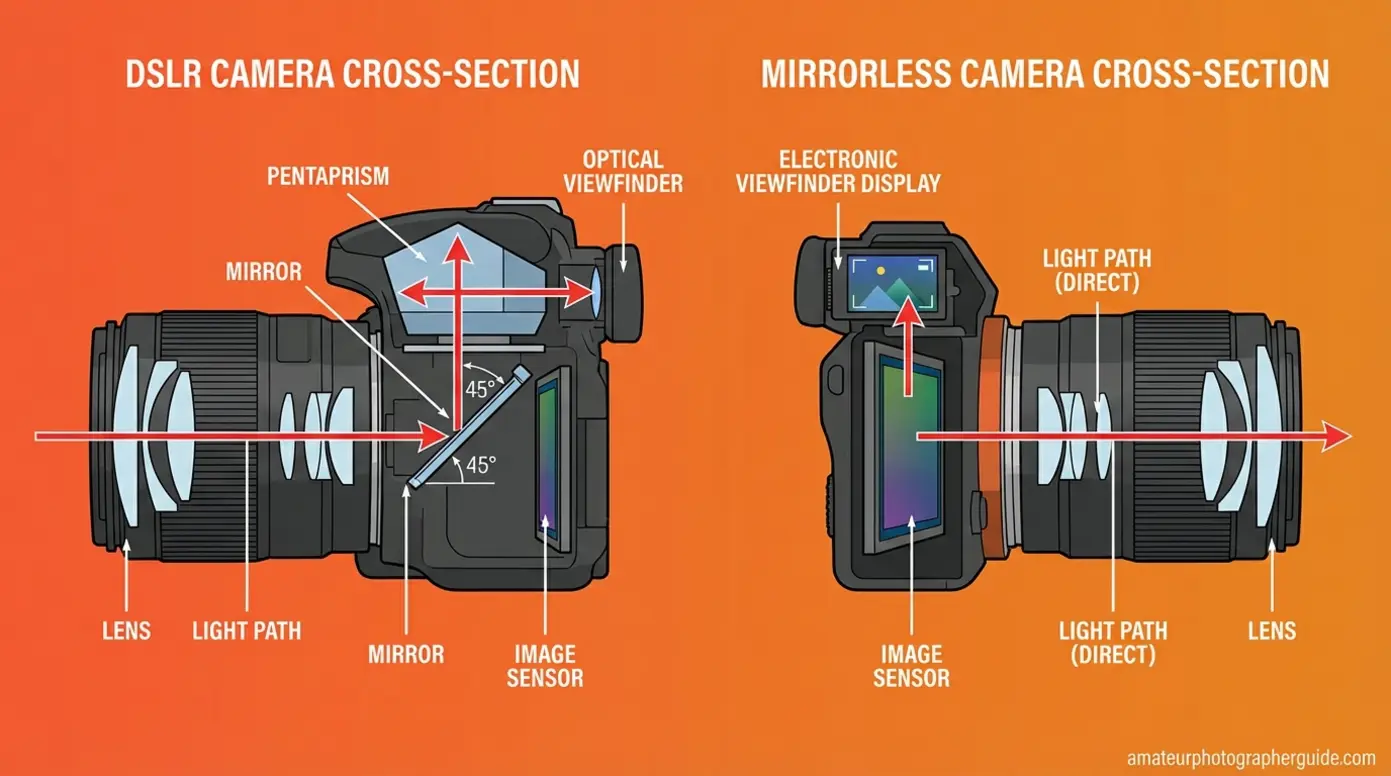
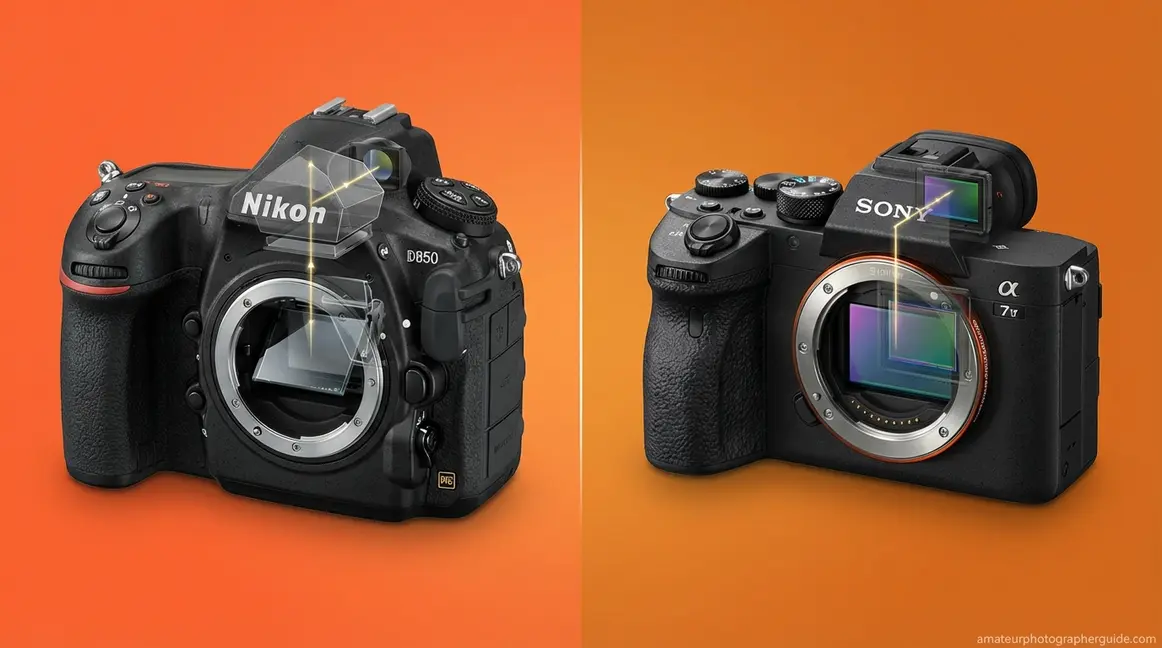
DSLR cameras use an internal mirror to reflect light into an optical viewfinder. Mirrorless cameras remove that mirror entirely and send light straight to a digital sensor. This single engineering choice creates a chain reaction affecting size, weight, autofocus speed, and battery life. Understanding this core distinction is the first step toward choosing the right camera system for your needs.
What Is a DSLR? The Mirror Mechanism Explained
A DSLR (Digital Single-Lens Reflex) camera works like a periscope. Light enters through the lens, bounces off an angled mirror, travels through a glass prism, and reaches your eye through the optical viewfinder (OVF) — the small window you press your eye against to frame a shot.
When you press the shutter button, the mirror flips up out of the way. The image sensor behind it captures the light. Then the mirror drops back down. That satisfying “clunk” sound? That’s the mirror at work. This mechanical process is one reason understanding DSLR camera mechanics matters — it explains why DSLR bodies are physically larger and heavier than mirrorless alternatives.
Popular DSLRs you may have heard of include the Nikon D3500 and Canon EOS Rebel T7 for beginners, and the Nikon D850 and Canon 5D Mark IV for professionals.
What Is a Mirrorless Camera? The Direct Sensor Approach
A mirrorless camera does exactly what the name suggests — it eliminates the mirror and prism entirely. Light passes through the lens and hits the image sensor directly. That sensor then displays a live, digital preview on the electronic viewfinder (EVF) — a tiny screen inside the eyepiece — or on the rear LCD screen.
No mirror means a smaller body and lighter weight. However, because the sensor and EVF are always powered on, mirrorless cameras consume more battery. That’s the fundamental trade-off. If you want to explore this further, here’s a deeper look at how mirrorless cameras work.
Think of it this way: an OVF is like looking through a window. An EVF is like watching a live TV feed of what’s outside — both show you the scene, but the TV feed can add helpful overlays like exposure previews and focus guides.
Popular mirrorless models include the Sony a6400 for beginners, the Canon EOS R6 Mark II at mid-range, and the Sony A7 IV for professionals.
Optical Viewfinder vs Electronic Viewfinder: What You’ll Actually See
This is the difference you’ll notice the moment you pick up each camera type.
“The most significant difference is the type of viewfinder, optical for DSLRs, electronic for mirrorless.”
The OVF experience: Zero lag — you see the scene in real time through glass. It works without battery power, stays comfortable in bright sunlight, and gives you that immersive “looking through the lens” feeling many photographers love. The trade-off is that you can’t preview how your exposure settings will affect the final image until after you take the shot.
The EVF experience: What you see is what you get. The electronic viewfinder shows a real-time preview of exposure, white balance, and even depth of field before you press the shutter. For beginners, this is a powerful learning tool — you can see the effect of changing settings instantly. Modern EVFs like the Sony A7 IV’s 3.69-million-dot panel also display histograms, focus peaking overlays, and shooting guides directly in the viewfinder.
Older EVF models (pre-2020) had noticeable lag and lower resolution, which frustrated many early adopters. According to clinical research on electronic vision systems, modern digital viewfinders can actually enhance visual function, countering common myths about digital eye strain. Today’s EVFs have largely closed the quality gap, though some photographers still prefer the OVF’s natural clarity.
Size, Weight, and Ergonomics: Which Feels Better in Your Hands?
Removing the mirror mechanism allows mirrorless cameras to weigh 20–40% less than equivalent DSLRs while maintaining the same sensor size and image quality.
| Feature | DSLR (Canon EOS Rebel T7) | Mirrorless (Canon EOS R50) |
|---|---|---|
| Weight | ~475g body-only | ~329g body-only |
| Grip | Deep, secure for large hands | Compact, can feel cramped with big lenses |
| Noise | Mechanical shutter “clunk” | Electronic shutter option — completely silent |
That ~30% weight difference adds up during all-day shooting or travel. However, DSLRs tend to have deeper, more substantial ergonomic grips that feel secure with heavy telephoto lenses. Mirrorless bodies can feel front-heavy when paired with large glass.
One practical advantage worth noting: mirrorless cameras can use electronic shutters for completely silent operation. If you plan to shoot at weddings, recitals, or wildlife hides, silent shooting is a genuine benefit DSLRs can’t match.
Performance Compared: Autofocus, Battery Life, and Video
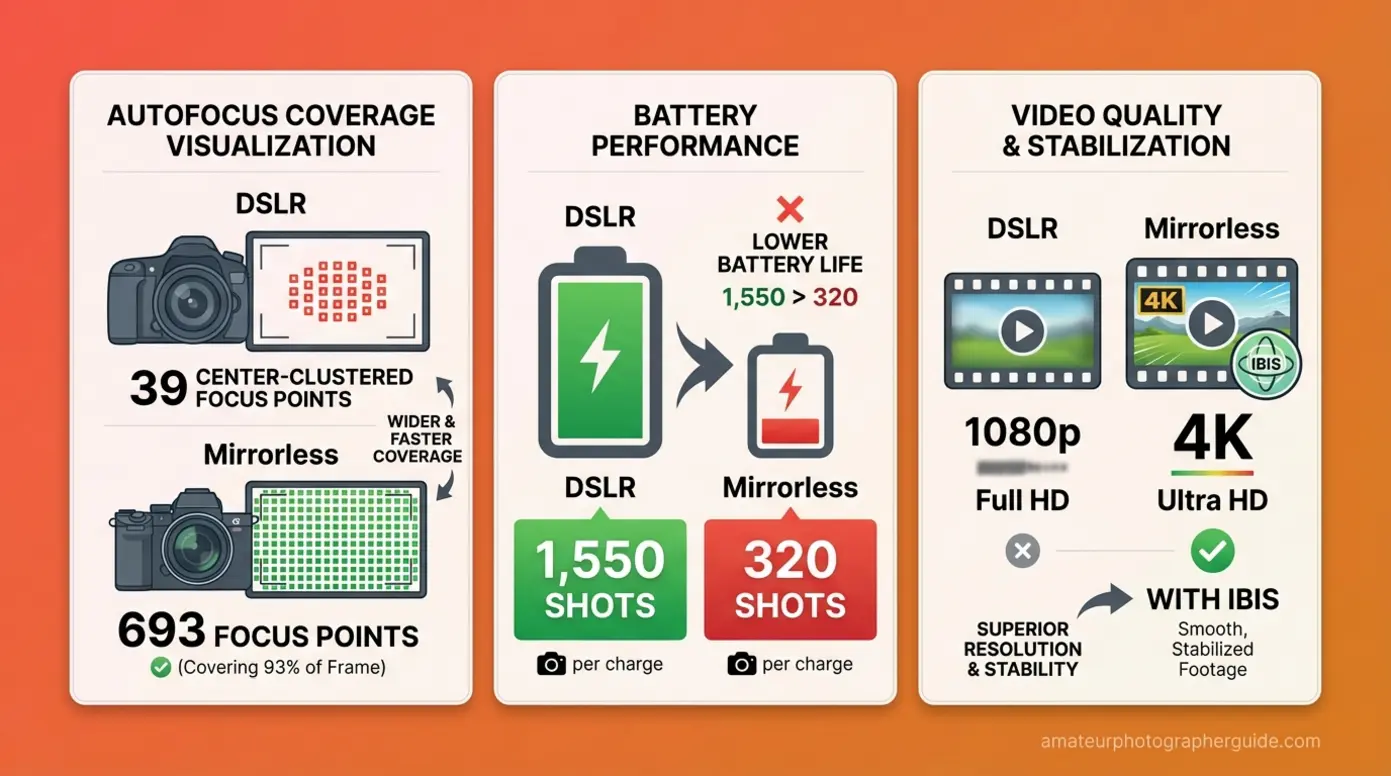
Both DSLR and mirrorless cameras produce excellent images from identical sensor technology. The real performance gap lies in how each system focuses, manages battery power, and handles video recording. When asking “mirrorless vs dslr which is better,” the answer depends on which of these performance areas matters most to you. Mirrorless cameras hold a decisive advantage in autofocus and video, while DSLRs retain a meaningful edge in battery endurance.
The Autofocus Gap: AI Tracking vs Center-Point Focus
This is the single biggest performance difference between the two systems — and it’s not close.
DSLR autofocus uses a dedicated sensor module separate from the imaging sensor. A typical DSLR offers 39–153 phase-detection focus points (the spots where the camera can lock focus), clustered near the center of the frame. You point the center focus spot at your subject, half-press the shutter, and the camera locks on. It works well for stationary subjects. For moving targets, you need to manually track them with the center point.
Mirrorless autofocus uses the imaging sensor itself for focusing, spreading 693+ hybrid AF points across up to 93% of the frame. Modern mirrorless cameras from Canon, Sony, and Nikon can identify and track human eyes, animals, birds, vehicles, and even aircraft in real time using AI-powered subject recognition. This is a generational leap.
What this means for you: imagine shooting your child’s soccer game. A mirrorless camera with AI tracking locks onto your child’s face and follows them across the entire frame — even as other players run past. A DSLR requires you to keep that center focus point on your child manually, which is far harder in fast-paced situations. User communities consistently report significantly higher “keeper rates” (sharp, usable photos) with mirrorless continuous autofocus capabilities.
Modern mirrorless AI autofocus systems achieve 95%+ subject tracking accuracy for moving subjects, compared to approximately 60–70% for traditional DSLR phase-detection systems. This gap is why professionals have been consolidating around mirrorless — according to Amateur Photographer market data, Sony led the 2025 mirrorless market with 29.9% share, followed by Canon at 27.4%, as professionals switch systems en masse.
Battery Life: DSLR’s Last Real Advantage?
Battery life is one area where DSLRs genuinely outperform mirrorless cameras — and the gap is significant.
CIPA (Camera & Imaging Products Association) is the industry standard for measuring battery life. Under CIPA testing conditions, a typical DSLR like the Nikon D3500 is rated at approximately 1,550 shots per charge. A comparable mirrorless camera like the Nikon Z50 is rated at roughly 320 shots. That’s nearly a 5:1 ratio on paper.
| Metric | DSLR (Nikon D3500) | Mirrorless (Nikon Z50) |
|---|---|---|
| CIPA Rating | ~1,550 shots | ~320 shots |
| Real-World Estimate | 1,200+ shots | 400–600 shots (ECO mode) |
In practice, CIPA ratings represent worst-case lab conditions. Real-world mirrorless usage with ECO mode enabled typically yields 400–600 shots per charge. DSLRs still pull ahead with 1,200+ shots. For all-day shooting without access to a charger, DSLRs have a genuine edge.
Cold weather makes this gap worse. DSLRs maintain battery life better in sub-freezing temperatures because the OVF draws no power. Wildlife photographers working in winter conditions report this as a meaningful practical advantage.
The mitigation is straightforward: spare mirrorless batteries cost $15–$30 and swap in 30 seconds. Most mirrorless cameras also charge via USB-C, so you can top up from a portable power bank between shots. This reduces the practical gap for most beginners to a minor inconvenience rather than a deal-breaker.
Video Capabilities: Why Mirrorless Dominates for Content Creators
For video, mirrorless cameras win outright. There’s no debate here.
4K video is standard on most mirrorless cameras under $1,000 — the Sony a6400 and Canon EOS R50 both shoot crisp 4K footage. Budget DSLRs like the Nikon D3500 and Canon Rebel T7 are limited to 1080p. If you plan to create content for YouTube, TikTok, or Instagram Reels, this alone may decide your purchase.
IBIS (In-Body Image Stabilization) is a system where the sensor physically shifts to counteract hand shake — like a tiny internal gimbal. Mirrorless cameras such as the Canon EOS R6 Mark II offer up to 8 stops of stabilization, producing handheld video that looks gimbal-smooth. Most DSLRs lack IBIS entirely.
Rolling shutter — the “jelly” distortion you see when panning quickly — is another area where mirrorless cameras have improved dramatically. Mirrorless bodies with stacked sensors have virtually eliminated it. DSLRs in video mode still suffer from noticeable distortion during fast camera movements.
Perhaps most critically, mirrorless cameras maintain continuous autofocus tracking while filming. DSLRs in video mode switch to slower contrast-detection AF, resulting in visible “hunting” — the frustrating back-and-forth focus searching that ruins otherwise good footage. To understand how camera type affects your shooting style, video capability is one of the biggest factors.
Image Quality: Does the Sensor Tell the Whole Story?
Here’s an often-surprising truth: a DSLR and a mirrorless camera using the same sensor produce virtually identical image quality. The Nikon D5600 and Nikon Z50 share a 24.2MP APS-C sensor, and their raw photo output is effectively indistinguishable. Your photos will look equally sharp from either system.
Where mirrorless cameras edge ahead is in computational photography — AI noise reduction, multi-shot HDR processing, and advanced color science. These features are only being developed for mirrorless firmware. DSLR bodies won’t receive these software updates. The difference isn’t in the photos you take today, but in the camera’s ability to improve over time.
DSLR vs Mirrorless: The Head-to-Head Comparison Table
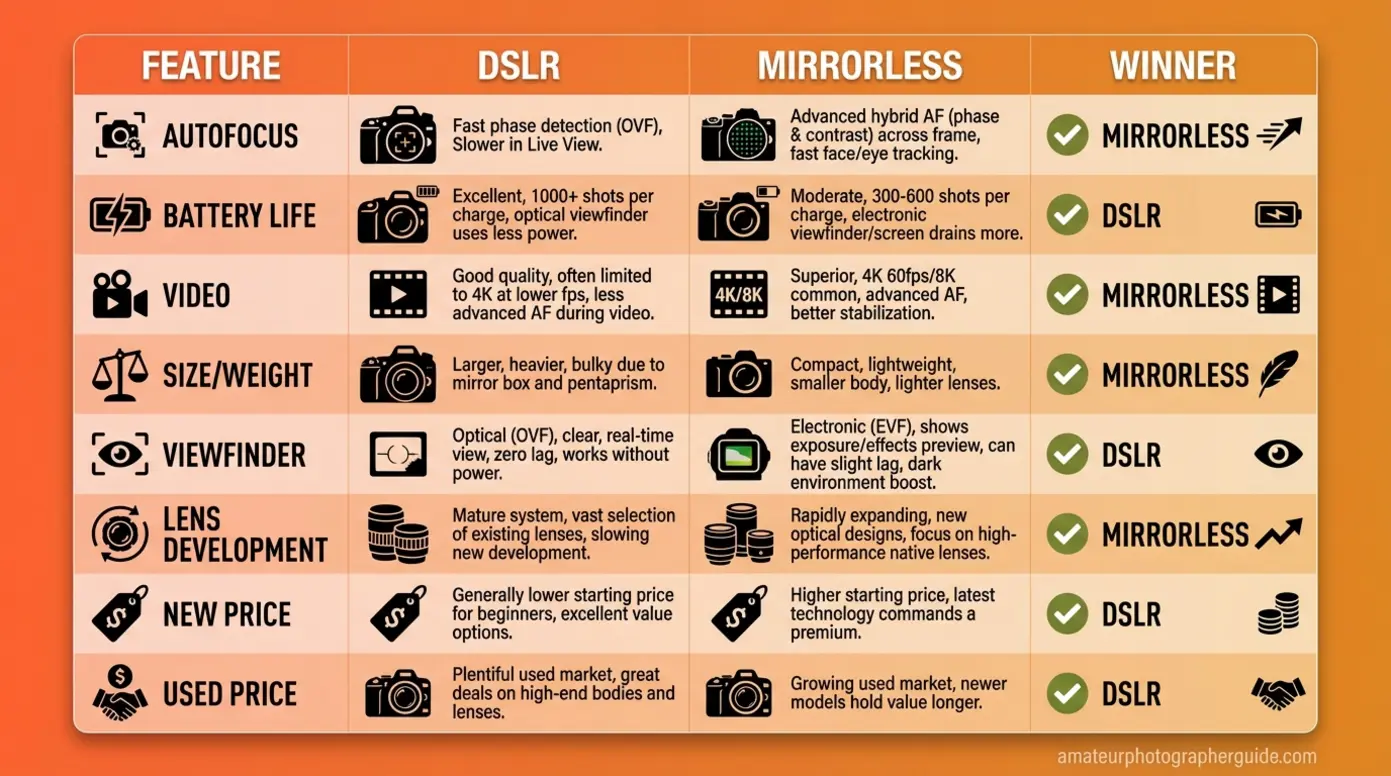
Here’s every major difference between DSLR and mirrorless cameras in one table. Bold text marks the winner in each category. Use this as your quick reference when shopping.
| Feature | DSLR | Mirrorless | Winner |
|---|---|---|---|
| Autofocus | 39–153 phase-detect points (center-clustered) | 693+ hybrid AF points (93% frame coverage), AI subject tracking | Mirrorless |
| Battery Life | 900–1,550 shots per charge (CIPA) | 300–400 shots per charge (CIPA) | DSLR |
| Video | 1080p on budget models; limited AF in video mode | 4K standard; continuous AF + IBIS | Mirrorless |
| Size & Weight | 475–1,000g body-only; deeper grip | 329–650g body-only; 20–40% lighter | Mirrorless |
| Viewfinder | Optical (zero lag, no power draw) | Electronic (real-time exposure preview, overlays) | Tie (preference) |
| New Lens Development | Discontinued (EF/F mount) | Active (RF/Z/E mount) — 30+ new lenses per year | Mirrorless |
| Price (New) | $450–$2,500 (limited new stock remaining) | $500–$6,500 (full range available) | Tie (similar entry prices) |
| Price (Used) | $200–$1,200 for flagship bodies | Limited used stock; retains value longer | DSLR |
Mirrorless cameras win 5 of 8 key comparison categories against DSLRs, losing only on battery life and used-market pricing (with viewfinder preference being a tie). According to the Data Insights Market report, the global mirrorless and DSLR market was valued at $7.12 billion in 2025, with growth driven almost exclusively by mirrorless adoption.
The table makes the technical case clear. But there’s a bigger story behind these numbers — one about the future of DSLR cameras as a product category.
The 2026 Market Reality: Is DSLR Dead?
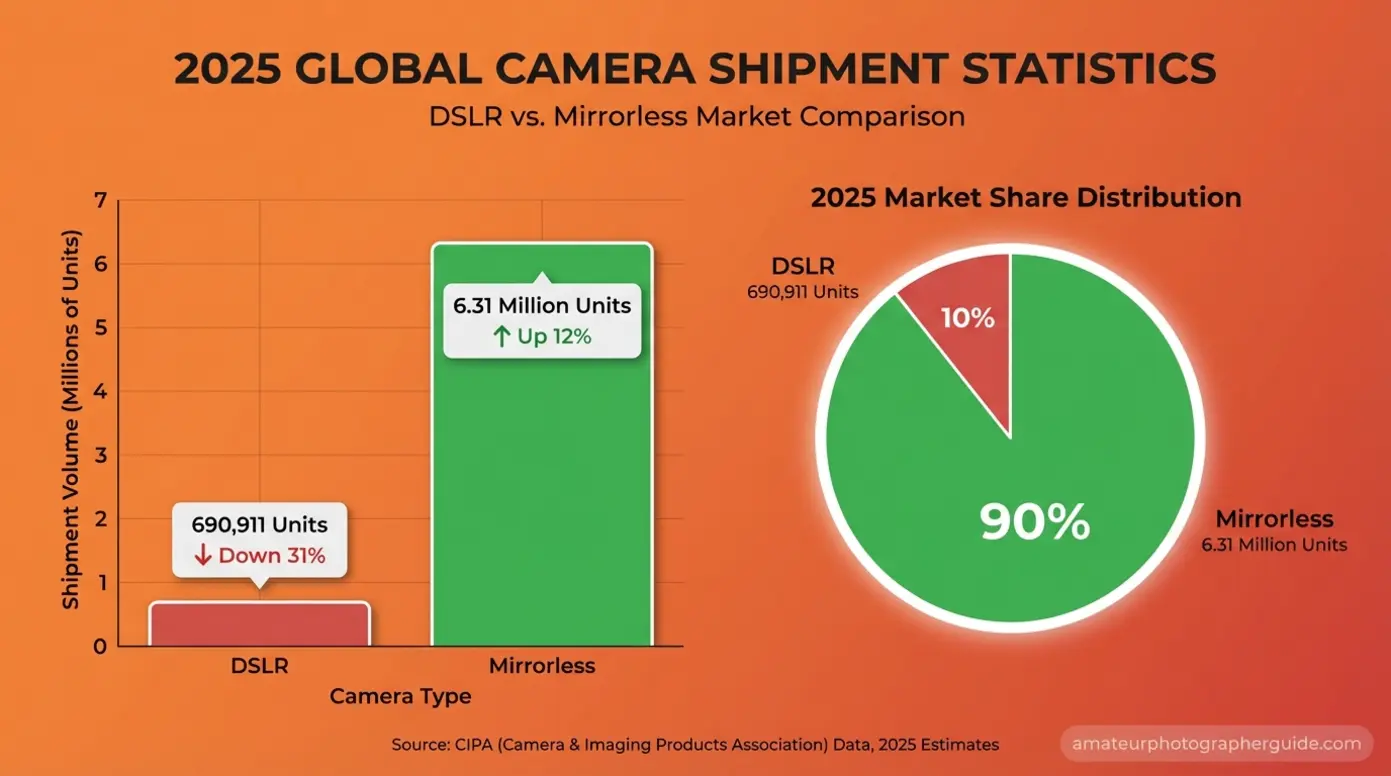
DSLRs are not “dead” for photographers who already own them, but they are effectively discontinued as a product category. In 2025, DSLR shipments collapsed by 31% to just 690,911 units globally, while mirrorless shipments grew 12% to 6.31 million units. This has created an unusual opportunity: used DSLR flagship bodies are available at historically low prices.
DSLR Discontinuation Timeline: What Canon and Nikon Have Confirmed
The shift away from DSLRs isn’t speculation — it’s confirmed by every major manufacturer.
Canon officially ceased development of new EF-mount lenses and bodies, directing all research and manufacturing to the RF mirrorless mount. Their 2024 annual report attributes “double-digit growth” specifically to mirrorless core products. No new Canon DSLRs are in development.
Nikon has not released a new F-mount DSLR since the D6 in 2020. All new Nikon lenses are Z-mount (mirrorless) only. The legendary F-mount lens catalog remains compatible via a $250 adapter, but no new lenses will be added.
Sony exited the DSLR market even earlier, discontinuing their A-mount system in 2018. Pentax is the only manufacturer still producing new DSLRs (the Pentax K-3 III Monochrome, released 2023), but strictly as a niche product for film-emulation enthusiasts.
Here’s the timeline at a glance:
- 2018: Sony discontinues A-mount DSLRs
- 2020: Nikon releases D6 — their last flagship DSLR
- 2024: Canon confirms all R&D now exclusively RF-mount
- 2025: DSLR shipments fall below 700,000 units globally — under 10% of interchangeable-lens market
According to CIPA camera shipment statistics, mirrorless camera shipments reached approximately 6.31 million units in 2025 (up 12%), while DSLR shipments fell 31% to under 700,000 units globally. These aren’t trends — they’re confirmed manufacturing decisions. To see how this fits into broader shifts, check out these emerging photography trends shaping 2025.
The Used DSLR Value Index: Flagship Bodies at Budget Prices
When manufacturers stop making new DSLRs, the used market floods with high-end bodies from professionals upgrading to mirrorless. The result? Flagship-quality cameras at beginner-friendly prices.
Here’s the Used DSLR Value Index — a snapshot of what professional-grade DSLR bodies cost on the used market as of early 2026 (prices based on eBay, KEH, and MPB averages in good condition):
| Camera | Original MSRP | Used Price (2026) | Savings | Key Spec |
|---|---|---|---|---|
| Nikon D850 | $3,300 | ~$1,000–$1,200 | 64–70% off | 45.7MP full-frame, 7 fps |
| Canon 5D Mark IV | $3,500 | ~$1,200–$1,400 | 60–66% off | 30.4MP full-frame, 4K video |
| Nikon D500 | $2,000 | ~$650–$800 | 60–68% off | 10 fps, 153-point AF, APS-C |
| Canon 7D Mark II | $1,800 | ~$500 | 72% off | 10 fps, dual-pixel AF, APS-C |
These are cameras that professional photographers used to shoot magazine covers, sports events, and wildlife documentaries. Now they’re available for less than the price of a new entry-level mirrorless body.
One important factor: check the shutter count before buying. Shutter count is the number of times the camera’s mechanical shutter has fired — think of it like an odometer on a car. Most DSLRs are rated for 150,000–300,000 actuations. A camera with 40,000 clicks has plenty of life left. One with 280,000 is nearing the end. For more guidance, see the 2025 camera market outlook.
Repairability and Parts Outlook Through 2030
Used DSLRs are a genuine bargain — but a bargain only matters if the camera remains repairable.
Canon and Nikon have historically committed to servicing camera bodies for approximately 7 years after discontinuation. For the Nikon D850 (released 2017), that means manufacturer service extends through roughly 2024–2027, depending on region. Parts availability is already narrowing for older models.
Third-party repair shops will continue servicing DSLRs longer than manufacturers. However, specific components — shutter assemblies, AF modules, and sensor cleaning mechanisms — will become increasingly scarce by 2028–2030. Canon’s 2024 annual report attributes their growth to mirrorless core products, signaling a decisive manufacturing shift away from DSLR production and parts inventory.
Honest recommendation: if buying a used DSLR, budget for a backup body. Eventually, repair costs may exceed replacement cost — especially for mechanical components unique to DSLRs.
Which Camera Should You Buy? Recommendations by User Type
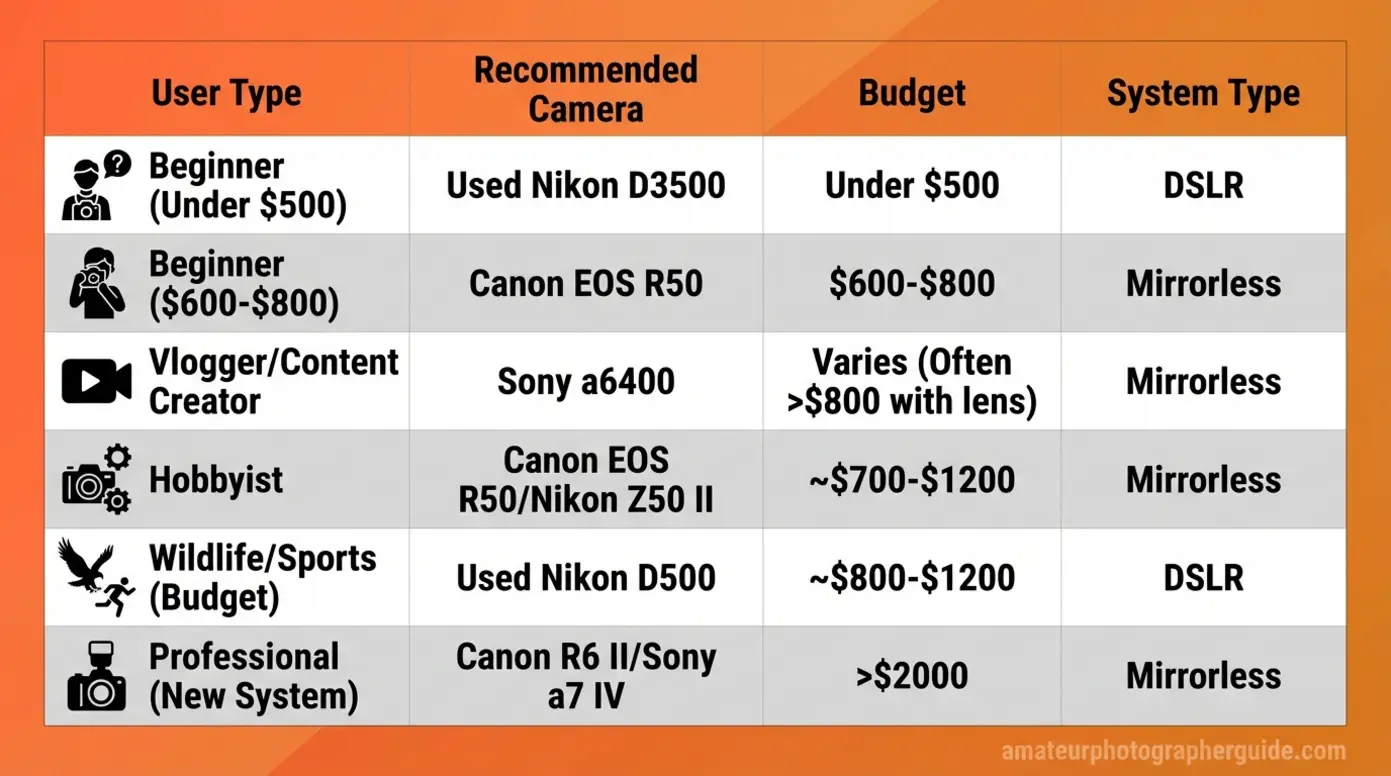
The right camera depends on three things: your budget, your primary use case (stills vs video), and how long you want the system to stay current. Here are specific recommendations for the three most common buyer profiles, each with exact camera models and price ranges for 2026.
Best Choice for Beginners on a Budget
For beginners weighing mirrorless vs dslr, budget is usually the deciding factor.
If your total budget is under $500, a used DSLR delivers the best image-quality-per-dollar. The Nikon D3500 (~$300–$350 used with kit lens) gives you a proven 24.2MP sensor, excellent battery life (1,550 shots per charge), and a comfortable grip for learning. It’s a fully capable camera that shoots beautiful photos.
If you can stretch to $600–$700, a new mirrorless camera is the smarter long-term investment. The Canon EOS R50 (~$679 new) offers AI autofocus, 4K video, and access to the growing RF-mount lens ecosystem for years to come. According to Statista camera market forecasts, mirrorless technology now accounts for nearly 90% of all interchangeable-lens camera shipments — that’s where all future development is headed.
The Reddit community consensus across r/Cameras and r/AskPhotography consistently recommends mirrorless for beginners unless budget is the single deciding factor. For tips on what $500 gets you in a DSLR, the options are genuinely impressive.
Verdict: Under $500 → used DSLR. Over $600 → new mirrorless. The $500–$600 range is the hardest decision — lean mirrorless if video matters to you at all.
Best Choice for Video Creators and Vloggers
For any form of video content — YouTube, TikTok, Instagram Reels, or client work — mirrorless is the only serious option. DSLRs lack 4K on budget models, lack continuous autofocus in video, and lack IBIS.
Budget picks: Sony a6400 (~$750 used, excellent autofocus for vlogging) or Canon EOS R50 (~$679 new, compact and beginner-friendly). Mid-range: Sony A7C II (~$2,200, full-frame with 4K 60p).
The key feature: mirrorless cameras keep your face in sharp focus while you talk to the camera. DSLRs will “hunt” in and out of focus during video recording. This single limitation eliminates DSLRs for vlogging and content creation.
Verdict: Mirrorless wins for video. No exceptions.
Best Choice for Professional and Action Photographers
Most professionals have migrated to mirrorless. The Canon EOS R5 Mark II, Nikon Z8, and Sony a1 now dominate professional sports and wildlife photography with AI-powered bird and animal eye tracking and 20+ fps burst rates.
The remaining DSLR niche is small but real. Some wedding photographers and photojournalists in extreme conditions still prefer DSLRs like the Nikon D6 and Canon 1D X Mark III for their 3,000+ shot battery life and zero-lag optical viewfinders in fast-paced environments.
Here’s the honest assessment: if you’re buying your first professional system in 2026, buy mirrorless. If you already own a DSLR system with thousands of dollars in lenses, it still works beautifully. A lens adapter (Canon EF→RF or Nikon F→Z, approximately $100–$250) bridges the gap when you’re ready to switch bodies. Check out the top beginner cameras for 2026 for more starting points.
Verdict: New professionals → Mirrorless. Existing DSLR owners → Keep shooting. Upgrade when it makes financial sense.
The Decision Matrix: Your Quick-Reference Buying Chart
For beginners in 2026, a new mirrorless camera under $700 is the safest long-term investment, while a used DSLR under $500 delivers the best image-quality-per-dollar if you shoot primarily stills.
| If You Are… | Buy This | Budget | System |
|---|---|---|---|
| Beginner, budget under $500 | Used Nikon D3500 + kit lens | ~$300–$350 | DSLR |
| Beginner, budget $600–$800 | Canon EOS R50 or Sony a6400 | ~$680–$750 | Mirrorless |
| Vlogger / Content Creator | Sony a6400 or Canon EOS R50 | $680–$750 | Mirrorless |
| Hobbyist upgrading from phone | Canon EOS R50 or Nikon Z50 II | $680–$850 | Mirrorless |
| Wildlife / Sports (budget) | Used Nikon D500 | ~$650–$800 | DSLR |
| Professional (new system) | Canon R6 II / Sony a7 IV / Nikon Z6 III | $1,800–$2,500 | Mirrorless |
Mirrorless appears in 4 of 6 recommendations for good reason — it’s the safer long-term bet. The DSLR recommendations exist for two specific scenarios: maximizing image quality on a strict budget, and budget-friendly action shooting with used pro-grade bodies.
When Neither Option Is the Right Fit
Situations Where You Should Consider Alternatives
Not everyone needs an interchangeable-lens camera. Being honest about that builds better buying decisions.
If you only shoot on your phone and want slightly better photos for social media, a high-end smartphone (iPhone 16 Pro, Samsung Galaxy S25 Ultra, Google Pixel 9 Pro) with computational photography may be more practical than a separate camera body. No lens changes, no camera bag, no learning curve. Modern smartphone cameras produce impressive results for social sharing.
If you want a fun, creative tool and don’t care about technical specifications, an instant camera like the Fujifilm Instax Mini 12 (~$70) or a premium compact like the Ricoh GR IIIx (~$900) might bring you more joy than navigating the DSLR vs mirrorless debate entirely. Photography should be enjoyable first, technically impressive second.
If your total budget is under $200, neither a new mirrorless camera nor a used DSLR will serve you well at that price point. Focus on mastering photography fundamentals with your current phone — composition, lighting, and timing matter more than gear. Invest in a camera system when you’re ready for that commitment.
Keep in mind that “best” is always subjective based on individual needs. If you’re buying gear for a specific professional purpose — real estate, product photography, scientific imaging — consult a working photographer in that specialty before purchasing. The ideal system varies dramatically by niche.
Frequently Asked Questions
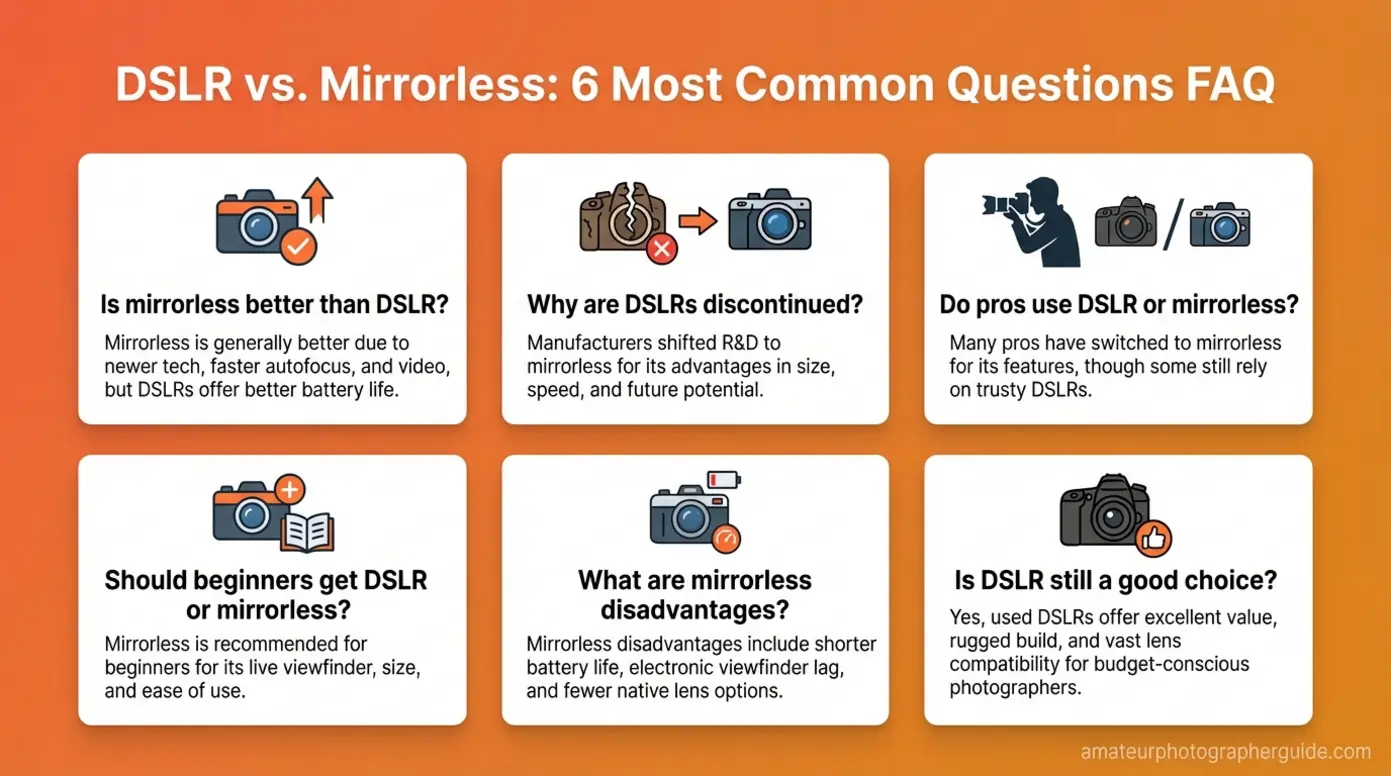
Is a mirrorless camera better than a DSLR?
For most photographers in 2026, mirrorless cameras are the better choice due to superior autofocus, lighter bodies, and active lens development from all major manufacturers. The electronic viewfinder shows real-time exposure previews, making it significantly easier for beginners to learn proper settings. All new camera technology — AI subject tracking, computational photography, and video features — is being developed exclusively for mirrorless systems. DSLRs remain a strong option only for photographers who prioritize battery life or are buying used on a strict budget.
Why are DSLRs being discontinued?
DSLRs are being discontinued because Canon, Nikon, and Sony have shifted all research and manufacturing investment to mirrorless camera systems. Mirrorless lens mounts allow for better optical designs, faster lens-to-body communication, and smaller form factors. Maintaining two separate production lines is cost-prohibitive when consumer demand has shifted overwhelmingly toward mirrorless technology. As of 2026, only Pentax continues producing new DSLR bodies, targeting a small niche enthusiast market.
Do professional photographers use DSLR or mirrorless?
Most professional photographers have migrated to mirrorless cameras for their AI-powered eye-tracking autofocus, silent shooting modes, and advanced video features. Sports and wildlife professionals increasingly rely on mirrorless flagships like the Sony a1, Canon EOS R5 Mark II, and Nikon Z8. However, some photojournalists and wedding photographers still use DSLRs for their exceptional battery endurance and zero-lag optical viewfinders. The industry transition is nearly complete, but DSLRs remain viable professional tools for those who already own them.
Should I get a DSLR or mirrorless as a beginner?
Beginners should generally choose a mirrorless camera because the electronic viewfinder shows exactly how exposure settings affect the image in real time, making it significantly easier to learn photography. Modern mirrorless cameras also offer AI subject tracking that helps beginners get sharp photos more consistently. Budget-friendly options like the Canon EOS R50 (~$679) provide an excellent starting point with 4K video and future-proof lens compatibility. The one exception: if your total budget is under $500, a used DSLR like the Nikon D3500 (~$300) delivers excellent still-photo quality at a lower entry price.
What are the disadvantages of mirrorless cameras?
The main disadvantages of mirrorless cameras are shorter battery life (300–400 shots vs 900–1,550 for DSLRs) and potential electronic viewfinder lag in older pre-2020 models. Because the sensor is exposed when changing lenses, mirrorless cameras can accumulate dust on the sensor more easily. Smaller bodies may also feel cramped with large telephoto lenses due to reduced grip depth. However, 2024–2026 models have dramatically improved battery efficiency and EVF responsiveness, largely closing these gaps. A $20 spare battery eliminates the battery concern for most shooting situations.
The Final Verdict: DSLR or Mirrorless in 2026?
For most buyers comparing dslr cameras vs mirrorless in 2026, the answer is clear: mirrorless cameras are the future-proof investment. With 90% of new camera shipments being mirrorless (CIPA, 2025), all new lens development focused on mirrorless mounts, and AI autofocus creating a generational performance gap, the technology has decisively moved forward. The mirrorless camera vs dslr debate now has a data-backed answer for the majority of photographers.
That said, this is genuinely a fork in the road — not a one-size-fits-all answer. If you want the safest long-term system with video capability and cutting-edge autofocus, buy mirrorless. If you want the absolute best image-quality-per-dollar and shoot primarily stills on a tight budget, a used DSLR flagship is one of the smartest deals in photography today.
Your next step is simple. Decide your budget first. Under $500? Browse used DSLRs on KEH or MPB — the Nikon D3500 and Canon 7D Mark II offer incredible value. Over $600? Visit a camera store, hold the Canon EOS R50 and Sony a6400 in your hands, and choose the one that feels right. Either way, you’re getting a capable camera — the best time to start shooting is now.