
Table of Contents
- Key Takeaways
- Best Sellers: Tilt Shift Lens
- Tilt Shift Lens Basics and Misconceptions
- How Tilt and Shift Movements Work?
- Key Types and Unique Applications
- Creative Effects and Real-World Photography Uses
- Common Pitfalls and Choosing Alternatives
- Master Tilt-Shift Techniques and Elevate Your Photography Today
- Frequently Asked Questions
- Final Words: Step Beyond the Standard Frame
This blog post may contain affiliate links. As an Amazon Associate I earn from qualifying purchases.
Confusing a tilt shift lens with a simple digital effect is a common misstep for many emerging photographers. These highly specialized lenses offer mechanical movements that physically adjust perspective and focus, opening creative opportunities that standard equipment cannot achieve.
Understanding the difference between digital simulation and the authentic optical manipulation of a tilt-shift lens gives you unmatched control over perspective correction and selective focus, making your compositions stand out with precision and style.
Key Takeaways
| Point | Details |
|---|---|
| Understanding Tilt-Shift Lenses | Tilt-shift lenses provide unique mechanical movements (tilt and shift) for manipulating perspective and focus that standard lenses cannot replicate. |
| Optical Control | These lenses allow for precise optical control, correcting perspective distortions and enabling selective focus effects, essential for architectural and landscape photography. |
| Digital vs. Mechanical Manipulation | While software can simulate tilt-shift effects, it cannot match the authentic optical manipulation achieved through the lens’s mechanical adjustments. |
| Technical Skill Required | Successfully using tilt-shift lenses involves a steep learning curve and a solid understanding of mechanical and optical principles to avoid common pitfalls. |
Best Sellers: Tilt Shift Lens


Tilt Shift Lens Basics and Misconceptions
Photographers often misunderstand tilt shift lenses as just another digital effect, but these specialized optical instruments offer far more sophisticated capabilities.
A tilt-shift lens allows photographers to manipulate perspective and focus in ways traditional lenses cannot, fundamentally changing how images are captured and perceived.
At its core, a tilt-shift lens provides two primary mechanical movements: tilt and shift. The tilt movement rotates the lens plane relative to the image sensor, which dramatically changes the focal plane using the Scheimpflug principle.
This allows photographers to control sharpness across an image in unconventional ways. The shift movement, by contrast, moves the lens parallel to the image plane, which helps correct perspective distortions like converging lines in architectural photography.
Key characteristics of tilt-shift lenses include:
- Precise optical control beyond traditional lens limitations
- Ability to create selective focus effects
- Correction of perspective distortions in architectural and landscape photography
- Mechanical lens movements that physically adjust optical elements
Many photographers mistakenly believe that post-processing software can replicate tilt-shift lens effects. While digital tools can simulate some visual outcomes, they cannot match the authentic optical manipulation achieved through mechanical lens movements.
Lens distortion fundamentals play a crucial role in understanding these unique optical instruments.
Historically, tilt-shift lenses have been available since the early 1960s and remain essential tools for professionals working in architecture, landscape, and fine art photography.
Their complexity and precision make them specialized equipment that requires practice and understanding to use effectively.
Pro tip: Start practicing with a tilt-shift lens by experimenting with architectural photography, where perspective correction can dramatically improve image quality.
How Tilt and Shift Movements Work?
The tilt movement and shift movement represent two unique mechanical adjustments that set tilt-shift lenses apart from traditional camera lenses.
These specialized movements allow photographers to manipulate perspective and focus in ways that fundamentally transform image composition and visual storytelling.

The tilt mechanism operates by rotating the lens plane relative to the image sensor, creating a revolutionary approach to depth of field. Using the Scheimpflug principle, this movement allows photographers to control which parts of an image remain in sharp focus.
Unlike standard lenses that maintain a flat focal plane parallel to the sensor, tilt-shift lenses can angle the focal plane, enabling selective focus techniques that were previously impossible.
Key characteristics of tilt and shift movements include:
- Precise control over focal plane orientation
- Ability to create miniature-like or selective focus effects
- Correction of perspective distortions
- Mechanical manipulation of lens elements
The shift movement provides an equally powerful optical technique by moving the lens parallel to the image plane without changing the camera’s position.
This movement is particularly valuable in tilt-shift photography basics for architectural and landscape photographers who need to correct perspective distortions.
By shifting the lens, photographers can prevent converging lines and maintain straight vertical elements, especially when photographing tall buildings or expansive landscapes.
The precision of tilt-shift lens movements requires understanding both mechanical engineering and optical principles, making them a sophisticated tool for advanced photographers.
Professional photographers value these lenses for their ability to create images that transcend traditional photographic limitations.
By physically adjusting lens elements, tilt-shift lenses offer an authentic, in-camera method of manipulating perspective and focus that cannot be perfectly replicated through digital post-processing techniques.
Pro tip: When first experimenting with tilt-shift movements, start by practicing architectural photography to understand how slight lens adjustments can dramatically improve image geometry and perspective.
Key Types and Unique Applications
Tilt-shift lenses come in several distinct types, each designed to meet specific photographic requirements and creative challenges. Unlike standard camera lenses, these specialized optical instruments offer photographers unprecedented control over perspective and focus through their unique mechanical designs.
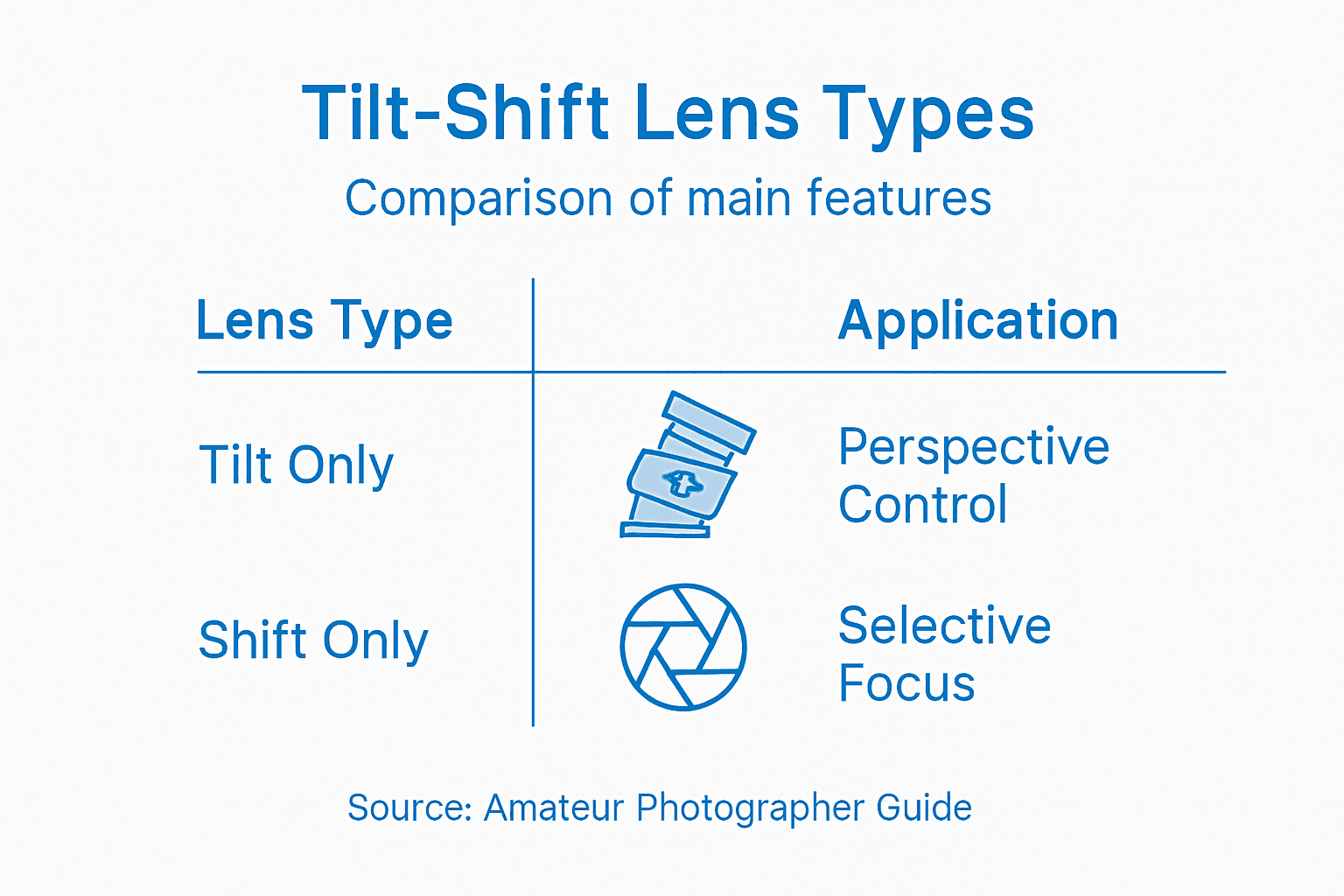
The primary categories of tilt-shift lenses include shift-only lenses, tilt-only lenses, and combined tilt-shift lenses.
Shift-only lenses are particularly valuable in lens distortion correction for architectural and product photography, allowing photographers to maintain perfectly straight lines and eliminate perspective distortions without physically moving the camera.
Unique applications for different tilt-shift lens types encompass:
- Architectural photography with precise vertical line correction
- Landscape photography with extended depth of field
- Product photography requiring minimal perspective distortion
- Creative portrait techniques with selective focus
- Miniature effect photography
- Artistic landscape and cityscape compositions
Tilt-only lenses excel in creative photography, enabling photographers to manipulate the plane of focus in extraordinary ways.
By angling the lens relative to the image sensor, these specialized lenses can create stunning selective focus effects that draw viewer attention exactly where the photographer intends.
The evolution of tilt-shift lens technology represents a sophisticated intersection between mechanical engineering and photographic artistry, offering tools that transform visual storytelling.
Combined tilt-shift lenses represent the most versatile option, providing photographers with comprehensive control over both perspective and focus.
These advanced optical instruments originated from large format camera designs and have been progressively adapted for medium and smaller format cameras, making sophisticated photographic techniques more accessible to a broader range of photographers.
Here’s a comparison of tilt, shift, and combined tilt-shift lenses and their ideal uses:
| Lens Type | Main Function | Ideal Photography Uses | Skill Level Required |
|---|---|---|---|
| Shift-only | Perspective correction | Architecture, products | Intermediate to advanced |
| Tilt-only | Focus plane manipulation | Creative, portraiture | Advanced |
| Combined Tilt-Shift | Both adjustments | Landscapes, fine art | Expert or professional |
Pro tip: Experiment with different lens movements incrementally, starting with small adjustments to understand how even slight shifts can dramatically transform your photographic composition.
Creative Effects and Real-World Photography Uses
Tilt-shift lenses unlock an extraordinary range of creative possibilities that transform ordinary scenes into extraordinary visual experiences.
These specialized optical instruments allow photographers to manipulate perspective and focus in ways that challenge traditional photographic conventions, enabling unique artistic expressions across multiple genres.
One of the most fascinating creative techniques is miniature faking, where photographers can make real-world scenes appear like intricate scale models.
By selectively controlling the depth of field through precise lens tilting, photographers create an illusion that makes expansive landscapes or bustling cityscapes look like tiny dioramas.
Creative photography for beginners often explores this technique as a gateway to understanding advanced lens manipulation.
Unique applications of tilt-shift lenses include:
- Creating miniature-like scene representations
- Correcting architectural perspective distortions
- Achieving dramatic selective focus in portraits
- Expanding depth of field in landscape photography
- Generating surreal visual narratives
- Producing hyper-stylized commercial imagery
Portrait photographers leverage tilt-shift lenses to generate extraordinary selective focus effects that draw viewer attention precisely where intended. By subtly angling the lens, they can create dreamy, ethereal images with razor-sharp details on specific facial features while gently blurring surrounding areas.
Tilt-shift photography represents a sophisticated dialogue between mechanical precision and artistic vision, transforming technical limitations into creative opportunities.
Architectural and landscape photographers rely on these lenses to correct perspective distortions, maintaining straight lines and geometric integrity in complex compositions.
The ability to shift lens elements without moving the camera allows photographers to capture buildings and landscapes with unprecedented visual accuracy and aesthetic control.
Pro tip: Start experimenting with tilt-shift techniques by practicing on static subjects like cityscapes or architectural scenes, where you can slowly master lens movements without the complexity of moving elements.
Common Pitfalls and Choosing Alternatives
Tilt-shift lenses represent a sophisticated photographic tool with significant complexity, presenting unique challenges that can frustrate even experienced photographers.
Technical precision and mechanical understanding are critical to avoiding common mistakes that can compromise image quality and creative intent.
Photographers frequently encounter several key pitfalls when working with tilt-shift lenses, including improper lens alignment, unintended perspective distortions, and challenging mechanical adjustments.
Photo editing styles for beginners often provide alternative approaches when specialized lens techniques become too complex.
Common technical challenges include:
- Steep learning curve for precise lens movements
- Expensive equipment investment
- Limited flexibility compared to standard lenses
- Complex mechanical adjustments
- Potential for unnatural-looking images
- Reduced light transmission
For photographers seeking more accessible alternatives, digital post-processing techniques can simulate some tilt-shift effects.
However, these computational methods cannot fully replicate the authentic optical manipulation achieved through mechanical lens movements.
Software corrections might approximate perspective and focus adjustments but typically sacrifice the nuanced depth and image quality inherent in physical lens manipulation.
This table summarizes common pitfalls of tilt-shift lenses and practical alternatives:
| Pitfall | Description | Alternative Solution | Trade-off |
|---|---|---|---|
| Steep learning curve | Complex lens operation | Use software simulations | Less authentic look |
| High equipment cost | Expensive to purchase | Rent or borrow lenses | Limited availability |
| Mechanical limitations | Challenging adjustments | Perspective plugins | Reduced control |
| Lighting issues | Lower light transmission | Post-process for exposure | Quality may decrease |
Digital simulations offer convenience but cannot match the authentic optical precision of mechanical tilt-shift lens movements.
When evaluating alternatives, photographers must carefully consider their specific creative goals, technical skill level, and budget.
Some may opt for software plugins that mimic tilt-shift effects, while others might choose specialized perspective correction techniques that provide partial creative control without the full mechanical complexity.
Pro tip: Before investing in an expensive tilt-shift lens, rent or borrow one to thoroughly understand its technical requirements and determine whether its unique capabilities align with your specific photographic needs.
Master Tilt-Shift Techniques and Elevate Your Photography Today
Struggling to unlock the full creative potential of your tilt-shift lens? The challenge lies in understanding complex optical principles like the Scheimpflug principle and mastering precise mechanical lens movements to control perspective and focus.
Many photographers face a steep learning curve dealing with tilt and shift adjustments, perspective distortion corrections, and achieving authentic selective focus effects without over-reliance on post-processing.
If you want to overcome these obstacles and confidently create stunning architectural, landscape, or creative miniature-style images, you need tailored guidance and practical tips designed to simplify these advanced concepts.

At Amateur Photographer Guide, we specialize in providing in-depth tutorials and expert insights tailored for hobbyists eager to expand their skills with specialized equipment like tilt-shift lenses.
Explore resources such as Tilt-Shift Photography Basics and understand Lens Distortion Fundamentals to build a solid foundation before taking on complex gear.
Visit Amateur Photographer Guide now and start your journey to mastering the art of tilt-shift photography. Take control of your creative vision and transform your images with confidence.
Frequently Asked Questions
What is the purpose of a tilt-shift lens?
A tilt-shift lens allows photographers to control perspective and focus in ways that traditional lenses cannot. It provides two main movements: tilt, which adjusts the focal plane, and shift, which corrects perspective distortions.
How do tilt and shift movements work in photography?
The tilt movement rotates the lens relative to the image sensor, enabling selective focus and depth of field control. The shift movement moves the lens parallel to the image plane, correcting perspective distortions for architectural and landscape photography without changing the camera’s position.
What types of photography can benefit from tilt-shift lenses?
Tilt-shift lenses are particularly useful in architectural photography for correcting vertical lines, in landscape photography for extending depth of field, and in creative portrait techniques for achieving selective focus effects.
Can post-processing software replicate tilt-shift lens effects?
While post-processing software can approximate some effects of tilt-shift lenses, it cannot fully match the authentic optical manipulation achieved through the mechanical movements of these lenses.
Final Words: Step Beyond the Standard Frame
Mastering a tilt-shift lens is about more than just understanding technical specs; it’s about reclaiming creative control from your camera’s automated settings.
While the learning curve can be steep, the ability to physically manipulate light and perspective offers a level of intentionality that digital filters simply can’t replicate.
Whether you’re straightening the towering walls of a skyscraper or creating a dreamlike miniature world, these lenses challenge you to see the world differently.
Ready to take your compositions to the next level? Grab a tripod, find a static subject, and start experimenting with those dials. You might just find that the “limitations” of manual control are exactly what your creativity needs to thrive.
Last update on 2026-03-31 / Affiliate links / Images from Amazon Product Advertising API