
Table of Contents
This blog post may contain affiliate links. As an Amazon Associate I earn from qualifying purchases.
Many photographers struggle to achieve flawless creative focus and perspective without spending hours editing. Learning tilt shift techniques opens up a world of visual possibilities for beginners and intermediate photographers eager for more control and artistry. With tilt shift lenses, anyone can manipulate depth, correct distortion, and even create scenes that look like miniature models. Nearly 80 percent of successful creative projects rely on mastering selective focus, making these tools essential for anyone serious about artistic storytelling.
Key Takeaways
| Point | Details |
|---|---|
| Tilt Shift Technique | This photographic method manipulates lens positioning to control focus and perspective, allowing unique visual representations. |
| Tilt and Shift Movements | These controls enable photographers to adjust the plane of focus and correct perspective distortions, enhancing architectural and landscape photography. |
| Common Missteps | Photographers often overuse lens movements or neglect stabilization, which can result in unnatural images; subtlety and precision are key. |
| Creative Applications | Tilt shift photography transforms ordinary scenes into extraordinary compositions, enabling artists to challenge viewer expectations through selective focus. |


What Is Tilt Shift in Photography?
Tilt shift is a specialized photographic technique that allows photographers extraordinary control over focus, perspective, and visual perception by physically manipulating camera lens positioning. Unlike traditional photography where lens and image sensor remain parallel, tilt shift photography enables photographers to change the orientation and relationship between these critical components.

The technique involves two primary movements: tilt and shift. Tilting the lens changes the plane of focus using the Scheimpflug principle, which means photographers can create diagonal or horizontal sharpness slices that dramatically alter how viewers perceive depth and scale. By shifting the lens position, photographers can also correct perspective distortion, particularly useful when photographing architectural scenes or landscapes with tall structures.
Here is a quick reference comparing tilt and shift lens movements:
| Lens Movement | Purpose | Typical Use Case |
|---|---|---|
| Tilt | Alters plane of focus | Creative selective focus, miniature effect |
| Shift | Corrects perspective distortion | Architectural photography, avoiding converging lines |
Originally developed for precision architectural and landscape photography, tilt shift has evolved into a creative tool for generating unique visual effects. Photographers can now create miniature model-like scenes by strategically blurring portions of an image while keeping a thin slice in sharp focus. This technique works exceptionally well when shooting scenes with repetitive elements, viewed from elevated perspectives like cityscapes, industrial landscapes, or crowded urban environments.
Modern tilt shift photography goes beyond technical correction and enters the realm of artistic expression. By manipulating focus and perspective, photographers can transform ordinary scenes into surreal, almost toy-like representations that challenge viewers’ perceptual expectations. Understanding perspective in photography becomes crucial when exploring these advanced techniques.
Pro tip: Practice tilt shift techniques by starting with high-contrast scenes shot from elevated angles, which will help you understand how selective focus can dramatically transform visual storytelling.
Essential Types of Tilt Shift Lenses
Tilt shift lenses come in various configurations, each designed to serve specific photographic needs and creative applications. These specialized optics are typically categorized by focal length, with each range offering unique advantages for different photographic scenarios, from architectural documentation to artistic landscape rendering.
Wide-angle tilt shift lenses, such as 17mm and 24mm focal lengths, are particularly popular among architectural and landscape photographers. These lenses provide exceptional perspective control and allow photographers to correct vertical lines and minimize distortion in complex scenes. Standard focal lengths around 50mm are versatile for product photography and general creative applications, enabling precise depth of field manipulation and selective focus techniques. Lens distortion understanding becomes crucial when exploring these specialized optics.
Professional photographers often invest in multiple tilt shift lens types to expand their creative possibilities. Macro tilt shift lenses offer extraordinary close-up capabilities, allowing photographers to control focus planes in intricate detail-oriented work. Some advanced models feature 360-degree rotation mechanisms, providing unprecedented flexibility in lens movement and perspective adjustment. These lenses are particularly valued for their ability to create miniature-like scenes, correct perspective issues, and generate surreal visual representations.
Photographers selecting tilt shift lenses should consider factors beyond focal length, including lens build quality, movement range, and compatibility with their specific camera system. While professional-grade tilt shift lenses can be expensive, they represent a significant investment for photographers seeking unparalleled creative control and technical precision in their image-making process.
Pro tip: Start with a standard 50mm tilt shift lens to learn fundamental techniques before investing in more specialized focal lengths.
How Tilt Shift Lenses Manipulate Perspective
Perspective manipulation is the core magic of tilt shift lenses, allowing photographers to fundamentally reimagine how visual spaces are represented and perceived. These specialized lenses provide unprecedented control over optical characteristics by enabling two critical movements: tilting and shifting, which dramatically transform how images are captured and interpreted.
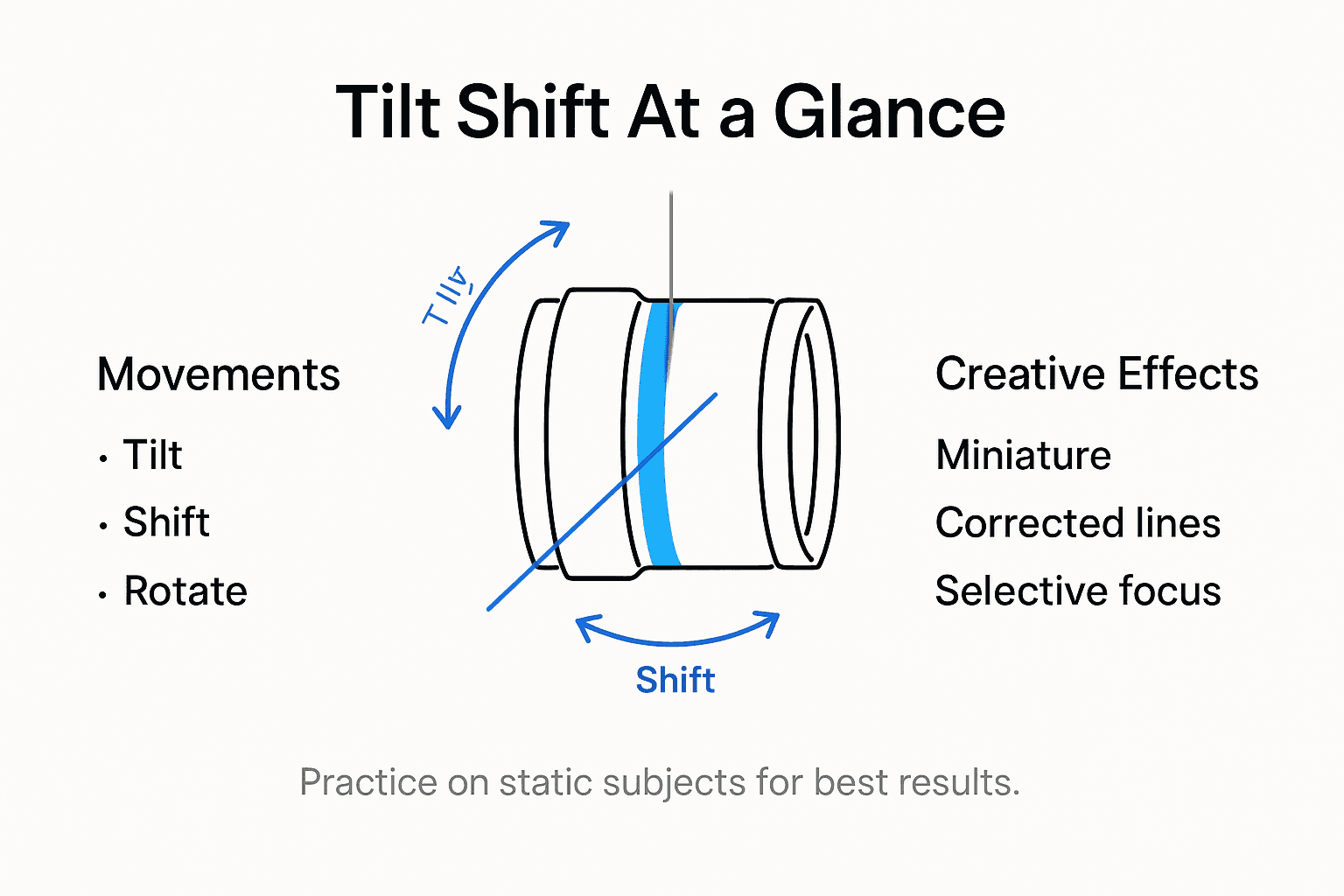
The tilt movement operates through the Scheimpflug principle, which allows photographers to change the focal plane dramatically. Instead of maintaining a traditional parallel focus, photographers can create diagonal or angled planes of sharp focus, selectively determining which elements appear crisp and which remain softened. This technique is particularly powerful for landscapes, architectural photography, and creating miniature-like scenes where only a precise slice of the image remains in sharp detail. Understanding focal length becomes crucial when mastering these advanced perspective techniques.
The shift movement provides horizontal and vertical lens repositioning without moving the camera body, which is revolutionary for correcting perspective distortions. Architectural photographers especially benefit from this capability, as they can photograph tall buildings without the typical converging vertical lines that occur with standard lenses. By shifting the lens parallel to the image sensor, photographers can maintain straight lines and geometric integrity, essentially solving perspective challenges that traditionally required complex post-processing techniques.
Beyond technical corrections, tilt shift lenses offer profound creative possibilities. Photographers can generate surreal images that challenge viewers’ perceptual expectations, transforming cityscapes into miniature model-like scenes or creating dreamlike landscapes with selective focus. The ability to manipulate perspective goes far beyond simple correction, becoming a powerful artistic tool that redefines visual storytelling and challenges traditional photographic representation.
Pro tip: Practice tilt shift perspective manipulation by first shooting architectural scenes from elevated positions to understand how lens movements transform visual perception.
Popular Uses and Creative Effects
Tilt shift photography represents a powerful artistic technique that transforms ordinary scenes into extraordinary visual narratives. Photographers leverage these specialized lenses to create unique perspectives that challenge viewers’ perceptual expectations, turning mundane landscapes into miniature-like worlds or correcting complex architectural compositions with remarkable precision.
Architectural photography stands as one of the most prominent applications for tilt shift techniques. Photographers can eliminate perspective distortions in buildings, ensuring perfectly straight vertical lines and maintaining geometric integrity without complex post-processing. Urban landscapes become meticulously crafted scenes where every architectural element appears crisp, balanced, and aesthetically controlled. Creative photography ideas often draw inspiration from these transformative perspective techniques.
The miniature effect has become particularly popular in contemporary photography, allowing creators to generate surreal representations of landscapes and cityscapes. By strategically blurring portions of an image while maintaining a razor-thin slice of sharpness, photographers can make expansive scenes appear like carefully constructed model environments. This technique works exceptionally well with overhead views of crowded streets, industrial complexes, or natural landscapes, instantly transforming realistic scenes into dreamlike, toy-like representations.
Beyond technical applications, tilt shift lenses offer profound artistic expression. Photographers use these tools to generate visual stories that challenge traditional photographic conventions, creating images that are simultaneously familiar and strange. The ability to selectively control focus and perspective opens up entirely new dimensions of visual storytelling, allowing artists to guide viewer attention and create emotional responses through sophisticated optical manipulation.
Pro tip: Experiment with shooting from elevated perspectives and use a narrow aperture to maximize the miniature effect in your tilt shift compositions.
Common Mistakes When Using Tilt Shift
Tilt shift photography demands precision and technical understanding, making it a technique where even experienced photographers can easily stumble. Mastering these specialized lenses requires more than just technical knowledge – it demands a nuanced approach that balances technical skill with creative vision.
One of the most prevalent errors is overusing lens movements, which can result in unnatural or distracting images. Photographers often become so excited by the ability to manipulate focus and perspective that they apply excessive tilt or shift, creating compositions that appear contrived rather than compelling. The key is subtlety – small, intentional adjustments that enhance the image without overwhelming the viewer’s perception. Common photography mistakes can provide broader context for understanding these technical nuances.
Technical mistakes frequently emerge from misunderstanding the fundamental principles behind tilt shift photography. Many photographers neglect critical considerations like proper stabilization, failing to use tripods that are essential for maintaining image sharpness during complex lens movements. The Scheimpflug principle – which governs how focus planes can be manipulated – is often misunderstood, leading to images that lack the precise, controlled focus that defines exceptional tilt shift work. Photographers must develop a deep understanding of how lens tilting changes focal planes and practice consistently to develop muscle memory for these intricate adjustments.
Creative missteps can be equally problematic. Photographers sometimes approach tilt shift as a gimmick, using the technique indiscriminately without considering compositional integrity or storytelling potential. The most successful tilt shift images are those that use the technique to reveal something unique about a scene – transforming perspective, highlighting architectural details, or creating miniature-like representations that challenge viewers’ perceptual expectations. Effective use requires thoughtful planning, technical skill, and a sophisticated understanding of visual narrative.
Below is a summary of common mistakes in tilt shift photography and tips to avoid them:
| Mistake Type | Example | Best Practice |
|---|---|---|
| Overuse | Excessive tilt/shift, unnatural look | Make subtle, intentional adjustments |
| Technical | Poor tripod use, misaligned focus | Use a sturdy tripod, study focus principles |
| Creative | Using for effect without intent | Apply technique with clear visual story |
Pro tip: Practice tilt shift techniques on static subjects like architectural scenes and gradually develop muscle memory for precise lens movements before attempting more complex compositions.
Master Tilt Shift Photography With Confidence
Are you ready to take your photography to the next level by mastering tilt shift techniques that transform ordinary scenes into stunning miniature-like works of art? Understanding how to control focus planes and perspective shifts is challenging but rewarding. If you want to avoid common mistakes like overusing lens movements or misjudging the Scheimpflug principle, then gaining clear, practical guidance is essential for your growth as a photographer.

Discover easy-to-follow tutorials, expert tips, and comprehensive gear recommendations at Amateur Photographer Guide. Dive deeper into related concepts like Understanding Perspective in Photography and learn how to avoid Common Photography Mistakes. Take control of your creative vision now and create images that truly captivate. Start exploring the full range of resources designed to empower amateur photographers at Amateur Photographer Guide.
Frequently Asked Questions
What is tilt shift photography?
Tilt shift photography is a specialized technique that allows photographers to manipulate focus and perspective by adjusting the lens position relative to the image sensor, utilizing movements known as tilting and shifting.
How do tilt and shift movements work?
Tilt movements alter the plane of focus based on the Scheimpflug principle, creating selective sharpness in images, while shift movements correct perspective distortions, particularly useful in architectural photography to maintain straight lines without converging verticals.
What are the benefits of using tilt shift lenses?
Tilt shift lenses enable photographers to achieve extraordinary creative control over focus and perspective, allowing for corrections of distortion in architectural photography and the creation of miniature effects in landscapes, enhancing visual storytelling.
What common mistakes should I avoid when using tilt shift lenses?
Common mistakes include overusing lens movements, misunderstanding the Scheimpflug principle leading to poor focus control, and applying the technique without clear creative intent, which can result in unnatural images.
Recommended
- Shutter Speed Explained: Key Effects and Techniques
- Common DSLR Camera Controls Explained: A Deep Dive for Enthusiasts & Beginners
- Depth of Field: How It Shapes Creative Photography
- Depth of Field Explained
Last update on 2026-04-22 / Affiliate links / Images from Amazon Product Advertising API